UPDATE Report – Updated: November 15, 2026 – Building on my Update from November 08, 2026
by Michael Hollister
Exclusive published at Michael Hollister on November 15, 2026
5.288 words * 28 minutes readingtime

Between a Pause in Strikes and a New Wave of Attacks: Hormuz, Abu Dhabi, and China’s Quiet Show of Force
THE WEEKLY SITUATION
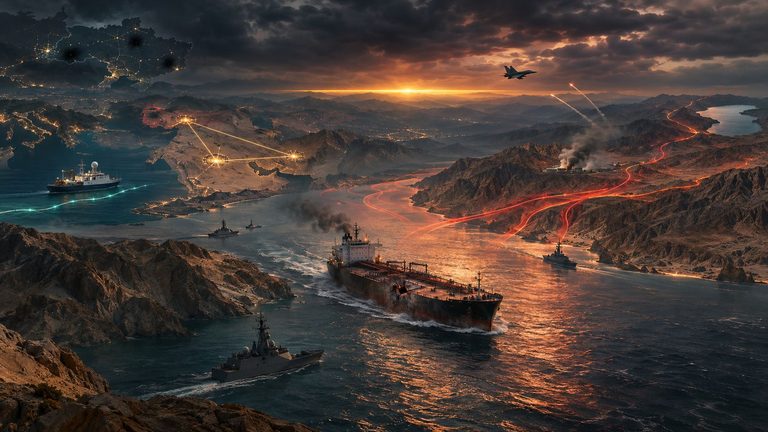
The week ends with a contradiction that describes the current conflict landscape better than any single report from the front. According to Reuters, US President Donald Trump is considering suspending further attacks on Iran as long as Washington registers no new provocation by Iran or the Houthis. Saudi Arabia and Turkey have urged him to show restraint. At the same time, early Sunday Saudi Arabia intercepted two Houthi ballistic missiles headed toward Riyadh and three drones over its oil-rich Eastern Province. Washington has not publicly defined whether an attack on an ally would count as the kind of provocation that could trigger an American response.
The military option remains in place in any event. A third US aircraft carrier is moving to the region. It is initially expected to replace one of the two carriers already deployed, but all three carrier groups could remain if escalation resumes. According to the report, US intelligence agencies doubt that further airstrikes would substantially change Iran’s negotiating position. Washington is therefore relying for now on blockade, sanctions, and economic attrition without relinquishing the option of attack.
The situation at sea remains dangerous. By November 13, Intertanko had confirmed 14 attacks on ships in the Gulf, at least one seafarer killed, and several others wounded. On Saturday, Iran also reported three burning tankers that it said had struck mines in the Strait of Hormuz. It released no names, flags, IMO numbers, crew totals, or precise damage assessments; Reuters could not independently verify the Iranian account. The actual increase in attacks is therefore documented, but the specific mine narrative involving these three vessels is not.
In Europe, too, diplomacy and escalation sit directly alongside one another. Russia and Ukraine reached an agreement in principle in Abu Dhabi on what may become the largest prisoner exchange of the war. At the same time, the mediators expanded the talks to encompass the entire European security order. According to Kyiv, Washington asked for the first time whether Ukraine would relinquish the parts of the Donbas it still controls in return for NATO membership. While this fundamental question was being discussed, Russia reported intercepting nearly 1,200 Ukrainian drones; Russian attacks killed and wounded people in Ukraine and caused power outages in twelve regions.
In the Eastern Mediterranean, another conflict was contained for the time being. The French survey vessel Abeille Marengo worked southeast of Karpathos, escorted by the Greek frigate Limnos and observed by the Turkish Gökova. Both warships communicated their governments’ legal positions, but the survey was not blocked. The situation in the Horn of Africa is more serious: Diplomatic sources report Ethiopian drone attacks and Eritrean artillery fire near Badme, where the 1998-2000 war began. No new declaration of full-scale war has been issued, but the threshold of direct interstate combat appears to have been crossed.
The editorial deadline for this issue was November 15, 2026.
IN MOTION – THE WEEK’S CONFLICT DEVELOPMENTS
IRAN AND THE UNITED STATES – MEDIATION, A CONDITIONAL PAUSE IN STRIKES, AND THREE UNCONFIRMED MINE INCIDENTS
On November 10, Qatar said mediation between Washington and Tehran had gained momentum. The meeting between the Qatari prime minister, Trump, and Vice President JD Vance had gone well. A few days later, Trump publicly stated that the United States might not need an agreement and instructed Vance to turn to other matters. According to Reuters, Trump is nevertheless considering suspending new attacks as long as Iran or the Houthis do not provoke the United States again. This is a conditional pause, not a ceasefire.
On Saturday, Iran reported three tankers that had allegedly struck mines and caught fire in or east of the Strait of Hormuz. The Islamic Revolutionary Guard Corps described two of them as ships that had used a prohibited route. Because no verifiable vessel data were provided, the account remains unconfirmed.
SAUDI ARABIA AND YEMEN – THE HORMUZ BYPASS ITSELF BECOMES A TARGET
The Houthis repeatedly attacked Riyadh, Jazan, airports, and energy facilities this week. Saudi Arabia reported intercepting ballistic missiles, cruise missiles, and drones; the Houthis claimed, among other targets, King Khalid International Airport, Abqaiq, and a pumping station on the East-West Pipeline. Riyadh did not confirm every claimed strike.
Early Sunday, the Saudi-led coalition said it had intercepted two more ballistic missiles headed toward Riyadh and three drones over the Eastern Province. No confirmed casualties or new damage were initially reported. The East-West Pipeline is strategically decisive: Because of the disruption in Hormuz, Saudi Arabia transports roughly four million barrels of crude oil a day through the pipeline to Yanbu on the Red Sea. The principal bypass around Hormuz thus runs directly into the operational reach of the war in Yemen.
THE MECCA ALLIANCE – TURKISH RATIFICATION AND A NEW DEFENSE PACT WITH QATAR
Turkey’s ratification of the Mecca Agreement with Saudi Arabia and Pakistan was published in the Official Gazette on November 14, bringing it into force for Turkey. The treaty treats an armed attack on one partner as an attack on all and establishes a framework for military coordination, intelligence sharing, training, and defense-industrial cooperation. Any deployment of Turkish troops still requires a separate parliamentary decision.
The day before, Turkey and Qatar signed an additional mutual defense agreement. Both countries pledged to adopt a joint position in response to an external armed attack and intend to deepen exercises, training, and industrial cooperation. Ankara is therefore building not one rigid alliance but several interconnected defense relationships.
SYRIA AND SAUDI ARABIA – REPORT OF 600 SPECIAL FORCES REMAINS DISPUTED
According to the Associated Press, Syria is preparing to deploy approximately 600 special forces personnel to the Saudi-Yemeni border. Syrian military advisers are reportedly already providing training in Saudi Arabia; no deployment into Yemen itself is planned. Damascus, however, officially describes the cooperation as training and capacity building and has not confirmed the reported combat deployment. Growing military cooperation is established; Syrian entry into the war is not.
Syria’s fragile internal security situation was again evident on Saturday evening. A car bomb in Jaramana, a Damascus suburb with a large Druze population, killed two people, including a child. Responsibility remained unclear at the editorial deadline.
ABU DHABI – MAJOR PRISONER EXCHANGE, BUT NO BREAKTHROUGH ON ENDING THE WAR
At their first direct talks in nine months, Russia and Ukraine agreed in principle to a large prisoner exchange. According to Ukraine, approximately 1,200 to 1,300 people on each side could be released. The exact number and timing have not yet been determined. No progress was agreed on territory, a ceasefire, energy facilities, or shipping in the Black Sea.
Moscow continues to demand the entire Donbas and wants the negotiations expanded to include the European security order. Kyiv rejects surrendering territory Russia has not captured, legally recognizing Russian annexations, and enshrining neutrality in its constitution.
UKRAINE – NEGOTIATIONS OVER THE WAR BECOME NEGOTIATIONS OVER EUROPE
According to Zelenskyy, the American side asked for the first time whether Ukraine could give up the parts of the Donbas it controls if it received NATO membership in return. Zelenskyy said he could put the question to Ukrainian society should it develop into a concrete offer backed by NATO members. He ruled out recognizing occupied territory as Russian.
European governments fear that Russia could use the talks to reopen questions about NATO’s presence, American troops in Eastern Europe, and the alliance’s post-1997 enlargement. Representatives of the United Kingdom, France, Germany, Italy, Poland, and the European Union are therefore expected to participate in future rounds of talks.
UKRAINE AND RUSSIA – THE DRONE WAR REACHES A NEW SCALE
Russia said it had intercepted 1,198 Ukrainian long-range drones in a single night. The figure is a Russian military claim and has not been independently confirmed. According to local authorities, attacks in three Russian regions killed seven people and wounded 17; Ukraine reported a strike on the Volgograd refinery.
Russia, in turn, deployed 117 drones against Ukraine. At least two people were killed, and an attack on residential buildings in Zaporizhzhia wounded 30. Strikes on energy facilities caused power outages in twelve Ukrainian regions. Readiness to negotiate and strategic infrastructure warfare are thus continuing at the same time.
STARSHIELD – A TECHNICAL RESTRICTION BECOMES AN OPERATIONAL FACTOR
Zelenskyy said Starshield limits the speed of Ukrainian drones along the front and in Russian-occupied territory to 100 miles per hour. This makes it more difficult to use interceptor drones against fast, jet-powered Russian systems. Kyiv demanded explanations from SpaceX, the Pentagon, and the US State Department.
Whether the restriction was imposed for technical, contractual, or political reasons remained unclear at the editorial deadline. The case nevertheless demonstrates that a private satellite service can affect the practical range and speed of military systems. The dependency lies not only in hardware and ammunition but also in software, authorizations, and rules of use.
GREAT SEA INTERCONNECTOR – A SURVEY VESSEL BETWEEN TWO FRIGATES
The Abeille Marengo began surveys southeast of Karpathos for the planned electricity link between Greece and Cyprus. The Turkish frigate Gökova radioed Ankara’s position that the work required Turkish approval. The Greek Limnos objected and stated that the work was being conducted with Greek authorization. No blockade or course change was forced. The survey continued under naval observation.
The vessel may return to Heraklion on November 16 for scheduled maintenance and resupply before resuming its work. This would not constitute political capitulation but an announced technical interruption. The legal dispute over the continental shelf and maritime jurisdiction remains unresolved.
EASTERN MEDITERRANEAN – RIVALRY AND MILITARY COOPERATION AT THE SAME TIME
The Nemesis 2026 exercise in Cyprus’s exclusive economic zone included Cyprus, Greece, Israel, France, and Italy, among others; Egypt, the United Kingdom, and the United States sent observers. Approximately 860 service members and 39 maritime and aerial systems trained in hostage rescue, evacuation, and oil-spill response.
At almost the same time, Greece participated with a warship in Turkey’s Blue Whale submarine exercise. More than 4,500 troops from twelve countries, eight submarines, and eleven warships took part. The exercises demonstrate growing military density, but not the formation of two war blocs directly arrayed against one another.
ISRAEL – EISENKOT NEGOTIATES WITH LIKUD, BUT NOT OVER NETANYAHU’S LEADERSHIP
Gadi Eisenkot still lacks a parliamentary majority of his own. His possible paths run through support from Arab-led parties, an agreement with ultra-Orthodox parties, or a broad government with Likud. On Saturday, Netanyahu called for unity talks without preconditions. Eisenkot described the public overture as a political maneuver but confirmed that the negotiating teams would meet on Sunday. The leadership dispute remains unresolved.
Eisenkot is prepared to include Likud in a government he leads but demands that it separate from its far-right partners. Netanyahu is unwilling to relinquish his leadership role. Until a new coalition is formed, his government remains in office in a caretaker capacity and retains military decision-making authority.
ISRAEL, LEBANON, AND GAZA – MILITARY CONTINUITY DESPITE POLITICAL NEGOTIATIONS
Israel continued airstrikes, artillery fire, and demolitions in southern Lebanon, including near Qantara and Kfar Tebnit. On November 10, a UNIFIL patrol near Wadi Jilu was attacked with approximately a dozen shots and returned fire. UNIFIL did not identify the attacker. At the same time, the mission is preparing for its withdrawal scheduled to begin at the end of 2026.
In Gaza, an Israeli drone strike killed two Palestinians on Saturday. Al-Shifa Hospital confirmed the deaths; the Israeli military said the two were Hamas members. No independent information on their identities was initially available.
CHINA AND TAIWAN – MORE THAN 100 SHIPS IN AN UNANNOUNCED LARGE-SCALE EXERCISE
In early November, China at times concentrated more than 100 naval and coast guard vessels around Taiwan and in the western Pacific. According to Taiwanese officials, forces from the eastern, northern, and southern theater commands practiced strikes, maritime area denial, and joint operations. A Chinese submarine also launched an intercontinental ballistic missile from the Yellow Sea toward the Chinese mainland.
The exercise was larger than several previously named Taiwan drills but was not announced by Beijing. On Friday, approximately 70 vessels were still operating inside the first island chain; the Liaoning carrier group was operating east of the Philippines. Beijing described the carrier movements as routine.
ETHIOPIA AND ERITREA – DIRECT FIGHTING REPORTED NEAR BADME
Diplomatic sources and residents report several days of fighting near Badme. Ethiopian forces are said to have used drones, while Eritrean units reportedly responded with heavy artillery. ACLED located Ethiopian troops between Sheraro and Badme and Eritrean forces on the edge of the town; neither side appeared to have clear control of Badme.
The available information does not yet justify declaring a new full-scale Ethiopian-Eritrean war. Direct drone and artillery use at the site whose disputed status triggered the 1998-2000 war is, however, a significant escalation signal. The fighting overlaps with the renewed war between Ethiopian federal forces and Tigrayan forces.
EASTERN CONGO – 323,000 DISPLACED IN SOUTH KIVU, 22 KILLED IN ADF ATTACKS IN ITURI
According to preliminary OCHA estimates, new fighting in Kalehe and Kabare displaced more than 323,000 people between November 6 and 9. Differing local reports put the civilian death toll at between five and ten. Fighting between Congolese government forces and the AFC/M23 structure operating under the name FRN is also blocking access for humanitarian organizations.
In Ituri, fighters from the Allied Democratic Forces, a group affiliated with the so-called Islamic State, killed at least 22 civilians in attacks on eight communities and abducted at least ten others. South Kivu and Ituri are separate fronts, but together they show how multiple armed conflicts are simultaneously overwhelming the Congolese state and the provision of basic services to the population.
ANALYSIS I – IRAN: A CONDITIONAL PAUSE WHILE THE SHOOTING AT SEA CONTINUES
Trump’s new position is narrower than the phrase “pause in strikes” suggests. He has neither declared a ceasefire nor lifted the blockade. According to Reuters, he is merely considering refraining from new attacks as long as the United States experiences no new provocation by Iran or the Houthis. What constitutes a provocation, who is authorized to attribute it, and whether attacks on US allies are included all remain open questions.
That ambiguity became operationally relevant within hours. The Houthis again fired missiles at Riyadh and drones toward Saudi Arabia’s Eastern Province. According to Saudi authorities, the projectiles were intercepted. No confirmed American loss resulted, but there was an attack on a close partner and on the core region of the global oil supply. Washington can ignore the incident, treat it as part of the Saudi-Yemeni front, or classify it as an Iran-linked provocation. None of these interpretations has been publicly established.
The three reported mine strikes do not automatically change the situation either, because Iran’s claims still lack verifiable vessel data. They do, however, reveal the political principle involved: Tehran is claiming not merely influence over Hormuz but the authority to determine who may pass through it. According to the Iranian account, ships using an unauthorized route must bear the risk themselves. This directly collides with the American claim to keep the sea lanes open by military means.
Qatar is therefore not mediating between two sides that have already shifted toward de-escalation. It is mediating amid an ongoing blockade, continuing attacks on commercial shipping, and regional missile strikes. For the moment, economic pressure weighs against a major new US air campaign: Washington is already placing Iran under considerable pressure without additional strikes, while its own stocks of precision munitions are strained and, according to US intelligence assessments, further attacks would do little to change Tehran’s demands.
STRATEGIC ASSESSMENT: The most likely short-term development is not a peace treaty but an armed state of suspension. The United States retains the blockade and its ability to strike, Iran retains the leverage of Hormuz, and the Houthis retain leverage over Saudi infrastructure. The question of whether the next hit is treated as a local operation or as the trigger for an American response could itself decide whether a new round of escalation begins.
ANALYSIS II – ABU DHABI: HUMANITARIAN SUCCESS, STRATEGIC EXPANSION
The planned prisoner exchange is a tangible result. If implemented with 1,200 to 1,300 people on each side, it would probably be the largest humanitarian exchange of the war. Its significance should neither be minimized nor mistaken for a peace breakthrough. The delegations found an area in which both sides can obtain an immediate benefit without abandoning their territorial positions.
At the same time, the subject of the negotiations expanded considerably. Moscow wants to discuss the European security architecture, NATO’s presence, and broader strategic conditions. According to Zelenskyy, Washington for the first time raised a possible connection between a Ukrainian withdrawal from the parts of the Donbas it still holds and potential NATO membership. Such a model would not be a simple territorial formula: It would shift the alliance boundary, affect Russian security demands, and require binding commitments from every NATO member.
This creates a double problem for Europe. Without European participation, Washington and Moscow could negotiate issues affecting European troop deployments, alliance obligations, and the security order of the entire continent. With participation, European states must develop common positions of their own on territory, sanctions, NATO accession, and Ukraine’s long-term armament. That dispute cannot be delegated to Kyiv.
The nearly simultaneous drone war demonstrates that both sides are reinforcing their negotiating positions by military means. Russia is attacking Ukrainian energy facilities and cities; Ukraine is attacking Russian refineries, ports, and infrastructure. A ceasefire covering energy facilities or the Black Sea would therefore be a sensible next partial step. Russia has not agreed to one so far.

STRATEGIC ASSESSMENT: Abu Dhabi has opened the door to limited agreements while exposing the political price of a comprehensive peace. The further the talks move from prisoner exchanges toward Europe’s security order, the more actors gain veto power-and the harder a rapid agreement becomes.
ANALYSIS III – FROM THE MECCA ALLIANCE TO A REGIONAL SECURITY NETWORK
With publication of the Turkish ratification, the Mecca Alliance now has a valid legal basis in Ankara as well. The new treaty with Qatar does not formally enlarge that system, but it creates a second collective-defense commitment with Turkey as the connecting link. Pakistan contributes nuclear deterrence and conventional forces, Saudi Arabia capital and strategic infrastructure, and Turkey its defense industry, air defenses, electronic warfare capabilities, and NATO’s second-largest army.
Syria could expand the network in practice before joining it politically. Military advisers, training, and a possible deployment to the Saudi-Yemeni border are lower thresholds than entering Yemen. The report of 600 special forces personnel remains disputed and must not be treated as a completed deployment. It nevertheless indicates what manpower Damascus could offer and how strongly Saudi Arabia is seeking battle-experienced partners.
For Syria, such cooperation has a second dimension. Israel has occupied the Syrian Golan Heights since 1967 and extended Israeli law, administration, and jurisdiction to the territory in 1981. The UN Security Council unanimously declared that annexation null and void in Resolution 497. After Assad’s fall, Israel additionally occupied parts of the UN-controlled buffer zone. Syria did not invite Israel to establish this military presence. Military cooperation that Damascus itself agrees with Turkey, Saudi Arabia, or Qatar therefore begins from a fundamentally different position under international law.
Iran is not a member of the Mecca Alliance. Its future inclusion would be militarily valuable because of its missiles, drones, combat experience, and geographic position, but it conflicts with the current Houthi front and the ongoing war with the United States. Pakistan’s and Qatar’s mediation roles keep channels open; they do not substitute for a decision on membership.
STRATEGIC ASSESSMENT: What is emerging is not a finished “Islamic NATO” but a flexible network of treaties, advisers, defense projects, and shared interests. Its actual strength will be measured not by declarations but by whether air defense, intelligence, and logistics function jointly during the next attack.
ANALYSIS IV – CHINA’S QUIET LARGE-SCALE EXERCISE: PRESSURE WITHOUT AN OFFICIAL ALARM
The size of China’s deployment is unusual; its form may be even more important. More than 100 naval and coast guard vessels operated at times in the western Pacific and around Taiwan. Forces from three theater commands were deployed jointly. This points to testing a cross-regional command structure, not merely another patrol in the Taiwan Strait.
Coast guard participation creates graduated steps between a policing action and war. In a blockade, Beijing could initially enforce inspections, exclusion zones, or purported customs and security measures using state vessels with a more civilian appearance, while keeping the navy in support. Practicing area denial and operations east of the Philippines also suggests that China is factoring in possible American and Japanese reinforcement routes.
Unlike earlier major exercises, the drill was not given a publicly announced name. Beijing thus avoided creating a clear diplomatic trigger even as Taiwan and foreign intelligence services were compelled to monitor the material concentration. The deployment applied pressure without committing China publicly to a narrative of escalation. Ahead of the APEC summit in Shenzhen, this was politically useful: demonstrating military strength without entirely burdening the diplomatic stage.
The launch of an intercontinental ballistic missile from a submarine in the Yellow Sea toward the Chinese mainland added a strategic signal to the naval exercise. Even though the missile did not fly out over the open sea, the event demonstrated the integration of naval nuclear forces into a period of heightened activity.
STRATEGIC ASSESSMENT: China is testing more than ships, aircraft, and command structures. It is testing how much military pressure can be exerted below the threshold of an officially declared crisis. This normalization of large, unannounced deployments will make it increasingly difficult to distinguish among an exercise, intimidation, and immediate preparations for an operation.
ANALYSIS V – ISRAEL AND LEBANON: POLITICAL TRANSITION WITH MILITARY CONTINUITY
Eisenkot’s mandate to form a government has ended Netanyahu’s parliamentary majority but has not yet produced a transfer of power. Talks with Likud show that a broad government is not out of the question. At the same time, their leadership claims are irreconcilable: Eisenkot wants a government led by him and the exclusion of far-right partners; Netanyahu is unwilling to step down politically and warns against a government dependent on Arab parties.
This struggle is taking place while the caretaker government remains fully capable of military action. Attacks and demolitions in southern Lebanon have continued. In Gaza, Israeli air and drone strikes continue almost daily despite the existing ceasefire. A mandate to form a government changes neither command structures nor rules of engagement.
An additional institutional problem is emerging in Lebanon. UNIFIL is expected to end its operations at the close of 2026 and then conduct an orderly withdrawal. The mission is already documenting airstrikes, artillery fire, road construction, and Israeli positions in the south. The attack on a patrol by unidentified armed men also shows that unidentified local actors threaten the peacekeepers’ freedom of movement.
Israel justifies its presence and attacks by pointing to the threat from Hezbollah. Lebanon demands the restoration of its territorial control, while the national army is not yet capable of fully replacing every armed structure in the south. UNIFIL’s withdrawal will not resolve these contradictions; it will remove an international observer and mediator from them.

STRATEGIC ASSESSMENT: A change of government in Israel could alter foreign-policy emphases, but it is neither certain nor complete. Until then, the firm finding is this: political reordering in parliament, military continuity at the fronts, and a growing security vacuum in southern Lebanon.
WEEKLY CONCLUSION – OVERALL STRATEGIC ASSESSMENT
Four interconnected developments shaped this week.
First, the Iran war is shifting from open large-scale escalation into an armed state of suspension. Washington is considering suspending new attacks but is maintaining the blockade, sanctions, and carrier groups. Iran is claiming the authority to establish its own rules of passage through Hormuz. The Houthis continue to attack Saudi Arabia and the infrastructure intended to compensate for the disruption of Hormuz. Any pause in strikes therefore remains revocable at any time.
Second, negotiations themselves are becoming a theater of strategic competition. Abu Dhabi brought a major prisoner exchange within reach but resolved no territorial question. Instead, NATO membership, the Donbas, and the entire European security order are now under discussion. The negotiating table is growing larger while the drone war reaches a new scale.
Third, regional security networks are forming faster than traditional alliance terminology can capture. The Mecca Agreement is in force for Turkey, Ankara and Doha have additionally committed themselves to mutual defense, and Syria is deepening its military cooperation with Saudi Arabia. Whether this produces joint operational capability will be shown in air defense, intelligence, and logistics-not in the number of documents signed.
Fourth, military pressure is increasingly being applied without a formal declaration of crisis. China concentrates more than 100 ships without announcing an exercise. Greece and Turkey accompany a technical survey operation with frigates but avoid a blockade. Ethiopia and Eritrea are apparently already using drones and artillery near Badme without declaring a new war. These gray zones do not reduce the risk. They merely make it harder to identify the moment when a political threat becomes open warfare.
The most dangerous short-term test lies in the Middle East: Will Washington classify the new wave of Houthi attacks as a local continuation of the Yemen war or as the very provocation to which Trump tied his pause in attacks on Iran? Four other points also require attention: Will Iran’s claims about the three tankers become verifiable? Will a date be set for the prisoner exchange between Russia and Ukraine? Can the Abeille Marengo resume its work after maintenance? And will Badme remain the site of limited fighting, or will it again become the starting point of an interstate war?
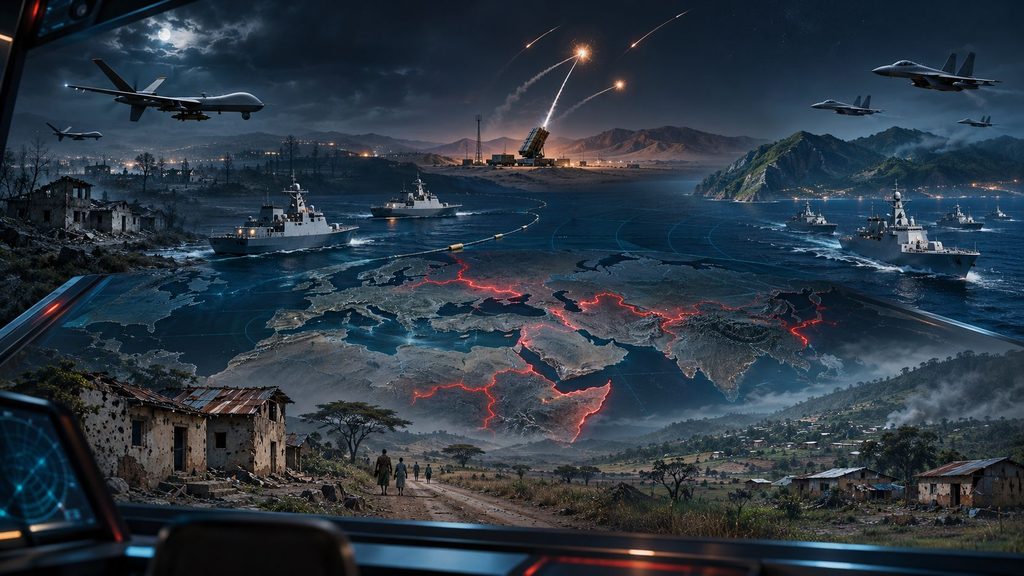
The common finding, therefore, is not that a global war is immediately imminent. It is that more and more conflicts are being waged in a condition in which diplomacy, blockade, drone attacks, military exercises, and limited fighting all take place at the same time. That simultaneity can create room for negotiations. It can also allow a single strike to set off a chain of reactions whose political conditions no one clearly defined in advance.

About the Author
Michael Hollister
is a geopolitical analyst and investigative journalist. He served six years in the German military, including peacekeeping deployments in the Balkans (SFOR, KFOR), followed by 14 years in IT security management. His analysis draws on primary sources to examine European militarization, Western intervention policy, and shifting power dynamics across Asia. A particular focus of his work lies in Southeast Asia, where he investigates strategic dependencies, spheres of influence, and security architectures. Hollister combines operational insider perspective with uncompromising systemic critique-beyond opinion journalism. His work appears on his bilingual website (German/English) www.michael-hollister.com and in investigative outlets across the German-speaking world and the Anglosphere.
Stay informed without having to work through the daily flood of news – the most important developments and connections summarized for you.

Sources
Iran, Hormuz, Saudi Arabia, and Yemen
\(1\) Ministry of Foreign Affairs of Qatar: Foreign Ministry: Qatari Mediation Efforts Continue to Bridge Views Between Washington, Tehran, November 10, 2026.
https://mofa.gov.qa/en/qatar/latest-articles/latest-news/details/2026/11/10/foreign-ministry–qatari-mediation-efforts-continue-to-bridge-views-between-washington–tehran
\(2\) Associated Press: Trump’s shifting Iran rhetoric leaves Mideast in limbo, November 14, 2026.
https://apnews.com/article/trump-iran-talks-strikes-limbo-02378df1ec3073d2c0f8f162e697d181
\(3\) Reuters: Trump tells advisers he may hold off on Iran attacks barring new provocations, sources say, November 14, 2026.
https://www.reuters.com/world/middle-east/trump-tells-advisers-he-may-hold-off-iran-attacks-barring-new-provocations-2026-11-14/
\(4\) Reuters: Iran’s navy says three tankers on fire after hitting mines in Hormuz, November 14, 2026.
https://www.reuters.com/world/middle-east/irans-navy-says-oil-tanker-fire-after-hitting-mine-hormuz-2026-11-14/
\(5\) Intertanko: Advice for Members regarding situation in Gulf Region, November 13, 2026.
https://notification.intertanko.com/news-desk/press-general-releases/pressreleasearticle/advice-for-members-regarding-situation-in-middle-east
\(6\) Reuters: Saudi-led coalition says it shot down Houthi missiles aimed at Riyadh, November 10, 2026.
https://www.reuters.com/world/middle-east/saudi-led-coalition-says-it-intercepts-two-houthi-missiles-fired-towards-riyadh-2026-11-10/
\(7\) Reuters: Yemen’s Houthis say they fired missiles at Saudi forces in Jazan, November 13, 2026.
https://www.reuters.com/world/middle-east/saudi-civil-defence-says-danger-passed-jazan-2026-11-13/
\(8\) Reuters: Saudi-led coalition intercepts missiles towards Riyadh, drones in Eastern Province, November 15, 2026.
https://www.reuters.com/world/middle-east/saudi-led-coalition-intercepts-missiles-towards-riyadh-drones-eastern-province-2026-11-15/
Mecca Alliance, Turkey, Qatar, and Syria
\(9\) Anadolu Agency: Türkiye publishes law approving ratification of Mecca joint defense pact, November 14, 2026.
https://www.aa.com.tr/en/world/turkiye-publishes-law-approving-ratification-of-mecca-joint-defense-pact/4124806
\(10\) Reuters: Turkey, Qatar sign mutual defence agreement, pledge unified stance against attack, November 13, 2026.
https://www.reuters.com/world/middle-east/turkey-qatar-sign-mutual-defence-agreement-turkish-presidency-says-2026-11-13/
\(11\) Associated Press: Saudi Arabia turns to Syria for help as fighting with Houthis escalates, November 8, 2026.
https://apnews.com/article/d436bdc81a8e6b28bb99c417aaeaf8b6
\(12\) Associated Press: A bomb rips through a Damascus suburb killing 2 including a child, November 14, 2026.
https://apnews.com/article/syria-explosion-damascus-jaramana-car-5d37a9bb4c4176986ff198c0766151b3
Ukraine, Russia, and Abu Dhabi
\(13\) Reuters: Russia, Ukraine reach deal on prisoner swap as US says lack of trust holds back talks, November 11, 2026.
https://www.reuters.com/world/europe/us-russia-ukraine-start-second-day-abu-dhabi-peace-talks-2026-11-11/
\(14\) Associated Press: Zelenskyy says a new European security framework floated by US could benefit Putin, November 14, 2026.
https://apnews.com/article/russia-ukraine-war-nato-us-zelenskyy-f9a8629626c087424f05adc85d127780
\(15\) Associated Press: Ukraine launches nearly 1,200 drones at Russia as US-led talks consider wider European security, November 13, 2026.
https://apnews.com/article/russia-ukraine-war-putin-trump-zelenskyy-europe-157d168cb7ff9cae318cbf6cecb3988f
Great Sea Interconnector and the Eastern Mediterranean
\(16\) Great Sea Interconnector: Seabed survey activities, November 6, 2026.
https://www.great-sea-interconnector.com/en/news/press-release-great-sea-interconnector-seabed-survey-activities
\(17\) Kathimerini: Strategic cable surveys move ahead, November 14, 2026.
https://www.ekathimerini.com/economy/energy/1321274/strategic-cable-surveys-move-ahead/
\(18\) Kathimerini: Turkish frigate hails French survey vessel; Greek Navy responds, November 12, 2026.
https://www.ekathimerini.com/politics/foreign-policy/1321113/turkish-frigate-hails-french-survey-vessel-greek-navy-responds/
\(19\) ERT News: Abeille Marengo continues surveys south of Karpathos and returns to Heraklion for technical maintenance, November 14, 2026.
https://www.ertnews.gr/eidiseis/ellada/abeille-marengo-synexizei-tis-ereynes-notia-tis-karpathou-epistrefei-sto-irakleio-gia-texniki-syntirisi/
\(20\) Daily Sabah: Türkiye, Greece, others join forces for major East Med drill, November 13, 2026.
https://www.dailysabah.com/politics/turkiye-greece-others-join-forces-for-major-east-med-drill/news/amp
\(21\) Defence Redefined: NEMESIS 2026 – Multinational exercise in Cyprus’ EEZ, November 12, 2026.
https://defenceredefined.com.cy/nemesis-2026-multinational-exercise-in-cyprus-eez-with-the-participation-of-eight-countries/
Israel, Gaza, and Lebanon
\(22\) Associated Press: Israel’s president taps opposition candidate Eisenkot to form a government, November 8, 2026.
https://apnews.com/article/75934bfce1f2f2e43e1823de3761b12d
\(23\) Reuters: Israel’s parliament sworn in as Eisenkot tries to forge a government, November 10, 2026.
https://www.reuters.com/world/israels-parliament-sworn-eisenkot-tries-forge-government-2026-11-10/
\(24\) Times of Israel: Netanyahu again urges unity talks without preconditions; Eisenkot rejects PM’s spin, November 14, 2026.
https://www.timesofisrael.com/netanyahu-again-urges-unity-talks-without-preconditions-eisenkot-rejects-pms-spin/
\(25\) United Nations Interim Force in Lebanon: UNIFIL statement, November 10, 2026.
https://unifil.unmissions.org/en/press-releases/unifil-statement-10-november-2026
\(26\) Anadolu Agency: Israeli attacks hit areas in southern Lebanon, November 12, 2026.
https://mobil.aa.com.tr/en/middle-east/israeli-attacks-hit-areas-in-southern-lebanon/4123262
\(27\) UN Peacekeeping: Lebanon: After 48 years patrolling the Blue Line, UN peacekeepers prepare exit, November 11, 2026.
https://peacekeeping.un.org/en/news/lebanon-after-48-years-patrolling-the-blue-line-un-peacekeepers-prepare-exit
\(28\) Associated Press: Israeli drone strike kills 2 Palestinians in Gaza, and other Mideast news, November 14, 2026.
https://apnews.com/article/mideast-news-israel-gaza-iran-november-14-ade76bebaf22135168aac6eb3016bc19
China and Taiwan
\(29\) Reuters: China stages unannounced Pacific drills in silent intimidation of Taiwan, officials say, November 13, 2026.
https://www.reuters.com/world/china/china-stages-unannounced-pacific-drills-silent-intimidation-taiwan-officials-say-2026-11-13/
Ethiopia, Eritrea, and Eastern Congo
\(30\) Anadolu Agency: Ethiopia, Eritrea reportedly exchange drone, artillery strikes as border fighting intensifies, November 14, 2026.
https://www.aa.com.tr/en/africa/ethiopia-eritrea-reportedly-exchange-drone-artillery-strikes-as-border-fighting-intensifies/4124999
\(31\) ACLED: Conflict in Ethiopia – Tension near the Badme border area increases, November 13, 2026.
https://www.acleddata.com/expert-comment/ethiopia-conflict-expert-insights
\(32\) Actualite.cd: RDC: plus de 323.000 déplacés enregistrés en quatre jours, November 12, 2026.
https://actualite.cd/2026/11/12/rdc-la-suite-dintenses-combats-au-sud-kivu-plus-de-323-000-deplaces-enregistres-en
\(33\) Radio Okapi: Une dizaine de civils tués dans des affrontements FARDC-FRN à Kalehe, November 13, 2026.
https://www.radiookapi.net/2026/11/13/actualite/securite/une-dizaine-de-civils-tues-dans-des-affrontements-fardc-frn-kalehe
\(34\) Associated Press: Islamic State group-affiliated rebels kill at least 22 in Congo’s eastern region, November 12, 2026.
https://apnews.com/article/c1c568db3a670679818aa426cf28fc80
International-Law Background
\(35\) United Nations Security Council: Resolution 497 (1981) – Occupied Syrian Golan Heights, December 17, 1981.
https://www.un.org/unispal/document/auto-insert-180751/
© Michael Hollister – Redistribution expressly encouraged.
I am pleased when my articles, commentaries, and analyses attract interest and are shared. Reproduction, distribution, and publication of my texts, in whole or in part, on other websites, blogs, or in other publications is expressly permitted and encouraged. No prior permission is required.
<u>The sole requirement:</u> Michael Hollister must be clearly and prominently identified by name as the author. In addition, a clearly visible, clickable link to the original website, www.michael-hollister.com, must be included.
Reuse without author attribution and a link is not permitted.
If this work helps you understand what lies behind the headlines, consider supporting it. Membership starts at $5 per month, includes access to all supporter-only analyses, and can be cancelled at any time.