
by Michael Hollister in interview with Deniz Karabağ
Published at GlobalBridge on May 25, 2026
4.258 words * 23 minutes readingtime
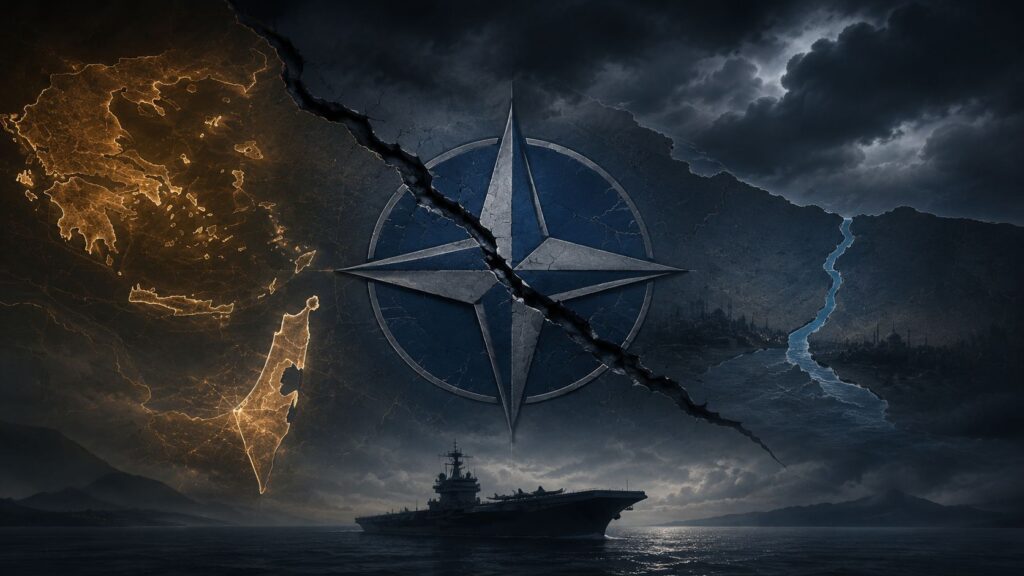
How Pakistan, Saudi Arabia, Turkey, and Qatar are sounding out a new security architecture in the midst of the Iran war – and what Bennett had already named in February
On April 7, 2026, the American president announced a two-week ceasefire with Iran ninety minutes before his own deadline. The decision came after a phone call with Pakistan’s Prime Minister Shehbaz Sharif and Army Chief Asim Munir. Eight days later, on April 15, Sharif set off with his Foreign Minister Ishaq Dar – one of the architects of the Islamabad talks – on a four-day tour. Three stops: Riyadh, Antalya, Doha. Three strategic partners. Four days. While the West was watching the second round of negotiations between Washington and Tehran, a consultation movement was playing out in the background that Western mainstream media treated as contextual footnote – and that encompasses precisely the axis that former Israeli Prime Minister Naftali Bennett had named by name in February: Pakistan, Saudi Arabia, Turkey. The fourth country – Qatar – was not formally at the table at any of the meetings and is nonetheless part of the movement.
The question this article pursues is not: is a new military alliance along NATO lines forming here? It is: what form of security architecture is taking shape here – and is it enough to name four countries together in order to describe them as a bloc?
The Ninety Minutes in Which Pakistan Became a Mediator
What Sharif carried to Riyadh, Antalya, and Doha in early April was not a routine dossier. A week earlier, his government had become visible in a function it had not held for decades: Pakistan had mediated between Washington and a regional power that Washington defines as a central threat. Trump’s Truth Social threat from the previous evening – an entire civilization would die “tonight” – had led Pakistan’s government and military leadership to request a postponement in a direct phone call. Trump announced the ceasefire ninety minutes before his own deadline expired. Peace talks began on April 10 in Islamabad under Pakistani mediation – the first direct talks between Washington and Tehran in decades.
That is the context against which Sharif’s tour must be read. Not as bilateral routine work, but as a consultation movement following a successful mediation – with the three capitals whose positions remain strategically most important to Pakistan. Saudi Arabia received Sharif first. Crown Prince Mohammed bin Salman finalized an additional three-billion-dollar deposit for Pakistan’s foreign exchange reserves; an existing five-billion-dollar deposit was extended. In Antalya, Sharif participated in the Diplomacy Forum and held bilateral talks with President Erdogan. Doha rounded off the visit.
What was already visible before Sharif had even departed: on April 11 – while the first US-Iran talks were running in Islamabad – Pakistan deployed combat jets to Saudi Arabia. It was the first visible step under the Saudi-Pakistani defense agreement concluded in September 2025 that operationally redeemed the alliance character of the pact. Pakistan’s Field Marshal Munir completed a visit to Tehran in the same week. The sequence ran in two directions simultaneously: westward to the Gulf partners and Turkey, eastward to the Iranian neighbor. Pakistan had within a few days become an actor capable of playing on four different boards at once – and one that Washington publicly praised. White House spokeswoman Karoline Leavitt called Pakistan’s role “incredible” and confirmed the second round of negotiations on April 15.
In this constellation, Sharif was not a supplicant. He was the mediator whose position was being freshly measured in four capitals. That is precisely the analytical difference between routine diplomacy and a consultation tour with strategic charge.
From the Turkish inside perspective, the Pakistani-Turkish connection is not a new factor but a long-underestimated one. Former Bundeswehr paratrooper Deniz Karabağ, whose geopolitical analyses today reach several hundred thousand followers on Instagram, YouTube, and TikTok, formulated the Turkish reading in a written interview for this analysis: “Pakistan is an often-underestimated factor in the security architecture. Between Ankara and Islamabad there are close political, cultural, and military relationships. Pakistan will always safeguard its own interests, but diplomatic support, strategic coordination, or armaments cooperation would be relevant in a crisis situation. Whoever believes Turkey stands alone misunderstands the partnerships it has built.” That is the voice from Ankara – not confirmation of a pact, but the positioning of Pakistan as a reliable quantity in Turkish situational assessment.
The Foundation: A Defense Agreement That No One Any Longer Considers Theoretical
On September 17, 2025, Saudi Arabia and Pakistan signed a defense agreement in Riyadh whose core sentence read: an attack on one country is considered an attack on the other. Reuters and Al Jazeera reported simultaneously; I assessed the agreement in a detailed piece on michael-hollister.com in November 2025 as the possible core of an “Arab NATO light” – without knowing at the time that the mutual assistance clause would become operationally visible within seven months in a running Iran war.

Structurally, the agreement means more than mutual defense obligations. Pakistan is the only nuclear power of the Islamic world; the country possesses, according to openly available estimates by Western foundations and research institutions, roughly one hundred and seventy nuclear warheads. A contractually codified mutual defense obligation between Riyadh and Islamabad is therefore de facto a nuclear umbrella – without the treaty text formulating it as such. In Riyadh, it has always been described as “strategic depth.” In Tel Aviv and Washington, it was read more carefully.
Six weeks after signing, Bennett spoke – himself no longer in any government function, but chairman of the party “Bennett 2026” that he founded in 2025 and a serious candidate for a return to the prime ministership – before the annual assembly of the Conference of Presidents of Major American Jewish Organizations in Jerusalem on February 17, 2026. His core sentence: “Turkey is the new Iran.” His more precise addition, verbatim as documented by The Media Line, i24NEWS, and Israel National News: Turkey is attempting to “flip” Saudi Arabia against Israel and build a hostile Sunni axis with nuclear-armed Pakistan. Bennett thereby named in February three of the four capitals that would make up Sharif’s itinerary in April – Saudi Arabia, Pakistan, Turkey. The fourth country, Qatar, Bennett had mentioned in the same speech: “Turkey and Qatar nurture a Muslim Brotherhood monster that could one day be as dangerous as the Iranian one.”
That is the analytical point that barely appears in the reporting of recent weeks. Bennett described a movement that six weeks later became visible as a consultation tour. From this, three things follow that must be clearly distinguished. First: Bennett is correct about the actors. Saudi Arabia, Pakistan, Turkey, Qatar – these four capitals are moving toward one another. Second: Bennett is not correct about the frame. A consultation movement that, after a war begun by Washington and Tel Aviv, is sounding out what security architecture is possible, is not necessarily “hostile.” It is autonomous – and that is a different category. Third, and this is the causally most interesting question: has Bennett’s public threat rhetoric itself intensified the pressure pushing the axis together?
The Turkish inside perspective on this point is clearer than the Western mainstream usually reflects. Karabağ formulates it thus: “Equating Turkey with Iran is analytically reductive. Turkey is a NATO member, economically closely tied to Europe, and pursues no revolutionary export ideology. Ankara acts on the basis of power politics and interests. When Turkey deepens its relationships with Saudi Arabia, Pakistan, or other Muslim states, that is legitimate foreign policy of a sovereign state. The key point: Turkey is not being criticized today because it is weak, but because it is taken seriously as an independent power factor.”
That is the reading from Ankara – not refutable, but also not decidable against Bennett’s reading. What is decidable is the observation: when Israel publicly introduces the prospect of confrontation with Turkey, Ankara has a rational reason to seek reassurance. Bennett, in this logic, is not only an observer of a movement – he is also its accelerator.
The Military Dimension: When Headquarters Speak to One Another
The most reliably documented sequence of Pakistani-Turkish military contacts does not lie in April 2026 but earlier. On January 30, 2026, the chief of the Turkish General Staff, General Selçuk Bayraktaroğlu, met Pakistan’s Field Marshal Asim Munir in Rawalpindi. The official statement from Pakistan’s Inter-Services Public Relations described the deepening of “military-to-military relations.” Arab News reported the same day that Turkish representatives had previously publicly stated they were in discussions about joining the Saudi-Pakistani defense pact. Already on September 3, 2025, Pakistan’s Air Chief Marshal Zaheer Ahmed Baber Sidhi had received the commander of the Turkish Air Force, Ziya Cemal Kadıoğlu, in Islamabad. The agenda list from the ISPR statement: joint training, mutual exercises, multi-domain operations.
Behind these meetings lies an industrial cooperation that began with the Bayraktar drone delivery in 2021 and has deepened since. Bloomberg reported in December 2025 that Turkey was preparing a drone assembly plant in Pakistan – a step from pure hardware delivery to embedded industrial cooperation. In the background, a joint program for developing a fifth-generation combat aircraft has been running for years, with Turkish Tusaş in the program lead and engineers from Pakistan’s NUST in collaboration. Both armed forces see the program as a possible replacement for their F-16 fleets. This is not symbolic politics. It is the slow solidification of a military-industrial connection capable of operating independently of Western supply chains.
At this point I offer an open source commentary: in April 2026, reports circulated in German-language social media about a new high-level Pakistan-Turkey military meeting, parallel to the US-Iran talks in Islamabad, covering topics such as satellite programs and operational preparation. A first-order Western primary source – Reuters, AP, AFP – is not available to me for this specific April meeting as of press time. The reliably documented meetings are those of January 30, 2026 (Munir and Bayraktaroğlu, Rawalpindi) and September 3, 2025 (Sidhi and Kadıoğlu, Islamabad). These two meetings are analytically sufficient to describe the substance of the connection without a single April appointment remaining poorly documented. Anyone wishing to draw a complete analytical arc will find it sufficiently clear in the January-September 2026 timeline.

Taken together, these sequences produce a picture that can no longer be captured with “bilateral routine work.” When the two highest military leaderships of two states meet directly twice within four and a half months, when a drone factory build is simultaneously in preparation and a fifth-generation combat aircraft is in the pipeline, then this is an axis that is becoming operational – even without a formal alliance structure.
Qatar: A Movement Whose Depth Remains Unclear
In the flow of material from recent weeks, a story surfaced repeatedly that was described in alternative media as a central turning point: Qatar had, as the first Gulf state, publicly demanded the withdrawal of all US troops from the region; the Qatari foreign minister had described the relationship with Iran as “brotherhood” and stated that Qatar had paid a “very high price” for hosting foreign troops. This story circulated in April via DID Press, X posts from several activist channels, Winter Watch, and similar platforms. I myself included it in my Iran conflict update of April 8 with the sources available at the time.
At this point an open source check is warranted. A confirmation of the Qatari foreign minister’s literal statement by a Western or official Qatari primary source – Reuters, AFP, AP, Al Jazeera, the Qatari Foreign Ministry itself – is not available to me as of press time. Times of Islamabad flagged the story on April 8 as not supported by verified diplomatic channels. What remains open: whether the statement was made in that sharpness, or whether it is a viral condensation of various statements.
What can be cleanly documented, by contrast, is the structural shift in Qatar’s position over recent months. CBS News reported on January 14, 2026 on a reduction of US personnel at Al Udeid, the largest US air base in the Middle East. Gulf News reported on February 22 on a further withdrawal of personnel from Qatar and Bahrain. On March 20 – at a press conference following attacks on energy infrastructure – Qatar’s Prime Minister Sheikh Mohammed bin Abdulrahman declared that the Iran war must be “stopped immediately.” Four days later, Qatar explicitly rejected its own mediation role in the Iran negotiations according to Iran International – a role Qatar had traditionally occupied in the region. This rejection is the actual movement that the mainstream has missed. Whoever can be a mediator and declines is not signaling neutrality – they are signaling a position.
Sharif’s Doha stop on April 17 and 18 fits into this movement. Pakistan and Qatar have been conducting bilateral defense discussions for years; the respected New Lines Magazine wrote in its analysis published in early May 2026 about speculation that Qatar might conclude a defense pact with Pakistan similar to Saudi Arabia’s. That is speculation, not a finding. But it is plausible enough not to suppress.
The more honest story therefore reads not: Qatar is ejecting the United States from Al Udeid. It reads: Qatar is repositioning itself – carefully, with double grounding, without detaching from the American security umbrella, but with a clearly discernible distancing. Al Udeid remains operational; personnel is reduced. Iran is no longer described as a threat but as a neighbor with whom one speaks. Sharif is received. A mediation role is declined. This is not breaking news. It is a shift that becomes visible in weekly rhythms – and Sharif’s tour was one of those rhythms.
The Cogs and Their Fault Lines
Whoever takes the four capitals seriously as an emerging security architecture must first describe what each one would bring to such an architecture. Only then can the question be answered of why this architecture, despite functional complementarity, has structural fault lines.
Turkey possesses the second-largest standing force in NATO with roughly four hundred and eighty thousand active soldiers, a battle-tested drone fleet of Bayraktar TB2 and Akıncı, autonomous missile production at Roketsan, avionics and electronic warfare systems from Aselsan, and a defense export record that at over $7 billion in 2024 was the eleventh-largest in the world. This industrial base is NATO-compatible but can be operated outside NATO supply chains. What Turkey contributes is not military size alone. It is the capacity to integrate other actors. It is a multiplier, not a participant.
Pakistan brings what no other majority-Muslim country offers: nuclear deterrence. Supplementing this are JF-17 combat aircraft production in cooperation with China and experience in the parallel operation of Chinese, Western, and indigenous weapons systems – a hybrid engineering achievement that cannot be expressed in statistics but makes the difference in a crisis. The limitation is obvious: Pakistan’s production capacity is not sufficient to modernize the JF-17 fleets of its own and a partner air force simultaneously. Sixteen to eighteen aircraft per year is not a scale for alliance-level needs.
Saudi Arabia brings capital, regional standing, and under the Crown Prince a programmatic localization of the defense industry over recent years through the state-owned Saudi Arabian Military Industries. Vision 2030 envisions raising the share of domestic defense production above fifty percent. For the axis, this would be the war chest – if Riyadh made the strategic decision to move substantively out of the American security umbrella. That is precisely what Riyadh is not doing. The additional three billion dollars to Pakistan, the extended five-billion deposit, the Saudi-Pakistani defense agreement of September 2025 – all of this functions within a security architecture that continues to accept the United States as the ultimate guarantor.
Qatar, finally, brings Al Udeid – and that is symbolically as well as operationally ambivalent. Turkey has operated its own military base on Qatari soil since 2014; together, Ankara and Doha have developed the TOLGA air defense system. Qatar’s special forces are small but well-equipped; its air force consists of Rafale, Eurofighter, and F-15. What Qatar would really contribute is the possibility of reframing a US base within an alternative architecture – not shutting it down, but reading it differently. Qatar’s fault line lies precisely here: Al Udeid is Qatar’s strongest negotiating instrument – and simultaneously the reason why Doha cannot risk a hard positioning as long as American combat jets are operating from there.
So much for the cogs. They mesh – on paper. The fault lines lie deeper.
First: Saudi Arabia has positioned itself within the American security architecture for three decades, with Vision 2030 tech partnerships, Patriot systems, F-15 fleets, and an oil trading structure that remains strongly dollar-based. An axis that structurally distances itself from Washington would be a qualitative break for Riyadh. Allowing Pakistan to mediate, extending a three-billion deposit, and receiving Sharif are nuances – not a break.
Second: Turkey has claimed Islamic leadership for years. Saudi Arabia has claimed it for decades. Both self-images do not logically exclude each other – they practically exclude each other the moment operational decisions must be made.
Third: Pakistan is domestically fragile and economically dependent on an IMF program and external deposits. An alliance architecture that places Iran on the other side would be foreign-policy risky for Pakistan – Munir was in April not only in Riyadh but also in Tehran. This dual role is a strength as long as Pakistan mediates. It becomes a weakness the moment Pakistan must take sides.
Precisely these fault lines, Karabağ formulates from the Turkish inside perspective without being asked – and unambiguously: “Sobriety is warranted regarding Saudi Arabia. Riyadh was deeply embedded in the American security architecture for decades and frequently followed Washington on key issues. Between Ankara and Riyadh there is occasional cooperation but no load-bearing alliance of trust. Turkey distinguishes very precisely between tactical collaboration and genuine strategic reliability.”
That is the methodically important voice: a Turkey-aligned analyst himself dampens the notion of a firm axis. Whoever would advance the thesis of a closed bloc would need to engage with this sober inside perspective – and take it seriously.
What Bennett Named – And What Is Actually Happening Between the Capitals
The analytical point of recent weeks is not that Bennett’s February speech was confirmed six weeks later by Sharif’s tour. That would be too neat a story. The point is that Bennett and the axis of Ankara, Riyadh, Islamabad, and Doha are simultaneously accelerating the movement that each is respectively observing or executing.
From the Israeli perspective, Turkey is the most dangerous actor in the Middle East because it cannot be isolated like Iran – it is a NATO member, economically intertwined with Europe, an energy corridor and Bosphorus gatekeeper. Bennett names this. He frames it as a threat.
From the Turkish perspective, Israel’s public threat rhetoric – combined with the American Iran operation, the closure of Turkish airspace by Ankara, the construction of a Greek-Cypriot-Israeli architecture in the eastern Mediterranean, and the question of a possible US arming of Kurdish groups – is a reason to seek reassurance. Pakistan, Saudi Arabia, and Qatar are not ideologically close, but they are the only capitals that simultaneously bring enough capital, enough nuclear deterrence, and enough regional standing to make a reassurance viable.
What follows from this is not what Bennett rhetorically claims – a finished hostile axis. It is also not what Western mainstream reporting suggests when it reads Sharif’s tour as an economic mediation mission. It is a consultation movement of four capitals that, after the Iran war, is sounding out what architecture is possible without – or with reduced – American security guarantee. That it is happening simultaneously is not coincidence. That it produces an alliance is open.
Karabağ formulates the structural logic behind it: “A multipolar world favors states with positional advantages, military capabilities, and diplomatic flexibility. This is precisely where Turkey possesses structural strengths. It can cooperate with the West, speak with Russia, trade with China, and expand regional influence. While others are still clinging to old structures, Turkey is already aligning itself with the new order.”
That applies not only to Turkey. It applies to each of the four capitals that Sharif visited in four days – and to the fifth, which he flew back to. Pakistan is building its role without positioning itself against Washington. Saudi Arabia supports Pakistan without moving out from under the American umbrella. Turkey deepens its industrial cooperation with Pakistan without touching its NATO membership. Qatar reduces US personnel at Al Udeid and receives Sharif without closing the base. Each of these steps individually is compatible with an old security architecture. Together they produce a pattern that no longer fits the old one.
Sharif Is Back in Islamabad
On April 19, Sharif landed back in Islamabad. The second round of negotiations with Iran was already running, without Trump announcing a new escalation. Erdogan had held his line in Antalya – no troop participation, no overflight rights, no entry into a US-Iran operation. Doha had received Sharif and continued to decline a mediation role. Riyadh had set eight billion dollars in motion and signaled no break with Washington.
No press release announced a new alliance. No charter was signed. No mutual assistance clause was expanded. That is precisely the form this movement has – and that is the point. A security architecture that functions without a formal alliance structure because it keeps options open. Karabağ’s formulation captures it: keep options open, strengthen one’s own value, align with a multipolar order.
Whether this movement becomes an alliance in a year cannot be forecast. But the question “alliance or no alliance” no longer applies here in any case. It is the wrong question.
The right question is: how long can a security architecture that formally does not exist do what a security architecture does?
Sharif is back in Islamabad. What he brought back from Riyadh, Antalya, and Doha will only be seen when the next crisis comes.

Michael Hollister
is a geopolitical analyst and investigative journalist. He served six years in the German military, including peacekeeping deployments in the Balkans (SFOR, KFOR), followed by 14 years in IT security management. His analysis draws on primary sources to examine European militarization, Western intervention policy, and shifting power dynamics across Asia. A particular focus of his work lies in Southeast Asia, where he investigates strategic dependencies, spheres of influence, and security architectures. Hollister combines operational insider perspective with uncompromising systemic critique – beyond opinion journalism. His work appears on his bilingual website (German/English) www.michael-hollister.com, at Substack and in investigative outlets across the German-speaking world and the Anglosphere.
Deniz Karabağ
is a former Bundeswehr paratrooper, political content creator, and interviewer of Turkish-Azerbaijani descent. His focus areas include internal and external security, migration, geopolitics, and social developments in Germany and Europe. Through interviews with politicians, diplomats, military figures, and public personalities, he has established himself as an independent, outspoken, and provocative voice in the German-speaking world. Written interview, conducted in April 2026, exclusive to this analysis.
Sources
Sharif’s tour and Pakistan’s new role:
- Reuters / U.S. News & World Report – Pakistan PM Sharif to Visit Saudi Arabia, Qatar and Turkey This Week, April 15, 2026: https://www.usnews.com/news/world/articles/2026-04-15/pakistan-pm-sharif-to-visit-saudi-arabia-qatar-and-turkey-this-week
- Khaleej Times – Pakistan PM to visit Saudi Arabia, Qatar, Turkey from April 15 to 18, April 15, 2026: https://www.khaleejtimes.com/world/pakistan-prime-minister-shehbaz-sharif-visit-saudi-arabia-qatar-turkey-us-iran-war
- Al Arabiya – Pakistan PM heads to Saudi Arabia, Qatar, Turkey to push for US-Iran talks, April 15, 2026: https://english.alarabiya.net/News/middle-east/2026/04/15/pakistan-pm-heads-to-saudi-arabia-qatar-turkey-to-push-for-usiran-talks
- The Peninsula Qatar – Pakistan PM heads to Saudi Arabia, Qatar, Turkey with efforts on for US-Iran talks, April 15, 2026: https://thepeninsulaqatar.com/article/15/04/2026/pakistan-pm-sharif-to-depart-for-saudi-arabia-official-visit
- Turkish Minute – Pakistani PM heads to Saudi Arabia, Qatar, Turkey amid push for US-Iran talks, April 15, 2026: https://www.turkishminute.com/2026/04/15/pakistani-pm-heads-to-saudi-arabia-qatar-turkey-amid-push-for-us-iran-talks/
- New Lines Magazine – Pakistan Is Taking on a New Role in the Middle East, early May 2026: https://newlinesmag.com/reportage/pakistan-is-taking-on-a-new-role-in-the-middle-east/
Saudi Arabia-Pakistan defense agreement:
- Michael Hollister – Saudi-Arabien, Pakistan und die Idee einer „arabischen NATO light,” November 16, 2025: https://www.michael-hollister.com/de/2025/11/16/saudi-arabien-pakistan-und-die-idee-einer-arabischen-nato-light/
Bennett speech, February 2026:
- The Media Line – ‘The New Iran’: Bennett Warns of Emerging Axis at Conference of Presidents, February 18, 2026: https://themedialine.org/headlines/the-new-iran-bennett-warns-of-emerging-axis-at-conference-of-presidents/
- i24NEWS – Former Israeli PM Bennett warns Turkey poses a new threat, February 17, 2026: https://www.i24news.tv/en/news/israel/defense/artc-former-israeli-pm-bennett-warns-turkey-poses-a-new-threat
- Israel National News – Bennett warns of ‘new Turkish threat,’ calls for Zionist unity, February 17, 2026: https://www.israelnationalnews.com/news/422561
- P.A. Turkey – Bennett Calls Türkiye the „New Iran,” Urges Coordinated Strategy Against Ankara, February 19, 2026: https://www.paturkey.com/news/2026/bennett-calls-turkiye-the-new-iran-urges-coordinated-strategy-against-ankara-27916/
Pakistan-Turkey military cooperation:
- Arab News – Pakistan, Türkiye military chiefs discuss defense cooperation amid Middle East tensions, January 30, 2026: https://www.arabnews.com/node/2631200/pakistan
- Arab News – Pakistan, Turkiye air forces agree to enhance joint training, mutual exercises cooperation, September 3, 2025: https://www.arabnews.com/node/2614039/pakistan
- Army Recognition (with Bloomberg reference) – Türkiye to open combat aerial drone assembly plant in Pakistan, December 2025: https://www.armyrecognition.com/news/aerospace-news/2025/tuerkiye-to-open-combat-aerial-drone-assembly-plant-in-pakistan-to-expand-defense-industry-ties
- Janes – Turkey, Pakistan to jointly develop fifth-generation fighter aircraft: https://www.janes.com/defence-intelligence-insights/defence-news/defence/turkey-pakistan-to-jointly-develop-fifth-generation-fighter-aircraft
US-Iran ceasefire and Pakistan’s mediation:
- CNBC – Trump-Iran ceasefire, Pakistan mediation, April 7, 2026: https://www.cnbc.com/2026/04/07/trump-iran-ceasefire-hormuz-strait.html
- Axios – Iran 2-week ceasefire Trump Pakistan: https://www.axios.com/2026/04/07/iran-2-week-ceasfire-trump-pakistan
- Michael Hollister Substack – UPDATE – USA UND ISRAEL GREIFEN IRAN AN, April 8, 2026: https://michaelhollister.substack.com/p/update-usa-und-israel-greifen-iran-6c0
Qatar’s position:
- CBS News – U.S. reduces some personnel at airbase in Qatar amid U.S. threats to target Iran, January 14, 2026: https://www.cbsnews.com/news/us-reduces-personnel-al-udeid-airbase-qatar-threats-iran/
- Gulf News – US withdraws hundreds of troops from Qatar and Bahrain as Iran tensions rise, February 22, 2026: https://gulfnews.com/world/gulf/us-withdraws-hundreds-of-troops-from-qatar-and-bahrain-as-iran-tensions-rise-1.500451377
- Euronews – Qatar PM after Gulf energy attacks: ‘This war must be stopped immediately,’ March 20, 2026: https://www.euronews.com/2026/03/20/qatar-pm-after-gulf-energy-attacks-this-war-must-be-stopped-immediately
- Iran International – Qatar says Iran war must end through diplomacy, no mediation role, March 24, 2026: https://www.iranintl.com/en/202603248432
- Times of Islamabad – Is Qatar Withdrawing United States Troops From Its Bases? (critical assessment of the viral story), April 8, 2026: https://timesofislamabad.com/08-04-2026/is-qatar-withdrawing-united-states-troops-from-its-bases/
Turkey background (my prior analysis):
- Michael Hollister – Turkey 2026 – The Power Nobody Will Name, March 15, 2026: https://www.michael-hollister.com/2026/03/15/turkey-2026-the-power-nobody-will-name/
© Michael Hollister – All rights reserved. Redistribution, publication or reuse of this text requires express written permission from the author. For licensing inquiries, please contact the author via www.michael-hollister.com.
Newsletter
🇩🇪 Deutsch: Verstehen Sie geopolitische Zusammenhänge durch Primärquellen, historische Parallelen und dokumentierte Machtstrukturen. Monatlich, zweisprachig (DE/EN).
🇬🇧 English: Understand geopolitical contexts through primary sources, historical patterns, and documented power structures. Monthly, bilingual (DE/EN).