
by Michael Hollister
Published at apolut media on May 07, 2026
3.929 words * 21 minutes readingtime
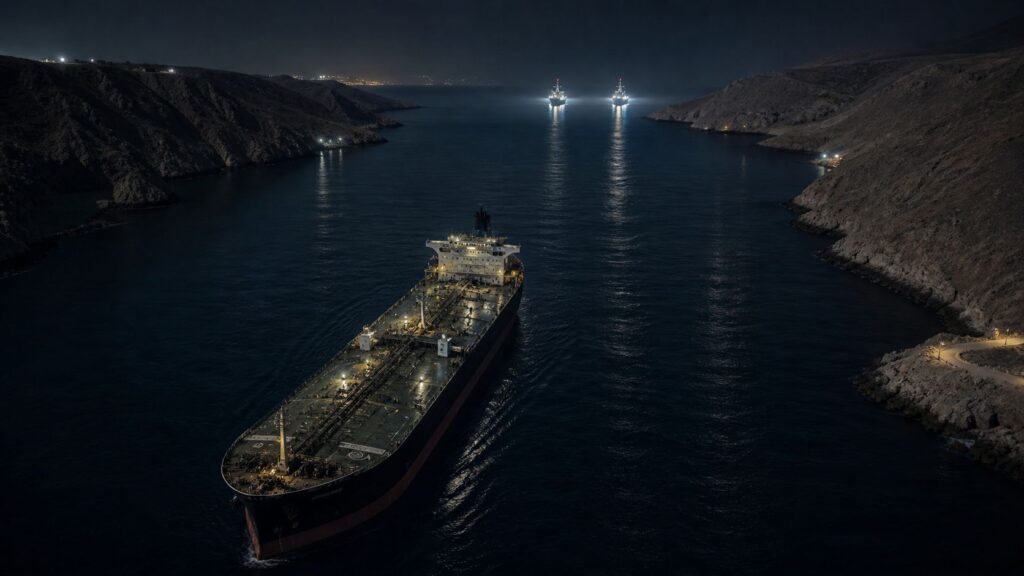
The Invisible Escalation Between Washington and Beijing
What Washington imposed on a Chinese Fortune Global 500 conglomerate was not a sanction in the conventional sense. It was a bargaining chip.
On April 24, 2026, the Office of Foreign Assets Control of the US Treasury Department placed Hengli Petrochemical (Dalian) Refinery Co., Ltd. on the Specially Designated Nationals List. The notice was brief; the implications were not. Hengli is not some obscure Chinese shell company with a Hong Kong post office box. Hengli is part of a conglomerate with approximately 35 billion dollars in revenue in 2024, listed on the Shanghai Stock Exchange, a member of the Fortune Global 500, operating a 400,000-barrel-per-day complex on the Changxing Peninsula in Dalian. The chairwoman of the listed parent entity, Fan Hongwei, ranks in 2026 – per Bloomberg’s assessment – as the eighth-wealthiest self-made woman in the world. This designation is the largest direct hit Washington has landed against a Chinese oil processor since the resumption of the maximum pressure campaign against Iran in 2019.
The official justification: Hengli had been purchasing Iranian crude oil worth billions since at least 2023, generating hundreds of millions of dollars in revenue for Iran’s armed forces. The seller on the Iranian side was identified as Sepehr Energy Jahan Nama Pars Company – the oil sales arm of the Iranian general staff. Through a trust mechanism documented in the OFAC press release “Economic Fury Targets Global Network Fueling Iran’s Oil Trade,” the funds flowed directly into the military supply chain of Iran’s armed forces.
That was the louder part. The quieter part is this: the sanction landed at a moment when Beijing and Washington were preparing a direct meeting between Donald Trump and Xi Jinping – reported by the South China Morning Post as falling “only weeks” after the designation. Hengli, in this context, is neither coincidence nor routine. Hengli is a bargaining chip.
The Central Question Behind the Iran War
Since February 28, 2026, international attention has been fixed on the military headlines: US and Israeli airstrikes on Iranian facilities, Iranian counterstrikes, seized tankers, missile attacks on stateless cargo vessels in the Strait of Hormuz. Coverage follows the stage. But beneath the stage, a second escalation is underway – one that does not address Iran but China.
Before the war began, China’s share of Iran’s crude oil exports stood at between 80 and 90 percent, according to Treasury data. Iran’s oil economy was effectively a Chinese supply route operating under an Iranian extraction license. What Washington has been executing since April 24 is not the weakening of the Iranian government – US strategists regard that as already well advanced. It is the elimination of a Chinese energy back door through three mutually reinforcing levers: physical pressure via the naval blockade, financial pressure via OFAC, and operational pressure via Hormuz shipping traffic.
Beijing is not responding with the tools a Western observer might expect. No escalating press conferences. No martial threats. Instead, four counters across four distinct levels: diplomatic, operational, legal, and collateral. Asian escalation does not operate through volume – it operates through the structural activation of its own levers. Those who read the escalation only through press conferences will miss it entirely.
This article describes how these six moves interlock across two levels of play – and why the real decision-making arena is neither Tehran nor Hormuz, but the summit between Trump and Xi that has not yet taken place.
Lever 1: Physical Blockade
On April 13, 2026, the US naval blockade of Iranian ports took effect. It has since been the first of three choking mechanisms.
The operational logic is classical: since the war began on February 28, Iran has largely sealed the Strait of Hormuz and since mid-April seized at least two tankers – the M/T Majestic and the M/T Tifani, carrying a combined total of nearly four million barrels of Iranian crude. The United States responded with interdictions in the opposite direction. On April 20, US Central Command fired missiles at the control room of the Iranian cargo vessel Touska, which according to CENTCOM had violated the blockade. On April 21, US military helicopters hovered over the sanctioned stateless tanker M/T Tifani; footage of the interdiction was released publicly by the Department of Defense.
The result is that every tanker movement out of Iran becomes a military operation. Insurers withdraw. Shipping companies without deep ties to Iran’s shadow network avoid Iranian ports. The physical blockade is not hermetic – tankers continue to get through via ship-to-ship transfers off Malaysia, documented for vessels including the Lynn, the Stellar Beverly, and the Covenio. But volume is declining, and the risk premium on every individual shipment is rising.
What matters analytically is what the blockade is not: it is not a military end in itself. It is the stage on which the financial and operational escalation can actually take effect. Without the blockade, the Hengli sanction would be an administrative act that Chinese shipping companies could route around. With the blockade, it becomes a trap: who transits, who pays, who guarantees – each of those questions becomes a sanctions question.
Lever 2: Hengli and the 50 Percent Rule
The April 24 designation formally targets Hengli Petrochemical (Dalian) Refinery Co., Ltd. In practice, it reaches further. OFAC operates under the so-called 50 Percent Rule: any entity owned directly or indirectly at least 50 percent by a designated person or firm is automatically treated as blocked – without requiring a separate listing. The sanctions shadow therefore extends across the entire Hengli corporate structure without OFAC needing to name the parent conglomerate individually.
The operational effect is reinforced by two measures that have received little coverage in Western reporting. First, OFAC issued General License V on April 24, permitting a wind-down period through May 14, 2026 for transactions involving Hengli. This is not leniency – it is a mechanism. Western counterparties are given three weeks to exit in an orderly fashion. Anyone still transacting after that date has no excuse. Second, OFAC published a formal alert on April 28 titled “Sanctions Risk of Dealing with Teapot Oil Refineries.” The alert explicitly lists the designated refineries – including, alongside Hengli, Shandong Jincheng Petrochemical Group and three further Chinese teapots sanctioned in 2025 rounds. It is addressed not only to US persons but explicitly to “non-US persons” – the language of secondary sanctions pressure.
In parallel, OFAC on the same date sanctioned approximately nineteen additional vessels and nineteen additional companies from Hong Kong, Panama, the Marshall Islands, Liberia, and Vietnam. The individual tanker tracking data Treasury disclosed is unusually granular. The Lisboa, registered to Hong Kong-based Lisboa Shipping Company Limited, transported more than 2.5 million barrels of Iranian naphtha to the UAE between July 2025 and January 2026. The Stellar Beverly moved more than two million barrels of Iranian crude to China in 2025. The Covenio has shipped more than six million barrels of Iranian oil since early 2025. This is not a random selection – it is a mapped supply network.
Behind Hengli, in OFAC’s reading, stands not merely a Chinese conglomerate. Behind Hengli stands the Iranian general staff. Sepehr Energy Jahan Nama Pars Company is assessed by the United States as a front company for Iran’s armed forces, operated through a network of intermediaries and vessels that moves sanctioned oil and channels proceeds into Iranian military programs and regional proxy networks. Treasury estimates that Iranian volumes routed through US correspondent accounts in 2024 alone amounted to approximately nine billion dollars – concentrated in Hong Kong, Oman, and the UAE. TRM Labs estimates daily IRGC revenues at approximately 20 million dollars.
The qualitative threshold Washington crossed with Hengli is clear. Earlier sanctions against smaller Shandong teapots could be ignored by Beijing – those refiners had no dollar accounts and minimal international exposure. Hengli is different. Hengli is publicly listed, maintains international banking relationships, insurers, ship charter arrangements, and bond issuances. The sanction forces every international partner with any connection to the conglomerate or its subsidiaries into a compliance decision. That was the point.
Lever 3: The Hormuz Trap
The third choking mechanism followed on May 1. OFAC published an alert titled “Sanctions Risks of Iranian Demands for Strait of Hormuz Passage.” The message: anyone paying Iran a “toll” for passage through the strait risks US sanctions – regardless of the form of payment. The alert explicitly lists fiat currencies, digital assets, barter arrangements, informal swaps, and “in-kind” payments such as nominally charitable donations to the Iranian Red Crescent Society, the Bonyad Mostazafan, or Iranian embassy accounts. Even the obfuscation techniques are named in advance.
The backdrop is a real Iranian operation. According to reports by TRM Labs and several industry services, Iran on March 31, 2026 introduced a formalized toll system for Hormuz transit – referred to internally as the “Tehran Toll Booth.” Vessels transmit ownership and cargo data through intermediaries, receive – following payment within a “conversion window” on Qeshm Island – a passcode transmitted by VHF radio, and are subsequently escorted through the chokepoint by the Iranian navy. This is not improvised extortion but a technically developed toll infrastructure with its own IRGC architecture. Hamidreza Haji Bababei, deputy parliamentary speaker of the Iranian parliament, publicly acknowledged initial toll revenues.
What OFAC created with the May 1 alert is a near-perfect shipping trap. Anyone who needs to transit Hormuz – and approximately 20 percent of globally shipped crude oil and LNG does – faces two options. Pay Iran, and risk US secondary sanctions with loss of access to the US financial system. Refuse to pay, and risk Iranian seizure. Insurers on the Lloyd’s side and P&I clubs must decide for each individual voyage whether to underwrite the risk. The cost implications are predictable: risk premiums, rerouting where possible, and in individual cases withdrawal from the trade.

On the same day, OFAC additionally sanctioned three Iranian money exchangers that Treasury says convert billions annually, along with the Panama-flagged oil tanker NEW FUSION. Treasury Secretary Scott Bessent stated the official mantra: the administration would “relentlessly attack the regime’s ability to generate, move, and repatriate funds.” The choice of money exchangers is not incidental – they are the bridges through which oil revenues from Hong Kong, Dubai, and Muscat are converted into usable currency. Severing those bridges severs the liquidity.
Three levers – physical, financial, operational – each of which exists independently but only together produces the effect Washington intends. Iran becomes a commercial dead end. But that is only half the story.
Counter 1: Lin Jian and the Question of Norms
Beijing’s first response came on April 28 from the press center of the Chinese Ministry of Foreign Affairs. Spokesman Lin Jian stated in the regular briefing: “China opposes illegal unilateral sanctions that have no basis in international law. We urge the United States to stop its arbitrary sanctions and long-arm jurisdiction. China will firmly defend the lawful rights and interests of Chinese companies.”
On first reading: standard phraseology. On second reading: a carefully calibrated positioning. Three terms matter – “illegal,” “unilateral,” “long-arm.” They frame the matter not as a bilateral US-China conflict but as Washington’s violation of a multilateral norm. In doing so, Beijing opens a front on which it is traditionally stronger than at the press conference podium: multilateral norm interpretation. Fu Cong, China’s UN ambassador, simultaneously described the Iran war itself as an “illegal war by the US and Israel” and called for resumed negotiations on reopening the Strait of Hormuz. The argumentative line is consistent, the message unambiguous: what Washington is doing is not compliant with international law, and China is documenting that publicly.
Those reading Western escalation codes will easily miss this front. The mode is not outrage but protocol – which is precisely what makes it accessible to third-party states that do not want to choose between Washington and Beijing.
Counter 2: Yuan, Shell Structures, Stockpiles
While the Foreign Ministry tended the normative front, Hengli responded operationally. On April 26, the conglomerate issued a statement declaring it had “never traded with Iran” and that all suppliers had “guaranteed” that crude did not originate from sanctioned regions. This position is legally calibrated – it is the opening line of any appeal against the designation. Politically, it is secondary. What matters are the measures taken in parallel.
Three are documented. First, Hengli announced that all future crude procurement would be settled in Chinese yuan. This technically neutralizes the sanction, which is constructed within a dollar-centric prohibition framework. Trading in yuan bypasses OFAC – provided the counterparty bank forgoes US correspondent accounts. That is a substantial friction increase but not a hard barrier. For Russia, Iran, and Central Asia transactions, yuan settlement has been routine since 2022.
Second, the Hengli conglomerate restructured its Singapore-based trading subsidiary, Hengli Petrochemical International. The sanctioned Dalian entity’s ownership stake was reduced from 100 percent to five percent, per Reuters reporting; the remaining 95 percent was assumed by a Chinese local government entity. This is a classic shell structure. Traders told Reuters skeptically that international counterparties will struggle to accept the arrangement – the ownership chain at the time of OFAC’s designation remains traceable. Nevertheless, the restructuring substantially increases the compliance burden of any due diligence check. It is not a shield; it is a tripwire.
Third, Hengli communicated that crude oil stockpiles at the Dalian facility are sufficient for more than three months of processing. Shares in the listed parent entity fell ten percent on April 28. The market waited in vain for crisis communications, a board reshuffle, or an emergency credit facility announcement. The message to investors: we are riding this out.
Counter 3: The Blocking Statute Activated
The central Chinese countermove – and simultaneously the one most underreported in Western coverage – came on May 2 and 3. The Chinese Ministry of Commerce activated the Anti-Foreign Sanctions Law introduced in 2021 – China’s equivalent of the European Blocking Statute – ordering Chinese companies not to recognize, implement, or comply with US sanctions against five refineries.
The entities covered are, alongside Hengli Petrochemical (Dalian) Refinery, the already-sanctioned Shandong Jincheng Petrochemical Group, Hebei Xinhai Chemical Group, Shouguang Luqing Petrochemical, and Shandong Shengxing Chemical. The Ministry justified the order on the grounds that US measures “violate international law and basic norms of international relations.”
The practical effect of this order is legally and economically significant. Until now, the Anti-Foreign Sanctions Law had been treated in Western compliance practice as a Chinese threat instrument of limited operational sharpness – Beijing had rarely activated it offensively since its introduction. With the May 2 order, the instrument is live against five Chinese energy actors, under the direct pressure of the largest OFAC designation in the history of China’s energy sector.
What this means in practice affects every internationally operating actor with ties to the five refiners. A Chinese bank that calls a loan to one of these refineries to avoid OFAC compliance risk violates Chinese law and becomes liable – up to fines and license revocation. If it follows the Chinese order and continues servicing the loan, it potentially loses access to the US financial system. Insurers, ship brokers, and logistics providers face the same choice. The compliance vice is not a footnote – it is the instrument.
Beijing has thereby activated a lever that neutralizes the operational effect of the OFAC sanction within Chinese jurisdiction and applies friction to it outside Chinese jurisdiction. This is not the symmetrical response of a state reaching for its own escalation ladder. It is the structural response of a state activating its own legal space simultaneously as shield and trap.
Counter 4: Seven EU Firms and the Taiwan Card
Simultaneously with the Blocking Statute order, the Chinese Ministry of Commerce placed seven EU companies on a restriction list for dual-use goods from China. The stated justification: alleged “collusion” with Taiwanese authorities. The identities of the seven firms were not made public.
This measure appears at first glance thematically disconnected from Hengli and Iran. It is not. It is the collateral pressure stage – a signal to Europe, which regularly plays the role of secondary follower in the Western sanctions architecture. If Brussels aligns with Washington’s Iran-China sanctions, Beijing has with the Taiwan card a mechanism to strike back asymmetrically without escalating the core conflict with Washington.
The message is readable on two levels. To the EU: your supply chains for strategic goods, your semiconductor industry, your high-technology exports depend on Chinese cooperation. To Taipei and Washington: we can activate the Taiwan framework at any time as justification for economic measures that are not directly US-facing but generate pressure on US allies.
Four counters – diplomatic, operational, legal, collateral. Not a single press conference with a raised voice. No announced retaliatory sanction against US firms. Instead, a coldly structured activation of its own levers across four distinct levels. Those measuring the conflict against Western communication patterns see no Chinese response. Those watching the structural moves see the opposite.
The Real Negotiating Table
Which leaves the question of what all this is for. Three levers, four counters – on which level do they get settled?
Until a few weeks ago, the answer lay on a planned direct meeting between Donald Trump and Xi Jinping. The South China Morning Post reported in April that the Hengli designation fell “only weeks” before this summit. No date was made public; the location: China. The meeting has since been called off – and the most plausible explanation has nothing to do with Iran or Hengli.
The analytical reading that follows the logic of Trump’s established negotiating behavior is this: Trump systematically builds leverage in order to dismantle it at the negotiating table. Tariffs are raised, then partially reversed – and the reversal is presented as a concession, even though the starting point lies below the pre-escalation baseline. Sanctions are imposed, then eased in exchange for counteroffers. The method is not original, but it is consistent.
A Trump-Xi summit, under this logic, requires Trump to have something to offer. Something he did not have before and that Xi did not have before. Hengli, the Hormuz toll sanction, the expanded secondary pressure on Chinese banks – that is precisely that something. At the summit, Trump could have offered to extend a General License for Hengli, modify the money exchanger sanctions, or qualify the Hormuz alert. Xi would in return have needed to offer something concrete and tangible – on semiconductor export controls, on rare earths, on Taiwan escalation.
That the meeting is not currently happening has, under the reading advanced here, a plausible reason: Trump is not personally deep in the Iran war – operational military leadership is handled by CENTCOM and the Department of Defense, not the White House. The Iran war need not be a direct obstacle. The real reason may be simpler. At the summit, Xi could have demanded concessions on semiconductors, rare earths, or Taiwan that Trump is not prepared to deliver for domestic political reasons. As long as the material on the negotiating table has not reached the right ratio, no summit will take place. The leverage-building continues.
This reading is an analytical thesis, not a proven claim. Other explanations – domestic political pressure on Xi, operational concerns about projecting weakness, escalation in the Taiwan Strait – are not excluded. But the observable behavioral pattern of recent weeks fits the lever-and-trade schema: buildup without drawdown, because the other side has not yet placed the right collateral.
The World Watches Hormuz. The Decision Falls Elsewhere.
What remains is the finding that the Iran war in spring 2026 serves a dual function. On the visible stage, a military conflict between the United States, Israel, and Iran is being fought, with all the attendant headline activity over seized tankers, missile strikes, and diplomatic crises. On the second stage, far less in the spotlight, an escalation against China’s energy supply is underway – one that uses Iran as its setting without being about Iran.
The Hengli sanction is the largest hit this program has landed to date. It crosses a qualitative threshold because it is the first time a publicly listed Chinese Fortune Global 500 conglomerate has been directly targeted. It is flanked by a naval blockade that gives the sanction practical force, and by a Hormuz toll alert that drives every shipping company into a compliance trap. Three levers that only work together.
Beijing’s response is not symmetrical. It forgoes the communicative escalation Western observers would expect, and instead reaches for structural means: yuan settlement, shell structures, the Anti-Foreign Sanctions Law activated against five refineries, collateral restrictions against seven EU firms. Four counters across four levels, interlocking to construct a protective space in which the OFAC sanction loses traction.
Those seeking to read over the coming months who is winning this contest will not find the answer in press conferences from Washington and Beijing. Nor in tanker interdictions off Hormuz. The answer will become visible through three indicators: whether yuan settlement of Chinese energy imports continues to grow and which third-country banks align themselves on the yuan side; whether OFAC escalates secondary pressure against Chinese banks or stays focused on individual refiners; and whether Trump and Xi find their way back to the negotiating table – or whether both sides continue running the current buildup mode, because neither holds the right concession in hand.
The world is watching Hormuz. The decision falls in Beijing and Mar-a-Lago.

Michael Hollister
is a geopolitical analyst and investigative journalist. He served six years in the German military, including peacekeeping deployments in the Balkans (SFOR, KFOR), followed by 14 years in IT security management. His analysis draws on primary sources to examine European militarization, Western intervention policy, and shifting power dynamics across Asia. A particular focus of his work lies in Southeast Asia, where he investigates strategic dependencies, spheres of influence, and security architectures. Hollister combines operational insider perspective with uncompromising systemic critique – beyond opinion journalism. His work appears on his bilingual website (German/English) www.michael-hollister.com, at Substack and in investigative outlets across the German-speaking world and the Anglosphere.
Sources
- US Department of the Treasury: “Economic Fury Targets Global Network Fueling Iran’s Oil Trade and Shadow Fleet,” April 24, 2026: https://home.treasury.gov/news/press-releases/sb0472
- OFAC, Iran Sanctions Program overview (including General License V, General License W, Alerts): https://ofac.treasury.gov/sanctions-programs-and-country-information/iran-sanctions
- OFAC Alert: “Sanctions Risk of Dealing with Teapot Oil Refineries,” April 28, 2026: https://ofac.treasury.gov/media/935546/download?inline=
- OFAC Alert: “Sanctions Risks of Iranian Demands for Strait of Hormuz Passage,” May 1, 2026: https://ofac.treasury.gov/media/935556/download?inline=
- Asia Times: “China defends firms as US sanctions Hengli over Iran oil,” April 28–29, 2026: https://asiatimes.com/2026/04/china-defends-firms-as-us-sanctions-hengli-over-iran-oil/
- Al Jazeera: “China blocks US sanctions against five ‘teapot’ refineries,” May 3, 2026: https://www.aljazeera.com/economy/2026/5/3/china-blocks-us-sanctions-against-five-teapot-refineries
- Bloomberg: “Beijing Tells China Firms to Ignore US Sanctions on Refiners,” May 2, 2026: https://www.bloomberg.com/news/articles/2026-05-02/beijing-tells-chinese-firms-to-ignore-us-sanctions-on-refiners
- US News / Reuters: “US Sanctions on China’s Hengli Mark Escalation in Iran Oil Crackdown,” April 29, 2026: https://www.usnews.com/news/top-news/articles/2026-04-29/explainer-us-sanctions-on-chinas-hengli-mark-escalation-in-iran-oil-crackdown
- Times of Israel / Reuters: “US warns shippers that paying Iran to traverse Hormuz may incur sanctions,” May 1, 2026: https://www.timesofisrael.com/us-warns-shippers-that-paying-iran-to-traverse-hormuz-may-incur-sanctions/
- Fox News: “Treasury sanctions Chinese refinery Hengli over Iran oil purchases,” April 24, 2026: https://www.foxnews.com/world/us-targets-china-refinery-sweeping-iran-oil-crackdown-sanctions-shadow-fleet-tankers
- RFE/RL: “Beijing Pushes Back As US Sanctions Chinese Oil Refinery Over Iran Links,” April 28, 2026: https://www.rferl.org/a/china-us-sanctions-oil-iran-eu/33744295.html
- Vision Times: “US Treasury Sanctions Major Chinese Oil Refinery and 40 Shipping Firms Tied to Iran’s Shadow Fleet,” May 1, 2026: https://www.visiontimes.com/2026/05/01/us-treasury-sanctions-major-chinese-oil-refinery-and-40-shipping-firms-tied-to-irans-shadow-fleet.html
- Tehran International Journalism: “Tehran’s Fortune 500 Customer: How Hengli Petrochemical Became the Centerpiece of Iran’s Shadow Oil Trade,” April 28, 2026: https://tij.news/hengli-petrochemical-iran-oil-sanctions-shadow-fleet-april-2026/
- Washington Examiner: “China defies US sanctions on Iranian oil purchases ahead of Xi summit,” May 2026: https://www.washingtonexaminer.com/policy/foreign-policy/4552646/china-blocks-sanctions-refineries-buying-iranian-oil/
- GovPing / Federal Register: “OFAC Sanctions 19 Entities, 19 Vessels Under Iran EO,” April 24, 2026: https://changeflow.com/govping/trade-sanctions/iran-sanctions-19-entities-19-vessels-designated-2026-04-24
© Michael Hollister – All rights reserved. Redistribution, publication or reuse of this text requires express written permission from the author. For licensing inquiries, please contact the author via www.michael-hollister.com.
Newsletter
🇩🇪 Deutsch: Verstehen Sie geopolitische Zusammenhänge durch Primärquellen, historische Parallelen und dokumentierte Machtstrukturen. Monatlich, zweisprachig (DE/EN).
🇬🇧 English: Understand geopolitical contexts through primary sources, historical patterns, and documented power structures. Monthly, bilingual (DE/EN).