
by Michael Hollister
Exclusive published at Michael Hollister on May 03, 2026
4.464 words * 24 minutes readingtime

The Two Investigations That Never Met
Anyone trying to understand the Epstein case has to stop reading it as a scandal. It is not a scandal. It is a systems case – and in 2026, it has acquired a new urgency: a US Senator has spent four years trying to obtain bank records, agency files, and an unclassified memorandum, and is meeting active resistance from the Justice Department. This is not historical reckoning. It is an ongoing fight.
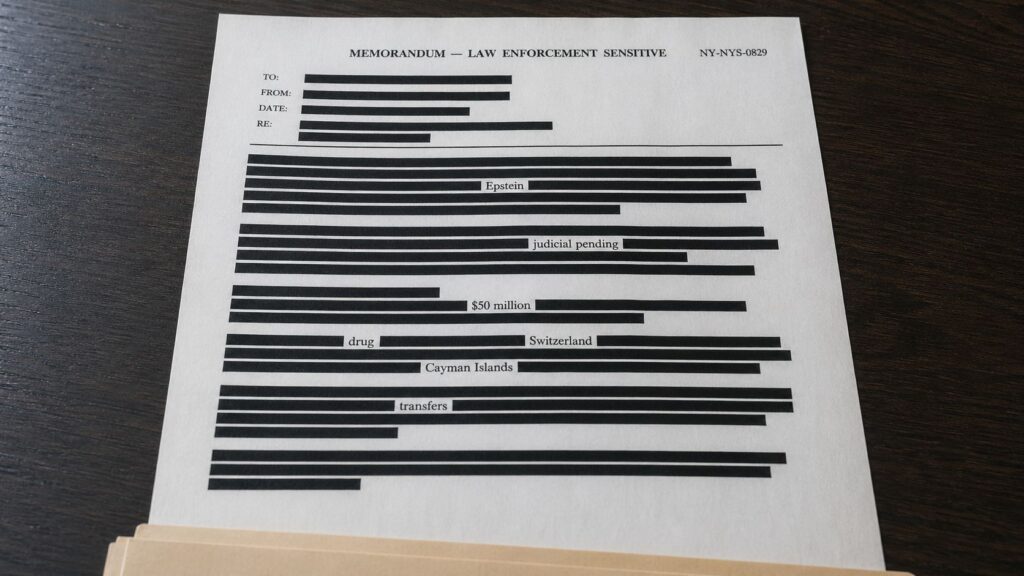
Two parallel investigative tracks against the same man, separated from each other, neither aware of the other. One ended with Epstein’s arrest in July 2019, his death in federal custody in August of that year, and the final conviction of his closest associate Ghislaine Maxwell to a 20-year prison sentence. The other track – the older one, the one with by far the broader institutional reach – vanished. No indictments, no public statement, no press release, no closure. Only a 69-page memorandum that lay buried for years and was released only in January 2026 under the Epstein Files Transparency Act – heavily redacted, posing more questions than answers.
Before Epstein was charged with sex trafficking in 2019, he had already, in 2008, secured a notorious settlement with the justice system – the so-called “Sweetheart Deal,” negotiated with Alexander Acosta, then US Attorney in Miami, who would later serve as Labor Secretary under Trump. Epstein pleaded guilty to a single state charge of soliciting prostitution, served 13 months in a county jail under generous work-release arrangements, and walked free. Federal charges did not follow. The victims were not consulted on the deal. The arrangement is well known, well documented, and has been analyzed many times. It is not the starting point of this article. It is a sign of a pattern.
The pattern is this: Epstein moved for decades through a space in which the most serious consequences never materialized. Not because there were no investigations – the opposite is true, as the newly surfaced documents show. But because investigations that pushed beyond the sex offenses into other terrain did not produce corresponding charges. Whether that was coincidence, a coordination failure between agencies, institutional dysfunction, or something more deliberate, is a question to which the available documents provide no conclusive answer. They do, however, raise it with mounting clarity.
What has dominated the public debate over Epstein for years are names. Who was on Little Saint James, his private island in the US Virgin Islands? Who flew on the private jet known internally as the “Lolita Express”? Which politician, which financier, which academic was in contact with him? These questions are legitimate – and they direct attention to the sexual, to celebrity, to outrage. While attention lingers there, another dimension remains largely unexamined: money. Structures. Institutions. Agencies. The question of how a network of this scope was financed, shielded, and protected from full prosecution over decades.
That is the subject of this article.
Operation Chain Reaction: What the Memo Shows
The Organized Crime Drug Enforcement Task Forces Fusion Center, OCDETF for short, was not an agency for routine cases. It was not an office that processed petty offenders or documented local drug crimes. OCDETF was a program established under President Reagan in the early 1980s, conceived as a response to the exploding cocaine trade – with an explicit mandate to identify, disrupt, and dismantle transnational drug cartels, organized crime, and the money-laundering structures behind them. The program operated across agency lines: DEA, FBI, ICE, IRS, Treasury, and homeland security agencies – all at the same table, all with access to their respective data pools. The OCDETF Fusion Center, opened in Virginia in 2009, was the hub of this cooperation: a clearinghouse for intelligence and investigative data drawn from across the federal apparatus. Anyone who landed in the Fusion Center’s sights was no minor target.
Jeffrey Epstein landed in those sights.
On December 17, 2010, the DEA in New York opened a case against him. Five years later, in May 2015, the director of the OCDETF Fusion Center produced a 69-page memorandum – internally classified as “law enforcement sensitive,” and to this day heavily redacted in the public version. The document carries the case number NY-NYS-0829 and the internal identifier OFC-TP-15-12392. It was released only in January 2026, more than a decade after it was written, under the Epstein Files Transparency Act – in a state with more redactions than legible text.
What is publicly visible from the document is enough, even so, to raise fundamental questions. Epstein and 14 other individuals are listed in it as targets of an ongoing investigation into “illegitimate transfers connected to illegal drug and/or prostitution activities in the U.S. Virgin Islands and New York City.” The status of the case in May 2015, five years after it was opened: “judicial pending” – an internal status meaning that investigators were waiting on judicial authorizations. Possibly for search warrants. Possibly for wiretaps. Possibly for other court-ordered investigative steps. A case that began in 2010 and was still active in 2015 – and where the responsible parties were apparently on the verge of an escalation.
For the DEA simply to open a case at all required, under applicable agency rules, a documented drug nexus. That is no formality – it is a high bar that demands substantive indicators. A law enforcement source who spoke to CBS News about the memo in February 2026 confirmed: the request to the Fusion Center was an indicator of a “significant” investigation, not a routine query. In other words: somebody inside the federal apparatus had enough material to elevate Epstein to that level – the level on which drug cartels and the Russian mafia are normally investigated.
The memo contains more than the Chain Reaction strand. It lists further investigations, until then completely unknown, all of which had some connection to Epstein. An ICE investigation in West Palm Beach, opened in 2006, closed in 2008. An ICE inquiry in Las Vegas. An ICE operation in Paris under the internal name “Operation Angel Watch,” opened in June 2013 and closed a few months later. And an FBI investigation that started in 2006 and was still active in 2015 – nine years later. Four separate agency tracks, activated at different times, in different places, by different federal agencies. All connected to Epstein. None of them ever made public.
To this is added the geographic and financial dimension the memo sketches. It lists bank accounts attributable to Epstein: in Switzerland, in France, in the Cayman Islands, and in New York. Four jurisdictions, four different legal systems, four different levels of transparency. And it documents roughly $50 million in suspicious transfers between 2010 and 2015 alone – with the names of the individuals involved in those transactions completely redacted. With one exception: apparently by accident, the name of a Polish modeling agent was not fully obscured – a woman who was listed as a target of the investigation, who was in personal contact with Epstein, and whose attorney told CBS News that she was a victim of Epstein. Whether she knew she was a DEA target is unknown.
Two of the corporate structures attributable to Epstein that are named in the memo were left unredacted: SLK Designs LLC and Hyperion Air. Hyperion Air served Epstein as a holding company for his aircraft, including the planes referred to as the “Lolita Express.” SLK Designs was operated by two women named in the 2008 “Sweetheart Deal” as potential co-conspirators. Both companies were controlled by Epstein’s lawyer Darren Indyke – a man whose possible role in the network’s financial architecture Wyden has explicitly named as a further subject of investigation.
What ultimately came of all of this is the question the entire material raises. Not a single drug-trafficking indictment. Not a single money-laundering indictment. No public outcome of Operation Chain Reaction. And – perhaps the structurally most significant point – the prosecutors who charged Epstein in 2018 in the Southern District of New York with sex trafficking knew, by their own account, nothing of the DEA investigation. Two federal investigations against the same man, over an eight-year span, with no connection, no transfer of knowledge, no discernible coordination.
In his letter to the DEA dated February 25, 2026, Senator Wyden posed six concrete questions: Why were Epstein and his 14 co-targets investigated? What exactly did the DEA mean by “illicit drug activities”? When did Operation Chain Reaction end? What was the outcome? Were charges recommended, and if so, why were they not brought? And why do the names of the 14 other target individuals remain redacted – in an unclassified document, in a process meant to protect victims, not perpetrators?
To this day, the DEA has answered none of these questions publicly.
The Banks: JPMorgan, BNY Mellon, and the System That Looked Away
Epstein’s financial architecture was no secret. It was documented, internally discussed, flagged with red flags – and even so left unevaluated for years. What Senator Ron Wyden’s four-year follow-the-money investigation in the Senate Finance Committee has progressively uncovered since 2022 is not the failure of a single institution. It is a pattern that stretches across two of the largest financial institutions in the United States, across nearly two decades, and across transaction volumes that, taken together, run well over a billion dollars.
Suspicious Activity Reports – SARs – are the central instrument of the American anti-money-laundering system. Banks are required under the Bank Secrecy Act to report transactions that may indicate criminal activity to the Treasury Department’s Financial Crimes Enforcement Network in a timely fashion. Timely, as a rule, means within 30 days of identifying the suspicion. SARs are not criminal complaints – they do not automatically trigger an investigation. But they are the early-warning system that allows law enforcement to detect patterns, follow threads, and open or deepen investigations. When banks fail to file SARs, file them late, or systematically report below the actual level of suspicious activity, they shut the system’s eyes. That is precisely what happened in the Epstein case at two banks in parallel.
JPMorgan Chase was Epstein’s principal bank for nearly two decades. In November 2025, Wyden’s staff released an 18-page analytical memorandum based on recently unsealed court filings – including internal correspondence between top managers at the bank. The conclusion is unambiguous in its language: JPMorgan shielded Epstein through a series of compliance failures the memorandum describes as “egregious” and as spanning “nearly two decades.”

The central figure is striking in its precision. As long as Epstein was alive and trafficking women and girls, JPMorgan reported suspicious transactions amounting to a little over $4.3 million. After his death in federal custody in August 2019, the same bank filed Suspicious Activity Reports retroactively – for nearly $1.3 billion, distributed across thousands of transactions reaching back to 2003. Three hundred times more than previously reported. Retroactively. After the man at the center was dead and there were no further consequences to fear.
What the memorandum lays out in detail is an anatomy of institutional failure – or institutional decision, depending on how one reads it. Mary Erdoes, one of the highest-ranking managers at JPMorgan, was according to the unsealed documents in constant direct contact with Epstein. John Duffy, former CEO of the private banking division, allegedly advised Epstein on how to structure cash withdrawals so as not to trigger statutory reporting thresholds. Structuring cash transactions to evade reporting thresholds is itself a federal offense in the United States – known as “structuring,” or colloquially, “smurfing.” That a senior bank executive is alleged to have advised a client on this approaches the offense of aiding and abetting. Internal emails further show that bankers systematically kept relevant information about Epstein’s suspicious activities away from the compliance department – the very internal control function tasked with identifying and filing SARs.
Epstein, according to the memorandum, belonged to JPMorgan’s so-called “Wall of Cash” – an internal elite category for the bank’s largest and most lucrative private clients. That classification helps explain why ordinary compliance processes may have run differently for him than for ordinary clients: the economic value of the relationship stood against the regulatory risk. As long as Epstein was alive, the bank apparently chose, repeatedly, the economic value.
The connection did not end even when JPMorgan officially terminated Epstein as a client. According to the memorandum, bankers continued personal relationships with him for a specific reason: Epstein’s influence over billionaire Leon Black, co-founder of Apollo Global Management. Black paid Epstein a total of $170 million over several years, ostensibly for tax and estate-planning services. Those payments were never investigated criminally. Wyden has had Black in his sights since 2022 and describes the payment structure as a possible further link in the network’s financial architecture.
The second banking trail leads to the Bank of New York Mellon. In January 2026, Wyden extended his investigation to BNY – and found a structure that resembles the JPMorgan story in its underlying logic but has dimensions of its own. Epstein moved nearly $378 million through 270 wire transfers across BNY accounts. For not a single one of these transactions could the bank identify a legitimate business purpose. Numerous transfers showed patterns regarded in the field as typical of money laundering: structuring, round-number amounts, regular rhythms with no discernible operational basis. Wyden’s letter to BNY CEO Robin Vince explicitly cites at least 18 round-number transfers of $1 million each from 2007 – transactions for which the bank apparently neither inquired nor reported.
BNY filed its SARs on Epstein’s transactions with Treasury only in 2019 – more than a decade after the earliest transfers, and only after Epstein had been arrested. That, in Wyden’s assessment, is a possible violation of the Bank Secrecy Act, which requires timely reporting. To the question of why the transactions were reported so late, and whether there were internal investigations of the bank managers responsible, BNY has so far made no public response.
Taken together, JPMorgan and BNY Mellon produce a picture that goes beyond individual failure. Two systemically important financial institutions allowed money flows from a man whose name had long been internally flagged with warning signals to pass for decades – and acted only after his death. The question this raises is not merely regulatory. It is structural: if the early-warning system of the American financial system failed this completely in a case of this magnitude and visibility – what does that say about the cases nobody is writing about?
Why No Indictment? The Question That Remains Open
That is the question the entire material poses – and to which there is no provable answer. Only provable facts that make it louder.
Fact: from December 2010, Epstein was the target of a DEA-led OCDETF investigation at the level of transnational organized crime. Fact: that investigation was still active in May 2015 and possibly close to a judicial escalation. Fact: Epstein and his 14 co-targets were never charged with drug trafficking, money laundering, or comparable federal offenses. Fact: the prosecutors who charged Epstein in 2018 in the Southern District of New York with sex trafficking had, by their own account, no knowledge of the DEA investigation. Fact: the OCDETF program that ran Operation Chain Reaction was disbanded by the Trump administration in 2025 – and with it the institutional structure that may have been the only one still holding access to the complete case files. Fact: the 69-page memo documenting the case has not, to this day, been provided to Congress in unredacted form.

These are not speculations. These are documented states of affairs.
What is not documented – and what therefore must not be asserted – is the causality behind these states of affairs. Why did Operation Chain Reaction end without indictments? Why did the SDNY prosecutors know nothing of it? Why were the $170 million Leon Black paid Epstein never investigated criminally? Why did two major banks report suspicious transactions in the billions only retroactively after Epstein’s death? To none of these questions is there a publicly documented answer.
Wyden has formulated his own assessment – and it is important to read it as his assessment, not as a proven finding. In his February 25, 2026, letter to the DEA, he writes that he is concerned “the DEA and DOJ during the first Trump administration may have ended the investigation in order to protect pedophiles.” That is an extraordinarily grave allegation in an official parliamentary letter from the ranking minority member of the US Senate Finance Committee. It is at the same time an allegation without proof in the sense of a document that establishes such intent. What is established is the result. No indictments. No public statement. No closure.
The structural logic of the case suggests a question one need not answer in order to ask. Epstein operated, by everything the record shows, a network over decades that linked several dimensions at once: sexual acts with minors that were documented and in part filmed; immense and difficult-to-explain money flows across multiple continents and jurisdictions; personal relationships with individuals at the highest levels of business, politics, academia, and the security apparatus; and offshore bank accounts in countries known for their discretion.
In a network of this kind, dependencies are inevitable. Whoever holds compromising material on a person has influence over that person. Whoever has facilitated financial services for someone outside regular structures shares an interest with that person – namely, that the fact not become public. This is not a conspiracy theory. It is the elementary logic of power structures, documented in research on organized crime for decades.
The analytic question that follows: cui bono? Who benefited from the fact that certain investigative threads were not carried to completion? Who had an interest in the 14 co-targets in Operation Chain Reaction remaining anonymous? Who benefited from the fact that $170 million in payments to a convicted sex offender were never investigated for tax fraud? Who benefited from the fact that two major banks for years filed no SARs and thereby did not trigger the early-warning systems of the law-enforcement apparatus?
The answers to these questions are unknown. But the fact that they are unknown – even though the foundations for answering them exist in agency files, bank data, and court documents that are not yet fully public – is itself a statement. There are cases in which ignorance is the result of missing information. And there are cases in which it is the result of withheld information. In the Epstein case, the record indicates that at least part of the ignorance belongs to the second category.
In February 2026, Senator Wyden put it on the platform X in a few words: “I’m convinced there’s a web of financial crimes running through the Epstein story – and that many people who were directly involved are still walking around free. That’s not acceptable.”
That is the assessment of an opposition politician with his own interests. It is also the assessment of a man who has spent four years working through bank records, agency files, and court documents that are not accessible to the public. Both are true at the same time.
Blockade: Wyden vs. Blanche
What sets this article apart from a historical reckoning is an active, ongoing political conflict – one that broke into the open in March 2026 and remains unresolved.
On February 25, 2026, Wyden formally asked the DEA to provide a fully unredacted version of the 2015 OCDETF memorandum. The memorandum is classified as “sensitive but unclassified” – that is, not secret in the formal sense of national-security classification, but merely internal. Under existing law, there is no basis on which to withhold such a document from Congress in a parliamentary investigation. Wyden set a deadline: March 13, 2026.
The deadline passed without an answer.
What happened then is the subject of a public dispute between two men, one of whom is a US Senator and the other the Deputy Attorney General of the United States. According to Wyden, his staff received a confidential tip: DEA Administrator Terrance Cole had been prepared to release the document – until Deputy Attorney General Todd Blanche intervened and instructed the DEA not to cooperate. When Wyden’s staff inquired with the DEA about the status of the request, they were referred to Blanche’s office.
Blanche is no neutral figure in this context. Until his appointment as Deputy Attorney General, he was Donald Trump’s personal attorney – the man who defended Trump in the criminal trials over the Stormy Daniels hush-money case and the federal proceedings on the election-fraud charges. His appointment to the second-highest law-enforcement post in the United States was politically contested from the start. In the Epstein context, he had drawn attention earlier: Wyden in his letter expressly references Blanche’s “bizarrely preferential treatment” of Ghislaine Maxwell, who reportedly enjoys particular privileges in a minimum-security facility – a circumstance brought to light by a whistleblower from the prison system.
On March 18, 2026, Wyden wrote directly to Blanche. The letter is unusually sharp in its language for official Senate correspondence. It calls Blanche’s alleged intervention “deeply troubling,” cites the ongoing obstruction of his investigation by the DOJ, and asks the rhetorical question of why the second-highest law-enforcement official in the country is blocking the release of an unclassified document in a parliamentary investigation into one of the most prominent criminal cases in American history.
Blanche responded – not by counter-letter, but publicly on the platform X. His formulation was concise: “HUGE: A sitting US Senator just completely fabricated a story for clicks. No one is blocking anything.” With this, he not only disputes Wyden’s account of events but explicitly characterizes it as a deliberate lie, motivated by attention-seeking.
Both statements are on the record. Which is correct has not been publicly clarified. What can be said with certainty: the unredacted memo has not, to this day, been provided to Congress. The DEA has not answered Wyden’s six concrete questions publicly. And the OCDETF program that ran Operation Chain Reaction, and whose files may have contained the most complete documentation of the investigation, was disbanded by the Trump administration in 2025 – that is, in precisely the period in which the parliamentary reckoning with the Epstein case was gaining speed. Whether that is a connection or a coincidence is a question the available documents do not answer. They raise it.
The Epstein Files Transparency Act, which forms the basis for Wyden’s demands, was passed with broad bipartisan support. It requires that redactions in published documents be justified to Congress – and that they may only be applied to protect victims, not perpetrators or co-conspirators. Wyden’s argument is therefore not only political but legally precise: if the 14 co-targets in Operation Chain Reaction were not victims but targets of a criminal investigation, there is, under the plain text of the law, no legal basis to redact their names.
To this, too, the DOJ has not so far responded.
Epstein as a Systems Case: What Remains
Jeffrey Epstein died on August 10, 2019, in his cell at the Metropolitan Correctional Center in New York. His death was classified as suicide. Ghislaine Maxwell is serving a 20-year sentence. With that, the public version of the case ends – clean, closed, with perpetrator and accomplice named and punished.
But cases do not end with the death of their best-known protagonist. They leave behind records. Bank data. Agency memos. Court documents. And questions these documents raise without answering them.
What the publicly accessible record today shows – Wyden’s Senate correspondence, the OCDETF memorandum, the lawsuits against JPMorgan, the investigative findings on BNY Mellon – is not the picture of a single perverse billionaire who operated in a legal gray zone and was stopped late. It is the picture of a hub. A man who was simultaneously the target of a DEA-OCDETF investigation for drug trafficking and money laundering, with bank accounts in Switzerland, in the Cayman Islands, and in France, with 270 wire transfers without legitimate business purpose at one bank, with another bank that retroactively identified three hundred times more activity as suspicious than during his lifetime – and with a parliamentary investigation that today is being actively blocked.
The public narrative of Epstein is that of a sex offender. He was that. It is documented, adjudicated, beyond dispute. But the record indicates that this narrative is incomplete. Not wrong. Incomplete. Whether the narrowing to the sex offenses was coincidence, institutional inertia between uncoordinated federal agencies, or the result of interests that prevented full disclosure – that is a question to which the available documents provide no conclusive answer.
What they provide is contours. And the contours show a case larger than its best-known crime. A case in which a US Senator has been fighting for four years against the resistance of the Justice Department to obtain an unclassified document. A case in which two major banks failed for years to report transactions in the billions. A case in which 14 co-targets remain anonymous to this day.
To shine the spotlight on these contours – factually, evidence-based, without name-list voyeurism – is not speculation. It is the only journalistic answer to a case that has not yet been fully told.
Michael Hollister
is a geopolitical analyst and investigative journalist. He served six years in the German military, including peacekeeping deployments in the Balkans (SFOR, KFOR), followed by 14 years in IT security management. His analysis draws on primary sources to examine European militarization, Western intervention policy, and shifting power dynamics across Asia. A particular focus of his work lies in Southeast Asia, where he investigates strategic dependencies, spheres of influence, and security architectures. Hollister combines operational insider perspective with uncompromising systemic critique – beyond opinion journalism. His work appears on his bilingual website (German/English) www.michael-hollister.com, at Substack and in investigative outlets across the German-speaking world and the Anglosphere.
Sources
- US Senate Finance Committee: “Wyden Questions DEA Over Mystery Epstein Investigation,” February 26, 2026 – https://www.finance.senate.gov/ranking-members-news/wyden-questions-dea-over-mystery-epstein-investigation
- US Senate Finance Committee: “Wyden Sounds Alarm as DAG Blanche Intervenes to Conceal Details of Mystery Epstein Investigation,” March 18, 2026 – https://www.finance.senate.gov/ranking-members-news/wyden-sounds-alarm-as-dag-blanche-intervenes-to-conceal-details-of-mystery-epstein-investigation
- US Senate Finance Committee: “Wyden Releases New Analysis Detailing How Top JPMorgan Chase Executives Enabled Epstein’s Sex Trafficking Operation,” November 20, 2025 – https://www.finance.senate.gov/ranking-members-news/continuing-epstein-investigation-wyden-releases-new-analysis-detailing-how-top-jpmorgan-chase-executives-enabled-epsteins-sex-trafficking-operation
- US Senate Finance Committee: “Wyden Expands Epstein Investigation with Probe of Hundreds of Suspicious Bank of New York Mellon Transactions,” January 15, 2026 – https://www.finance.senate.gov/ranking-members-news/wyden-expands-epstein-investigation-with-probe-of-hundreds-of-suspicious-bank-of-new-york-mellon-transactions
- CBS News – Daniel Ruetenik, Pat Milton, Cara Tabachnick: “Newly unearthed DEA document from Epstein files raises question: Did Epstein facilitate drug trafficking?,” February 23, 2026 – https://www.cbsnews.com/news/jeffrey-epstein-files-dea-document-drug-trafficking-investigation/
- Bloomberg: “Senator Accuses Blanche of Blocking Release of Unredacted Epstein Document,” March 18, 2026 – https://www.bloomberg.com/news/articles/2026-03-18/senator-accuses-blanche-of-blocking-release-of-unredacted-epstein-document
- The Hill: “Blanche accuses Wyden of ‘completely fabricated story’ on DEA Epstein document,” March 19, 2026 – https://thehill.com/homenews/administration/5790547-wyden-accuses-blanche-blocking-epstein-report/
- OCDETF memorandum (69 pages, heavily redacted), May 2015, released under the Epstein Files Transparency Act – https://www.justice.gov/epstein/files/DataSet%209/EFTA00173953.pdf (accessible in browser after age verification)
© Michael Hollister – All rights reserved. Redistribution, publication or reuse of this text requires express written permission from the author. For licensing inquiries, please contact the author via www.michael-hollister.com.
Newsletter
🇩🇪 Deutsch: Verstehen Sie geopolitische Zusammenhänge durch Primärquellen, historische Parallelen und dokumentierte Machtstrukturen. Monatlich, zweisprachig (DE/EN).
🇬🇧 English: Understand geopolitical contexts through primary sources, historical patterns, and documented power structures. Monthly, bilingual (DE/EN).