
by Michael Hollister
Exclusive published at Michael Hollister on April 19, 2026
2.702 words * 14 minutes readingtime

How Herbicides Complete What Bombs Begin
The Morning the UN Took Cover
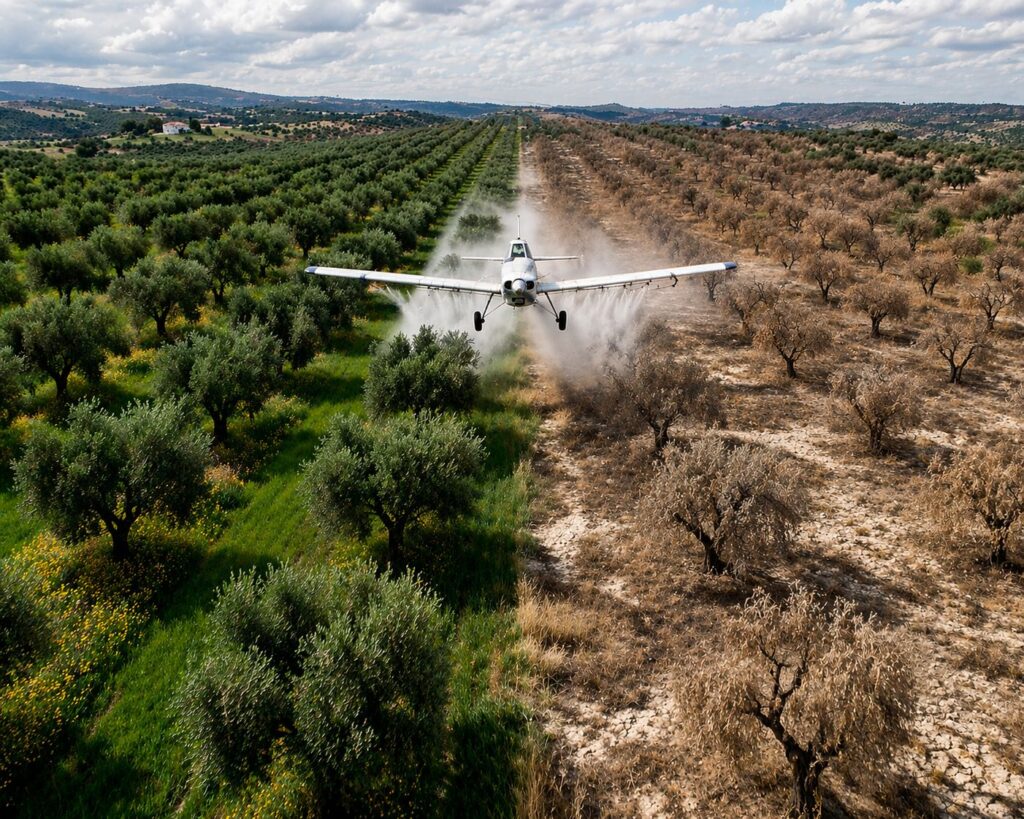
On the morning of February 1, 2026, the Israeli military notified the UN peacekeeping force UNIFIL of an impending air operation near the Blue Line in southern Lebanon. The message was unambiguous: peacekeepers were to take cover and remain there. Israeli military aircraft would be dispersing a chemical substance over areas near the demarcation line. For nine hours, UNIFIL was unable to carry out a single one of its mandated tasks along a third of the Blue Line. Dozens of planned activities were cancelled. The Israeli military described the dispersed substance as “non-toxic.”
Four days later, Lebanon’s ministries of agriculture and environment published the results of their laboratory analyses, conducted on samples collected jointly by UNIFIL and the Lebanese army. The substance was glyphosate. The measured concentrations were 20 to 30 times above normal agricultural application levels. Glyphosate is banned in Lebanon.
The logic of these 2 statements side by side is straightforward: an authority that orders its own soldiers to take protective cover while simultaneously claiming the dispersed substance is harmless produces a statement that refutes itself. UNIFIL called the operation “unacceptable and in contradiction to Resolution 1701.” UN Spokesperson Stéphane Dujarric made clear: any activity by Israeli forces north of the Blue Line constitutes a violation of that resolution. Not possibly. Not under certain circumstances. A violation.
What began in southern Lebanon on that morning is not an isolated incident. It is the most thoroughly documented step to date of a system spanning 3 countries and more than a decade.
What Glyphosate Does – and What It Does Not Distinguish
Glyphosate blocks the EPSPS enzyme that plants need to produce essential amino acids. Without those amino acids, the plant dies – typically within 1 to 3 weeks of absorption through leaves or roots. The mechanism is non-selective. Glyphosate makes no distinction between crops and weeds, between military targets and civilian infrastructure. It kills what is green.
That is the starting point for normal agricultural applications, in which farmers around the world use glyphosate for weed control – at defined concentrations, on their own land, with the explicit goal of being able to replant afterward. Recommended application rates range from approximately 1.3 to 3.6 lbs of active ingredient per acre, depending on crop and objective. No farmer who understands his soil as the foundation of his livelihood applies glyphosate at multiples of that rate. The logic forbids it: the goal of agriculture is growth, not its permanent suppression.
The Lebanese laboratory analyses document concentrations 20 to 30 times above normal agricultural application levels – measured in samples collected jointly by UNIFIL and the Lebanese army. The New Arab, citing Lebanese ministry sources, reports individual samples registering up to 50 times the normal dosage. The WHO’s cancer research agency IARC has classified the substance as “probably carcinogenic to humans” since 2015.
What the substance does to soil at these concentrations extends beyond its immediate effect on plants. Glyphosate is a chelating agent – it binds minerals such as iron, manganese, and zinc in the soil, rendering them unavailable to plants and soil organisms. This effect persists even after the active ingredient itself has broken down. In parallel, glyphosate attacks the EPSPS enzyme not only in plants but also in soil bacteria and fungi – precisely the organisms responsible for soil fertility and for the natural degradation of the herbicide itself. A high glyphosate concentration thus destroys the only natural infrastructure capable of removing it.
In Quneitra, Syrian authorities identified the additional herbicide diuron in plant samples following overflights by Israeli agricultural aircraft in late January 2026. Diuron differs from glyphosate in one decisive respect: it does not act primarily through leaf contact but is absorbed through the soil and inhibits photosynthesis systemically. Its water solubility is lower, its persistence in the soil correspondingly higher. Syrian environmental expert Mwaffak Chikhali told Syria Direct that the damage pattern – yellowing following rainfall, slow detachment of the substance from stones – pointed to a combination of both substances. Lebanese chemist and parliamentarian Najat Saliba, a professor at the American University of Beirut, added that glyphosate is not applied as a pure active ingredient but as a commercial formulation combining glyphosate salt with surfactants that increase penetration depth into plant tissue. These formulations are more aggressive than the active ingredient alone.
2 herbicides with different mechanisms of action. One kills through leaves, the other through the soil. Together, they cover both uptake pathways. This is not overdosed weed control. It is an agronomic finding about the intent behind the application.
Three Countries, One Documented Pattern
The southern Lebanon incident of February 1, 2026, is not the beginning of this practice. It is its most thoroughly documented instance to date.
The Israeli Ministry of Defense confirmed, in response to freedom of information requests from the NGO Gisha, that it had applied herbicides along the border fence nearly 30 times between November 2014 and December 2018. Forensic Architecture documented that the substances were deliberately dispersed during westerly wind conditions, drifting hundreds of meters onto Palestinian farmland in Gaza – onto land Israel has never entered and does not control. The Palestinian Ministry of Agriculture estimates that between 2014 and 2018, more than 13,000 dunams of agricultural land in Gaza were destroyed by drift. A dunam equals approximately a quarter of an acre – 13,000 dunams is roughly 3,200 acres, about the equivalent of 1,800 soccer fields.
In the Syrian province of Quneitra, documented overflights began on January 25, 2026. Israeli agricultural aircraft – identified by the Dutch peace institute PAX through image analysis as Ayres S2R Thrush aircraft, based at Mahanaim airfield northwest of the Sea of Galilee – overflew border villages on at least 3 days: January 25, 27, and 30. Farmers from the villages of Kudna, al-Asha, and al-Rafid described to Syria Direct and France24 a sticky white substance dispersed at low altitude over their fields, pastures, and homes for hours at a time. The effect appeared 3 days later, after the first rain: everything turned yellow. Then brown. Then dead.
PAX analyzed Copernicus Sentinel-2 satellite imagery and PlanetScope footage from February 8, 2026. NDVI analyses by Dr. He Yin of Kent State University document the vegetation loss through before-and-after comparison: deep green to brown, along a strip of at least 34 miles along the Syrian-Israeli demarcation line. The Syrian documentation center Sijil recorded the affected areas: 865 acres of pastureland destroyed, 111 acres of winter crops dead, 12 acres of olive groves damaged.
On February 1, 2026, the Lebanon incident followed. Same aircraft types. Same substances. Same procedure: advance notification to UN forces, instruction to take cover, then dispersal over civilian agricultural land – this time across approximately 2,100 acres along the Blue Line, documented through laboratory analyses by Lebanese ministries, UNIFIL sample collection, and independent field research.
The herbicide operations do not stand alone. The Syrian documentation center Sijil has recorded more than 1,000 Israeli violations in the Quneitra region since August 2025, including 310 ground incursions. In early 2025, the Israeli military cleared approximately 2,200 acres of forest in the Quneitra region – including orchards and ancient oak woodland. The felled trees were not left to Syrian residents. First the trees. Then ground presence. Then chemicals on the fields.
3 countries. The same aircraft. The same substances. Over more than a decade. Documented through UN statements, satellite data, laboratory analyses, Forensic Architecture, and direct field research by independent media.
What Happens to the Soil – and for How Long
Glyphosate is broken down in soil primarily through microbial activity. Soil bacteria and fungi metabolize the substance – that is the only relevant natural degradation pathway. The half-life under normal conditions ranges from 30 to 130 days depending on soil type, temperature, and microbial activity. In Mediterranean clay soils – the dominant soil type in southern Lebanon and Quneitra – the half-life tends toward the upper end of that range. Clay-rich soils with high aluminum oxide content bind glyphosate strongly to soil particles, impeding microbial access and reducing degradation rates.
Here lies the structural problem of the situation at hand: the substance that must be broken down simultaneously destroys the only infrastructure capable of breaking it down. Glyphosate is toxic to approximately 55 percent of native soil organisms because it inhibits the EPSPS enzyme – the same enzyme found not only in plants but also in soil bacteria and fungi. High-concentration repeated application decimates the soil microbiome that would otherwise handle the degradation. Scientific studies show that with repeated applications, the total mineralization time increases with each additional round – degradation becomes slower the more frequently the substance is applied.
The breakdown product AMPA – aminomethylphosphonic acid – is more persistent than glyphosate itself and detectable in soil and water samples long after glyphosate has fallen below the detection threshold. AMPA has its own toxicological properties and accumulates cumulatively with repeated application.
What this means for affected olive groves is agronomically unambiguous: an olive tree that has grown for 30 years absorbs the systemic herbicide through leaves and bark and translocates it into the roots – where the tree’s multi-year reserves of energy and nutrients are stored. The tree does not die immediately. It dies over months as the substance migrates through the phloem. Replanting requires 7 to 10 years to reach the first significant harvest. The combination of high concentration, repeated application, and diuron as a soil-active additive extends the period during which meaningful replanting is possible to years – for perennial crops, potentially beyond a generation.
This is not an estimate in the realm of speculation. It is the logical consequence of established agronomic relationships applied to the documented parameters of these operations.

Who Gets Hit
70 percent of the population of Quneitra province lived from agriculture and livestock farming. That is what Quneitra Governor Ahmed al-Dalati stated on February 13, 2026 – in the past tense.
Abu Taha from the village of al-Rafid, a few hundred feet from the demarcation line, lost all 50 acres of his farmland and pasture. Abu Salah from al-Razaniyeh – name changed at his request, testimony given to France24 – lost 185 acres of wheat. His entire annual harvest, financed on credit, because the preceding years had been poor due to drought. This year the rains were good. The harvest was growing. Then the planes came. Abu Hussein from Kodana, interviewed by the Irish Times, reported that his children developed red eyes after the overflight. He is a livestock farmer. His animals grazed on the sprayed land. His livelihood is gone.
Khaled Shams al-Rahil, also from Quneitra, told Sijil: the pastures had completely disappeared. Not damaged. Disappeared. Even khubeiza – wild mallow shoots that families in the region traditionally gather in winter as a food supplement – yellowed and dried after contact with the substance.
In southern Lebanon, Majed Taheini, mayor of Aita al-Shaab, estimated his personal losses at more than $30,000 – 2 acres of olive trees, 1 acre of tobacco, on land that had already been inaccessible for 2 years due to ongoing Israeli military operations. 2 years without an olive harvest. Now no olive trees at all.
These people are not peripheral to the conflict. They are its center. The UN Food and Agriculture Organization FAO documented that Israeli military operations in Lebanon between 2023 and 2024 had already caused direct agricultural sector damage of approximately $118 million, with indirect economic losses exceeding $586 million – concentrated in southern Lebanon and the Bekaa Valley. The herbicide operations come on top of that.
Smallholder farmers in this region operate without a buffer. A single bad harvest – not from chemicals, just from weather – means 2 to 3 years of debt. That is the baseline. Anyone who understands that also understands what the loss of several consecutive harvests means: not economic weakening, but the forced abandonment of a livelihood. The UN Special Rapporteur on the Right to Food has noted in comparable contexts that the deliberate targeting of a civilian population’s agricultural productive assets does not merely cause economic harm but directly violates the right to food as a fundamental human right. What is documented in Quneitra and southern Lebanon fits that description precisely.
The Legal Question
UNIFIL classified the action of February 1, 2026 as a violation of Resolution 1701. That is not an interpretation – it is the official statement of the UN peacekeeping force. UN Spokesperson Dujarric confirmed: any activity by Israeli forces north of the Blue Line constitutes a violation of that resolution. The fundamental legal classification of the Lebanon incident is thus not in dispute.
The cross-border dispersal of chemicals over Syrian territory – without the consent of the Syrian government, in the context of a continuing military presence in a de facto occupation zone – violates Article 2 of the UN Charter, which prohibits attacks on the territorial integrity of another state. This classification applies regardless of whether glyphosate falls under the Chemical Weapons Convention – which it does not.
The UN Office of the High Commissioner for Human Rights OHCHR described the reports as a “serious humanitarian risk” and explicitly referenced the obligations of all parties under international humanitarian law. Rule 54 of customary IHL protects objects indispensable to the survival of the civilian population – explicitly including agricultural land and food production systems. The destruction of these objects without specific military necessity is prohibited under this rule.
The Euro-Mediterranean Human Rights Monitor classified the operations as war crimes. The reasoning: large-scale destruction of private property without military necessity, deliberate harm to civilian livelihoods, violation of the prohibition on attacks against objects indispensable to civilian survival.
The Dutch institute PAX is more cautious on the ENMOD classification and points to the convention’s high threshold – “widespread, long-lasting and severe.” This restraint is legal precision, not exculpation: ENMOD and IHL Rule 54 are distinct legal instruments with distinct elements of offense. Failure to satisfy one does not preclude satisfaction of the other.
The finding stands: violation of sovereignty, breach of Resolution 1701, potential war crime under IHL Rule 54. Final legal classification is a matter for an international court. The facts on which it would rest are documented.
What Remains After the Ceasefire
A ceasefire ends the dying of soldiers. It does not end what happened on the fields of Quneitra and Aita al-Shaab.
When soils are poisoned, wells contaminated, pastures rendered barren for years, olive groves dead – then return is not a question of political will. It is an agronomic question. And the agronomic answer is: not in this decade, not for this generation of farmers.
Displacement by chemicals leaves no bodies. It leaves brown fields, empty stalls, and debt. It is no less effective than displacement by bombs. It is slower. It is more durable. And it is harder to reverse, because no ceasefire detoxifies a soil.
The satellite data, the laboratory reports, the UN statements, and the farmers’ testimonies from 3 countries describe the same thing: a system that does not aim for victory. It aims for uninhabitability.
Michael Hollister
is a geopolitical analyst and investigative journalist. He served six years in the German military, including peacekeeping deployments in the Balkans (SFOR, KFOR), followed by 14 years in IT security management. His analysis draws on primary sources to examine European militarization, Western intervention policy, and shifting power dynamics across Asia. A particular focus of his work lies in Southeast Asia, where he investigates strategic dependencies, spheres of influence, and security architectures. Hollister combines operational insider perspective with uncompromising systemic critique – beyond opinion journalism. His work appears on his bilingual website (German/English) www.michael-hollister.com, at Substack and in investigative outlets across the German-speaking world and the Anglosphere.
Sources
- UNIFIL Statement, February 2, 2026 – https://unifil.unmissions.org/en/press-releases/unifil-statement-2-february-2026
- UN News / OHCHR, February 6, 2026 – https://news.un.org/en/story/2026/02/1166907
- Al Jazeera, February 4, 2026 – https://www.aljazeera.com/news/2026/2/4/health-crime-aoun-slams-israel-over-spraying-chemicals-in-south-lebanon
- Euro-Med Monitor, February 4, 2026 – https://euromedmonitor.org/en/article/6973/Israel%E2%80%99s-chemical-spraying-of-farmland-in-Lebanon-and-Syria-amounts-to-war-crime,-targets-civilian-survival
- PAX for Peace, February 19, 2026 – https://paxforpeace.nl/news/israel-should-stop-cross-border-spraying-of-herbicide-in-syria-and-lebanon/
- The New Arab, February 11, 2026 – https://www.newarab.com/news/israeli-chemical-attacks-devastates-lebanese-syrian-farms
- Syria Direct, March 3, 2026 – https://syriadirect.org/how-israeli-herbicides-destroyed-quneitra-crops-and-pastures/
- Irish Times, March 2, 2026 – https://www.irishtimes.com/world/middle-east/2026/03/02/the-plane-flew-and-started-spraying-israel-accused-of-poisoning-syrian-farmland-with-chemicals/
- France24, February 18, 2026 – https://www.france24.com/en/middle-east/20260218-israel-spraying-herbicides-syrian-crops
- Military.com, February 13, 2026 – https://www.military.com/feature/2026/02/13/israeli-chemical-spraying-lebanon-environmental-harm-and-legal-dispute.html
- Anadolu Agency, February 4, 2026 – https://www.aa.com.tr/en/middle-east/lebanon-documents-israeli-spraying-of-toxic-substances-plans-un-security-council-complaint/3820529
- Palestine Chronicle, February 24, 2026 – https://www.palestinechronicle.com/from-gaza-to-quneitra-israels-chemical-spraying-expands-across-borders/
© Michael Hollister – All rights reserved. Redistribution, publication or reuse of this text requires express written permission from the author. For licensing inquiries, please contact the author via www.michael-hollister.com.
Newsletter
🇩🇪 Deutsch: Verstehen Sie geopolitische Zusammenhänge durch Primärquellen, historische Parallelen und dokumentierte Machtstrukturen. Monatlich, zweisprachig (DE/EN).
🇬🇧 English: Understand geopolitical contexts through primary sources, historical patterns, and documented power structures. Monthly, bilingual (DE/EN).