
UPDATE Report – Updated: June 28, 2026 – Building on my update from June 24, 2026
by Michael Hollister
Exclusive published at Michael Hollister on June 28, 2026
2.886 words * 15 minutes readingtime
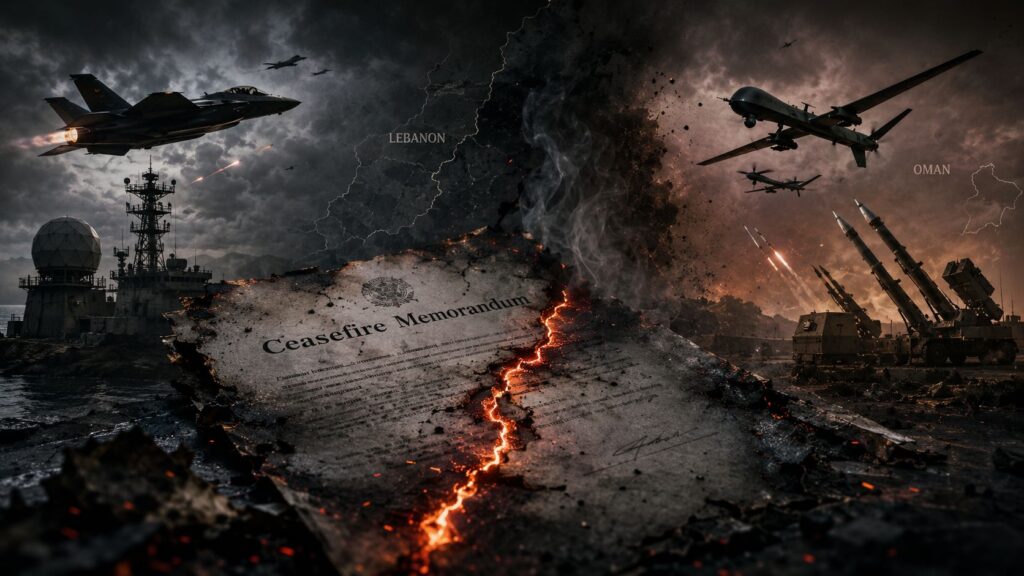


FIRE ON THE CEASEFIRE: THE MEMORANDUM PUT TO THE TEST
TICKER
USA STRIKES IRAN ON TWO CONSECUTIVE NIGHTS – CENTCOM SPEAKS OF “LARGER OPERATION” Ten days after the signing of the memorandum, the United States has bombed Iranian targets for the first time since the ceasefire-on two consecutive nights. On 26 June, U.S. aircraft hit Iranian missile and drone depots as well as coastal radar installations in the Sirik area; on 27 June, strikes followed against surveillance infrastructure, communications systems, air defense positions, drone depots, and mine-laying capabilities. A U.S. defense official told Fox News the second operation was larger than the first. CENTCOM justified both waves of strikes with Iranian drone attacks on commercial vessels and stated that Iran had “been given a chance to comply with the ceasefire but chose not to.”
IRAN FIRES AT LEAST FOUR DRONES AT SHIPS IN SOUTHERN CORRIDOR – EVER LOVELY HIT On 25 June, an Iranian kamikaze drone struck the Singapore-flagged container ship M/V Ever Lovely as it exited the Strait of Hormuz along the Omani coast. Trump stated on Truth Social that Iran had fired a total of at least four drones at ships in the strait; three others had been shot down. The attack targeted vessels using the southern corridor established by the IMO and Oman-a route Iran considers impermissible. The IRGC had already warned on the same day via VHF Channel 16 that passage without Iranian authorization was “extremely dangerous and prohibited.”
IRGC ENFORCES ROUTE CONTROL – FIVE SHIPS FORCED TO TURN BACK Already before the attack on the Ever Lovely, the IRGC had on 25 June forced ships in the southern corridor to turn back. The maritime analytics platform Windward identified five vessels exhibiting reversal behavior, including the Omega Trader, SG Pegasus, Blue Star I, and Azumasan. The Omega Trader lost its AIS signal and changed its registered destination within two hours. Iran thereby claims control over all three corridors of the strait-the northern one along its coast, the central mined corridor, and now the southern one along Oman. On 24 June, 49 AIS-visible transits had still been recorded-the highest figure since the start of the war.
IRAN REPORTS RETALIATORY STRIKES – BAHRAIN HIT BY DRONES, SUPERTANKER KIKU DAMAGED On 27 June, the Revolutionary Guards declared they had attacked “several locations of the U.S. terrorist army in the region” in response to the American strikes, without naming specific targets. Bahrain confirmed an Iranian drone attack on its territory and condemned it as a “flagrant violation of sovereignty”-the country hosts the headquarters of the U.S. Fifth Fleet. In parallel, the Panama-flagged supertanker Kiku was struck by a kamikaze drone in the Strait of Hormuz; the vessel was transporting over two million barrels of Qatari crude oil toward Fujairah, according to CENTCOM. A U.S. official told CNN that after Iran’s retaliation announcement, “a few drones” had been detected but no U.S. military assets were hit.

IMO HALTS EVACUATION – JMIC RAISES THREAT LEVEL AND SIMULTANEOUSLY EXPANDS CORRIDOR The International Maritime Organization suspended its organized evacuation operation for stranded ships after the attack on the Ever Lovely. Until then, 115 ships with approximately 2,450 seafarers had been guided through the coordinated procedure; on 25 June alone, 51 passages had been recorded-the highest single-day figure of the entire operation. On 27 June, the Joint Maritime Information Centre raised the threat level from “moderate” to “substantial” and warned of mines. At the same time, the JMIC expanded the southern corridor for simultaneous inbound and outbound traffic-an operational expansion concurrent with a heightened risk assessment.
USA AND GULF COOPERATION COUNCIL DEMAND FREE PASSAGE – IRAN REJECTS DECLARATION AS “PROVOCATIVE” Secretary of State Rubio and the six GCC foreign ministers adopted a joint declaration in Manama on 25 June demanding free, unconditional, and unrestricted navigation through Hormuz-with no tolls, forced registration, or unilateral Iranian control. The declaration condemned attacks by Iran and Iran-linked groups on Gulf states and tied further economic cooperation to compliance with the memorandum. The Iranian Foreign Ministry rejected the Manama declaration as “interventionist, irresponsible, and provocative” and accused the Gulf states of adopting American and Israeli positions.
OMAN SIGNS TWO INCOMPATIBLE DECLARATIONS IN 48 HOURS On 24 June, Oman signed a joint declaration with Iran establishing a working group on the “future management” of navigation in the strait, including “services and related costs.” Two days later, Oman signed the GCC declaration in Manama, which explicitly rejects fees and control attempts. According to Bloomberg, Omani diplomats have told European counterparts that a return to the prewar status quo is impossible-ships might have to pay for demining or navigation assistance. Oman is under Iranian pressure; at the same time, it is studying the Malacca model as a possible template. Sultan Haitham travels to Paris on 28 June to meet Macron-the topic, according to the Élysée: “free and unconditional passage through the Strait of Hormuz.”
ISRAEL, LEBANON, AND USA SIGN TRILATERAL FRAMEWORK AGREEMENT On 26 June, Israeli Ambassador Yechiel Leiter, Lebanese Ambassador Nada Hamadeh Moawad, and State Department adviser Dan Holler signed a framework agreement in Washington. It provides for a phased Israeli withdrawal from two pilot zones in southern Lebanon-one north, one south of the Litani-the takeover by the Lebanese army, and the disarmament of Hezbollah. Rubio described the agreement as “the beginning of the beginning” and announced a trilateral Military Coordination Group as well as $100 million in humanitarian aid. Netanyahu stated that Israel would retain the buffer zone “as long as Hezbollah is not disarmed and remains a threat to Israel” and described the withdrawal from areas the IDF “does not need.”
HEZBOLLAH AND AMAL REJECT THE AGREEMENT – CIVIL WAR WARNING Hezbollah Secretary-General Naim Qassem called the framework agreement “null,” a “humiliation,” and a “surrender of sovereignty” and demanded it be replaced by the U.S.-Iran memorandum. Any attempt to tie the Israeli withdrawal to the disarmament of Hezbollah crosses “red lines.” Hezbollah parliamentarian Hassan Fadlallah stated the agreement could only be enforced through a “U.S.-backed civil war”; Hezbollah supporters demonstrated in Beirut on Friday evening. On 27 June, the Amal Movement-Hezbollah’s principal political ally-joined the rejection and called the agreement “unbalanced.” Both major Shiite forces in Lebanon now stand against the accord.
ISRAEL STRIKES IN LEBANON AGAIN ONE DAY AFTER SIGNING – ONE DEAD On 27 June, the Lebanese state news agency NNA reported an Israeli drone strike in Nabatieh al-Fawqa-outside the security zone defined by Israel and one day after the signing of the framework agreement. Al Jazeera reported, citing Lebanese sources, one dead and one wounded. The Israeli military confirmed the strike and stated the target had been an individual who posed a threat to Israeli forces. Lebanese President Joseph Aoun subsequently spoke with Trump by phone on Saturday evening and asked the United States to press Israel to comply with the agreement and withdraw from occupied territories.
IAEA INSISTS ON INSPECTIONS – IRAN BLOCKS ACCESS TO DAMAGED SITES IAEA Director General Grossi stated on 24 June in Fukushima and on 26 June in Tokyo that the memorandum “expressly” provides for inspections; a “very strong verification system” was necessary. Initial technical contacts with Iranian officials had already taken place. Iran’s Deputy Foreign Minister Gharibabadi contradicted: there were no plans for access to damaged nuclear facilities; this would be considered “exclusively within the framework of a final agreement and after practical steps to lift all sanctions.” Grossi had not received a meeting with Iranian representatives in Switzerland “although he had requested one.” The inspection dispute from the previous update has thus not resolved but hardened.
WHITE HOUSE REQUESTS $87.6 BILLION FOR THE WAR IT DECLARED OVER On 24 June, the White House submitted to Congress a supplemental spending bill of $87.6 billion, of which $67.15 billion for the military-including $21 billion for munitions and industrial capacity, $17.3 billion for operational costs, and $21.1 billion for classified programs. The request was filed on the same day the Senate passed the War Powers Resolution. Senator Patty Murray called the war a “disastrous war of choice”; Democratic Representative Rosa DeLauro declared her party would not support “tens of billions for Trump’s aimless war.” Treasury Secretary Bessent claimed on 26 June that crude oil was already below prewar levels-Brent was indeed trading at roughly $72 to $75, its lowest since 27 February, with a weekly loss of over ten percent.
DRONE STRIKE ON IRANIAN-KURDISH OPPOSITION CAMP NEAR ERBIL On 27 June, a camp of an Iranian-Kurdish opposition group north of Erbil in northern Iraq was attacked with an explosive drone. According to two security sources speaking to Reuters, there were no casualties; the camp had been evacuated beforehand. Iran initially did not comment on the incident. In March, the U.S. press had reported that the White House was examining options for supporting Kurdish opposition groups in Iraq-in the context of regime-change deliberations regarding Tehran. The Kurdish autonomous region in Iraq hosts several Iranian-Kurdish exile groups that have repeatedly been targeted by Iranian drone and missile attacks since the start of the war.

ANALYSIS
I. From War of Words to War of Fire: Why the Memorandum Is Breaking on the Route Question
The central finding of this week is not the dispute over texts-we had that in the last update-but a battle for physical control over sea lanes. The memorandum provides for “safe passage with no charge for 60 days” but does not specify through which corridor. Iran recognizes only the northern route along its coast. The IMO and CENTCOM operate a southern corridor along Oman, which Oman itself has furnished with authorized waypoints. Iran warns ships by radio, forces them to turn back, and fires on those that proceed regardless. The United States then bombs Iranian coastal positions. Both sides invoke the same document-and both frame their attacks as defense of the ceasefire. The escalation sequence of this week-four strikes in three days-shows that the gap in the memorandum was not a diplomatic ambiguity but the cause of war. The problem is not the competing readings. It is the missing map.
II. An Agreement Without the Party That Would Have to Implement It
The framework agreement between Israel and Lebanon was signed on 26 June in Washington-without Hezbollah, which was neither a negotiating party nor willing to participate in implementation. Qassem calls it “null”; Fadlallah threatens civil war; the Amal Movement joins the rejection. Netanyahu celebrates the withdrawal from two areas the IDF “does not need” and in the same breath declares the buffer zone will remain until Hezbollah is disarmed. Structurally, a circular logic is at work: Israel withdraws when Hezbollah is disarmed; Hezbollah will not disarm as long as Israel does not withdraw. The agreement does not break this circle-it documents it. That Israel does not consider itself a party to the U.S.-Iran memorandum, even though it provides for an end to fighting “on all fronts, including in Lebanon,” sharpens the finding: the memorandum has no enforcement power for Lebanon-and the framework agreement has no implementation party.
III. Oman Between the Fronts: The Silent Key to the Postwar Order in Hormuz
In 48 hours, Oman signed two incompatible declarations-on Tuesday, a paper with Iran on “services and related costs” in the strait; on Thursday, a declaration with the GCC that rejects any fee. Omani diplomats tell European counterparts that a return to the prewar status quo is impossible; they are under Iranian pressure. An Iranian negotiation team member confirmed to Iran International that Tehran will impose fees after the 60-day period expires. Oman is meanwhile studying the Malacca model as a template-there, no mandatory fees exist. On 28 June, Macron receives Sultan Haitham in Paris; the topic, according to the Élysée: “free and unconditional passage.” Oman is the key actor no one names: if Muscat goes along with fees, the entire postwar maritime order in the Persian Gulf shifts. If not, the Sultanate stands alone against its most powerful neighbor. The decision will not be made in Washington or Tehran-it will be made in Muscat.
IV. $87.6 Billion for a War That Is Over
On the same day the Senate for the first time in history passed a War Powers Resolution through both chambers, the White House requested $87.6 billion in supplemental spending-predominantly for the war it has officially declared over. Washington is currently telling three stories simultaneously: the war is over (memorandum), the war costs $87.6 billion (supplemental budget), the war must end (War Powers). All three are domestically motivated, and all three are mutually exclusive. The request meets a Republican Party in which four senators have already voted against their own president, and a Democratic opposition that publicly rejects “billions for Trump’s aimless war.” In parallel, Treasury Secretary Bessent claims crude oil is below prewar levels-while a supertanker carrying two million barrels is hit on Hormuz. The memorandum’s 60-day clock expires in mid-August, in the heat of the midterm campaigns. The real vulnerability of the agreement thus lies where it lay in the last update: not in Tehran, but in Washington.
STRATEGIC ASSESSMENT
Two weeks after the signing of the memorandum, the dispute is no longer about texts-it is about fire. Four strikes in three days, a second tanker hit, a Gulf state bombed, two waves of U.S. strikes on Iranian coastal positions. The Lebanon framework fails at the party that would have to implement it, and Oman faces a decision that will determine the postwar order in the Persian Gulf. While the markets price in peace and Brent falls to prewar levels, the conflict escalates over the question the memorandum left open: who controls which corridor-and at what price. The 60 days have become a countdown whose zero point lies not at the negotiating table but on the water.
If you regularly read my updates and analyses, I would be grateful for your support.

Or support my work by leaving a tip

About the Author
Michael Hollister
is a geopolitical analyst and investigative journalist. He served six years in the German military, including peacekeeping deployments in the Balkans (SFOR, KFOR), followed by 14 years in IT security management. His analysis draws on primary sources to examine European militarization, Western intervention policy, and shifting power dynamics across Asia. A particular focus of his work lies in Southeast Asia, where he investigates strategic dependencies, spheres of influence, and security architectures. Hollister combines operational insider perspective with uncompromising systemic critique – beyond opinion journalism. His work appears on his bilingual website (German/English) www.michael-hollister.com and in investigative outlets across the German-speaking world and the Anglosphere.
Sources
- Al Jazeera, 27 June 2026 – US launches second night of strikes against Iran after ship struck by drone: https://www.aljazeera.com/news/2026/6/27/us-launches-second-night-of-strikes-against-iran-after-ship-struck-by-drone
- NBC News, 27 June 2026 – Iran says it has struck U.S.-linked targets as tensions flare up over Hormuz: https://www.nbcnews.com/news/us-news/us-launches-strikes-iran-attack-ship-strait-hormuz-rcna351992
- CNN, 27 June 2026 – Live updates: US launches more strikes against Iran: https://www.cnn.com/2026/06/27/world/live-news/iran-war-strikes-trump
- Fox News, 27 June 2026 – Bahrain targeted by Iranian drones / US launches additional strikes on Iran: https://www.foxnews.com/live-news/iran-war-strait-of-hormuz-drones-bahrain-israel-lebanon-june-27-2026
- Seatrade Maritime, 27 June 2026 – Tanker hit in Hormuz, threat level raised (Kiku, 300,866 dwt, 2 million barrels): https://www.seatrade-maritime.com/security/tanker-hit-in-hormuz-threat-level-raised
- Windward Maritime AI, 25 June 2026 – IRGC Orders Vessels to Turn Back: The Southern Corridor Reversal: https://windward.ai/blog/irgc-turn-back-order-stalls-strait-of-hormuz-recovery/
- NPR, 26 June 2026 – UN agency pauses evacuation of ships through Strait of Hormuz after attack on vessel: https://www.npr.org/2026/06/26/nx-s1-5871963/un-agency-pauses-evacuation-of-ships-through-strait-of-hormuz-after-attack-vessel
- Euronews, 27 June 2026 – Escalation at the Hormuz passage: USA launches new strikes on Iran: https://de.euronews.com/2026/06/27/attacke-frachtschiff-hormus-passage-usa-greifen-iran-wieder-an
- Bloomberg via The Edge Singapore, 26 June 2026 – Oman tells allies ships may have to pay to go through Hormuz: https://www.theedgesingapore.com/news/geopolitics/oman-tells-allies-ships-may-have-pay-go-through-hormuz–bloomberg
- Outlook India, 24 June 2026 – Oman and Iran agree to discuss navigation fees, management of Hormuz: https://www.outlookindia.com/international/oman-iran-agree-to-discuss-navigation-fees-management-of-hormuz
- Oman Observer, 26 June 2026 – HM the Sultan to pay official visit to France on Sunday: https://www.omanobserver.om/article/1191859/oman/hm-the-sultan-to-pay-official-visit-to-france-on-sunday
- Axios, 26 June 2026 – Israel and Lebanon sign framework agreement: https://www.axios.com/2026/06/26/israel-lebanon-framework-agreement-hezbollah
- Al Jazeera, 26 June 2026 – What is the framework agreement signed by Israel and Lebanon?: https://www.aljazeera.com/news/2026/6/26/what-is-the-framework-agreement-signed-by-israel-and-lebanon
- CNN, 26 June 2026 – Israel to withdraw from two areas in Lebanon under newly signed agreement: https://www.cnn.com/2026/06/26/middleeast/israel-and-lebanon-sign-framework-agreement-latam-intl
- Times of Israel, 26 June 2026 – Israel and Lebanon ink framework deal for ending conflict: https://www.timesofisrael.com/israel-and-lebanon-ink-framework-deal-for-minor-idf-withdrawal-after-4-days-of-dc-talks/
- t-online, 27 June 2026 – Israel and Lebanon conclude agreement – many hurdles: https://www.t-online.de/nachrichten/ausland/id_101315854/israel-und-der-libanon-schliessen-abkommen-viele-huerden.html
- Al Jazeera, 24 June 2026 – UN nuclear chief says Iran inspections will happen, Tehran says after deal: https://www.aljazeera.com/news/2026/6/24/un-nuclear-chief-says-iran-inspections-will-happen-tehran-says-after-deal
- NPR, 24 June 2026 – Dispute widens over Iran nuclear inspections: https://www.npr.org/2026/06/24/g-s1-129770/iran-nuclear-inspection
- Al Jazeera, 26 June 2026 – IAEA demands strong verification of Iran’s nuclear programme: https://www.aljazeera.com/news/2026/6/26/iaea-demands-strong-verification-of-irans-nuclear-programme
- CNBC, 24 June 2026 – White House requests $87.6 billion supplemental spending for Iran war, farm aid: https://www.cnbc.com/2026/06/24/iran-war-supplemental-trump-congress.html
- Al Jazeera, 24 June 2026 – Trump White House requests $87.6bn in spending, including for Iran war: https://www.aljazeera.com/news/2026/6/24/trump-white-house-requests-87-6bn-in-spending-including-for-iran-war
- Al Arabiya, 27 June 2026 – Bahrain condemns Iranian drone attacks on its territory: https://english.alarabiya.net/amp/News/gulf/2026/06/27/bahrain-condemns-iranian-drone-attacks-on-its-territory
- Middle East Eye, 27 June 2026 – Drone targets Iranian Kurdish opposition camp in Iraq: https://www.middleeasteye.net/live-blog/live-blog-update/drone-targets-iranian-kurdish-opposition-camp-iraq-reuters-reports
- Geneva Solutions, 26 June 2026 – Iran wants to charge fees on Hormuz passage. What impacts could that have?: https://genevasolutions.news/peace-humanitarian/iran-wants-to-charge-fees-on-hormuz-passage-what-impacts-could-that-have
- Fox News, 26 June 2026 – Iran negotiation team member confirms fees after 60-day suspension (Hossein Ghorbanzadeh): https://www.foxnews.com/live-news/iran-drone-strait-of-hormuz-israel-lebanon-conflict-june-26-2026
- Michael Hollister – Iran Insight: Ground Troops and the Double Lock (29 March 2026): https://www.michael-hollister.com/de/2026/03/29/iran-insight-bodentruppen-und-das-doppelschloss/?utm_source=substack&utm_medium=Update&utm_campaign=2806
© Michael Hollister – All rights reserved. Redistribution, publication or reuse of this text requires express written permission from the author. For licensing inquiries, please contact the author via www.michael-hollister.com.
Newsletter
🇩🇪 Deutsch: Verstehen Sie geopolitische Zusammenhänge durch Primärquellen, historische Parallelen und dokumentierte Machtstrukturen. Monatlich, zweisprachig (DE/EN).
🇬🇧 English: Understand geopolitical contexts through primary sources, historical patterns, and documented power structures. Monthly, bilingual (DE/EN).