
by Michael Hollister
Exclusive published at Michael Hollister on June 26, 2026
5.449 words * 28 minutes readingtime
This analysis appears as part of Hollister’s Geopolitics. New deep-dive analyses weekly – subscribe for free.

The new UN report on Gaza does not make numbers its argument – it makes the child.
The deliberate killing of Palestinian children, the Commission of Inquiry writes, is one of the key elements establishing genocidal intent, because children are the continuation of the group.
This analysis tests that thesis against the material, brings it together with what has been documented over two years, and ends where Germany stands: with a government that justified lifting its own arms restrictions by citing a ceasefire that this report refutes.
Two Brothers, Firewood
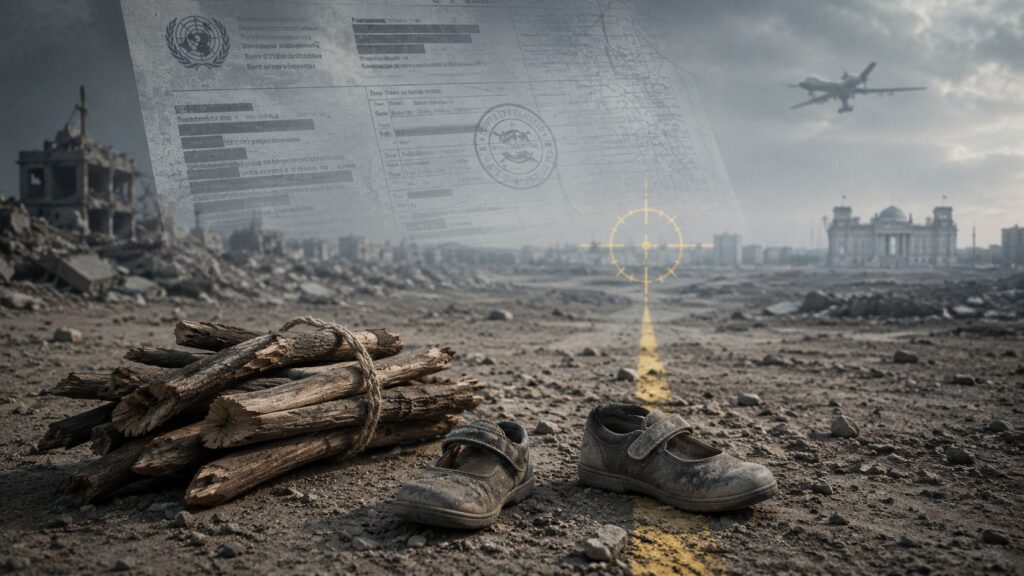
On 29 November 2025, two brothers were gathering firewood in eastern Khan Yunis. The older was ten, the younger nine. They were doing it for their father, who is in a wheelchair and cannot collect the wood himself. Near the town of Bani Suheila, an Israeli drone strike hit them. Both boys died.
The Israeli security forces stated that soldiers had observed two “suspects” crossing the so-called yellow line, behaving suspiciously, and approaching their own forces; a drone had neutralized the immediate threat. The United Nations Commission of Inquiry, which reconstructed the case, reached a different conclusion. According to its findings, the boys were more than 300 meters from the soldiers’ rifles-at that distance, they could not have posed an immediate danger. They were visibly doing nothing other than collecting firewood. The soldiers had failed to adequately assess their age, their intent, and their capacity as a “threat.” The Commission notes that the Kfir Brigade of the Israeli security forces was operating in the area. It is not aware of any investigation into the incident.
The yellow line where the two died is a demarcation line the Israeli military drew inside Gaza after the ceasefire of October 2025. On one side, Israeli forces control the territory; on the other, Hamas. The problem, as a doctor described it to the Commission, is both banal and deadly: the line is not clearly marked, it shifts, and there is nothing-no fence, no sign-by which a person, least of all a child, could tell where it runs. The Israeli security forces did state that concrete blocks had been placed at 200-meter intervals along the line; in some areas, however, the markers lay deep inside Hamas-controlled territory, effectively expanding the exclusion zone. Anyone who crosses it because they want to go home or are looking for wood gets shot.
The decisive circumstance in this case is not its cruelty. It is its date. The two boys died after the guns were supposed to have fallen silent-more than six weeks after the ceasefire took effect. We will return to this date at the end of this analysis, because it coincides with a decision made not in Gaza but in Berlin.
This text is about a report that treats such cases not as individual tragedies but as evidence. And it poses a question different from the usual one. Not: How many children have died? But: What does the deliberate killing of children prove?
What the Report Is-and What It Is Not
The document carries the reference number A/HRC/62/CRP.2 and the title “The essence of childhood has been destroyed.” It is dated 18 June 2026, was publicly presented on 23 June 2026, and runs approximately 94 pages. It was authored by the Independent International Commission of Inquiry on the Occupied Palestinian Territory, including East Jerusalem, and Israel.
The figures cited in the report represent a documented floor, not an upward estimate. Between 07 October 2023 and 07 October 2025, at least 20,179 children were killed and 44,143 injured in the Gaza Strip. Children thus accounted for approximately 30 percent of those killed and 26 percent of those injured. Among the dead were at least 5,031 children under five, of whom 1,029 were under one year old and approximately 420 were newborns. The Commission assumes the actual number is higher because the missing, those buried under rubble, and unregistered dead are only partially accounted for. The figures are based on data from the Health Ministry in Gaza, transmitted through the UN relief agency OCHA, as well as UNICEF and the WHO.
What is noteworthy is the shift in the ratio. In the escalations of 2008/2009 and 2014, children accounted for approximately 24 percent of conflict-related deaths; now it is 30 percent. The children killed correspond to roughly two percent of Gaza’s total child population of approximately 1.2 million. There is also a physiological factor: according to research data, children die from the effects of explosive weapons roughly seven times more frequently than adults. This is not collateral damage within the range of previous wars but an increase the report attributes to the use of wide-area-effect weapons in densely populated territory and an expanded target selection.
Before these numbers are interpreted, one needs to know what kind of document this is-because precision is everything here. The report is not a judgment by an international court. It is a finding by an independent body established by the UN Human Rights Council, and it works with the evidentiary standard of “reasonable grounds to conclude.” This standard falls below what would be required for the criminal conviction of an individual. The report can establish facts and patterns, assess state responsibility, name military units, and legally characterize potential criminal offenses. It cannot convict anyone. The methodology of international criminal law-the separation of the objective act from intent-I have treated in detail in the analysis The Finding: Genocide; here the evidentiary standard suffices as a frame of reference.
A second point matters more for context than it might initially seem, and the opposing side will invoke it, so let us address it preemptively. The genocide finding on which this report builds was issued on 16 September 2025 by a differently constituted commission-under Navi Pillay, together with Miloon Kothari and Chris Sidoti. All three subsequently stepped down. On 27 November 2025, the President of the Human Rights Council, Jürg Lauber, appointed new members: the Indian jurist Srinivasan Muralidhar, former Chief Justice of the Orissa High Court, as chair; the Zambian judge Florence Mumba, who once sat on the Yugoslavia Tribunal; and-reappointed-Chris Sidoti. This children’s report is the first major piece produced by the newly constituted Commission. It reaffirms the genocide finding of its predecessor. Anyone seeking to discredit the finding by pointing to a biased prior panel must explain why new judges with experience at international criminal tribunals arrive at the same conclusion.
The report itself names one limitation, and it is substantial. Israel does not recognize the Commission and did not cooperate with it; 13 requests for information submitted since October 2023 went unanswered. The Commission therefore had no access to internal operational orders, target selection procedures, or military investigation files. It reconstructs intent and responsibility primarily from external circumstances, from recurring patterns, from weapons effects, witness testimony, and public statements. This is a real boundary of the process. As will be shown, it cuts in both directions.
Why the Child
The analytical core of this report lies not in the numbers, crushing as they are. It lies in an argument. The Commission designates the deliberate killing of children as one of the key elements demonstrating the genocidal intent of the Israeli authorities and security forces to destroy the Palestinian group in whole or in part. The reasoning is as simple as it is consequential: children are the biological and social continuation of a population group. Whoever destroys a group’s children destroys its future.
To understand why this sentence amounts to more than a turn of phrase, one needs to know where the real difficulty lies in international criminal law. For a series of war crimes to legally constitute genocide, two elements must be present: the act and the special intent, the dolus specialis. The Commission had already established the acts in September 2025-four of the five categories defined in the 1948 Genocide Convention: the killing of members of the group, the infliction of serious bodily or mental harm, the imposition of destructive conditions of life, and measures to prevent births. The contested part is always intent. It is the hardest element to prove, because it resides in the minds of the actors and rarely appears in a document.
Two clarifications are needed for the argument to hold. The Genocide Convention does not require the intent to eradicate a group completely; it suffices to intend to destroy it in whole or in part. And of the five categories of acts listed in the Convention, the Commission identifies four as fulfilled-the fifth, the forcible transfer of children to another group, expressly not. This is not a minor detail but an indication of the Commission’s methodology: it does not claim more than it believes it can substantiate. Precisely for that reason, it carries significant weight where children appear twice-as killed and as prevented. The report links the category of birth prevention to the collapse of maternal and neonatal care, to the rise in premature births, miscarriages, and infant mortality. The future of the group is not only being shot; it is also no longer being born.
This is exactly where the children’s report begins its work. It argues that intent is nowhere more clearly revealed than in the treatment of children. Not because children are more innocent than adults-that is a moral category, not a legal one. But because the systematic killing of precisely the children of a group, sustained over two years, is difficult to explain other than by the intent to strike the group as such. A single dead child is a tragedy and can be the result of war. Twenty thousand dead children, a specific pattern in their killing, and the explicit rhetoric of officials describing children as enemies-that, in the Commission’s reading, constitutes a bundle of circumstantial evidence pointing toward intent.
With this, the subject of this text is outlined. It is not about yet another report on suffering in Gaza; there are enough of those, and they are being recounted everywhere these days. It is about testing a thesis: Does the material support the claim that the child is the site where intent becomes visible? The following sections lay out the material-both the new evidence in this report and what has been documented over two years. At the end stands the question of what this means for the state that has declared itself the advocate of international law for decades while also being one of the suppliers: Germany.
Finding I: The Deliberate Killing of the Individual
The report supports its sharpest claim-deliberate killing-not on the mass of the dead alone but on a medical pattern. The Commission interviewed 17 medical professionals who served in various hospitals in Gaza between October 2023 and July 2025. They consistently reported children admitted with a single gunshot wound inflicted by snipers or quadcopters. The point is both medical and legal: a child killed by a single, precisely placed shot is not the victim of crossfire or a ricochet. The single hit points to deliberate aiming. Two independent forensic pathologists reviewed CT scans, X-rays, and photographs; the openly available visual and video material was collected according to forensic standards and verified through geolocation, metadata analysis, and cross-referencing with additional sources. Beyond the individually examined cases, the Commission documented 168 additional children with gunshot wounds; at least 88 of them died, at least 73 had been struck in the head, 22 in the chest.
A doctor who had been on a medical mission in Gaza described to the Commission a pattern that goes beyond the single gunshot wound: the frequency of injuries and the body parts hit revealed that soldiers had struck adolescents on different days in different parts of the body-as though hitting different body parts were a form of target practice. An additional pattern emerged after May 2025: medical personnel reported children with gunshot wounds who had been hit on their way to or at the distribution sites of the Gaza Humanitarian Foundation. Israeli soldiers have acknowledged firing on unarmed Palestinians at these sites, including children; Doctors Without Borders and the International Committee of the Red Cross documented such cases. Hunger and the bullet converge here: the child is killed while trying to reach food.
Three cases stand for the pattern. The best known is that of five-and-a-half-year-old Hind Rajab, killed on 29 January 2024 along with six family members and two paramedics in Tal al-Hawa in Gaza City. The Israeli security forces had initially stated that their forces were not in the vicinity of the vehicle. The Commission found this claim to be false based on satellite imagery and attributes the fire to the 401st Brigade under the 162nd Division, which fired on the car from close range despite children being visibly inside and prevented the rescue attempt by firing on the ambulance. A second case: on 24 January 2024, in Khan Yunis, a 15-year-old stepped out of his family’s house carrying a white flag. He was shot in the foot, fell, and as he tried to get up, two more shots followed-in the back and the neck; his 20-year-old brother, who rushed to help, was also shot dead. The Commission attributes the fire to a sniper of the 98th Division, who at roughly 200 meters must have been able to identify the target as a child carrying a white flag. The third case is that of a ten-day-old infant who on 12 April 2024 was shot at by a quadcopter in the Nuseirat camp while being breastfed by his mother in a tent; the child survived with brain injuries.
The report provides unusually precise details about the weapons deployed, and much of it comes from Israeli sources themselves. The quadcopters are operated by a specialized unit of the Israeli security forces, Multidimensional Unit 888, also known as “Refaim” or the Ghost Unit. In a segment on Israeli broadcaster Channel 14 from July 2025, members of the armed forces described these devices as a new generation of lethal weapons and compared operating them to watching a video game. As the primary sniper weapon, the Commission identifies the DAN .338 rifle manufactured by Israeli firm IWI, with a precision range of up to 1,200 meters. The Commission further documents that quadcopters played recorded sounds-crying children, women’s voices, calls for help-to lure people out of their homes and then fire on them. What is remarkable is where the incriminating material comes from: it derives in large part from Israel itself-from statements by Israeli soldiers in the newspaper Haaretz, in the news outlet Siha Mekomit, in the ITVX documentary “Breaking Ranks,” and in the investigations of the organization Breaking the Silence. One soldier described how the first shot goes straight to the head. Another reported, according to Haaretz, that killing had been turned into an internal competition and the victims, including children, were subsequently classified as “terrorists.” Where individual statements are concerned, these are accounts from individual witnesses-and the Commission marks them as such.

Reading the named units together yields a map of responsibility: Kfir Brigade, 401st Brigade and 162nd Division, 98th Division, 99th Division, and in the West Bank the Menashe and Ephraim Brigades. This attribution is the report’s strength and simultaneously the point where intellectual honesty requires drawing a line. That a pattern points to deliberate killing is not the same as proof that every single shot was ordered from above. The Commission derives the deliberate targeting from the individual cases and from the totality of attacks, not from a command document-which, due to the lack of cooperation, it does not possess. It speaks itself of a permissive military culture in which soldiers are encouraged to target children, with or without an explicit order. This distinction-pattern versus individual order-is precisely where the opposing side will push back. It is stated here openly, before anyone presents it as a gap.
Finding II: The Child as Enemy
Alongside the operational findings stands a second trail, and it is child-specific: the explicit rhetoric casting children as enemies. The report documents a series of statements by Israeli officials, with names and dates. Deputy Knesset Speaker Nissim Vaturi declared in January 2025 that in Gaza, every child born is already a terrorist from the moment of its birth. Knesset member Amit Halevi described the approximately 300 babies in the maternity ward of Al-Shifa Hospital in July 2024 as born terrorists. Former Likud lawmaker Moshe Feiglin said in May 2025 that every child in Gaza is the enemy and that not a single one should be left there. A female lawmaker stated in parliament in October 2023 that children in Gaza had brought their fate upon themselves.
Such sentences are not a side note but constitute evidence in international criminal proceedings. The special intent, the dolus specialis, can be inferred from explicit statements by officeholders-this is what the Commission had already done in September 2025 when it named Netanyahu, Herzog, and former Defense Minister Gallant by name. The children’s report adds the child-specific variant: not merely the rhetoric of the enemy in general, but of the child as enemy, of the infant as terrorist.
How deeply this framing intertwines age and gender is illustrated by the West Bank, where no open hostilities are underway. Between October 2023 and October 2025, Israeli security forces killed 213 Palestinian children there according to the data evaluated by the report, including 206 boys. The Commission reads this as a policy that targets boys as “terrorists” or “future terrorists”-the male Palestinian child as threat by virtue of identity. That girls are not safe either is demonstrated by the most recent documented case: on 25 January 2025, south of Jenin, a two-year-old girl was shot in the back of the head while eating dinner with her family and died instantly; the Commission places the Menashe Brigade at the scene. Added to this is violence by Israeli settlers, often under the protection or inaction of the army: the report describes the abduction of two siblings under five who in April 2025 were tied to an olive tree with knives, as well as two 15-year-olds who were kidnapped while herding livestock, beaten, and sexually abused.
Here a circle closes to the operational findings. The same logic that declares the child a terrorist from birth returns on the ground when killed children are retroactively turned into “suspects.” The two brothers at the beginning of this analysis were labeled “suspects” at the yellow line. In the West Bank, the report documents expanded rules of engagement under which merely “handling something on the ground”-bending down, dropping an object-can serve as grounds for lethal fire; a ten-year-old boy was killed this way, and a soldier told the father, according to the Commission’s account, that he had shot his son and the boy would die. How far the retroactive reframing extends is shown by a case on 16 November 2025 in the Al-Faraa camp near Tubas: a 14-year-old boy lay bleeding on the ground for at least 45 minutes after being shot while soldiers stood around him, filmed him, and placed a stone next to him-in order, as the Commission finds, to make the incident appear as a stone-throwing attack; a waiting ambulance was prevented from approaching. The boy died. Rhetoric and trigger follow, as the material suggests, the same line: whoever declares the child an enemy has already justified the shot. This is not a moral objection but an observation about the chain from word to deed.
The Convergence: What We Already Know
Up to this point, the children’s report has been treated on its own terms. Its true weight, however, only emerges when placed alongside what has been documented over two years. Three strands that stood independently in earlier analyses converge in the child.
The first is the machine. Target selection in Gaza no longer arises primarily from individual intelligence work but from software: from systems like Lavender, which scores humans as targets, and “Where’s Daddy?”, which signals the moment a marked man enters his residence-so the bomb falls while the family is gathered. What this does to children is shown by the present report: obliterated households, the statistical signature of entire families-on 23 May 2025 in Khan Yunis, nine out of ten children in one family killed in a single strike, both parents physicians. The attack drones named in the report also carry corporate names-“Birds of Prey” by Elbit, a drone designated “Predator,” a system by the firm Xtend. How the digital architecture becomes a kill chain and why the corporations involved almost never face accountability, I laid out in the analysis Killing as a Product. The clearance rule documented there-under which one to two dozen civilian deaths per marked low-ranking combatant were considered acceptable-explains the statistical signature the children’s report describes: not the isolated error but the system of entire obliterated households. The children’s report delivers what stands at the end of that chain.
The second strand is detention. The report describes how the Israeli security forces, during mass arrests in Gaza, systematically singled out boys from the age of twelve, separated them from their families, and treated them as suspected members of armed groups-like adults, as “terrorists,” despite their recognizable age. It documents minors in administrative detention without charge, sexualized violence, forced undressing, and torture. In doing so, it confirms and extends what the UN Committee Against Torture had established in December 2025 as de facto state policy of torture-explicitly including children-and what had been emerging for years within Israel’s detention architecture of special-status legislation. I laid out both in the analyses The System Behind the Bars and What the UN Committee Against Torture Found. The child in the interrogation room is not a new chapter but the same apparatus, one age bracket younger.
The third strand is living conditions. According to the data evaluated by the report, between October 2023 and September 2025, at least 21,000 children in Gaza were newly disabled; in the first three months of the attacks alone, according to UNICEF, over 1,000 children lost one or more limbs. The UN Secretary-General called the Strip the place with the world’s highest per capita number of child amputees, many operated on without anesthesia. A child who loses a limb needs an average of eight to twelve surgeries by adulthood for the prosthetic to keep pace with growth-care that does not exist in Gaza after the destruction of the healthcare system, along with the absence of prosthetics and rehabilitation. Over 97 percent of school buildings are damaged or destroyed, more than 668,000 school-age children were without education for extended periods, and nearly all children require psychosocial support. The deliberate deprivation of food, water, medicine, and fuel constitutes, the Commission reiterates, the crime of starvation as a method of warfare. For children, this deprivation is especially lethal: infants and toddlers die first, and the survivors carry the consequences-stunted growth, weakened immune systems, developmental disorders-for life. How systematically the destruction of the foundations of life has been pursued-including the destruction of agriculture with herbicides-was already the subject of the analyses The Finding: Genocide and Agronomic Warfare.
That is the meaning of the keystone. The child is not one chapter among many. It is the point where the machine, the detention system, and the destruction of the foundations of life converge-and where, in the Commission’s reading, the intent behind the sum becomes visible.
The Opposing Side
Honest reporting demands that the Israeli position be presented in full. Israel has rejected the report in the strongest terms. The Israeli mission in Geneva called it a libelous sham and the product of a fundamentally biased mechanism. The government states that it does not intentionally target children and strives to minimize civilian harm even under wartime conditions. It accuses Hamas of embedding military infrastructure in civilian areas, using schools and hospitals, diverting aid supplies, and deploying children as fighters and human shields. It points to evacuation warnings, vaccination programs, and field hospitals. To this is added the fundamental critique of the mandate, advanced notably by UN Watch: that the Commission was founded in bias and directed solely against Israel.

At its core lies a real dispute. Israel argues that the high number of children killed is the consequence of Hamas deliberately operating within a dense civilian population-in schools, hospitals, and residential neighborhoods-thereby making it impossible to distinguish between combatants and civilians. Where the military hits children, it happens not by design but as the consequence of an adversary that entrenches itself behind them. This objection cannot be swept aside; it identifies a real feature of asymmetric warfare in densely populated territory, and the Commission itself has established that Hamas uses civilian structures.
What the Commission’s argument counters with is not a denial of this circumstance but a case-by-case examination. In the cases examined in detail-the car with Hind Rajab, the boy with the white flag, the nursing infant in the tent, the firewood collectors at the yellow line-there was, according to the Commission’s reconstruction, no military target nearby, no firefight underway, and no discernible threat. The embedding by Hamas explains a portion of the civilian losses; it does not explain the single shot from short range at a target recognizably identifiable as a child. Precisely where the human-shield argument should apply, it does not hold up on the record.
These objections do not automatically refute the findings, but they belong in an honest assessment-and at one point the report itself provides the counterweight. The same Commission has found that Hamas and other armed Palestinian groups committed war crimes and crimes against humanity on 07 October 2023, including against Israeli children: 40 children killed, hundreds injured, abductions, the filming of children for propaganda purposes. This is in the same report. The accusation that the Commission ignores Hamas’s crimes does not match the record.
The strongest objection remains, and it is methodological: without Israel’s internal operational data, some individual cases may lie differently from how the Commission reconstructs them. This is correct. But it is Israel itself that withholds this data-13 requests for information went unanswered. The boundary of the process is simultaneously a decision by the government that invokes it. Whoever refuses to provide clarity cannot derive an acquittal from the resulting lack of clarity.
One final caveat must in fairness be stated, and it concerns not the Commission but the status of its finding. The establishment of genocide by an investigative body is not a legally binding judicial ruling. The genocide question in the legal sense is being adjudicated by the International Court of Justice in the case brought by South Africa against Israel; a judgment is pending and may take years. Anyone citing the report should say as much: it finds, with substantial grounds, but it does not convict. This does not diminish its weight as documentation-the facts, the units, and the dates stand-but it defines its reach.
The Indispensable Third Party
This brings us to the question that makes this finding uncomfortable for a German audience. The German government has so far rejected the genocide accusation-less on the basis of facts than by invoking German Staatsräson and a special responsibility toward Israel. On this report, as of the date of publication, it has not commented on the substance; the well-rehearsed pattern is to reference ongoing international proceedings and the formula that it is up to the Israeli government to address the allegations.
The German role becomes concrete when it comes to weapons, and here a close look at the timing is worthwhile. After 07 October 2023, the Scholz government initially increased arms exports to Israel; before leaving office in May 2025, it approved exports worth nearly half a billion euros. For the first half of 2025, the German government reported approvals with Israel as end destination totaling approximately 86.8 million euros, nearly 60 percent of which were for armored vehicles and tank components. Berlin had barely approved any pure weapons of war since late 2023; before the International Court of Justice, Germany stated in 2024 that since the start of the war it had issued only four licenses for weapons of war, with the vast majority of exports covering other equipment such as helmets and protective clothing. Under Chancellor Merz, Berlin made a correction in the summer of 2025: on 08 August 2025, Merz ordered a temporary halt to the approval of any defense goods that could be used in Gaza. In the first five weeks thereafter, not a single export was approved. This decision merits an observation that cuts against the government, even though it appears to cut in its favor: whoever suspends deliveries because they might contribute to violations of international law thereby acknowledges that a risk exists which can prohibit approval. It was precisely the rigor of this review process-Germany’s arms export control framework with its protective provisions-that Germany had cited before the International Court of Justice in 2024, which rejected Nicaragua’s request for provisional measures by 15 votes to 1, relying in significant part on this very control framework. The Federal Constitutional Court dismissed on 03 February 2026 the constitutional complaint of a man from Gaza against the approval of tank gearbox components-essentially on procedural grounds, because German law does not grant third parties standing to challenge arms export approvals. Those affected by the consequences thus have virtually no legal recourse; the European Center for Constitutional and Human Rights spoke of the denial of effective legal protection. Lawsuits by Palestinians against the deliveries were also dismissed as inadmissible by the Berlin Administrative Court.
On 24 November 2025, the German government lifted the partial suspension. The government spokesperson’s justification: the ceasefire in effect since 10 October 2025 had stabilized in recent weeks, along with efforts toward a lasting peace and enhanced humanitarian aid. Germany was returning to case-by-case review. Barely two weeks later, on 06 December 2025, Merz traveled to Israel and met Netanyahu-the first European head of government to do so in over a year.
And here the circle closes to the two brothers with the firewood. The premise on which Berlin lifted its restraint-a stabilized ceasefire, an improving situation-is precisely what this report disproves. Its most recent material documents the continued killing of children after the ceasefire: along the yellow line, while collecting wood, on the way home. According to the report, at least 265 children have been killed since the ceasefire took effect; Amnesty International counted at least 136 children killed in October and November 2025 alone. The two brothers died on 29 November 2025-five days after Berlin had lifted its arms restrictions citing the stable situation. Germany lifted its restraint into the exact window that a UN body documents as ongoing child killing.
The same pattern is visible beyond weapons. Within the European Union, Germany blocks the suspension of the association agreement with Israel. And the German contribution to Israel’s armament is no marginal item: Germany is the second-largest arms supplier to Israel after the United States; approximately 30 percent of Israel’s arms imports come from the Federal Republic. And in the proceedings in which Nicaragua accuses Germany of complicity in genocide, Berlin answers the charge not on the merits but with jurisdictional objections and the argument that Germany’s responsibility cannot be judged without first judging Israel-the indispensable third party. How this procedural evasion works and why it reveals more politically than it resolves legally, I have laid out separately in the analysis The Indispensable Third Party.
What remains is to draw the whole picture soberly together. A UN body, newly constituted and staffed with judges of international criminal jurisdiction, reaffirms the finding of genocide and identifies the child as the point where intent becomes visible-with the names of the units, the types of the weapons, the dates of the cases. The body identifies the child not out of pathos but for evidentiary reasons: it is the site where intent is least amenable to being explained away as a mere consequence of war. In the same sequence of weeks, the German government withdraws its arms restraint, on the grounds that the situation has calmed, while that same situation has children shot at an unmarked line. The question is no longer whether Berlin could not have known. The question is what it says about a state that has made international law its brand when it resumes deliveries at precisely the moment a UN report tallies twenty thousand dead children-and the ceasefire it invokes is one in which children continue to die.

If you regularly read my updates and analyses, I would be grateful for your ongoing support.

About the Author
Michael Hollister
is a geopolitical analyst and investigative journalist. He served six years in the German military, including peacekeeping deployments in the Balkans (SFOR, KFOR), followed by 14 years in IT security management. His analysis draws on primary sources to examine European militarization, Western intervention policy, and shifting power dynamics across Asia. A particular focus of his work lies in Southeast Asia, where he investigates strategic dependencies, spheres of influence, and security architectures. Hollister combines operational insider perspective with uncompromising systemic critique – beyond opinion journalism. His work appears on his bilingual website (German/English) www.michael-hollister.com and in investigative outlets across the German-speaking world and the Anglosphere.
Did this analysis help you make sense of what’s happening? Hollister’s Geopolitics delivers deep dives like this every week – primary-source-based, without partisanship.
Subscribe free of charge.
Sources
- UN Commission of Inquiry (OHCHR), 18 June 2026 – “The essence of childhood has been destroyed”: Israel’s deliberate targeting of Palestinian children in the OPT since 7 October 2023, A/HRC/62/CRP.2: https://www.ohchr.org/sites/default/files/documents/hrbodies/hrcouncil/sessions-regular/session62/a-hrc-62-crp-2.pdf
- UN News, 23 June 2026 – Israel continues to commit genocide… by deliberately targeting Palestinian children: https://news.un.org/en/story/2026/06/1167790
- OHCHR, 27 November 2025 – Press release on the appointment of new Commission members (Lauber appoints Muralidhar, Mumba, Sidoti): https://www.ohchr.org/en/press-releases/2025/11/human-rights-council-president-appoints-members-commission-inquiry-occupied
- OHCHR – Commission of Inquiry overview page (mandate, reports, September 2025 genocide finding): https://www.ohchr.org/en/hr-bodies/hrc/co-israel/index
- t-online, 16 September 2025 – Four of five elements fulfilled: UN Commission accuses Israel of genocide: https://www.t-online.de/nachrichten/ausland/krisen/id_100916050/gaza-krieg-un-menschenrechtsrat-wirft-israel-genozid-vor.html
- Jüdische Allgemeine, 16 September 2025 – UN Commission accuses Israel of genocide (also Pillay resignation): https://www.juedische-allgemeine.de/israel/un-kommission-wirft-israel-genozid-vor/
- UN Watch, June 2026 – Legal Rebuttal: Disproving the Pillay Commission’s Charge…: https://unwatch.org/un-watch-legal-rebuttal-disproving-the-pillay-commissions-charge-that-israel-deliberately-targets-palestinian-children/
- IBTimes UK – UN report… Israel targeting Palestinian children (Israel’s rejection as “libelous sham,” vaccinations/field hospitals, 13 requests for information): https://www.ibtimes.co.uk/un-report-israel-targeting-palestinian-children-gaza-1804781
- Islamische Zeitung – Deliberate killing of children in the Gaza Strip (Israel: “deeply flawed and one-sided”; Foreign Ministry on Hamas/child soldiers): https://islamische-zeitung.de/un-gezielte-toetung-von-kindern-in-gaza/
- ZDFheute – Israel: German government lifts arms export restrictions (08 August 2025 halt; 24 November lifting): https://www.zdfheute.de/politik/ausland/ruestungsgueter-exporte-deutschland-israel-nahost-100.html
- Legal Tribune Online – Arms for Israel: German government lifts approval halt (Kornelius justification; Berlin Administrative Court): https://www.lto.de/recht/nachrichten/n/waffenlieferungen-waffenexporte-israel-gaza-waffenruhe-bundesregierung
- Jüdische Allgemeine – German government lifts halt on arms exports to Israel: https://www.juedische-allgemeine.de/israel/bundesregierung-hebt-stopp-der-ruestungsexporte-nach-israel-wieder-auf/
- Federal Constitutional Court, Decision of 03 February 2026, 2 BvR 1626/25 (H1-2025: €86,809,879; 59.9% armored vehicles; ICJ reference; procedural dismissal): https://www.bundesverfassungsgericht.de/SharedDocs/Entscheidungen/DE/2026/02/rk20260203_2bvr162625.html
- ECCHR – No German weapons to Israel (constitutional complaint, Berlin Administrative Court Nov 2025, Federal Constitutional Court Feb 2026, “denial of effective legal protection”): https://www.ecchr.eu/fall/keine-deutschen-waffen-nach-israel/
- Legal Tribune Online, 09 April 2024 – Germany defends itself against Nicaragua (four weapons of war licenses; 98% other defense goods): https://www.lto.de/recht/hintergruende/h/igh-nicaragua-deutschland-israel-gaza-waffen-export-lieferung
- Qantara – Interview with L. Löwenbrück (ECCHR), “Approvals very likely unlawful” (98%; Germany ~30% of Israeli arms imports): https://qantara.de/artikel/waffenexporte-nach-israel-%E2%80%9Egenehmigungen-sehr-wahrscheinlich-rechtswidrig%E2%80%9C
- amerika21 – ICJ continues Nicaragua’s case against German military aid for Israel (emergency application rejected 15:1): https://amerika21.de/2024/07/269379/nicaragua-eilantrag-waffenexporte
- Wikipedia (orientation) – ICJ Case No. 193 Nicaragua v. Germany (objections 21 October 2025, suspension of main proceedings): https://de.wikipedia.org/wiki/IGH-Gerichtsverfahren_Nr._193_Nicaragua_gegen_Deutschland
- Amnesty International (Germany), 18 December 2025 – Amnesty criticizes Merz trip to Israel and end of arms export restrictions (136 children killed since ceasefire; Merz visit): https://www.amnesty.de/pressemitteilung/deutschland-israel-reise-merz-waffenexporte-embargo
- Amnesty International (Austria) – Israel’s deadly blockade continues (327 dead / 136 children since ceasefire; GHF): https://www.amnesty.at/presse/amnesty-schlaegt-mit-neuem-gaza-bericht-alarm-israels-toedliche-blockade-geht-weiter/
© Michael Hollister – All rights reserved. Redistribution, publication or reuse of this text requires express written permission from the author. For licensing inquiries, please contact the author via www.michael-hollister.com.
Newsletter
🇩🇪 Deutsch: Verstehen Sie geopolitische Zusammenhänge durch Primärquellen, historische Parallelen und dokumentierte Machtstrukturen. Monatlich, zweisprachig (DE/EN).
🇬🇧 English: Understand geopolitical contexts through primary sources, historical patterns, and documented power structures. Monthly, bilingual (DE/EN).