
Situation Report, June 26, 2026 – Building on Update of June 19,2026
by Michael Hollister
Exclusive published at Michael Hollister on June 26, 2026
3.008 words * 16 minutes readingtime


TICKER
CRIMEA BUCKLES – THE OCCUPATION ADMINISTRATION ADMITS THE CONSEQUENCES ITSELF
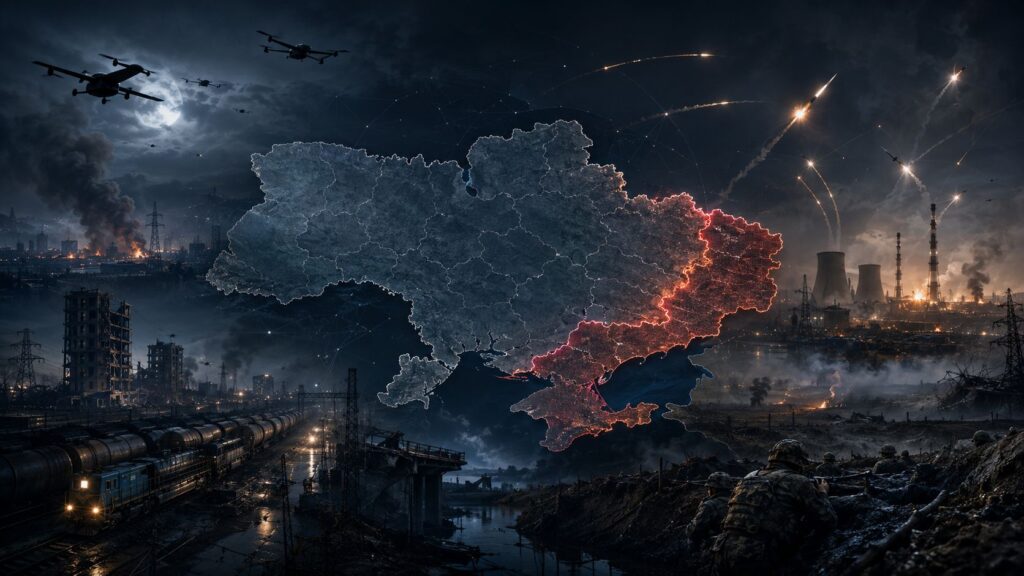
The strategic core of this week is not a claim from Kyiv but an admission from Moscow’s own appointees. Sergei Aksyonov, Russia’s installed head of Crimea, halted all civilian fuel sales at 9:00 a.m. on June 21 – gasoline and diesel now flow only to state entities maintaining administration and security. In Sevastopol, Governor Mikhail Razvozhaev simultaneously imposed power restrictions, switched off street lighting, and reduced public transit. Children’s summer camps were suspended until September 01, rail connections to the peninsula were cut, and ferry service across the Kerch Strait was halted. The trigger is Ukraine’s sustained campaign against fuel logistics and energy infrastructure; Aksyonov also reported four dead and 28 wounded from strikes near Kerch.
RUSSIA CONTINUES AIR WAR AGAINST UKRAINE UNABATED
While Ukraine’s long-range strikes dominated the headlines, Russia’s air campaign continued at undiminished intensity. Zelensky reported more than 200 drones deployed in a single day on June 20, with hits including in Zaporizhzhia, where local authorities reported five dead and ten wounded. On June 22, three members of a family were killed in Sumy, including a 13-year-old boy, according to Ukrainian authorities; on June 23, authorities in Kryvyi Rih reported four dead and 30 wounded following a ballistic strike. On June 24, a Russian Iskander-M reportedly struck a Norwegian People’s Aid demining team in the Kherson region – two Ukrainian staff members were killed. The UN Human Rights Mission had classified May as the deadliest month for Ukrainian civilians since April 2022, with at least 274 killed.
LUKOIL KSTOWO OFFLINE – FIFTH REFINERY SHUT DOWN IN JUNE
Ukraine’s deep-strike campaign reached another central node with the NORSI refinery. The Lukoil-Nizhegorodnefteorgsintez facility near Kstovo in Nizhny Novgorod Oblast – Russia’s fourth-largest refinery by processing capacity and second-largest gasoline producer – halted operations on June 24 following a drone strike; according to Reuters industrial sources, a primary unit accounting for roughly a quarter of capacity was damaged. It is the fifth Russian refinery shut down in June. Russian gasoline production fell by approximately 25 percent compared to the previous year according to Reuters estimates; Moscow is planning seaborne fuel imports for the first time in years. The Moscow refinery is not expected to resume operations until 2027. Governor Gleb Nikitin reported two deaths from falling debris.
VORONEZH – SEMICONDUCTOR PLANT SUPPLYING ISKANDER AND KH-101 STRUCK
The strike against Russian defense manufacturing this week hit a components producer. The Ukrainian General Staff reported an attack on June 22 with air-launched cruise missiles on the VZPP-S semiconductor plant in Voronezh, which produces electronics for Iskander and Kh-101 missiles as well as the Pantsir-S1 air defense system. Regional Governor Alexander Gusev confirmed a severe strike on a production facility with five dead and dozens wounded; a video reviewed by Reuters showed heavy smoke columns over the site. The strike is thus confirmed by both sides. The precise role of the plant in missile production and the extent of permanent output losses remain disputed.
FINANCIAL TIMES – US INTELLIGENCE SUPPORTED THE MOSCOW STRIKES
Direct American involvement in strike planning moved into concrete focus for the first time. The Financial Times reported on June 23 that the strikes on the Moscow refinery on June 16 and 18 were supported by US intelligence data; the coordination has been running since summer 2025 and was never publicly acknowledged by Washington. According to one US official, Kyiv selects the targets while Washington provides data on their vulnerabilities – flight routes, altitude, timing to evade air defenses; other sources told the FT that US intelligence also assists in identifying high-value targets. Foreign Minister Sergei Lavrov accused the United States on June 24 of having abandoned the role of objective mediator.
TRUMP “IMPRESSED” – PATRIOT LICENSE PRODUCTION IN EUROPE AND UKRAINE UNDER DISCUSSION
A possible shift in the American line emerged from the G7 summit. According to the Financial Times, Trump told Zelensky at the meeting in Évian that he was “hugely impressed” by Ukraine’s deep strikes and agreed to tougher sanctions against the Russian energy sector. Zelensky stated that Trump and Secretary of State Rubio had for the first time responded positively to the question of licenses for domestic production of Patriot interceptor missiles. Licensed production in Europe and Ukraine is under discussion; the details are to be negotiated between National Security and Defense Council Secretary Rustem Umerov and US counterparts. Ukrainian officials remain skeptical and point to earlier unfulfilled commitments.
ZELENSKY APPROVES 40-DAY PRESSURE CAMPAIGN BY THE SBU
Ukraine’s long-range strikes are now officially part of a named, time-limited strategy. Zelensky stated on June 25, following a report by acting SBU chief Yevheniy Chmara, that he had approved a 40-day “influence operation” against Russia. He described it as an operation “to force the aggressor state to end the war.” The campaign is embedded in what Kyiv calls “long-range” and “medium-range sanctions.” A complete target list, the precise significance of the 40-day deadline, and measurable success criteria were not disclosed.
EU DISBURSES 3.2 BILLION EUROS AND EXTENDS SANCTIONS UNTIL 2027
The financial and sanctions flank was locked in this week. Commission President Ursula von der Leyen announced in Gdansk on June 25 at the Ukraine Recovery Conference the disbursement of the first tranche of 3.2 billion euros from the 90-billion-euro Ukraine Support Loan; a first tranche of a 6-billion-euro drone package is to follow in the days ahead. The EU Council on the evening of June 25 extended sectoral economic sanctions for twelve months rather than the usual six, through July 31, 2027. A 21st sanctions package – following 20 already adopted – is in preparation.
ZELENSKY’S BELARUS ULTIMATUM – FACILITIES REPORTEDLY OFFLINE SINCE JUNE 22
Belarus moved back to the center of the conflict for the first time in a long while. Zelensky demanded on June 19 that Minsk dismantle relay stations on border towers in the Gomel and Brest regions within a week – stations that, in Ukraine’s account, guide Russian drone attacks – or Ukraine would act itself. On June 24 he stated that the facilities had been offline since June 22 according to Commander-in-Chief Syrskyi; whether they had been dismantled remained open. The Kremlin called the ultimatum an “aggressive” interference in Belarus’s sovereignty. President Lukashenko ruled out entering the war; RT quotes him as referencing “a very serious target” with precise coordinates not far from Belarus. Putin and Lukashenko announced an imminent meeting.
CHERNIHIV – MANDATORY EVACUATION OF TWELVE BORDER VILLAGES
The Defense Council of Chernihiv Oblast ordered a measure along the northern border. According to Governor Vyacheslav Chaus on June 24, twelve border villages will be subject to mandatory evacuation from July 01 onward, at the request of the military. The measure was extended for seven localities already ordered to evacuate in winter. According to local administration estimates, approximately 1,000 people still live in the 19 affected settlements, including around 120 children. Temporary accommodation is to be provided; the evacuation is planned for a duration of two months.
UN SECURITY COUNCIL – “OUR PATIENCE IS NOT ENDLESS”
The Security Council addressed the war again on June 22. Ukrainian UN Ambassador Andriy Melnyk stated that Kyiv remains ready for direct negotiations on the basis of the UN Charter but warned that Ukraine may reconsider its offer of a ceasefire along the existing front line should the Council remain passive. Lavrov declared on June 23 that Russia is prepared to resume talks where they last ended – linked to the unchanged demand for Ukrainian cession of additional parts of the Donbas, which Kyiv rejects. The fundamental deadlock thus remained exactly where it has been for months.
FRONT KOSTIANTYNIVKA – PINCER MOVEMENT, BUT NO BREAKTHROUGH
The ground situation shifted locally without strategic rupture. The focus was Kostiantynivka in Donetsk Oblast: Putin declared on June 23 that his forces were on the verge of taking it; the Russian Defense Ministry reported advances in the southwest of the city on June 24. The Ukrainian OSINT group DeepState acknowledged “successes by the Muscovites” on June 22; its map of June 24 showed a pincer movement from the south and northeast. No operational breakthrough, encirclement, or fall of the city is documented. Monthly tallies diverge: for the four weeks ending June 23, DeepState records a Russian net gain of twelve square miles; ISW records a Russian net loss of twenty square miles.
STRIKE RHYTHM UNBROKEN – CRIMEAN AIRFIELDS AND MOSCOW AGAIN
The mutual long-range strike war continued through the editorial deadline. The Ukrainian Security Service SBU reported strikes on June 24 against the military airfields at Saky and Hvardiyske as well as components of one S-400 and two Pantsir-S1 systems near Kerch, calling Crimea a “zone of constant losses.” In the early hours of June 26, Moscow Mayor Sergei Sobyanin again reported a drone attack on the capital with at least 39 intercepted drones from approximately 2:30 a.m. onward. Simultaneously, a Russian ballistic strike hit Kyiv, where Mayor Klitschko reported two wounded; explosions were also reported in Kremenchuk.

ANALYSIS
The Energy Front Becomes the Main Front
No week of this war has made the shift in emphasis from territory to depth of effect as plain as this one. The decisive finding does not lie at the ground front but in an admission: with Aksyonov and Razvozhaev, Moscow’s own appointees in Crimea are confirming the consequences of Ukrainian strikes – fuel halt, power restrictions, suspended summer camps, reduced rail service. This is not a Ukrainian claim; it is a self-disclosure by the occupation administration, and as such the most reliable statement of the week. In parallel, the NORSI refinery became the fifth Russian facility to go offline in June, gasoline production fell by roughly a quarter according to Reuters estimates, and Moscow is planning seaborne imports for the first time in years.
But discipline is required precisely here. What is confirmed are the admitted supply consequences and the number of shuttered refineries. The permanent extent of the production losses is not: whether NORSI quickly resumes operations through other units, whether the Moscow refinery truly stays offline until 2027, cannot be conclusively verified from the available industry data. Russia’s macroeconomic facade holds – the substance is eroding at specific chokepoints. The fact that Moscow is openly ordering fuel rationing in the south is the independent proof that this calculation is working at specific points. Precisely this gap between headline and depth of effect must be named without overstating it.
Washington Returns – and Crosses a Threshold
The most remarkable thread of the week is the American movement. According to the Financial Times, the Moscow strikes of June 16 and 18 were supported by US intelligence, the coordination has been running since summer 2025, and Trump described himself at the G7 summit as “hugely impressed” by Ukraine’s deep strikes. Add to this the prospect of licensed Patriot interceptor missile production in Europe and Ukraine. The American role is thus shifting from that of a hesitant mediator toward that of an active supporter of Ukrainian strike capability – a finding that points beyond the individual report.
Cui bono? Whoever wants to negotiate from a position of strength shortly before possible talks demonstrates that strength. Two established facts mark the threshold at which this week is decided: Washington has never publicly acknowledged the coordination, and Lavrov accused the United States on June 24 of having abandoned the role of objective mediator. Whether providing intelligence on vulnerabilities, flight routes, and high-value targets constitutes participation in the war is a judgment the reader may form from these facts. What remains to be noted is the sober point: the operational threshold between support and involvement has moved lower this week – and both parties to the conflict know it.
From Operation to Doctrine
Ukraine’s long-range strikes have changed their status this week. What until now appeared as the product of individual operations has, with Zelensky’s approval of the SBU’s 40-day “influence operation” on June 25, become officially a named, time-limited strategy. The term “long-range sanctions” shifts the logic: strikes against refineries, semiconductor plants, and logistics are now framed not only militarily but as an economic pressure instrument intended to force Russia to the negotiating table. The disbursement of the first 3.2 billion euros of the EU loan and the extension of sanctions through 2027 provide the financial and political backbone.
The finding is therefore not “peace window” but institutionalization of pressure. Both sides are consolidating their means rather than moving their demands: Russia maintains its air war at undiminished intensity – documented by lethal strikes in Sumy, Kryvyi Rih, and Zaporizhzhia – while Ukraine is casting its deep-strike campaign into a 40-day program. A notable gap remains: neither the target list nor measurable success criteria for this campaign are public. A strategy whose termination conditions are unknown is difficult to limit politically – that is the real unknown behind the announcement.
The Margins: Belarus and Frozen Diplomacy
While the energy front is in motion, the diplomatic core is hardening. At the Security Council, Melnyk warned on June 22 that Ukrainian patience is not endless; Lavrov offered the next day to resume talks “where they ended” – attached to the unchanged Donbas demand. The fundamental deadlock thus stands exactly where it has stood for months: Kyiv demands a ceasefire and security guarantees first; Moscow demands territorial concessions first. The G7 commitments of the previous week and the meeting Zelensky offered and Moscow rejected have changed nothing.
At the same time, the war is expanding at its margins. Zelensky’s Belarus ultimatum of June 19 and his statement that the relevant relay facilities have been offline since June 22 mark a new front of threat; the Kremlin called it aggressive interference, Lukashenko ruled out entering the war. In parallel, the Ukrainian Defense Council ordered the mandatory evacuation of twelve border villages in Chernihiv. For the assessment of this week, the structural point counts: as long as capitals, energy nodes, and alliance and state borders remain within range and within the rhetoric of both sides, this war is losing calculability at its margins – regardless of what either party offers at the negotiating table.
STRATEGIC ASSESSMENT
On war day 1,584, this is a conflict whose center of gravity has definitively shifted from territory to depth of effect. The most reliable statement of the week comes not from Kyiv but from the admitted supply consequences on Russian-controlled Crimea and the fifth refinery shut down in June – for the first time an adversarially confirmed effect of Ukraine’s deep-strike campaign. At the same time, Washington is moving closer to Ukrainian strike capability through intelligence support and the prospect of Patriot licenses, while Kyiv casts its strikes into a 40-day program and the EU disburses 3.2 billion euros. The diplomatic core remained unmoved in the same week: commitments without breakthrough, a rejected meeting, new instruments rather than a ceasefire. The front shifted slightly in favor of Russia near Kostiantynivka without breakthrough – and with every energy node, every border region, and every ultimatum directed at Belarus, the question grows more urgent: whether this war remains manageable at its margins.

Michael Hollister
is a geopolitical analyst and investigative journalist. He served six years in the German military, including peacekeeping deployments in the Balkans (SFOR, KFOR), followed by 14 years in IT security management. His analysis draws on primary sources to examine European militarization, Western intervention policy, and shifting power dynamics across Asia. A particular focus of his work lies in Southeast Asia, where he investigates strategic dependencies, spheres of influence, and security architectures. Hollister combines operational insider perspective with uncompromising systemic critique – beyond opinion journalism. His work appears on his bilingual website (German/English) www.michael-hollister.com and in investigative outlets across the German-speaking world and the Anglosphere.
If you regularly read my updates and analyses, I would be grateful for your ongoing support.

Sources
- Meduza – Crimea halts all public gasoline sales, restricts fuel to government agencies: https://meduza.io/en/news/2026/06/21/crimea-halts-all-public-gasoline-sales-restricts-fuel-to-government-agencies
- CNN – Power outages, fuel bans and no summer camps: Ukraine steps up pressure on Russia by targeting Crimea: https://www.cnn.com/2026/06/26/europe/ukraine-crimea-pressure-russia-intl-cmd
- New Voice of Ukraine – Occupied Sevastopol bans fuel sales and tightens restrictions: https://english.nv.ua/nation/occupied-sevastopol-bans-fuel-sales-and-tightens-restrictions-50618177.html
- RFE/RL – Russian Authorities Halt Fuel Sales In Occupied Crimea: https://www.rferl.org/a/russia-ukraine-war-crimea-fuel-shortage-drone-strikes/33785662.html
- AP/Union-Bulletin – A Russian drone strike in Ukraine kills 3 from one family; Ukrainian strike kills five: https://www.union-bulletin.com/news/world/a-russian-drone-strike-in-ukraine-kills-3-from-one-family-including-a-13-year/article_349fecef-5d61-5516-a53f-34c47fce04d3.html
- Liveuamap – Defense Council of Chernihiv Oblast announces mandatory evacuation; Norwegian People’s Aid demining team struck: https://liveuamap.com/en/2026/24-june-15-the-defense-council-of-chernihiv-oblast-announces
- Kyiv Independent – Russia’s 4th-largest oil refinery shuts down after Ukrainian drone strike: https://kyivindependent.com/russias-4th-largest-oil-refinery-shuts-down-after-ukrainian-drone-strike-reuters-reports/
- LIGA.net – Reuters: Lukoil’s Largest Refinery Shut Down Following a Drone Attack: https://biz.liga.net/en/energy/news/reuters-lukoils-largest-refinery-shut-down-following-a-drone-attack
- The Moscow Times – Ukraine Strikes Electronics Plant in Voronezh, Killing At Least 5: https://www.themoscowtimes.com/2026/06/22/ukraine-strikes-electronics-plant-in-voronezh-a93069
- SOFX – Ukraine Hits Critical Russian Semiconductor Plant Supplying Missile Production Lines: https://www.sofx.com/ukraine-hits-critical-russian-semiconductor-plant-supplying-missile-production-lines/
- Euromaidan Press – Trump told Zelenskyy he was impressed by Ukraine’s battlefield results, FT reports: https://euromaidanpress.com/2026/06/24/trump-told-zelenskyy-he-was-impressed-by-ukraines-battlefield-results-ft-reports/
- The Moscow Times – U.S. Intelligence Helps Ukraine Strike Russian Energy Infrastructure: https://www.themoscowtimes.com/2025/10/12/us-intelligence-helps-ukraine-strike-russian-energy-infrastructure-ft-a90789
- United24 Media – Trump Reportedly Backs Tougher Russia Energy Sanctions After Ukraine’s Deep Strikes: https://united24media.com/world/trump-reportedly-backs-tougher-russia-energy-sanctions-after-ukraines-deep-strikes-20106
- Kyiv Independent – Ukraine’s SBU to wage 40-day pressure campaign against Russia: https://kyivindependent.com/ukraines-sbu-to-wage-40-day-pressure-campaign-against-russia-zelensky-says/
- Bloomberg – Zelenskyy Orders 40-Day Campaign to Influence Russia to End War: https://www.bloomberg.com/news/articles/2026-06-26/zelenskyy-orders-40-day-campaign-to-influence-russia-to-end-war
- European Commission – First €3.2 billion instalment disbursed under the €90 billion Ukraine Support Loan: https://enlargement.ec.europa.eu/news/commission-disburses-first-eur32-billion-instalment-ukraine-under-eur90-billion-ukraine-support-loan-2026-06-25_en
- Euronews – Ukraine gets €3.2 billion from EU support loan: https://www.euronews.com/my-europe/2026/06/25/von-der-leyen-announces-first-payment-to-ukraine-under-90-billion-loan
- Kyiv Independent – Zelensky issues ultimatum to Lukashenko over drone-guidance equipment: https://kyivindependent.com/a-week-will-be-enough-zelensky-issues-ultimatum-to-lukashenko-over-drone-guidance-equipment/
- Kyiv Independent – Belarus halts equipment used to guide Russian strikes, Zelensky says: https://kyivindependent.com/belarus-halts-equipment-used-to-guide-russian-strikes-zelensky-says-after-ukraines-ultimatum/
- RT – Zelensky doubles down on ultimatum to Russian ally: https://www.rt.com/news/641947-zelensky-belarus-lukashenko-ultimatum/
- Berliner Zeitung – Selenskyj droht Belarus: Russland schlägt Alarm und stellt sich hinter Lukaschenko: https://www.berliner-zeitung.de/article/selenskyj-belarus-ultimatum-drohnen-putin-lukaschenko-10123492
- New Voice of Ukraine – Chernihiv Oblast border villages ordered to evacuate: https://english.nv.ua/nation/chernihiv-oblast-border-villages-ordered-to-evacuate-50619035.html
- Ukrainska Pravda – Ukraine signals possible shift in approach at UN Security Council: https://www.pravda.com.ua/eng/news/2026/06/23/8040643/
- Russia Matters – The Russia-Ukraine War Report Card, June 24, 2026: https://www.russiamatters.org/news/russia-ukraine-war-report-card/russia-ukraine-war-report-card-june-24-2026
- ISW/Critical Threats – Russian Offensive Campaign Assessment, June 21, 2026: https://www.criticalthreats.org/analysis/russian-offensive-campaign-assessment-june-21-2026
- Kyiv Independent – Ukraine reportedly launches dozens of drones towards Moscow (June 26): https://kyivindependent.com/moscow-june-26/
- Kyiv Independent – Crimea now ‘zone of constant losses,’ SBU says: https://kyivindependent.com/crimea-power-plant-reportedly-struck-by-ukrainian-drones-as-peninsula-faces-outages/
© Michael Hollister – All rights reserved. Redistribution, publication or reuse of this text requires express written permission from the author. For licensing inquiries, please contact the author via www.michael-hollister.com.
Newsletter
🇩🇪 Deutsch: Verstehen Sie geopolitische Zusammenhänge durch Primärquellen, historische Parallelen und dokumentierte Machtstrukturen. Monatlich, zweisprachig (DE/EN).
🇬🇧 English: Understand geopolitical contexts through primary sources, historical patterns, and documented power structures. Monthly, bilingual (DE/EN).