
UPDATE Report – Updated: June 24, 2026 – Building on my update from June 21, 2026
by Michael Hollister
Exclusive published at Michael Hollister on June 24, 2026
3.339 words * 18 minutes readingtime

TICKER
BÜRGENSTOCK TALKS BEGIN – IRAN LEAVES THE TABLE AFTER TRUMP THREATS
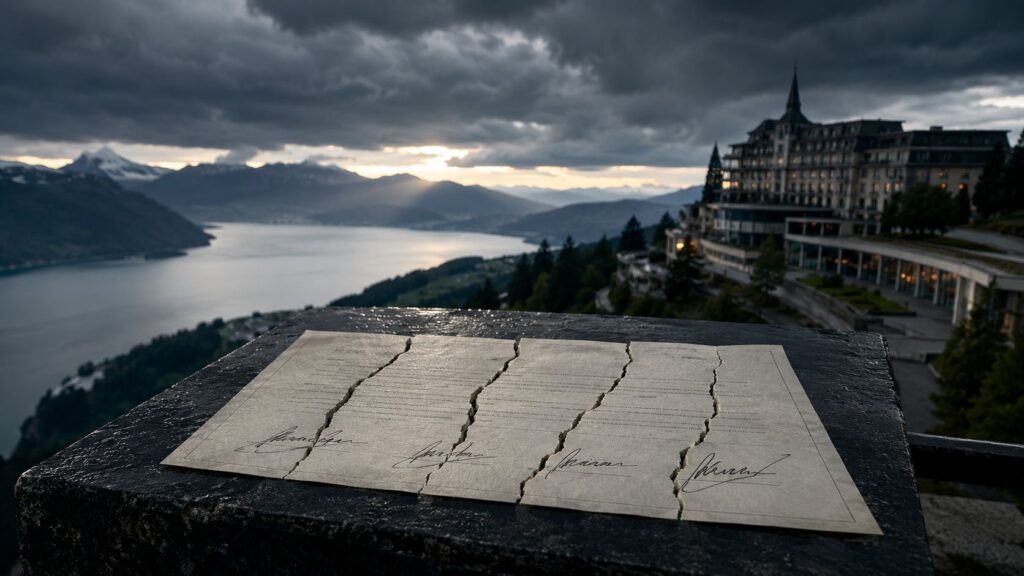
On June 21, the delegations of the United States and Iran met for the first time at the highest level since the signing of the memorandum – at the Bürgenstock Resort above Lake Lucerne, mediated by Qatar and Pakistan. While US Vice President JD Vance was still describing the meeting as historic, US President Donald Trump intervened via a Fox News phone call: if Iran closed the Strait of Hormuz, it would “have no country anymore.” According to the Tasnim news agency, the Iranian delegation lodged a formal protest and temporarily left the negotiating venue; in the Iranian reading, even the threat itself constitutes a violation of the memorandum, which commits both sides to refraining from attacks and threats. Chief negotiator Mohammad Bagher Ghalibaf countered that the Americans would not be in their current position if such threats actually had any effect. The delegation returned to the table that same night; a US diplomat involved in the talks told Reuters that the Iranians had never left and had continued negotiating deep into the night.
TRUMP THREATENS DESTRUCTION AND HORMUZ TAKEOVER – WHILE ISRAEL BREAKS THE CEASEFIRE
Trump demanded on Truth Social that Iran immediately stop its “highly paid proxies” in Lebanon – otherwise the US would strike Iran “very hard again.” In a Fox News interview he additionally raised the prospect of a military takeover of the Strait of Hormuz, including a US-imposed transit fee of 20 percent of the oil flowing through it; he described the US role as that of a “guardian angel” of the region. The construction merits close attention: Hezbollah is firing in response to Israeli attacks that themselves violate the agreed ceasefire – the memorandum explicitly provides for an end to hostilities “on all fronts, including Lebanon.” Trump addresses the Iranian side of the escalation chain and leaves the Israeli side unmentioned.
TALKS CONTINUE – 60-DAY ROADMAP AND FOUR WORKING GROUPS AGREED
After roughly 18 hours of negotiations, Qatar and Pakistan announced “encouraging progress” in the early hours of Monday morning. Agreed were a roadmap intended to produce a final agreement within 60 days and four working groups covering sanctions, the nuclear program, reconstruction, and implementation. Additional agreements include a communication channel to prevent incidents in the Strait of Hormuz and a deconfliction cell for Lebanon. IAEA Director General Rafael Grossi was denied access to the talks at the explicit request of the Iranian side – a detail that foreshadows the later dispute over nuclear inspections.
US EASES OIL SANCTIONS – SHIPPING TRAFFIC PICKS UP BUT REMAINS FAR BELOW PRE-WAR LEVELS
Washington granted Iran a temporary exemption from oil and related economic sanctions starting Monday – Tehran may again sell oil and receive payments during the negotiating period. According to data from the analytics firm Kpler, shipping traffic through the strait rose to as many as 39 transits on Monday, after fewer than ten ships per day had been recorded in early June. Before the war, 100 to 130 ships passed through the strait daily. US Energy Secretary Chris Wright declared that oil transport was back to “pre-crisis levels,” and Trump called it a record – Kpler explicitly contradicts both characterizations. The main route is still considered mined; ships are diverting through northern Iranian and southern Omani waters.
VANCE CLAIMS IAEA COMMITMENT – TEHRAN DENIES IMMEDIATELY
At the conclusion of the talks, Vance stated that Iran had agreed to readmit IAEA inspectors; discussions could begin “today.” Iran’s Foreign Ministry spokesman Esmail Baghai contradicted this the same day via the Irna agency: Iran had not negotiated its nuclear program in Switzerland and had taken on no new commitments. On Tuesday, Baghai clarified that there had been no meeting with Grossi and no protocol for inspections of damaged facilities; Iran would continue to fulfill its existing obligations under the Nuclear Non-Proliferation Treaty. Whether inspectors would travel was a matter for a working group that had not yet even convened.
TRUMP: IRAN HAS AGREED “TO INFINITY” – TEHRAN: “FALSE STATEMENTS”
Trump escalated the contradiction on Truth Social. Iran had agreed “fully and completely” to the highest level of nuclear inspections “far into the future (Infinity!!!),” he wrote, adding that this ensured “nuclear honesty”; had Iran not agreed, there would be “no more negotiations.” He dismissed the Iranian denial as “protests and false statements.” Iran’s UN Ambassador in Geneva, Ali Bahreini, maintained the Iranian counter-narrative. President Masoud Pezeshkian wrote on X that statements going beyond the agreed text did not contribute to progress in the negotiations – a rejection of the US account that was diplomatically phrased but substantively unambiguous.
IRAN SEPARATES “NO NUCLEAR WEAPON” FROM “NO ENRICHMENT”
Pezeshkian reaffirmed that Iran is prepared to give binding assurances against developing nuclear weapons. At the same time, Tehran made clear it will not relinquish its claimed right to uranium enrichment for civilian purposes. Two positions that the American side has until now treated as identical are thus in direct collision – but they are not identical: the renunciation of the bomb and the renunciation of enrichment are two separate questions for Tehran. This distinction was visible on the very first day of talks and is likely to be among the hardest knots in the technical follow-on negotiations.
MONEY DISPUTE: 12 BILLION DOLLARS RELEASED – BUT WHO DECIDES HOW IT IS SPENT?
Ghalibaf stated that the parties had agreed on the release of 12 billion dollars in frozen Iranian assets; according to Iran’s central bank governor, the first six billion concern outstanding South Korean payments for earlier oil deliveries. Vance, however, described a trust mechanism controlled by the US and Qatar under which the funds may be used exclusively for US agricultural products – soybeans, corn, wheat. Iran’s UN Ambassador Bahreini rejected this sharply in Geneva: “Iran is the only country that decides what happens with its assets. No other country has the right to influence that.” The construction – money is released but may only be spent in the adversary’s country – remains unresolved between the two sides.
HORMUZ: IRAN CLAIMS ADMINISTRATION – OMAN PACT AND FEES, RUBIO CONTRADICTS
On the flight home from Switzerland, Ghalibaf stated that the Strait of Hormuz would “never return to its pre-war state” but would henceforth be administered by the Islamic Republic of Iran – a statement that appears in none of the mediators’ joint communiqués. Shortly afterward, Iran and Oman signed a joint declaration in Muscat: a working group of both foreign ministries is to govern the future administration of shipping as well as “services and associated costs”; both states emphasize their sovereignty and jurisdictional rights over the strait. US Secretary of State Marco Rubio countered the same day upon his arrival in Abu Dhabi: “No country may impose tolls or fees on an international waterway. That is established international law.” Oman currently administers the transit system free of charge.
PEZESHKIAN IN PAKISTAN: THE MISSILE PROGRAM IS NOT ON THE TABLE
At a press conference in Islamabad, Pezeshkian declared that the ballistic missile program is not part of the 14-point memorandum “and never will be.” Without those missiles, the president said, Israel and the United States would have “devastated” Iran; they are essential for national defense. The published MoU text in fact contains no missile restrictions – the only weapons-related commitment is Iran’s pledge not to acquire or develop nuclear weapons. The US side nonetheless treats the missile issue as a possible future subject of negotiation. For an understanding of why Tehran holds immovably to its missile arsenal and its regional allies, see the earlier Iran Insight analysis “Bodentruppen und das Doppelschloss.”
ISRAEL REFUSES WITHDRAWAL FROM SOUTHERN LEBANON – HEZBOLLAH ANNOUNCES RESPONSES
Defense Minister Israel Katz stated that Israeli soldiers face no restrictions when they identify a threat; Prime Minister Benjamin Netanyahu said the forces would remain in the southern Lebanese zone as long as necessary. This stands in direct contradiction to the Iranian position, which makes an Israeli withdrawal a condition of the overall negotiations – and to the memorandum itself, which provides for an end to fighting on all fronts. On Tuesday, Hezbollah again accused Israel of breaking the ceasefire; in an incident near Nabatieh, two people were killed, whom Israel described as disguised Hezbollah fighters and the militia as civilians. Hezbollah Secretary General Naim Qassem announced responses to further violations. Against this backdrop, Netanyahu also published a call on X for building a defense industry independent of the United States: Israel values American support, he wrote, but must break free from dependency and develop its own weapons systems. According to SIPRI data, 68 percent of Israeli weapons imports between 2021 and 2025 came from the US; the country is itself now the world’s seventh-largest arms exporter. The statement comes in the middle of a period of growing tensions with Washington over a deal Israel largely rejects.
US SENATE PASSES WAR POWERS RESOLUTION 50 TO 48
For the first time since the War Powers Act came into force, a corresponding resolution has passed both chambers of Congress. The Senate voted 50 to 48 on June 23 to direct the president to end unauthorized military operations against Iran. Four Republicans – Rand Paul, Susan Collins, Lisa Murkowski, and Bill Cassidy – voted with nearly all Democrats; Democrat John Fetterman voted against, while Republicans McConnell and McCormick were absent. The White House regards the resolution as non-binding. Whatever its disputed legal effect, Congress has now issued a formal directive to the president – and domestic pressure on Trump is growing.
PENTAGON REQUESTS 80 BILLION DOLLARS ADDITIONAL – PREDOMINANTLY FOR THE IRAN WAR
The US Department of Defense briefed members of Congress on an additional funding requirement of approximately 80 billion dollars, predominantly for the costs of the Iran war. No formal budget submission from the White House was initially forthcoming; earlier Pentagon estimates had been lower. The request also contains individual line items not directly related to the war. The timing is noteworthy: the administration declares the war over and simultaneously presents a multi-billion-dollar bill – a tension that adds further fuel to the domestic debate.
RUBIO TOURS THE GULF STATES – SKEPTICISM ABOUT THE DEAL IS GROWING
Rubio visited the United Arab Emirates, Kuwait, and Bahrain starting Tuesday, with a meeting of the Gulf Cooperation Council also scheduled. The Gulf states broadly welcome the ceasefire but have expressed concerns: the absence of limits on Iran’s missile program, potential Iranian revenues, and the unresolved Hormuz arrangement. The UAE and Bahrain were among the states most frequently struck by Iranian attacks during the war. That Rubio – who has been conspicuously restrained in public comment on the deal – is now the one being sent to explain it to regional partners has been noted in Washington.
KHAMENEI BURIAL ANNOUNCED FOR JULY 09 – MOJTABA STILL INVISIBLE
More than 130 days after his death, former Iranian Supreme Leader Ali Khamenei is to be interred on July 09 in his birthplace of Mashhad, next to the mausoleum of the eighth Shia Imam Reza. Memorial ceremonies are planned beforehand in Tehran (July 4 and 5) and in the pilgrimage city of Qom (July 6); Vice President Mohammad-Reza Aref expects millions of mourners and declared a total of five public holidays. Khamenei was killed in late February in an Israeli airstrike on his official residence. His son and successor Mojtaba, who was severely injured in the attack, has not appeared in public since – speculation about his health continues.

ANALYSIS
I. The Signed Dissent: How a Memorandum Became Two Competing Narratives
The central finding of these days is not the roadmap – it is its immediate collapse into two competing accounts. Bürgenstock did not produce an agreement; it produced a procedure: a 60-day corridor, four working groups, two communication mechanisms. What was intended as a shared foundation disintegrated the moment the delegations left the resort. Four points of contention now stand irreconcilably side by side. On nuclear inspections, Washington claims a commitment “to infinity” that Tehran categorically denies. On the released funds, Washington asserts control over how they are spent; Tehran claims sole authority. On Hormuz, Iran declares future self-administration including possible fees, while the US invokes international waterway law. And on missiles, Pezeshkian draws a red line that does not appear in the text but that Washington nonetheless treats as a subject for negotiation. Four questions, four diametrically opposed readings – and not one is resolvable on the basis of the available record. Following the principle of presenting both possibilities: the contradictions may be deliberate domestic politics on both sides, each needing to sell a victory to its respective hardliners – or they may reflect a genuinely unresolved negotiating position that was prematurely presented as an agreement. The factual record supports both interpretations.
II. Trump’s Threat and the Hidden Half of the Escalation Chain
Trump’s Sunday threat – Iran would “have no country anymore” – is more than rhetorical routine; it reveals the structural asymmetry of the entire construction. The president addresses the Iranian side of an escalation chain while systematically ignoring the Israeli side. The sequence is documented: Israel does not abide by the ceasefire, strikes in southern Lebanon, kills civilians; Hezbollah responds; Trump threatens Iran with destruction because its ally is shooting back. The memorandum that Trump himself signed explicitly provides for an end to fighting in Lebanon as well – yet the sanction threat is directed at only one of the two parties breaking it. The Hormuz episode follows the same logic: the transit fee that Trump prohibits Iran from charging, he potentially claims for the United States itself in its role as “guardian angel.” Anyone who describes the structure without moralizing recognizes a pattern: the rules apply to one side. The finding is not outrage – it is asymmetry. And that asymmetry is the real explosive device the 60-day window carries within it.
III. The Three Lines Iran Draws – and Why They Belong Together
Nuclear inspections, enrichment, and missiles are frequently collapsed in Western perception into a single “nuclear dispute.” Tehran separates them strictly, and in that separation lies the core of Iranian negotiating doctrine. First: renunciation of the bomb – yes, Pezeshkian offers this explicitly. Second: renunciation of civilian enrichment – no, this claimed right is not on the table. Third: the missile program – it does not exist in the memorandum and is never to do so. These three lines are not tactical individual positions; they are the expression of a coherent security logic. After a war that, according to Iranian judicial authorities, cost 3,519 lives and killed the Supreme Leader, Tehran regards enrichment and missiles as the twin locks of its deterrence. That IAEA chief Grossi was excluded from the talks at Iranian insistence is, in this light, not an affront but a method: Iran is negotiating over sovereignty, not submission. Anyone who expects Tehran to surrender one of these lines in the technical follow-on talks underestimates how deeply they are embedded in national security doctrine.
IV. Washington Under Pressure from Within – a Deal Without a Secure Foundation
While Trump projects strength externally, the foundation at home is crumbling. The Senate has for the first time passed a War Powers Resolution through both chambers with 50 to 48 votes – a primarily symbolic but historically unprecedented act that formally directs the president to end the unauthorized military operations. Four Republicans broke with Trump; this is less a legal than a political signal, measuring the growing erosion of support within his own party. In parallel, the Pentagon is requesting approximately 80 billion dollars in additional funding – for a war the administration has officially declared over. And Washington is sending Rubio – the very man who has most publicly distanced himself from the deal – to explain it to skeptical Gulf states. Three signals that together show the same thing: the memorandum rests on no firm domestic foundation. Senate Minority Leader Chuck Schumer described the Senate vote as the tenth attempt to stop the war and called it one of the gravest foreign policy blunders in American history. The proposed 300-billion-dollar reconstruction fund, the sanctions relief, and the fund transfers will sooner or later require a congressional majority the president does not currently have secured – particularly since the fund, according to available reports, is structured as a private investment instrument whose resources are to flow only after a final agreement. The real vulnerability of the deal thus lies not in Tehran but in Washington. It will become more visible over the coming 60 days, as the financial commitments the president would need to push through against his own party’s resistance become more concrete.
STRATEGIC ASSESSMENT
Within four days, the signing of the memorandum has become a web of four open contradictions – over inspections, funds, Hormuz, and missiles. Bürgenstock has not brought peace; it has brought a 60-day negotiating corridor whose outcome is more open than the success announcements of both sides suggest. The actual violence of these days took place once again not between Washington and Tehran but in southern Lebanon, where a ceasefire remained fragile and Israel refuses any withdrawal. While the president threatens Iran with destruction and simultaneously announces inspection commitments that Tehran denies, domestic pressure in Washington is mounting – through a Senate resolution, a multi-billion-dollar Pentagon demand, and skeptical allies in the Gulf. What began at the negotiating table now stands under the double reservation of a front that neither signatory controls and a home base the president has yet to secure.

Michael Hollister
is a geopolitical analyst and investigative journalist. He served six years in the German military, including peacekeeping deployments in the Balkans (SFOR, KFOR), followed by 14 years in IT security management. His analysis draws on primary sources to examine European militarization, Western intervention policy, and shifting power dynamics across Asia. A particular focus of his work lies in Southeast Asia, where he investigates strategic dependencies, spheres of influence, and security architectures. Hollister combines operational insider perspective with uncompromising systemic critique – beyond opinion journalism. His work appears on his bilingual website (German/English) www.michael-hollister.com and in investigative outlets across the German-speaking world and the Anglosphere.
If you regularly read my updates and analyses, I would be grateful for your support.

Sources
- ZDFheute, June 22, 2026 – Switzerland: Talks between Iran and US temporarily concluded: https://www.zdfheute.de/politik/ausland/iran-usa-schweiz-gespraeche-arbeitsebene-kommunikationskanal-hormus-100.html
- Handelsblatt, June 21, 2026 – Iran conflict: Negotiations in Switzerland – Trump threatens from Washington: https://www.handelsblatt.com/politik/international/iran-konflikt-verhandlungen-in-der-schweiz-trump-droht-aus-washington/100234636.html
- news.de, June 22, 2026 – “You will have no country anymore”: Trump threatens Iran with destruction and Hormuz takeover: https://www.news.de/politik/859743387/donald-trump-eskaliert-nach-iran-drohung-waehrend-fox-news-telefonat-trump-droht-mit-iran-vernichtung-und-uebernahme-der-strasse-von-hormus/1/
- SWI swissinfo.ch, June 23, 2026 – Iran contradicts Vance: no agreement on IAEA inspectors: https://www.swissinfo.ch/ger/iran-widerspricht-vance:-keine-einigung-zu-atom-inspektoren/91634506
- The New Republic, June 23, 2026 – Trump Spirals as Iran Exposes His Lies About the Deal: https://newrepublic.com/post/212200/trump-spirals-iran-exposes-lies-nuclear-deal
- The Times of Israel, June 23, 2026 – Contradicting Vance, Iran says no plans for IAEA inspections, asserts sovereignty at Hormuz: https://www.timesofisrael.com/contradicting-vance-iran-says-no-plans-for-iaea-inspections-of-damaged-nuclear-sites/
- Weltwoche, June 23, 2026 – Iran gains access to frozen billion-dollar assets and reaffirms leading role in the Strait of Hormuz: https://weltwoche.ch/daily/nach-verhandlungen-in-der-schweiz-iran-erhaelt-zugang-zu-eingefrorenem-milliardenvermoegen-und-bekraeftigt-fuehrungsrolle-in-der-strasse-von-hormus/
- PR Newswire, June 23, 2026 – Joint Statement of the Sultanate of Oman and the Islamic Republic of Iran: https://www.prnewswire.com/news-releases/gemeinsame-erklarung-des-sultanats-oman-und-der-islamischen-republik-iran-302808097.html
- t-online, June 24, 2026 – Iran does not see missiles as part of the agreement: https://www.t-online.de/nachrichten/ausland/krisen/id_101306700/krieg-in-nahost-iran-sieht-raketen-nicht-als-teil-der-vereinbarung.html
- The Tribune / ANI, June 24, 2026 – Iran’s missile programme not part of agreement with US: President Pezeshkian: https://www.tribuneindia.com/news/bilateral-relations/irans-missile-programme-not-part-of-agreement-with-us-president-pezeshkian
- taz, June 23, 2026 – Iran war: Hezbollah accuses Israel of violating ceasefire in Lebanon: https://taz.de/Iran-Krieg/!6189892/
- Berliner Zeitung, June 23, 2026 – Netanyahu calls for more indigenous defense systems: https://www.berliner-zeitung.de/article/unabhaengigkeit-von-us-waffen-netanjahu-fordert-mehr-eigene-ruestungssysteme-10126425
- Al Jazeera, June 23, 2026 – US Senate votes to pass Iran war powers resolution in blow to Trump: https://www.aljazeera.com/news/2026/6/23/us-senate-votes-to-halt-iran-war-bucking-trump
- PBS News, June 23, 2026 – Senate for 1st time approves war powers resolution to halt Iran conflict: https://www.pbs.org/newshour/politics/senate-again-set-to-vote-on-war-powers-resolution-to-halt-iran-conflict
- Jüdische Allgemeine, June 23, 2026 – Rubio speaks with Gulf states about Iran deal: https://www.juedische-allgemeine.de/politik/rubio-spricht-mit-golfstaaten-ueber-iran-abkommen/
- SWI swissinfo.ch, June 23, 2026 – Iran: Khamenei burial on July 09 in Mashhad: https://www.swissinfo.ch/ger/iran:-chameneis-beisetzung-am-9.-juli-in-maschhad/91637116
- Tagesspiegel, June 23, 2026 – US Senate votes against Trump’s unilateral Iran war conduct: https://www.tagesspiegel.de/internationales/liveblog/trotz-waffenstillstand-israel-fliegt-offenbar-mehrere-angriffe-im-suden-des-libanon-10586281.html
- Michael Hollister – Iran Insight: Bodentruppen und das Doppelschloss (March 29, 2026): https://www.michael-hollister.com/de/2026/03/29/iran-insight-bodentruppen-und-das-doppelschloss/
© Michael Hollister – All rights reserved. Redistribution, publication or reuse of this text requires express written permission from the author. For licensing inquiries, please contact the author via www.michael-hollister.com.
Newsletter
🇩🇪 Deutsch: Verstehen Sie geopolitische Zusammenhänge durch Primärquellen, historische Parallelen und dokumentierte Machtstrukturen. Monatlich, zweisprachig (DE/EN).
🇬🇧 English: Understand geopolitical contexts through primary sources, historical patterns, and documented power structures. Monthly, bilingual (DE/EN).