
by Michael Hollister
Exclusive published at Michael Hollister on June 23, 2026
4.254 words * 22 minutes readingtime
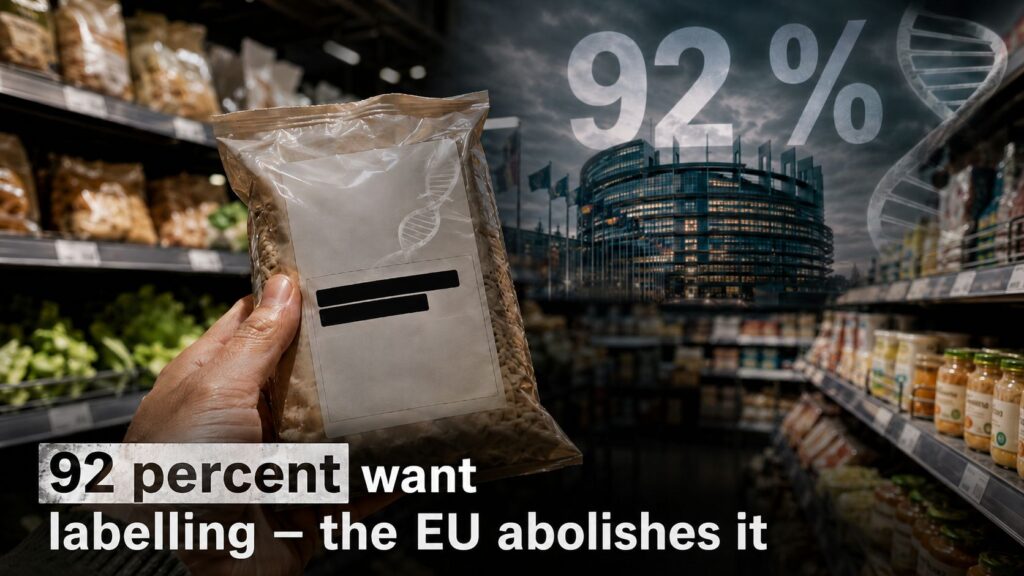


How the EU Ignored 92 Percent of Germans
On June 17, 2026, the EU decided that genetically modified foods may henceforth be sold without labeling. Ninety-two percent of Germans wanted the opposite. A finding.
The Quiet Decision
In early May 2026, Rewe, dm, and the organic farming association Demeter co-signed an open letter to the European Parliament. Their concern was straightforward: foods produced using new genetic engineering methods should remain identifiable as such. Labeling, they argued, is not hostility toward technology – it is the prerequisite for consumers to have any choice at all. More than 2,000 companies from agriculture, food processing, and retail had added their names to the letter.
Around the same time, a representative Forsa survey commissioned by the consumer organization foodwatch was already on record, conducted in September 2023 among 1,003 people in Germany. The result: 92 percent of respondents said foods produced using new genomic methods must be labeled. Ninety-six percent demanded that potential risks of new genetic engineering procedures be examined before market launch. These figures were stable across party lines – 92 percent among SPD voters, 91 percent among CDU/CSU voters, 85 percent among FDP voters, 92 percent among AfD voters.
On June 17, 2026, the European Parliament voted in Strasbourg. Of 43 submitted amendments, not one achieved a majority. An amendment calling for full mandatory labeling was supported by 258 MEPs – 376 voted against it, 289 abstained. The new Regulation on New Genomic Techniques, the NGT Regulation, is now definitively adopted. From 2028 onward, most genetically modified plants and the foods derived from them may enter the EU market without testing, without authorization, and without labeling. Five days later, barely a consumer had heard about it.
The question this article asks is not whether new genetic engineering is good or bad. There are valid scientific arguments for new genomic techniques – and there are valid objections. Both will be presented below. The real question is: whose interests did the European Parliament represent on June 17, 2026 – and why did a social majority of 92 percent play no role in that decision?
The Regulation in Plain Terms: What Applies from 2028
New genomic techniques are methods that modify the genetic makeup of plants in a targeted and precise manner – without introducing foreign genetic material from other species. The best-known of these methods is the so-called gene scissors CRISPR/Cas, with which individual DNA building blocks in a plant’s genome can be selectively switched off, rewritten, or inserted. Unlike classical genetic engineering, in which genes from bacteria or other organisms are introduced into a plant, NGT keeps the genetic material within the species. Proponents point out that such modifications could theoretically have arisen through natural mutation – which raises the question of why they should then be the subject of a patent application, but more on that later.
The new EU regulation distinguishes two categories. NGT-1 covers plants with limited modifications: a maximum of 20 altered DNA building blocks at up to three locations within a protein-coding sequence. Such plants will henceforth be treated like conventionally bred varieties – no risk assessment, no authorization, no labeling on the end product. Only the seed remains labeled. What grows from that seed – grain, vegetables, fruit – and what is processed from it – flour, bread, baby food, frozen pizza, animal feed – will carry no indication whatsoever. NGT-2 covers plants with more extensive modifications, particularly those with herbicide resistance or the capacity to produce insecticides. For these, the existing strict GMO rules continue to apply.
Critical to evaluating this division is a single figure: according to estimates by the Federal Agency for Nature Conservation, an estimated 94 percent of all future NGT plants will fall into the NGT-1 category – and thus be removed entirely from genetic engineering law.
Proponents of the regulation point to real challenges. Climate change demands crops that can cope with drought, flooding, and rising temperatures. The existing GMO authorization procedures sometimes took a decade and were barely affordable for smaller breeding companies, argued among others EVP rapporteur Jessica Polfjärd, who has led the legislative process since 2023. CRISPR enables a precision that conventional cross-breeding cannot achieve, and the results are in any case no longer distinguishable from conventionally bred plants. These arguments are not made in bad faith – they simply do not explain why the invisibility of a modification should mean consumers need not be informed about it.
An important distinction is frequently blurred in public debate: the NGT Regulation does not govern whether NGT plants may be cultivated. It governs whether consumers must be told. These are two separate questions. One can regard new genetic engineering as a promising technology and still advocate for consumers’ right to read on packaging what they are dealing with. The Forsa survey shows that this combination is widespread in the German population – including among people who are fundamentally open to technology.
What Applied Before – and What Is Now Being Cut
To understand what was decided on June 17, 2026, one must know what had applied up to that day. European genetic engineering law is not the product of overly cautious bureaucracy; it is the result of a long social learning process that began in the 1990s and found its legal expression in the EU Deliberate Release Directive of 2001.
Under that directive, transposed into the national law of all member states, every genetically modified organism was subject to a multi-stage procedure before market launch: a comprehensive risk assessment by the European Food Safety Authority EFSA; a formal authorization procedure at EU level; full traceability throughout the entire supply chain – from seed through harvest to supermarket shelf – as well as a mandatory labeling requirement for all foods containing more than 0.9 percent of authorized GMO constituents. Member states retained the right to ban the cultivation of specific GMO varieties on their territory.
This system was not perfect. The EFSA repeatedly faced criticism for being too close to the agricultural industry – and in fact it has approved every authorization application in favor of the applying corporation. And the authorization procedures were expensive and time-consuming. But the system had a clear function: it ensured that an independent review took place before a product entered circulation, and that consumers were informed so they could decide.
The European Court of Justice expressly extended this framework to new genomic techniques in 2018. In a landmark ruling, the ECJ decided that NGT plants also fall under strict genetic engineering law – on the grounds that these are new methods with little accumulated experience, and that the precautionary principle therefore requires risk assessment and authorization. That ruling was binding European law. The NGT Regulation of June 17, 2026 attempts to override it through legislation.
What is specifically being cut is remarkable in its detail: for NGT-1 plants, the risk assessment is eliminated entirely. The mandatory labeling requirement on the end product is eliminated. The traceability requirement is eliminated. The verification obligations for seed and harvest are eliminated. And – this is the most legally explosive novelty – the classification of a plant as NGT-1, once made, cannot be reversed under the regulation even if harmful consequences are actually identified after release. The damage would be on record; the right to correction would be forfeited.

The legal opinion published in May 2026 by the Berlin law firm GGSC, commissioned by the organic food industry association BÖLW, concludes that the NGT Regulation breaks existing EU law in two respects. The comparison is instructive: when the EU Deliberate Release Directive entered into force in 2001, the procedure was deliberately constructed to be rigorous. An applicant – typically a corporation – had to submit complete documentation to EFSA on the composition, properties, and possible risks of a new plant. Independent scientists reviewed it. Member states could raise objections. The procedure often took nine months, sometimes years, and frequently ended with conditions or rejection. Not a single authorization application was ever completed without objections from one or more member states. That system was slow and expensive – but it was a system. The NGT Regulation replaces it, for 94 percent of new plant varieties, with a simple notification. The applicant decides for themselves whether their plant meets the NGT-1 criteria. A national authority reviews this formally – but not the plant’s offspring. The system has been replaced by a form.
What the Consumer Loses: Freedom of Choice as a Fundamental Question
The debate over new genetic engineering is frequently framed as a conflict between science skepticism and progress. That framing is misleading – and the survey data make this clear. The Forsa survey of September 2023 did not ask whether people fundamentally reject genetic engineering. It asked whether they want to be informed about genetic modifications in food. The answer was unambiguous: 92 percent said yes to labeling, 96 percent yes to risk assessment. Among them, 85 percent of FDP voters – a party not suspected of spreading technophobia. A Civey survey commissioned by the Association Food Without Genetic Engineering in May 2024, in which 5,007 people were surveyed, confirmed this picture: 84 percent supported labeling of foods from both old and new genetic engineering. The government-commissioned Nutrition Report 2024 from the Federal Ministry of Agriculture additionally found that 64 percent of Germans consider a clear indication of the genetic engineering-free status of foods important or very important – a figure that is even lower, because it asked about the desire for GMO-free products, not the right to information.
What these figures document is not a blanket rejection of technology. It is a clear social mandate for transparency and freedom of choice. Anyone who wants to decide whether to buy genetically modified food needs that information on the packaging. This is neither a radical nor an unreasonable demand.
From 2028, that demand becomes moot for the bulk of new genetic engineering. Anyone who then wants to shop GMO-free in a supermarket will depend on voluntary labels – the “Ohne Gentechnik” seal, which manufacturers can apply on the basis of a private-law standard but are not required to, or the EU organic label, which excludes genetic engineering as a matter of principle. Both routes have gaps. The “Ohne Gentechnik” seal does not cover the entire supply chain. Organic products remain officially GMO-free – but the new regulation explicitly clarifies that a technically unavoidable presence of NGT-1 plants in organic products will not be treated as a violation. What that means in practice when NGT-1 plants are grown at scale and cross-pollinate into neighboring fields through wind: it is not foreseeable – and will no longer be tracked.
The paradox the regulation creates is most visible in the behavior of retailers. Edeka, Lidl, Aldi, and Rewe all told the Hamburg Consumer Advice Center in 2023 that they respect their customers’ rejection of genetic engineering and would not tolerate genetically modified products in their ranges. In the same year, the consumer advice center found such products in a spot check in German supermarkets – isolated cases, through independent assortment decisions by individual retailers. Rewe and dm wrote an open letter to the European Parliament in May 2026 demanding labeling. The Parliament ignored the demand. From 2028, retailers will no longer know what they are selling – and consumers even less.
The consequence is as simple as it is consequential: anyone who wants to be certain from 2028 onward that they are not buying NGT-1 products will have to buy exclusively certified organic food – and live with residual risk even there. Conventional shopping will become an informational black box.
The labeling technology, for its part, has long existed. For classical GMO products it has functioned for more than two decades. The argument that new genomic modifications can no longer be analytically detected in the finished food is a technical point frequently advanced by proponents – but it is not an argument against labeling; at most it is an argument against retrospective lab testing. Mandatory labeling based on production documentation – as already functions for organic products – would have been possible. It was not wanted politically.
There is an objection that proponents of the regulation regularly raise at this point: the consumer can always buy organic if they want to avoid genetic engineering. That is true – and it reveals the real nature of the decision. The mandatory labeling requirement is not being abolished because it would be technically impossible. It is being abolished because the goal is to make NGT products invisible in the conventional market. Those who want transparency should pay extra for it. Those who cannot or will not afford to will shop in the dark from 2028. That is not a regulatory failure – it is an explicit political decision about whose interests take priority on the supermarket shelf.
The Power Question: Who Won Here?
The path to the NGT Regulation does not begin on June 17, 2026. It begins in 2023, when the European Commission presented its legislative proposal. Shortly before that, the lobby group Euroseeds – the direct representative of the interests of chemical and seed corporations Bayer, BASF, and Syngenta – had described in a strategy paper exactly the deregulation that is now law: plants from targeted mutagenesis and cisgenesis should be removed from GMO rules because, in their view, they are equivalent to conventionally bred plants. An analysis by GLOBAL 2000 documented that the European Commission adopted these formulations in its legislative proposal almost word for word – including the argument that new genetic engineering modifications cannot be detected, and without raising a single question about stricter risk assessments.
Who benefits from the new regulation can be stated concretely. Four corporations – Bayer with its subsidiary Monsanto, Corteva (formed from the agricultural divisions of Dow and DuPont), Syngenta (now owned by ChemChina), and BASF – already control more than 50 percent of the global seed market, according to the Heinrich Böll Foundation. This concentration is the result of a merger wave in 2017 and 2018. The NGT Regulation now opens the next phase of this business model: NGT plants are patentable – including for characteristics that occur naturally or could have arisen through conventional breeding.
This is not an abstract threat. In 2025, the European Patent Office granted 40 patents on conventional plant breeding – rights to properties that had previously been common heritage. The NGT Regulation accelerates this trend. Anyone who cultivates a plant carrying a patented characteristic – even if they never purchased NGT seed but encountered it through cross-pollination – could theoretically face liability. Smaller and medium-sized breeding companies, which lack the resources to systematically check patent databases and negotiate licensing agreements, are the losers in this system. German agricultural and breeding associations warned of precisely this in the run-up to the vote.
Did this analysis help you make sense of what’s happening? Hollister’s Geopolitics delivers deep dives like this every week – primary-source-based, without partisanship. Subscribe free of charge.
The European Parliament had recognized this danger. In February 2024, it had adopted its own position calling for a far-reaching patent ban on NGT plants. EVP chief negotiator Jessica Polfjärd simply did not represent this position in the trilogue negotiations with the Commission and Council. The result: a public database in which patent holders can voluntarily disclose their intellectual property rights, and a non-binding code of conduct for fair licensing. Neither is legally binding. On June 17, 2026, as the vote began, Polfjärd called on her fellow MEPs to block every single amendment: “The amendments would kill the deal!” With that threat – either this regulation or none at all – the conservative-liberal majority held firm. All 43 amendments failed.
The promise the agricultural industry attaches to this regulation is: new genetic engineering will make plants more climate-resilient, reduce pesticide use, and increase yields. It is a familiar promise. Classical genetic engineering in the 1990s was introduced with the same promises. The result after 25 years: today, 80 percent of genetically engineered plants cultivated worldwide are herbicide-resistant – not climate-resistant, but designed to be compatible with the use of specific herbicides. In countries with high GMO shares, herbicide use since then has not decreased but multiplied, because resistant weeds have emerged that in turn require stronger agents. Reliable market data on NGT plants show a similar pattern: worldwide, only five non-transgenic NGT plants are currently on the market – none of them in the EU. A study by the European Non-GMO Industry Association ENGA in 2025 concluded that the announced climate adaptation plants are still not market-ready, while the deregulation of the framework conditions has already been completed.
NGT is more precise than old genetic engineering – that is scientifically accurate. But precision in the intervention does not rule out unintended consequences. Even minor genetic modifications without foreign material can, according to experts at the Federal Agency for Nature Conservation, have significant impacts on ecosystems. The threshold value defined in the regulation – a maximum of 20 altered DNA building blocks for the NGT-1 classification – is, in the assessment of several experts, scientifically unjustifiable. It is a political stipulation, not a biological fact. Ninety-four percent of all future NGT plants will enter circulation under this regulation without any examination of those consequences.
There is also a structural asymmetry that is rarely named: the corporations developing NGT plants can patent both the plants themselves and the individual genome modifications. If a released NGT-1 plant turns out to develop undesirable properties or cross-breeds with wild plants – who is liable? The regulation contains no liability rules. Damage to the environment or supply chains would arise in a legal framework that protects the originators and leaves those affected to fend for themselves.
The Legal Question: Two Breaches and a Ruling from London
Thirteen days before the European Parliament voted in Strasbourg, the High Court of Justice in London issued a ruling that went almost unnoticed in German reporting. On June 04, 2026, England’s and Wales’s highest administrative court declared the British equivalent of the NGT Regulation “irrational” and therefore unlawful. The background was a 2025 regulation by the British government intended to facilitate the cultivation of NGT plants in England. The judge found that the responsible minister had been misinformed by his advisers on the question of mandatory labeling – he had incorrectly assumed that a comprehensive labeling requirement exceeded his legal authority. Because that misinformation had materially constrained his decision, the entire regulation was to be classified as irrational. The British court ordered further deliberation on the consequences.
This ruling is not a marginal case. It is a precedent in a legal system closely related to continental law, and it shows that the question of mandatory labeling for NGT plants is not as legally clear-cut as proponents of the regulation claim.
At the EU level, the legal situation is equally contested. The 60-page legal opinion by the Berlin law firm GGSC, commissioned by the organic food industry association BÖLW and published in May 2026, concludes that the NGT Regulation breaks existing EU law in two respects. First, it violates the precautionary principle, which is enshrined in the EU treaties themselves and requires that in cases of scientific uncertainty about possible harm, the protection of health takes precedence. Second, it undermines the Cartagena Protocol to the UN Convention on Biological Diversity, which mandates a risk assessment before the release of any genetically modified organisms. Particularly problematic from the perspective of the legal experts: the text of the law assumes that certain DNA modifications, arbitrarily defined by the legislator, make NGT plants equivalent to conventional plants – and this equivalence classification is to remain irrevocable even if harmful consequences are identified after release. The damage would be documented; the right to correction would be forfeit.
Several organizations have announced they will initiate legal proceedings. Within two months of the regulation’s publication in the EU Official Journal, lawsuits can be filed before the European Court of Justice. The prospects for such suits are, from a legal standpoint, not poor. The ECJ already ruled clearly in 2018 that NGT plants fall under strict genetic engineering law – explicitly on the grounds that these are new methods with insufficient accumulated experience to justify abandoning the precautionary principle. The NGT Regulation attempts to override precisely that ruling through legislation. Whether the ECJ will accept that is the open question – and it will determine the next two years while the regulation is not yet being applied.
What is already taking shape in this transition period: political resistance will not abate. Austria has announced it will examine all legal options and actively support an ECJ challenge. The Working Group on Peasant Agriculture has announced its own legal action. ARCHE NOAH, one of Europe’s largest seed conservation organizations, described it as a “black day for diversity.” The fact that Parliament demanded a patent ban in 2024 and has now approved a regulation that corresponds to none of its own previous demands is likely to feature prominently in the legal filings.
What Remains: A Decision About Control
June 17, 2026 is not a technical regulatory act. It is a decision about who in Europe retains control over food chains – and who loses it.
The losers, first and foremost, are consumers: from 2028, they will no longer know what is in the majority of conventional food products. A social majority that consistently and across party lines has advocated for labeling over years was overruled – not by a different social majority, but by a parliamentary voting mechanism that shielded the trilogue outcome from amendment.
Potentially losing out as well are smaller breeders and farmers: in a system where natural plant properties become patentable and four corporations already control more than half of the global seed market, the question of market power is not abstract. It determines who may breed, who cultivates, who pays licensing fees, and who sets the price.
The winners are the corporations whose lobby associations have been demanding this deregulation for years and whose demands were adopted into European law almost word for word. That is not an accusation that can be proven like a date or a vote count – it is the sober description of an alignment of interests between industry positions and legislative decisions that can be documented across three years.
What remains open is the legal question. The ECJ will deal with the regulation. The British High Court has shown that comparable deregulatory moves can also be overturned judicially. And in Germany, the Working Group on Peasant Agriculture has already announced it will exhaust every legal avenue. The story that was not finished in Strasbourg on June 17, 2026, will continue in Luxembourg.
What matters now: anyone who still wants to know what they are eating should take note of the “Ohne Gentechnik” seal and the EU organic label – and should know that even these no longer provide complete assurance once NGT-1 plants are in widespread circulation. The decision about what goes on the plate has until now rested with the consumer. From 2028, it will increasingly rest elsewhere.
That is the sober summary of a decision that barely registered in public debate. No referendum, no broad discourse, no media outcry – even though 92 percent of the population would have wanted a different outcome. The question that arises from this is not only one about genetic engineering. It is one about the functioning of democratic institutions at a time when, as documented here, lobby documents and legislative texts are near-identical – word for word.

Michael Hollister
is a geopolitical analyst and investigative journalist. He served six years in the German military, including peacekeeping deployments in the Balkans (SFOR, KFOR), followed by 14 years in IT security management. His analysis draws on primary sources to examine European militarization, Western intervention policy, and shifting power dynamics across Asia. A particular focus of his work lies in Southeast Asia, where he investigates strategic dependencies, spheres of influence, and security architectures. Hollister combines operational insider perspective with uncompromising systemic critique – beyond opinion journalism. His work appears on his bilingual website (German/English) www.michael-hollister.com and in investigative outlets across the German-speaking world and the Anglosphere.
Support my Work – become a Member

Sources
- Informationsdienst Gentechnik: EU-Parlament weicht Regeln für neue Gentechnik auf (June 17, 2026) – https://www.keine-gentechnik.de/nachricht/eu-parlament
- Council of the European Union: New genomic techniques – Council adopts new rules (April 21, 2026) – https://www.consilium.europa.eu/de/press/press-releases/2026/04/21/new-genomic-techniques-council-adopts-new-rules-to-boost-sustainable-and-competitive-eu-food-systems/
- Council of the European Union: New genomic techniques – Council and Parliament reach agreement (December 04, 2025) – https://www.consilium.europa.eu/de/press/press-releases/2025/12/04/new-genomic-techniques-council-and-parliament-strike-deal-to-boost-the-competitiveness-and-sustainability-of-our-food-systems/
- transgen.de: Plants with new genomic techniques – The new EU rules (June 17, 2026) – https://www.transgen.de/recht/2916.ngt-pflanzen-verordnung-eu.html
- transgen.de: Seven long years. The arduous path to reforming genetic engineering law – https://www.transgen.de/aktuell/2880.ngt-regulierung-eu-kommission-crispr-gentechnik.html
- Bund Ökologische Lebensmittelwirtschaft (BÖLW): Legal opinion – New genetic engineering regulation unlawful (May 06, 2026) – https://www.boelw.de/news/rechtsgutachten-neue-gentechnik-verordnung-rechtswidrig/
- Informationsdienst Gentechnik: Ruling in England – new genetic engineering regulation unlawful (June 05, 2026) – https://www.keine-gentechnik.de/nachricht/britisches-gericht-kippt-neue-gentechnikregeln
- Informationsdienst Gentechnik: Controversial reactions to new rules for GMO plants (June 18, 2026) – https://www.keine-gentechnik.de/nachricht/reaktionen
- GLOBAL 2000: Genetic engineering – GLOBAL 2000 criticizes capitulation to industry (June 17, 2026) – https://www.ots.at/presseaussendung/OTS_20260617_OTS0136/gentechnik-global-2000-kritisiert-kniefall-vor-industrie
- pro.earth: Deregulation of new genetic engineering adopted by EU Parliament (June 17, 2026) – https://pro.earth/2026/06/17/deregulierung-von-neuer-gentechnik-in-eu-parlament-beschlossen/
- Verbraucherzentrale Hamburg: Genetic engineering – in future unlabeled in supermarkets – https://www.vzhh.de/themen/lebensmittel-ernaehrung/gentechnik-zukuenftig-ohne-kennzeichnung-im-supermarkt
- ZDFheute: Genetic engineering without labeling – EU relaxes rules for food in supermarkets (June 17, 2026) – https://www.zdfheute.de/politik/gentechnik-kennzeichnung-lebensmittel-supermarkt-eu-100.html
- GLOBAL 2000 / Austrian Press Agency: Analysis – EU plans on new genetic engineering mirror demands of seed and chemical lobby (March 16, 2023) – https://www.ots.at/presseaussendung/OTS_20230316_OTS0054/analyse-zeigt-grosse-teile-der-eu-plaene-zu-neuer-gentechnik-decken-sich-mit-forderungen-der-saatgut-und-chemielobby
- Via Campesina Austria (ÖBV): Trilogue agreement on new genetic engineering – a betrayal of farmers’ interests (December 04, 2025) – https://www.viacampesina.at/trilog-neue-gentechnik-verrat-an-baeuerinnen/
- BUND (Friends of the Earth Germany): Genetic engineering – laws and authorizations – https://www.bund.net/themen/landwirtschaft/gentechnik/gesetze-und-zulassungen/
- Forsa survey “New Genetic Engineering,” September 2023 – https://www.foodwatch.org/fileadmin/-DE/Themen/Gentechnik/2023-09-Umfrage_Forsa_Tabellen_Neue_Gentechnik.pdf
© Michael Hollister – All rights reserved. Redistribution, publication or reuse of this text requires express written permission from the author. For licensing inquiries, please contact the author via www.michael-hollister.com.
Newsletter
🇩🇪 Deutsch: Verstehen Sie geopolitische Zusammenhänge durch Primärquellen, historische Parallelen und dokumentierte Machtstrukturen. Monatlich, zweisprachig (DE/EN).
🇬🇧 English: Understand geopolitical contexts through primary sources, historical patterns, and documented power structures. Monthly, bilingual (DE/EN).