
by Michael Hollister
Exclusive published at Michael Hollister on June 21, 2026
6.888 words * 38 minutes readingtime
The “Global Situation Report” is published as part of Hollister’s Geopolitics.
New analyses every week – subscribe for free.
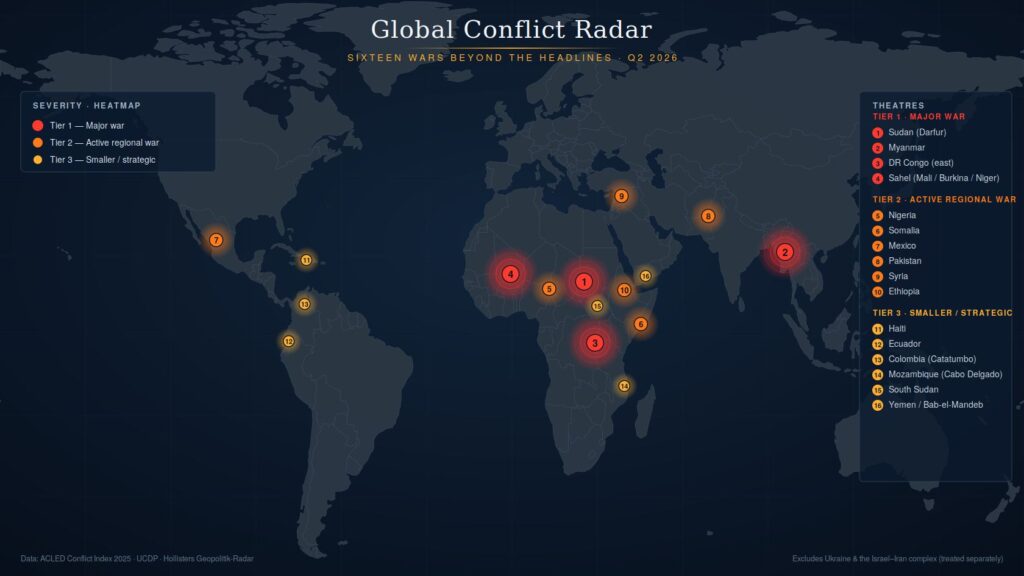
Global Situation Report Q2/2026
Ask today about the world’s wars and two names come up: Ukraine and Gaza. With a little thought, perhaps Iran as well. Then it goes quiet. Yet according to data from the conflict monitor ACLED, the world recorded more than 550 violent incidents – per day – in 2025. The perception of two or three large wars is no description of reality. It is the result of a selection.
This situation report undoes that selection. It sets aside the two conflicts that are on the front pages every day anyway – Ukraine and the Israeli-Iranian complex, together with the Gaza, Lebanon, and Yemen strands – and turns the gaze to what continues to run behind them. To sixteen active wars and conflict zones, most of them well documented and yet made invisible politically, in the media, and emotionally. They lie in Africa, Asia, Latin America, and at the edges of disintegrating states. Some decide over raw materials, sea lanes, and migration movements. Others show how states lose their monopoly on force. Still others mark the retreat of Western ordering power and the rise of new actors.
The thesis behind it is simple and uncomfortable at once: the simultaneous multiplicity of these wars is no coincidence. It is the visible pattern of a transition of order – the fault line between a world ordered for decades by a single power and a multipolar world whose contours are only now taking shape. Whoever looks only at the two big wars sees the headline. Whoever lays the other sixteen alongside them sees the map.
How This List Came About
A number like “sixteen” is only worth as much as the criterion behind it. This situation report therefore follows no gut decision but two established standards. The academic definition is supplied by the Uppsala Conflict Data Program (UCDP): an armed conflict is a contest over government or territory in which the use of armed force between two parties – at least one of which is the government of a state – causes at least 25 battle-related deaths within a calendar year. At 1,000 dead or more per year, the research speaks of a war. Alongside this, Uppsala also records non-state conflicts between two armed groups without state involvement – the category under which gang wars such as those in Haiti, Ecuador, or Mexico can be cleanly placed without stretching the term.
The currency is supplied by ACLED, which maps violent incidents worldwide almost in real time and publishes its conflict index every December. For the year 2025, the index lists ten theaters in its highest category, “extreme” – alongside the Israeli-Palestinian complex, among others Myanmar, Syria, Mexico, Nigeria, Ecuador, Haiti, Sudan, and Pakistan, almost all of which recur in this situation report.
From these two sources the selection follows. Included was whatever breaches the threshold and exhibits a state or quasi-state actor as well as a cross-border or civil-war-like dimension. Not included were frozen conflicts without current fighting, as well as isolated single incidents. The number is therefore no complete register of the world’s wars – several hot spots lie just below the line. It is the robust core of what is burning right now.
Why These Wars Remain Invisible
Before the conflicts are introduced one by one, the analytical preliminary question is worth posing: why does almost no one know them, even though the information is available? The answer is no central conspiracy but a bundle of mechanisms that, together, are all the more effective.
The first mechanism is news logic. Editorial desks report not where the most suffering objectively lies but where proximity, image availability, and political connectability come together. The Israeli-Iranian complex is instantly tellable for Western outlets: the nuclear question, the oil price, Washington, Tel Aviv, Tehran, live images. A civil war in Myanmar with more than a thousand armed groups, ethnic armies, and border economies cannot be pressed into ninety seconds.
The second mechanism is access. In Ukraine or Gaza, despite all restrictions, there exist permanent media channels, satellite images, and press briefings. In Darfur, North Kivu, Kachin State, or the Sahel, reporting is expensive, dangerous, and slow, and many international outlets have thinned their correspondent networks in Africa and Asia. Even real wars then appear only as a wire dispatch.
The third mechanism is audience fatigue. Surveys of news consumption document that a considerable share of people now actively avoid war reporting. For editorial desks that is a signal to push slow and complex conflicts aside.
The fourth mechanism weighs heaviest because it is political. Conflicts possess differing geopolitical usability. What legitimizes Western ordering policy is made large: an aggressor, a clear enemy image, a connectability to existing narratives. What embarrasses Western ordering policy is made small. Congo would make visible the raw-material chains and the hypocrisy of the rules-based order; Sudan, the role of a close partner as financier of a genocide; the Sahel, the failure of the European security architecture. These conflicts raise uncomfortable follow-up questions: who supplies the weapons? Who buys the gold? Who officially counts as an anchor of stability and is in truth part of the problem? There is no institutional incentive to make them large.
The fifth mechanism follows from this: these wars are depoliticized. Sudan, Congo, or Somalia are usually spoken of only when hunger, flight, or massacres force it – and then as a “humanitarian catastrophe,” not as a political war with interests, money flows, and strategic goals. That is precisely how the power questions vanish from the picture. The finding, therefore, is not: the media do not report. It is: they report in such a way that the connection disappears. This situation report restores it.
“Global Situation Report” is an exclusive Chapter for Supporter
Readers who support my work will receive this analysis exclusively as a PDF by email on the day of publication.
If you support my work after publication and would also like to read the article, simply send a short message to:
mh@michael-hollister.com
I will be happy to send you the PDF afterwards.

Aboout the Autor
Michael Hollister
is a geopolitical analyst and investigative journalist. He served six years in the German military, including peacekeeping deployments in the Balkans (SFOR, KFOR), followed by 14 years in IT security management. His analysis draws on primary sources to examine European militarization, Western intervention policy, and shifting power dynamics across Asia. A particular focus of his work lies in Southeast Asia, where he investigates strategic dependencies, spheres of influence, and security architectures. Hollister combines operational insider perspective with uncompromising systemic critique – beyond opinion journalism. His work appears on his bilingual website (German/English) www.michael-hollister.com and in investigative outlets across the German-speaking world and the Anglosphere.
© Michael Hollister – All rights reserved. The distribution, publication or use of this text requires the express written permission of the author. If interested in reuse, please contact the author via www.michael-hollister.com.
Newsletter
🇩🇪 Deutsch: Verstehen Sie geopolitische Zusammenhänge durch Primärquellen, historische Parallelen und dokumentierte Machtstrukturen. Monatlich, zweisprachig (DE/EN).
🇬🇧 English: Understand geopolitical contexts through primary sources, historical patterns, and documented power structures. Monthly, bilingual (DE/EN).