
von Michael Hollister
Exklusive Veröffentlichung nur bei Michael Hollister am 17.06.2026
4.708 Wörter * 25 Minuten Lesezeit

This analysis appears as part of Hollister’s Geopolitics. New deep-dive analyses every week – subscribe free of charge.

On Friday, June 26, 2026, the German Bundestag votes on what Chancellor Friedrich Merz himself has called one of the largest welfare-state reforms in decades. One day earlier, on Thursday, June 25, 2026, the same parliament decides on four further laws: on biometric passport data in private hands, on new powers of intervention for the security agencies, on curtailed rights to sue, and on accelerated construction procedures. Most of these measures hit millions of people directly – in the wallet, in their personal data, in their access to the courts.
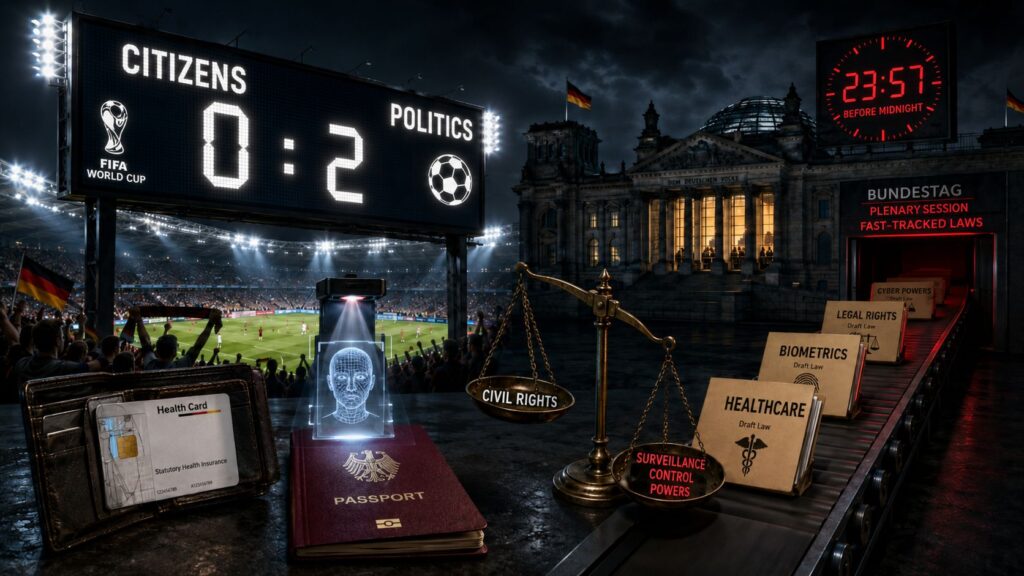
That same week, the football World Cup is underway. The nation’s attention is on the ball, the front pages belong to the tournament, and whatever is passed in the Reichstag building this Thursday and Friday runs alongside it, unnoticed. The sports pages carry line-ups and standings; the Bundestag’s agenda carries contribution hikes and new police powers. The thesis of this piece is not that anyone is deliberately hiding these laws behind the tournament. That cannot be proven, and anyone who claims it leaves the ground of fact. The thesis is more sober and at the same time more uncomfortable: consequential laws receive their final vote in a window where almost no one is looking – and they get there via hearings whose deadlines practically rule out any serious participation. Anyone who wants to know what is actually being decided this week has to read the official agenda. It is the only reliable yardstick, and it is unambiguous. Five measures are at the center: four of them come to a final vote and thus become law, one is only beginning its passage. What connects them is not a common theme but a common moment – and the fact that each touches the citizen at a point where it hurts: in their health, in their own data, in their right to defend themselves in court.
The Question Hardly Anyone Asks During Football Week
Anyone seeking to understand this week’s slate of decisions looks not at the headlines but at the official agenda of the 85th through 87th sittings of the Bundestag. It is public, it bears the date of June 11, 2026, and it is the starting point of any serious examination. The central question is: what is actually being decided here, while everyone is watching – only somewhere else?
The frame is quickly sketched. In June the Bundestag sits for only a single session week, from June 22 to 26. After that comes one final week from July 06 to 10, then the parliamentary summer recess begins; in August the parliament does not sit. That objectively creates a narrow window. Anyone wanting to finish a measure before the recess has to push it through now. This pre-recess compression is no secret and no trick – it repeats itself year after year. What is new is only that this summer it coincides with the maximum distraction of a major sporting event. When a whole country watches football, most of the media report on football too; and whatever is not reported on takes place without public resonance. For these three session days alone, from Wednesday to Friday, the agenda lists more than 30 items – from health insurance to building and planning law to several laws with a European dimension. It is the last great clearing-out week before the recess.
This is precisely where the sober analysis begins, not the outrage. Weak public scrutiny is structurally convenient – regardless of whether it is intended. A law passed in the spotlight of a broad debate has to justify itself differently than one decided on a Friday morning in the shadow of a round-of-sixteen match. The federal government itself set an explicitly tight timetable for its most important measure this week, the health insurance reform: the Bundestag and Bundesrat were to pass the law conclusively before the summer recess. Who benefits from this haste and the weak public scrutiny follows on its own. That conclusion is for the reader to draw, not the author. What can be proven here is twofold: what is being decided, and at what pace it was driven through the participation process. Both are documented, both can be verified, and both speak for themselves – without the need for a single insinuation. Both follow now, finding by finding.
The Wallet: The Health Insurance Reform
What the Insured Will Pay
The hardest piece is the Statutory Health Insurance Contribution Rate Stabilization Act (GKV-Beitragssatzstabilisierungsgesetz), Bundestag document 21/6130. The Bundestag decides on its second and third readings – that is, the final vote – on Friday, June 26, 2026. Officially it is about stabilizing contribution rates; the government points to an expected funding gap in the statutory health insurance system of 15.3 billion euros in 2027 and up to roughly 40 billion euros in 2030. In fact, the package contains a series of direct burdens and benefit cuts for the insured. It follows years of rising contribution rates and essentially implements the recommendations of the Health Finance Commission: of its 66 proposals, more than three quarters are to be put into practice, according to Health Minister Nina Warken. The timetable was tightly packed – only weeks passed between the publication of the commission’s recommendations in the spring and the cabinet decision on April 29, 2026.
In order. The contribution assessment ceiling – the income level up to which contributions are levied – will be raised exceptionally by 300 euros a month starting in 2027, equivalent to an annual increase of 3,600 euros. For high-earning members that means an additional burden of up to roughly 25 euros a month. For spouses and partners previously co-insured free of charge without certain caregiving responsibilities, an additional contribution of 2.5 percent is levied on the income of the main earning member; exempt are, among others, parents of children under seven, family caregivers, and people above the standard retirement age. So anyone who until now co-insured a non-working partner free of charge will pay for it in future. Alongside the contribution assessment ceiling, the compulsory insurance threshold is also being raised – the figure that determines the income level at which a switch to private health insurance becomes possible, a detail lost in public perception but with immediate consequences for those affected. That the issue is contentious is shown by the agenda itself: alongside the government bill, several counter-motions from the AfD, the Greens, and the Left are called up on June 26 which – from differing directions – demand that the insured be relieved rather than burdened.
For co-payments, which have remained largely unchanged since 2004, comes an increase of 50 percent. For medicines, the personal contribution rises from at least five and at most ten euros to at least 7.50 and at most 15 euros per drug; for remedies and home nursing care, too, the co-payment rises to up to 15 euros. For a chronically ill person with two long-term medications – say an asthma spray and a pancreatic preparation – this quickly adds up to a noticeable monthly sum, and that for people who cannot do without these drugs. The fixed subsidy for dental prosthetics falls from 60 to 50 percent, returning to the level before October 2020. Homeopathy and anthroposophic remedies drop out of reimbursement for lack of scientific proof of efficacy, as do cannabis flowers. The pharmacy discount rises from 1.77 to 2.07 euros, the employer contribution for mini-jobs from 13 to 17.5 percent. And in a separate procedure, a levy on sugar-sweetened beverages is to be introduced from 2028. A flat cut to sick pay considered at first did not come in the end; instead, a graduated partial sick note at 25, 50, and 75 percent is made possible.
Through the Hearing at Top Speed
So much for the content. At least as revealing is the pace at which this law was put through the prescribed participation process. The departmental draft was sent to nearly 100 health-sector institutions on April 16, 2026 – with a deadline for comment of April 20, 9 a.m. That is less than four days, most of which fell on a weekend. Associations such as ver.di, the Parity Welfare Association, and the German Social Association criticized the deadline as inadequate and inappropriate; one professional body reported that it received the request for comment only after the deadline had already passed. Anyone who asks nearly a hundred organizations over a weekend for comments on a law that overhauls the financing of statutory health insurance is not seeking a serious debate. He is seeking a check mark behind a procedural step.
To put the magnitude in perspective: the government puts the relief for health insurance at 16.3 billion euros for 2027 and up to 38.1 billion euros by 2030. The larger part of that, around 69 percent, is to come in 2027 from remuneration caps and savings at practices, clinics, and drug manufacturers. The annual remuneration increases will in future be capped at the actual cost trend or the so-called basic wage rate, whichever is lower; for the years 2027 to 2029 an additional deduction of one percentage point applies. The National Association of Statutory Health Insurance Physicians sharply criticized the cabinet decision and warned of a paradigm shift in outpatient care. Behind the sober billion-euro figures, then, lies not only a redistribution at the expense of the insured but also an intervention in the financing of care itself. The share borne by patients through higher co-payments and benefit adjustments stands, according to the draft, at 3.8 billion euros in 2027 and roughly 4.4 billion euros in 2030. At the same time, the federal government cuts its subsidy to health insurance by two billion euros a year from 2027; the move toward stronger refinancing of the health costs of Bürgergeld recipients starts with a mere 250 million euros in 2027 and only rises to two billion from 2031. The burden is thus not merely shifted, it is shifted downward – onto those who pay contributions and need benefits.
Biometrics and State Powers
The Passport in Private Hands
On Thursday, June 25, the Act to Enable Digital Passenger Processing comes up for its final vote, Bundestag document 21/6129. It sounds like a technical administrative matter and is in truth a breaking of the dam in the handling of biometric data.
The core: in future, private aviation companies are to be permitted to read out and process the biometric data stored on the passport chip in order to process the passenger at the airport without repeated document checks. At the individual checkpoints, only the facial image captured at that point would then be matched against the biometric pattern recorded at the start. Until now, the mandatorily collected chip data may be used exclusively by police forces and by passport, ID-card, and registration authorities. It would be, as the civil-liberties organizations netzpolitik.org and the Chaos Computer Club jointly note, the first time such data is handed to the private sector. When the biometric passport was introduced in 2005, it was expressly laid down by law that the chip data may be used only by authorities and for narrowly limited purposes of counterterrorism. That boundary is now being deliberately moved. The draft relies on European requirements for security features in passports and ID cards and creates, in the Aviation Act and the Passport Act, the authorization for aviation companies to read the required data from the chip. It thus fits into a longer trend: in previous years too there were pushes to centralize biometric data more and make it usable across agencies. What begins as a convenience gain at check-in is part of a gradual normalization of biometric access – this time with the private sector as the new recipient.

The government stresses that the procedure is voluntary and speeds up processing; the regular check remains possible. The expected time gain, according to the draft, is estimated at one minute per passenger, across some 38 million affected private air journeys. The pattern is familiar: voluntary today, infrastructural standard tomorrow. And it meets an industry whose IT security does not enjoy the best reputation. Data leaks at airlines are no rarity – only that this time it would not be booking data but biometric features which, unlike a password, cannot be changed. A facial pattern once compromised stays compromised. The backstory is also notable: the previous government had already planned a similar law but no longer implemented it in 2024. Now it is being passed on and put to a vote. The trade-off being made here is, at its core: one minute of time saved at the airport against the permanent opening of a hitherto strictly protected data category to private hands. That is precisely why such a switch-setting belongs in a broad public debate – and not in a twenty-minute exchange on the margins of a football week.
The State Reaches In
That same Thursday, the Act to Strengthen Cybersecurity comes before parliament in its first reading. First reading means: it is not yet passed this week but only begins its parliamentary passage. It matters nonetheless, because it makes visible the thrust of this government’s security policy. The federal cabinet adopted the draft on May 27, 2026.
In substance, the law marks a departure from the principle that the best protection against attacks lies in prevention and resilience. In future, the Federal Criminal Police Office, the Federal Police, and the Federal Office for Information Security are to be allowed not only to detect attacks but to intervene actively. Concretely, under the draft, that means: prohibiting or restricting the operation of IT systems, rerouting or blocking data traffic, and reading out, deleting, or altering data in information-technology systems – expressly even without the knowledge of those affected. This is anchored, among other things, in a new Section 41a of the Federal Police Act and a new chapter in the Federal Criminal Police Office Act; the office also receives the new task of warding off IT threats with an international or foreign- and security-policy dimension. The Federal Office for Information Security gains powers to issue orders to DNS and digital service providers, as well as expanded options for protecting the federal government’s communications; operators of critical infrastructure are to channel availability indicators to the office in automated form. Federal Interior Minister Alexander Dobrindt announced that attackers would be disrupted and their infrastructure shut down. For the new tasks, more than 350 additional positions and around 50 million euros a year are earmarked. In the justification, the government points to the geopolitical situation, hybrid threats, and the war in Ukraine.
For fairness, the counterposition belongs here. The government stresses that these are not so-called hackbacks in the sense of retaliatory strikes; the targets are exclusively those servers from which attacks emanate. And the Federation of German Industries supports more effective defense in principle. Yet the combination of far-reaching technical powers, interventions without the knowledge of those affected, and new obligations for service providers creates a framework of intervention powers that, without intensive judicial and parliamentary scrutiny, can quietly lower the threshold from threat prevention to covert surveillance. netzpolitik.org calls the draft a dangerous offensive. How far the measure reaches can be read from the referral alone: the lead committee is the Interior Committee, but the committees for economics, defense, transport, digital affairs, and the budget are co-advising – a law that reaches deep into the state, the economy, and critical infrastructure all at once. It is a measure that would have deserved a broad public reckoning – and barely gets one in a football week.
Legal Recourse and Participation
Who Is Still Allowed to Sue
Back to the laws actually being passed this week. On Thursday, June 25, the Bundestag decides on the amendment to the Environmental Appeals Act, Bundestag documents 21/4146 and 21/4961. The government wants to streamline the right of environmental associations to sue, as it puts it, and to speed up court proceedings in order to implement infrastructure projects faster.
At its core this means stricter rules for the association lawsuit. Pending legal proceedings are to no longer have suspensive effect – a project can thus continue while its lawfulness is still being contested. The principle of judicial investigation, under which the court establishes the facts ex officio, is restricted in favor of the principle of party presentation, under which the parties must supply the material themselves; a deadline for the defense reply is introduced, an abuse clause is specified, and the recognition of associations entitled to sue is more strongly tied to their spatial and substantive standing. What sounds technical has a tangible consequence: if the suspensive effect falls away, excavators can roll and routes can take shape before a court has ruled on the suit. By the time the dispute is eventually decided, the facts have often long since been created – a won case is of little use if the forest has already been cleared. To be fair: the draft also extends the circle of those entitled to sue to foundations, and industry representatives expressly welcome the reform. In parallel, there is a bill from the AfD that seeks to strip state-funded non-governmental organizations of the right to sue entirely – which further illuminates the thrust of the debate.
Yet the experts named by the SPD, Greens, and Left warned in the hearing that the goal of acceleration would be missed and nature conservation weakened; they also raised concerns under international and EU law, because the Aarhus Convention secures access to courts in environmental matters. Deutsche Umwelthilfe sees in the amendment a worsening compared to the current legal situation. The Green parliamentary group puts the finding in a nutshell: under the guise of acceleration, information and standing rights would be dismantled. It is one of the basic rights of citizens that administrative action can be reviewed in court. Whoever curtails that possibility touches not a technical procedural question but a question of democratic control. The Bundestag debates it for 20 minutes. Twenty minutes for a change that determines who in future may even go to court when an authority waves through a major project – that is the proportion at issue.
Acceleration as Method – and the Grotesque Deadline
Closely linked to it is the Infrastructure Future Act, Bundestag documents 21/4099 and 21/4301, which is to be passed on its second and third readings the same Thursday. It is an omnibus law that, in one go, amends 18 existing laws and one ordinance in order to accelerate and consistently digitize planning and approval procedures, above all in the transport and energy sectors. Transport Minister Patrick Schnieder calls it a gamechanger; one key point, he says, is prioritization. In practice this means: the plan-approval procedure is consistently digitized, prospectively shifted to “digital only,” and central transport projects are given legal priority. Essential transport infrastructure is placed in the overriding public interest – a status that gives it precedence among protected interests in the weighing process and structurally downgrades opposing concerns such as nature or resident protection. Express reference is made to the interests of national and alliance defense – a wording that shows how far rearmament and infrastructure now interlock. In conservation law, the substitute payment is to rank equally alongside real offsetting measures; environmental associations warn of a de facto abolition of real compensation. Here too experts warned of falling protection standards and shrinking participation rights, while representatives of municipalities, Deutsche Bahn, and the construction industry welcomed the measure.
And here the pattern of the health insurance reform shows in its purest form. The departmental draft of this law went into the participation process for the federal states and associations, according to the government’s rebuttal, on Friday, December 12, 2025, at 3:30 p.m. The deadline for comments ended on Monday, December 15, 2026, at 10 a.m. Anyone who does the math arrives at a single weekend – for a law that amends 18 other laws. A federal government that sends out such a draft on a Friday afternoon and closes the window on a Monday morning did not intend the participation as a corrective but as a formality. The Bundesrat expressly criticized this procedure. It is the same logic with which the health insurance law was pushed through the hearing – only a notch more blatant. Two laws, the same script: deadline over the weekend, final vote in football week. On top of that, the law is part of a larger acceleration course that recalibrates planning law, environmental law, and participation across several measures; the Infrastructure Future Act and the amendment to the Environmental Appeals Act expressly interlock. Read together, the two reveal the common line: build faster, sue less, have less say.
Who Benefits from the Lack of Scrutiny
Put the five measures together and what emerges is no coincidence but a pattern. Across several laws, the participation deadlines are so short that serious expert review is barely possible – less than four days over a weekend for the health insurance law, literally from Friday afternoon to Monday morning for the Infrastructure Future Act. The final votes bundle into a single week before the summer recess. And that week falls into the largest attention vacuum the calendar has to offer. Each of these three findings is provable on its own; together they yield a constellation in which consequential laws are passed under a fraction of the attention they deserve.
The honest counter-check belongs here. The Bundestag’s session calendar is real and not invented for the football World Cup; the pre-recess compression exists every year. The dates of major sporting events are set not by any government but by international federations. It therefore cannot be proven that these laws lie in this week because the World Cup is running. Nor is that necessary. What can be proven is that the result is the same, whether intended or not: higher contributions, opened biometric databases, new powers of intervention, and curtailed rights to sue pass through parliament while the nation watches the ball. And it can be proven that the procedures leading to these decisions cut public participation to the bare minimum. Who benefits from weak scrutiny is not a question of insinuation but of logic – and everyone may give the answer for themselves. The task of the press would be to grow louder, not quieter, in precisely such weeks. That the mainstream barely meets this task in a tournament week is no malice but market logic: hardly anyone reads about a contribution hike in statutory health insurance during football week. That only makes the hole all the larger. Informed democratic scrutiny would need the opposite: adequate hearing deadlines, separate deliberations instead of bundled clearing-out weeks, and reporting that puts consequential laws on the agenda even when they bring fewer clicks than a penalty shootout. None of these conditions is met this week.
What Is Happening in Brussels at the Same Time
The pattern does not end at the German border. In exactly the same window, the European Union is likewise shifting fundamentals – and there too the argument holds that it hits the citizen without the citizen noticing. Four measures run in parallel, and all four have to do with money, freedom, or control. In early June, Parliament and Council agreed on the new Return Regulation, which enables deportations to third countries via so-called return hubs, introduces a European return order, and provides for detention periods of up to 24 months; human rights organizations such as Amnesty International and ECRE are up in arms and speak of the institutionalization of deterrence and detention. The CSAM Regulation known as chat control is stuck in the decisive trilogue with a target finish of June 2026 – mandatory suspicionless mass surveillance is off the table, but the transitional rule for voluntary scanning already expired on April 03, 2026, and the new front line is age verification, in effect an ID requirement for large parts of the internet. On June 16, the European Parliament gave final approval to the EU-US tariff deal, under which the EU abolishes its tariffs on US industrial goods while European exports continue to be charged at around 15 percent into the US – a deal many MEPs themselves call one-sided. And over it all hangs the new EU long-term budget of around two trillion euros for the years 2028 to 2034, paid above all by one country: Germany, the Union’s largest net contributor, which immediately objected to a budget of this size.
These four measures deserve their own examination. It follows in Part 2 of this analysis a week from now – by the same yardstick and with the same sober eye.
Conclusion: Scrutiny Depends on Attention
This text is not about football, and it is not about a conspiracy. It is about a plainer and harder insight: democratic scrutiny lives on attention, and attention is finite. A parliament can decide, on a single Thursday and Friday, on the financing of health insurance, on biometric data in private hands, on active powers of intervention for the security agencies, and on access to the courts – and the public barely registers any of it, because its attention is bound elsewhere.
When consequential laws are bundled, after rushed hearings, into an attention-poor window, the scrutiny deficit is real, whatever the motive from which it arises. The consequence is not outrage but a task – and it lies not with the government but with the citizen: look closely, precisely when everyone else is looking elsewhere. Anyone who wants to be taken seriously as a responsible citizen cannot rely on the important decisions being served up at the right time. Sometimes they sit on page 14 while page 1 belongs to the kickoff. For the contributions that rise from 2027, the passports that are read out, and the rights to sue that shrink, remain in force long after the final whistle has faded. The game is on. The only question is who has lost in the end.

Did this analysis help you make sense of what’s happening? Hollister’s Geopolitics delivers deep dives like this every week – primary-source-based, without partisanship. Subscribe free of charge and don’t miss Part 2 on the EU level.
Michael Hollister
is a geopolitical analyst and investigative journalist. He served six years in the German military, including peacekeeping deployments in the Balkans (SFOR, KFOR), followed by 14 years in IT security management. His analysis draws on primary sources to examine European militarization, Western intervention policy, and shifting power dynamics across Asia. A particular focus of his work lies in Southeast Asia, where he investigates strategic dependencies, spheres of influence, and security architectures. Hollister combines operational insider perspective with uncompromising systemic critique – beyond opinion journalism. His work appears on his bilingual website (German/English) www.michael-hollister.com and in investigative outlets across the German-speaking world and the Anglosphere.
Support my Work – become a Member

Sources
- Deutscher Bundestag – Agenda of the 85th to 87th sittings (as of June 11, 2026): https://www.bundestag.de/resource/blob/473452/Tagesordnung-komplett.pdf
- Federal Ministry of Health – FAQ on the GKV Contribution Rate Stabilization Act: https://www.bundesgesundheitsministerium.de/service/gesetze-und-verordnungen/guv-21-lp/gkv-beitragssatzstabilisierungsgesetz-faq
- Federal Ministry of Health – Cabinet decision on the GKV Contribution Rate Stabilization Act: https://www.bundesgesundheitsministerium.de/ministerium/meldungen/gkv-beitragssatzstabilisierungsgesetz-kabinett-29-04-26
- Deutscher Bundestag – First reading of the GKV reform (text archive, week 24): https://www.bundestag.de/dokumente/textarchiv/2026/kw24-de-gkv-1181958
- Deutsches Ärzteblatt – Federal cabinet adopts the GKV Contribution Rate Stabilization Act: https://www.aerzteblatt.de/news/bundeskabinett-beschliesst-gkv-beitragssatzstabilisierungsgesetz-a314b29b-7fd8-4763-8e6f-77c472f4089e
- Bundestagszusammenfasser – Statements and hearing deadlines on the GKV law: https://bundestagszusammenfasser.de/details?docid=1220
- Deutscher Bundestag – Document 21/6129, Act to Enable Digital Passenger Processing: https://dserver.bundestag.de/btd/21/061/2106129.pdf
- netzpolitik.org – Federal government wants to give companies access to state biometric data: https://netzpolitik.org/2026/flugreisen-bundesregierung-will-unternehmen-zugriff-auf-staatliche-biometrie-daten-geben/
- ZDFheute – Cyber defense in cabinet: more rights for security agencies: https://www.zdfheute.de/politik/deutschland/cyberabwehr-hackerangriff-bundeskabinett-polizei-bsi-100.html
- Federal Ministry of the Interior – Draft law to strengthen cybersecurity: https://www.bmi.bund.de/SharedDocs/gesetzgebungsverfahren/DE/CI1/cyberabwehr.html
- netzpolitik.org – Draft law to strengthen cybersecurity: a dangerous offensive: https://netzpolitik.org/2026/gesetzentwurf-zur-staerkung-der-cybersicherheit-gefaehrliche-offensive/
- Deutscher Bundestag – Environmental Appeals Act, final vote (text archive, week 26): https://www.bundestag.de/dokumente/textarchiv/2026/kw26-de-umwelt-rechtsbehelfsgesetz-1184342
- Bündnis 90/Die Grünen parliamentary group – Environmental Appeals Act: local say unwanted: https://www.gruene-bundestag.de/unsere-politik/fachtexte/umwelt-rechtsbehelfsgesetz-mitsprache-vor-ort-unerwuenscht/
- Deutscher Bundestag – Infrastructure Future Act, decision (text archive, week 26): https://www.bundestag.de/dokumente/textarchiv/2026/kw26-de-infrastruktur-zukunftsgesetz-1184312
- Deutscher Bundestag (hib) – Government’s rebuttal on the Infrastructure Future Act: https://www.bundestag.de/presse/hib/kurzmeldungen-1150806
- Council of the EU – Agreement on the Return Regulation: https://www.consilium.europa.eu/en/press/press-releases/2026/06/01/council-and-parliament-reach-deal-on-returns-of-illegally-staying-third-country-nationals/
- netzpolitik.org – Trilogue on chat control enters decisive phase: https://netzpolitik.org/2026/interne-dokumente-trilog-zur-chatkontrolle-geht-in-entscheidende-phase/
- Council of the EU – Agreement on implementing the EU-US trade deal: https://www.consilium.europa.eu/en/press/press-releases/2026/05/20/eu-us-trade-council-and-parliament-strike-a-deal-to-implement-the-tariff-elements-of-the-joint-statement/
- European Commission – EU budget 2028-2034 explained: https://commission.europa.eu/topics/budget/eu-budget-2028-2034-explained_de
© Michael Hollister – All rights reserved. Redistribution, publication or reuse of this text requires express written permission from the author. For licensing inquiries, please contact the author via www.michael-hollister.com.
Newsletter
🇩🇪 Deutsch: Verstehen Sie geopolitische Zusammenhänge durch Primärquellen, historische Parallelen und dokumentierte Machtstrukturen. Monatlich, zweisprachig (DE/EN).
🇬🇧 English: Understand geopolitical contexts through primary sources, historical patterns, and documented power structures. Monthly, bilingual (DE/EN).