
Published at GlobalBridge on June 08, 2026
4.145 words * 22 minutes readingtime
How Germany Procedurally Evades the Genocide Case
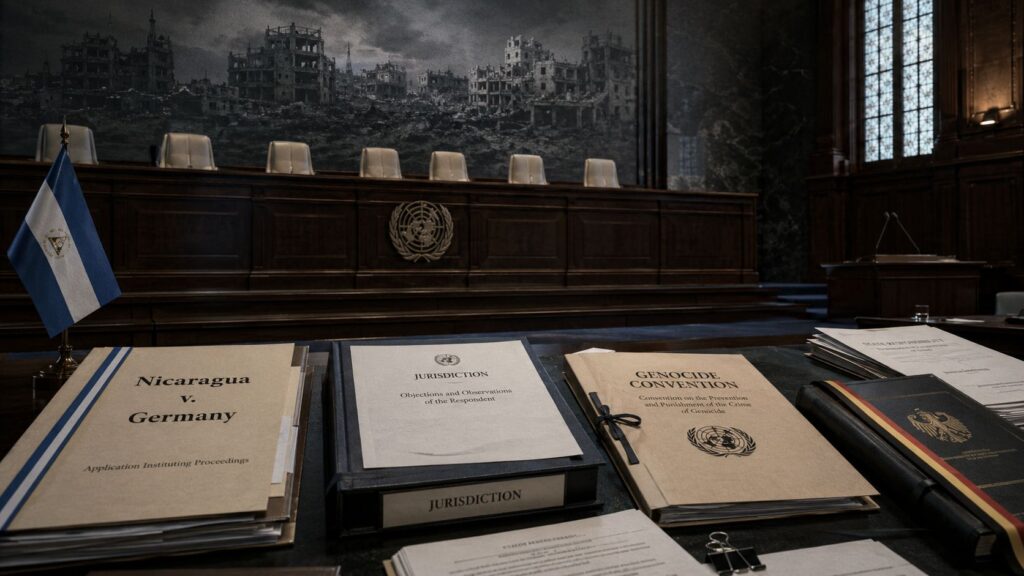
On 21 October 2025, the Federal Republic of Germany allowed a deadline at the world’s highest court to run down to the last hour. It was the final day on which Berlin could, under the rules of the International Court of Justice, still raise preliminary objections to the court’s jurisdiction – three months after receipt of Nicaragua’s application. Germany used it. The filing automatically suspended the proceedings on the merits. A founding member of the European Union, which for decades has cast itself as a champion of the rules-based order, answered the charge of complicity in genocide not by engaging with the substance, but with a procedural maneuver. It is precisely this maneuver that is the subject of this analysis – not because it is legally impermissible, but because it reveals a great deal politically.
The central question is not whether Germany will ultimately be found liable; that is for judges to decide, and the road there is long. The question is more precise: What does the manner in which Berlin defends itself say about the relationship of Western states to the international law they invoke so insistently against others?
The Chronology of an Evasion
The case begins on 01 March 2024. Nicaragua files an application against Germany at the International Court of Justice in The Hague. The charge: through arms deliveries to Israel and through the suspension of payments to the UN relief agency UNRWA, Germany violated its obligations under the Genocide Convention of 1948 and the Geneva Conventions. In short: Berlin was facilitating the commission of genocide and failing to do everything in its power to prevent it. Nicaragua simultaneously requests provisional measures – the court should prohibit Germany, with immediate effect, from delivering further arms.
On 08 and 09 April 2024, the court holds public hearings. On 30 April 2024 it rules: by 15 votes to 1, the court rejects the request for provisional measures. The sole dissenting vote comes from Judge ad hoc Al-Khasawneh, whom Nicaragua itself had nominated. At first glance, a clear victory for Germany. On closer inspection, less clear-cut – and for two reasons.
First, the order was unusually brief. The substantive portion ran to barely two pages – one of the shortest provisional measures orders in the court’s history. The court declined almost entirely to set out its reasoning on jurisdiction, plausibility of rights, and urgency. It rested essentially on Germany’s assurances: a robust control system for arms exports, a marked decline in licenses since November 2023, only four licenses for “war weapons,” and the observation that contributions to UNRWA were voluntary in nature and that no payment had in any case been due at the material time.
Behind the second pillar of the case – the UNRWA charge – lies its own chronology. Germany had temporarily suspended its payments to the agency in late January 2024, after Israel claimed that individual UNRWA staff members had been involved in the attacks of 07 October 2023. Berlin later resumed funding and pointed to its continued support for Gaza through the European Union and other organizations. It was precisely here that the court intervened: contributions to UNRWA were voluntary, and no payment had been outstanding at the material time. The full weight of the issue only became apparent afterward: on 28 October 2024, the Knesset passed legislation barring the agency from operating in territory claimed by Israel. The humanitarian dimension intensified while the proceedings remained legally frozen in place.
Second, the court simultaneously rejected Germany’s application to have the case removed entirely from the list. There was no “manifest lack of jurisdiction” – the proceedings would therefore continue. And in a passage that was often lost in the reporting on the German “victory,” the court expressly reminded all states, Germany explicitly among them, of their obligations under international law when supplying arms to parties in a conflict, so as to avoid those arms being used in violation of the Genocide Convention and the Geneva Conventions. The order prejudged neither jurisdiction nor the merits.
The path to full proceedings was thus open. By an order of 19 July 2024, the court set the timetable: Nicaragua was to file its Memorial by 21 July 2025, Germany its Counter-Memorial by 21 July 2026. Nicaragua met its deadline and submitted its Memorial on 21 July 2025 as required. In that pleading, Managua consolidated its charges into nine concrete submissions – those sub-paragraphs of paragraph 484 against which Germany’s later preliminary objections were explicitly directed. What had begun as an emergency application in 2024 had become a fully elaborated claim on the merits. Germany, however, filed no Counter-Memorial. It chose the other path.
On 21 October 2025 – the last day permissible under the court’s rules – Berlin filed preliminary objections to the court’s jurisdiction and to the admissibility of the application. Under Article 79bis of the Rules of Court, this automatically suspends the proceedings on the merits; a separate incidental phase begins, dealing solely with the preliminary questions. The court set Nicaragua a deadline of 23 February 2026 to respond to the objections. Only after that will an oral hearing on the preliminary questions be scheduled – hardly before the second half of 2026 in observers’ assessments. A decision on the objections, which the court issues in the form of a judgment, is unlikely before the first half of 2027. And only if the court rejects the objections will the merits be heard at all.

It is worth examining the pace. Preliminary objections are in principle meant to be raised “as early as possible.” Germany had in substance signaled them as early as April 2024, yet then waited until the very last permissible day. Almost all states exhaust the three-month period; few stretch it as fully as Germany did. Whoever uses the deadline to the maximum gains time – time during which the proceedings on the merits are stayed.
The Legal Core: Israel as the “Indispensable Third Party”
The content of the German objections is not public. But what Berlin is arguing can be inferred from the oral proceedings of 2024, in which Germany had already set out its line of argument. It rests on two pillars.
The first is formal: at the time of the application, no dispute between the parties had yet “crystallized”; Nicaragua had sued prematurely. The objection targets a basic precondition of jurisdiction: for the court to have jurisdiction, there must be a discernible disagreement between the parties over a question of law or fact. Nicaragua had filed its application only a few days after its diplomatic announcement – in Germany’s view, too soon to speak of a settled dispute. The second pillar is the substantive one and draws on an old doctrine of the court, the Monetary Gold case of 1954: the court may not adjudicate on the responsibility of a state if doing so would first require it to establish the responsibility of a third state that is not party to the proceedings. Germany’s argument runs accordingly: the court cannot rule on German complicity without first establishing that Israel itself is acting in violation of international law. But Israel is not a party and has not consented to jurisdiction. The application is therefore inadmissible and the case should be dismissed.
This is a legally serious objection – the then Vice-President of the court, Julia Sebutinde, shared it expressly in her separate opinion in 2024, even though she voted with the majority against provisional measures. Her reasoning anticipated the German preliminary objections: a dispute had not crystallized by 01 March 2024, the court lacked jurisdiction prima facie, and Germany’s conduct could not be adjudicated without first examining the lawfulness of Israeli action. The sole dissenting vote, for its part, came from Nicaraguan Judge ad hoc Al-Khasawneh, who described the Israeli military operation as an ongoing human tragedy of nearly apocalyptic proportions. The breadth of the opinions alone showed that the brief order concealed deep divisions among the judges. But it is by no means conclusive – and it is precisely here that the legal battle to be fought over the coming years lies.
International law scholar Adil Haque of Rutgers University has formulated the counter-position with precision. His core argument: the obligation under the Genocide Convention is directed, at its source, at preventing individuals from committing genocide. A state violates its duty to prevent when it fails to use its influence to restrain individuals – including officials of another state – from committing acts of genocide. The court therefore need not establish that Israel as a state bears international responsibility; it suffices to establish that Israeli officials committed acts of genocide and that Germany failed to bring its influence to bear against them.
Haque sharpens this with a logical distinction that is likely to prove decisive in the proceedings: Israel’s state responsibility is a logical consequence of Germany’s responsibility, not a logical precondition for it. The Monetary Gold doctrine applies only where the responsibility of the absent third party constitutes the actual subject matter of the decision. That is not the case here. The court relied on the same mechanism in 2007 in the proceedings of Bosnia v. Serbia, when it found Serbia responsible for failing to prevent the genocide at Srebrenica – committed by actors whose conduct was not attributable to any state.
Haque also separates two charges that sound alike in everyday language but diverge in law. A state’s assistance in the internationally wrongful act of another state – governed by the law of state responsibility – does indeed presuppose that the third party’s act is established; here the Monetary Gold doctrine could well apply. Complicity within the meaning of the Genocide Convention, by contrast, attaches to persons: a German official would be complicit if he supplied Israeli officials with the means to commit the act – irrespective of Israel’s state responsibility. The same logic underlies the obligation under common Article 1 of the Geneva Conventions to ensure respect “in all circumstances.” Which reading the court adopts will determine whether Israel’s absence becomes an insurmountable obstacle or a peripheral issue.
Whether the court follows this line is open. What is clear is only this: the initial proceedings are not about whether Germany is complicit. They are about whether the court may adjudicate at all. Substance yields to jurisdiction – and that is, procedurally, the most effective way to slow an inconvenient case.
Germany’s Position – and the Three-Month Stop
Germany has consistently rejected the charges as unfounded, and its line of defense deserves a fair presentation. At the hearing in April 2024, the Legal Adviser of the Foreign Office, Tania von Uslar-Gleichen, stated that Israel had a right to defend itself against the terror of Hamas; unlike Nicaragua, Germany did not look past the fact that Hamas, too, bore obligations under international humanitarian law that it was not meeting. Germany’s agent, Christian Tams, explained that every export license was assessed on a case-by-case basis; since October, Germany had not supplied artillery shells or ammunition. From Germany’s perspective, the case rested on thin evidence and a one-sided view of the war.
This defense draws on a real institutional architecture that the court expressly recognized in 2024. German arms exports are governed by the War Weapons Control Act and the Foreign Trade Act; the most sensitive exports are decided by the Federal Security Council, a cabinet committee that meets in secret under the Chancellor’s chairmanship. Berlin argued that every license was examined individually to determine whether the goods could be used to commit genocide, crimes against humanity, or serious violations of the Geneva Conventions. The court’s decision against provisional measures rested precisely on this review mechanism and the documented decline in licenses. The strength of this defense is also its weakness: whoever invokes the diligence of their controls thereby acknowledges that there is something to control – a risk that may preclude a license.
Noteworthy is what Germany did not argue. Berlin did not claim before the court that Israel was complying with international humanitarian law or was not committing genocide. On the contrary: Germany told the court that it was not lack of funding that was preventing humanitarian aid from reaching the population of Gaza, but the restrictions on entry and distribution – and that those restrictions originated with Israel. Observers such as Haque read that as a de facto acknowledgment of the situation: whoever names the blockade of aid does not deny it.
Against this backdrop, German arms policy in 2025 is instructive – less for any single decision than for its timing. Between 07 October 2023 and 13 May 2025, the federal government approved arms exports to Israel worth 485.1 million euros, according to the Federal Ministry for Economic Affairs. What Berlin delivered in detail the government does not disclose; a parliamentary inquiry by the Left Party put individual export licenses between January 2024 and June 2025 at around 251 million euros. A few weeks after Nicaragua filed its Memorial on 21 July 2025, Berlin executed a widely noted reversal: on 08 August 2025, Chancellor Friedrich Merz announced that he would no longer approve arms goods that could be deployed in the Gaza Strip until further notice. The trigger was a concrete military step – the Israeli Security Cabinet’s decision to take over Gaza City. It was a historic distancing by one of Israel’s most steadfast supporters.
The move was contested domestically. Parts of Merz’s own CDU and the Central Council of Jews in Germany criticized it sharply, while the SPD and the opposition welcomed it as long overdue. Merz himself accompanied the announcement with the assurance that Israel had the right to defend itself against Hamas terror, that the release of the hostages and negotiations toward a ceasefire remained the priority, and that Hamas could play no role in a future Gaza. The distancing was thus limited and conditional. Historically, Germany is one of Israel’s most important arms partners – it has supplied submarines and naval vessels over decades, systems at the higher end of the value range. Against that background, even a three-month licensing freeze represented a break with the routine of a long partnership.
It lasted three months. On 24 November 2025, the federal government lifted the freeze, citing the ceasefire in Gaza. A few days later, on 06 December 2025, Merz traveled to Israel and met Prime Minister Benjamin Netanyahu – the first European head of government to do so in more than a year. The sequence speaks for itself, without any need to impute intent: the freeze fell in the weeks after the Memorial was received, the resumption followed shortly after the October preliminary objections. Whoever resumes arms transfers knows the documented situation in Gaza – and with it the risks that any transfer into a region carries, one in which violations of international law have simultaneously been recorded in Lebanon as well. The reader draws their own conclusion.
The Power Logic: Why Nicaragua, Why Germany
An objective analysis does not rest with the plaintiff’s side. That Nicaragua of all states is bringing this case is no coincidence but strategy – and it has an uncomfortable flipside.
Nicaragua chose Germany for a sober procedural reason: Berlin has accepted the compulsory jurisdiction of the International Court of Justice; the United States has not. Anyone wishing to sue Israel’s largest arms supplier – Washington – ran into its consent reservation. Germany was, purely in legal terms, the reachable target. There is also a historical thread: the Sandinista movement has maintained relations with Palestinian organizations since the revolution of 1979, and Nicaragua can point to its own precedent. In 1986, the same court found against the United States in Nicaragua v. United States, over support for the Contra rebels. Managua thus appears not as a newcomer, but as a state that has once before successfully wielded the weapon of international law against a major power.
The precedent is more than historical backdrop. In 1986, the court found that the United States had violated international law by supporting the Contra rebels and mining Nicaraguan ports. Washington did not recognize the judgment and blocked its enforcement in the Security Council by veto. Nicaragua thus knows from its own experience both sides: that a small state can prevail over a major power before the world’s highest court – and that a judgment without an enforcer carries no consequence. Nor does the case against Germany stand alone. It follows South Africa’s proceedings against Israel and forms part of a broader movement of Global South states using international law as a lever against Western policy. Some criticize this as instrumentalization; others defend it as the legitimate use of precisely those institutions the West itself created.
The flipside: the Ortega government is a problematic advocate of international law. In February 2024, a UN-backed body of independent human rights experts charged the leadership in Managua with abuses “amounting to crimes against humanity” – detention of political opponents, suppression of dissent. The government rejected the findings. This tension – a state facing serious charges of its own, taking another before the world’s highest court – belongs to an honest accounting. It does not legally invalidate the case, for in court it is the pleading that counts, not the character of the plaintiff. But it explains why Berlin and voices sympathetic to it could dismiss the proceedings as “biased” without having to engage with the substance.
On the German side, two principles collide. One is Staatsräson toward Israel, a foundation of German foreign policy for decades. It is an expression of historical responsibility stemming from the Holocaust and has been elevated by several chancellors to a matter of national identity. The other is Germany’s own obligations under international law, to which the court expressly reminded it in 2024. In this tension lies the real charge of the proceedings. For the evidentiary picture of the situation in Gaza has grown not weaker, but denser, since 2024. On 16 September 2025, the United Nations Independent International Commission of Inquiry on the Occupied Palestinian Territory found: Israel is committing genocide in the Gaza Strip. It is the finding of a mandated UN body that examined the facts using the methodology of international criminal law and considered four of the five acts of genocide defined in the 1948 Convention to be established. It is not an enforceable court judgment – none exists to this day, and accordingly nothing has yet been decided regarding German complicity. But it is admissible as evidence before the International Court of Justice and the International Criminal Court. What had been politically contested for two years now lay before the world as a verified finding.
Here, the double standard becomes a measurable quantity. During a genocide established by a UN body, arms exports to Israel rose overall by 18 percent; the European Union’s share of Israeli military imports nearly doubled, reaching around 54 percent in 2024 – according to figures from UN Special Rapporteur Francesca Albanese. More than half the weapons Israel imported during this period thus came from the EU. The largest individual share was still held by the United States, with around two thirds of Israeli arms imports; Washington also provided political cover for the conduct of the war through seven vetoes in the UN Security Council. It is the most precise measure of the distance between European claim and European conduct – and the backdrop against which Germany’s retreat into procedural tactics acquires its real meaning.
This logic also explains why the proceedings run into limits even in the best case. The International Court of Justice can establish facts and issue judgments but cannot enforce them; enforcement lies with the Security Council, in which Israel’s most important patron holds a veto. A judgment against Germany – should it ever come to that – would initially be a document, not an enforcement. That is exactly the asymmetry Nicaragua knows from its own case of 1986: whoever makes the finding rarely has the power to enforce it; whoever could enforce it rarely has an interest in doing so. This does not devalue the proceedings – a finding by the world’s highest court carries weight even without an enforcer – but it marks their reach soberly.
Three Scenarios
How does the case end? Three paths are conceivable.
In the first, the preliminary objections succeed. The court gives Germany right, declares itself without jurisdiction or the case inadmissible – whether because it regards Israel as an indispensable third party, or because it considers the dispute insufficiently crystallized. The case then dies at the threshold, without the merits ever being heard. This possibility is real; some observers consider it unlikely that the case will advance to the merits phase. Politically, it would be a victory of form over substance – and a signal to all Western supplier states that the aiding-and-abetting construction is barely sustainable in court. For the parallel wave of cases, from South Africa to the states that have declared their intervention in those proceedings, it would be a setback with effects reaching far beyond The Hague.
In the second, the preliminary objections fail. If the court rejects them – perhaps along the lines sketched by Haque – the actual proceedings on the merits begin. Germany would have to file its Counter-Memorial, there would be evidence-taking and oral argument. Years would pass before a judgment on the merits. Even such a procedural advance would carry weight: it would be the first time a Western state had to defend itself on the substance of a charge of complicity in genocide before the world’s highest court.
In the third, politics overtakes law. If the ceasefire, fragile since November 2025, holds, if the situation in Gaza changes fundamentally, or if the parties reach a lasting agreement, the proceedings could lose urgency without formally ending. The resumption of German deliveries was itself justified with the ceasefire – a pointer to how quickly the political basis of the dispute can shift. Nicaragua might nonetheless pursue the case on principle; the legal precedent would remain in the world, and with it the question the proceedings have raised.
Conclusion
Regardless of the outcome, these proceedings have already exposed something. Germany had a choice between two responses to the gravest charge international law knows. It could have engaged with the substance – with files, licensing lists, proof of its control mechanisms. Instead it chose the path via the jurisdictional question and the last permissible day. That is legitimate, and it is shrewd. But it is a choice, and it fits into a larger pattern: a freeze on deliveries when the Memorial arrived; resumption when the preliminary objections were filed; a Chancellor’s visit to Jerusalem a few days later.
The finding that goes beyond the legal one is therefore not the possible complicity, on which no court has yet ruled. The finding is the method. A state that declares international law to be the foundation of its foreign policy evades it the moment that law turns against the state itself. Whether the International Court of Justice is ultimately competent or not will occupy lawyers. The political lesson is already clear: the rules-based order applies – for the others.
German version exclusive published at GlobalBridge on June 08, 2026

Michael Hollister
is a geopolitical analyst and investigative journalist. He served six years in the German military, including peacekeeping deployments in the Balkans (SFOR, KFOR), followed by 14 years in IT security management. His analysis draws on primary sources to examine European militarization, Western intervention policy, and shifting power dynamics across Asia. A particular focus of his work lies in Southeast Asia, where he investigates strategic dependencies, spheres of influence, and security architectures. Hollister combines operational insider perspective with uncompromising systemic critique – beyond opinion journalism. His work appears on his bilingual website (German/English) www.michael-hollister.com and in investigative outlets across the German-speaking world and the Anglosphere.
Sources
- International Court of Justice – Case page “Alleged Breaches of Certain International Obligations in respect of the Occupied Palestinian Territory (Nicaragua v. Germany)”: https://www.icj-cij.org/case/193
- ICJ, Order on Provisional Measures of 30 April 2024 (15 to 1): https://www.icj-cij.org/node/203997
- ICJ, Press Release on Suspension of Merits Proceedings and Setting of Time-Limits (24 October 2025, PDF): https://www.icj-cij.org/sites/default/files/case-related/193/193-20251024-pre-01-00-en.pdf
- ICJ, Notice of Filing of Nicaragua’s Application (01 March 2024): https://www.icj-cij.org/node/203822
- GPIL / Stefan Talmon, “Germany Files Preliminary Objections at the Last Minute” (10 November 2025): https://gpil.jura.uni-bonn.de/2025/11/nicaragua-v-germany-germany-files-preliminary-objections-at-the-last-minute/
- GPIL, “Nicaragua Continues ICJ Proceedings Against Germany” (April 2025): https://gpil.jura.uni-bonn.de/2025/04/nicaragua-continues-icj-proceedings-against-germany/
- Just Security / Adil Ahmad Haque, “Nicaragua v. Germany: Why Israel is Not an Indispensable Third Party” (20 November 2025): https://www.justsecurity.org/124907/nicaragua-germany-israel-indispensable/
- Verfassungsblog, “Nicaragua Comes Up Empty: Provisional Measures in Nicaragua v Germany”: https://verfassungsblog.de/nicaragua-comes-up-empty/
- Euronews, “Germany stops military exports that could be used in Gaza, Chancellor Merz says” (08 August 2025): https://www.euronews.com/2025/08/08/germany-stops-military-exports-that-could-be-used-in-gaza-chancellor-merz-says
- Al Jazeera, “Germany lifts curbs on arms exports to Israel, citing Gaza ceasefire” (17 November 2025): https://www.aljazeera.com/news/2025/11/17/germany-lifts-curbs-on-arms-exports-to-israel-citing-gaza-ceasefire
- OHCHR, “Israel has committed genocide in the Gaza Strip, UN Commission finds” (16 September 2025): https://www.ohchr.org/en/press-releases/2025/09/israel-has-committed-genocide-gaza-strip-un-commission-finds
- Michael Hollister, “Israel – The Finding: Genocide” (31 May 2026): https://www.michael-hollister.com/de/2026/05/31/israel-der-befund-voelkermord/
© Michael Hollister – All rights reserved. Redistribution, publication or reuse of this text requires express written permission from the author. For licensing inquiries, please contact the author via www.michael-hollister.com.
Newsletter
🇩🇪 Deutsch: Verstehen Sie geopolitische Zusammenhänge durch Primärquellen, historische Parallelen und dokumentierte Machtstrukturen. Monatlich, zweisprachig (DE/EN).
🇬🇧 English: Understand geopolitical contexts through primary sources, historical patterns, and documented power structures. Monthly, bilingual (DE/EN).