
UPDATE Report – Updated: June 07, 2026 – Building on my update from June 03, 2026
by Michael Hollister
Exclusive published at Michael Hollister on June 07, 2026
2.880 words * 15 minutes readingtime
TICKER
ISRAEL AND LEBANON AGREE ON CEASEFIRE FRAMEWORK IN WASHINGTON – HEZBOLLAH WAS NOT AT THE TABLE
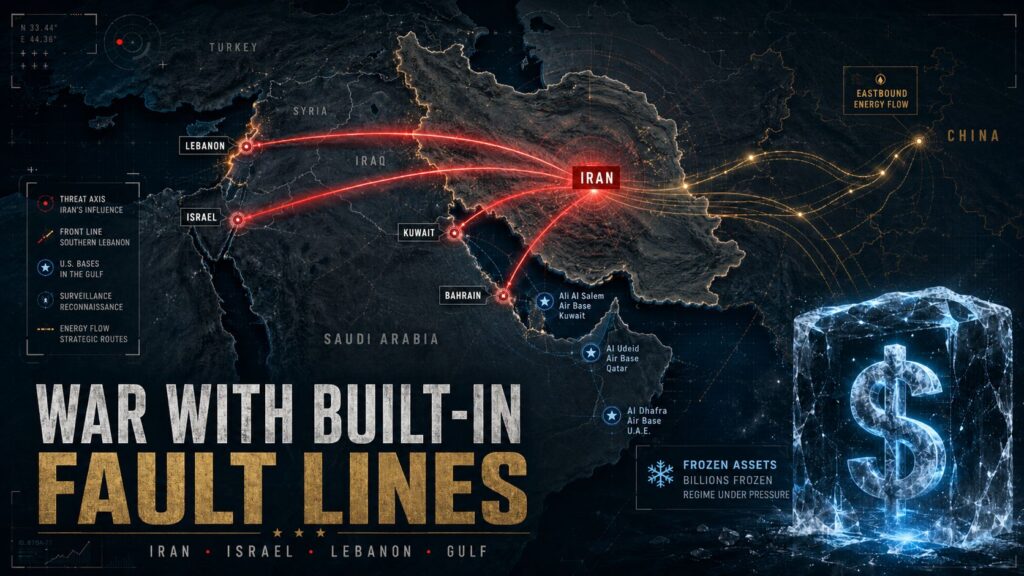
Ambassador Yechiel Leiter and Ambassador Nada Hamadeh signed a framework at the US State Department on 03 June obliging Hezbollah to a complete cessation of all attacks and to withdrawal south of the Litani. The Lebanese government was a party; Hezbollah was not. The framework obliges Israel to troop limitations and provides for a demilitarized zone under Lebanese Army administration. President Joseph Aoun called the agreement “the last chance” for a comprehensive ceasefire. That same night after the signing, Israel struck new targets in southern Lebanon.
IRGC DRONE HITS TERMINAL 1 OF KUWAIT INTERNATIONAL AIRPORT – 1 DEAD, 63 WOUNDED
On 03 June, an Iranian drone struck Terminal 1 of Kuwait International Airport; Kuwait’s Ministry of Health reports one dead and 63 wounded – one of the most costly days for the Arab Gulf states since the war began. Kuwait’s defense authorities stated they had intercepted 13 ballistic missiles and 17 drones. The IRGC denied striking the airport and blamed a misdirected US Patriot interceptor. Kuwait released CCTV footage showing the direct drone impact. CENTCOM described the Iranian account as “Totally FALSE” – a deliberate, calculated attack on a civilian airport.
IRGC CLAIMS ATTACKS ON ALI AL SALEM AND US FIFTH FLEET – CENTCOM STRIKES QESHM AGAIN
Also on 03 June, the IRGC stated it had fired missiles and drones at Ali Al Salem Air Base in Kuwait and at the US Fifth Fleet in Bahrain. CENTCOM struck an Iranian ground control center on Qeshm in response. Bahrain activated sirens and called on residents to seek shelter. No US casualties reported. The pattern – IRGC fires at Gulf states, CENTCOM strikes Iranian infrastructure – now runs as a permanent operational mode independent of the negotiating table.
SERBIAN UN PEACEKEEPER DIES FROM MORTAR FIRE – 7TH UNIFIL FATALITY SINCE WAR BEGAN
In the night of 03 to 04 June, mortar fire killed Sergeant Milovan Jovanović of Serbia at UN Position 7-2 near Marjayoun in southeastern Lebanon. Two further peacekeepers were wounded. UN Secretary-General Guterres condemned the death and called for a prompt investigation. UNIFIL reported an “increasingly high number” of projectile trajectories and impacts near its positions. It was the seventh UNIFIL fatality since the war began on 02 March. Who fired has not been definitively established; the IDF named Hezbollah mortars from the Al-Qatrani area as the cause.
HEZBOLLAH CATEGORICALLY REJECTS WASHINGTON FRAMEWORK – KASSEM: “CAPITULATION AND DEFEAT”
Hezbollah leader Naim Kassem declared on 04 June that the demand for withdrawal from southern Lebanon while Israeli attacks continued amounted to “capitulation, defeat, and the achievement of the enemy’s objectives.” Hezbollah rejected the framework as illegitimate, as the organization had not been part of the talks. It continued firing on Israeli positions and vehicles in southern Lebanon. The ceasefire is thus concluded at the government level but not in force on the battlefield – the structural trap of the entire Lebanon negotiation.
LAVROV IN ST. PETERSBURG: “EVERYTHING NOW DEMANDED OF IRAN WAS ALREADY THE CASE BEFORE THE AGGRESSION”
Russian Foreign Minister Sergei Lavrov declared on 05 June at the St. Petersburg International Economic Forum in an Izvestia interview: before 28 February, the Strait of Hormuz had been freely and toll-free navigable for all, Khamenei’s fatwa against nuclear weapons had been in force, and the IAEA had regularly confirmed the absence of military diversion. “Everything now demanded of Iran was already the case before the aggression. The United States has painted itself into a corner.” Lavrov additionally referenced Libya: Gaddafi gave up his nuclear program and was deposed; North Korea kept its weapons and survived.
CENTCOM SHOOTS DOWN FOUR DRONES AND STRIKES GORUK AND QESHM – TWO MORE ON 06 JUNE
On 05 June, CENTCOM shot down four Iranian attack drones over the Strait of Hormuz and then struck coastal radar and surveillance installations at Goruk and on Qeshm. Iran described this as a clear violation of the ceasefire and identified the struck installations as protection for its borders and international shipping. On 06 June, CENTCOM shot down two further drones over Hormuz. In parallel, CENTCOM reports 129 ships redirected and 6 disabled since the blockade began. The volume of exchanges this week exceeds every comparable period since April.
ISRAEL KILLS LEBANESE BRIGADIER GENERAL THREE DAYS AFTER CEASEFIRE – AOUN: “FLAGRANT VIOLATION”
Israeli air strikes killed nine people in southern Lebanon on 06 June, including a brigadier general, a captain, and a soldier of the Lebanese Army near Kfar Tibnit. President Aoun spoke of “a flagrant violation of Lebanese sovereignty and international law.” The Lebanese Army stated that Israel’s “deliberate, repeated aggression” aimed at torpedoing every attempt at a solution. Israel stated the struck vehicle had been moving suspiciously toward its own soldiers; it was operating against Hezbollah, not against the Lebanese Army. More than 3,500 dead in Lebanon since the war began.

LEBANON ACCUSES IRAN OF USING THE COUNTRY AS A BARGAINING CHIP – ARAGHCHI PUSHES BACK
President Aoun and Prime Minister Salam stated publicly on 05 and 06 June that Iran was using Lebanon as a “hostage” in talks with Washington. Iran explicitly ties its peace with the United States to a complete Israeli withdrawal from Lebanon and Gaza. Foreign Minister Araghchi responded directly: one should save Lebanon “from its real enemy,” and referred to Israeli occupation, daily bombardment, and more than one million displaced. Politically new is the constellation: an Arab state publicly holding Iran partly responsible for its own war damage.
PAKISTAN INTERIOR MINISTER NAQVI IN TEHRAN WITH LETTER FOR MOJTABA KHAMENEI – THIRD VISIT IN FEW WEEKS
Pakistan’s Interior Minister Mohsin Naqvi arrived in Tehran on 06 June – his third visit within a few weeks. He carried, according to IRNA, Tasnim, and ISNA, a letter from Pakistani Army Chief Field Marshal Asim Munir and Prime Minister Shehbaz Sharif directly to Ayatollah Mojtaba Khamenei. Naqvi confirmed himself: “I am here to deliver a special letter.” He also met Foreign Minister Araghchi. It is the first publicly confirmed direct channel to the Supreme Leader in this form – bypassing all civilian negotiating channels.
KHAMENEI’S MILITARY ADVISER DEMANDS 24 BILLION DOLLARS – WASHINGTON PLANS THE SAME MONEY FOR GULF STATES
Mohsen Rezaei, military adviser to Mojtaba Khamenei, publicly named a specific figure for the first time on 05 June in a CNN interview: 24 billion dollars in frozen Iranian foreign assets as the condition of a peace agreement. On 06 June, Reuters reported: Treasury Secretary Scott Bessent has ordered a damage assessment for the Gulf allies and is examining whether to use those same Iranian assets for repairs of past and future damages. The same sum has received two opposing recipients in the same week – peace price for Tehran, reconstruction fund for Kuwait and Bahrain.
IAEA CAN NO LONGER VERIFY IRANIAN NUCLEAR STOCKPILES – GROSSI WARNS OF “ILLUSION OF A DEAL”
The IAEA has had no access to the damaged Iranian nuclear facilities since the military strikes. The last verified dataset comes from report GOV/2026/8 of 27 February – the day before the war began: 440.9 kilograms of highly enriched uranium at 60 percent and 8,599.6 kilograms of lower-enriched material. The sole current inspection: the Bushehr reactor, 01 to 03 June, with Russian-supplied fuel at 4.5 percent – a special case technically and politically. IAEA Director General Grossi has stated the situation publicly in plain terms: without inspectors, one does not get an agreement, but the illusion of one.
An Editorial Note – The Minab Case
On the first day of the war, a US cruise missile struck a girls’ school in Minab in southern Iran. Washington speaks of outdated target data and a tragic error. But debris analysis, satellite imagery, congressional testimony, and Western weapons experts draw a different picture – one in which not a weapon failed, but a targeting system did exactly what it was programmed to do. Who bears responsibility when precision weapons precisely strike the wrong target? The complete reconstruction in two parts:
Deep Dive – Minab: What Really Happened at the Shajareh-Tayyebeh School
Briefing – Minab: Precise and Wrong
ANALYSIS
I. The Ceasefire Nobody Holds
The Washington framework of 03 June is a textbook case in the architecture of this entire Lebanon track. Two ambassadors sign in a State Department room, flanked by US mediators – and the armed actor whose conduct is the sole issue at stake is not at the table. The Lebanese government can negotiate whatever it wishes; it can deliver nothing as long as Hezbollah determines the military reality south of the Litani. Naim Kassem’s response of 04 June – withdrawal under fire amounts to “capitulation” – is coherent from the organization’s own logic and renders the framework practically worthless.
The other half of the trap is supplied by Israel itself. Three days after the signing, an air strike kills a Lebanese brigadier general, a captain, and a soldier – not Hezbollah fighters, but members of exactly the army that under the agreement is supposed to administer the demilitarized zone. Aoun calls it a flagrant violation of sovereignty; the Lebanese Army speaks of deliberate torpedoing. Israel in turn justifies the strike on a suspicious vehicle with concrete indications of Hezbollah fire from the same area.
Both sides undermine the agreement without formally breaking it: Hezbollah through refusal, Israel through action. In precisely that same night a Serbian UN soldier dies from mortar fire. Whoever looks for the ceasefire on paper finds it. Whoever looks for it on the ground finds seven dead peacekeepers and one dead brigadier general. This is not the exception to the pattern – it is the pattern.
II. Lavrov’s Corner and the Dilemma of the Iranian Hardliners
Lavrov articulated something at the St. Petersburg Forum that is uncomfortable because it is difficult to refute on the facts. Before 28 February, the Strait of Hormuz was freely navigable, a religious decree against nuclear weapons was in force, and the IAEA confirmed the absence of military diversion in every quarterly report. Precisely these states – open strait, no weapons program – define Washington’s war objective today. The JCPOA of 2015 enshrined them contractually, until the United States unilaterally withdrew from the agreement in 2018. Lavrov’s point: a war is being fought to restore a condition the US itself destroyed.
The real strategic explosive lies in the Libya addendum. Gaddafi gave up his nuclear program in 2003 and was deposed and killed eight years later; North Korea kept its weapons and remained untouched. This argument is not a Russian import product in Tehran – it is the internal justification of the IRGC faction against any disarmament offer. It cannot be defused by better terms, but only by security guarantees that Washington, after the killing of the Supreme Leader, can no longer credibly provide.
This shifts the analysis of the negotiating situation. As long as the hard core in Tehran regards its own nuclear disposition as the only survival guarantee, every demand for nuclear concessions is not one negotiating point among many, but a demand for self-disarmament. Lavrov has provided this position with a framework in international law and history on Russia’s largest economic stage – and in doing so handed the Iranian hardliners an argument that will carry far beyond the current week.
III. Pakistan as Military Courier
The direct line to the Supreme Leader. Mohsin Naqvi did not travel to Tehran as a diplomat. An interior minister who delivers a letter from an army chief to a supreme leader is not conducting foreign policy but security policy. The sender line – Field Marshal Asim Munir and Prime Minister Sharif – and the recipient line – Ayatollah Mojtaba Khamenei – define a channel that bypasses the entire civilian negotiating level. Araghchi and Ghalibaf are, in this architecture, couriers, not addressees.
This fits precisely the picture Rubio had drawn before the Senate on 02 June: Mojtaba Khamenei communicates exclusively in writing and through intermediaries. Naqvi’s visit is the publicly confirmed instance of exactly that mechanism – confirmed not by US authorities, but by Iranian state media and Naqvi himself. Pakistan thereby holds a position no other mediator holds: verifiable direct access to the actual decision-making authority.
Strategically, this is a declared double game. Islamabad simultaneously maintains the channel to Washington, the one to Tehran, and – through the Bishkek forum – the one to the Shanghai Cooperation Organisation. Whoever carries the letter to the Supreme Leader controls the bottleneck of any negotiation. That this bottleneck lies not in Geneva, Vienna, or Muscat, but in a Pakistani military line, is the underestimated power shift of this reporting week.
IV. The Asset Trap – The Same Billions, Two Recipients
In the same week, two actors have assigned the same pool of money in directly opposing directions. Rezaei, the Supreme Leader’s military adviser, specifies in a CNN interview the release of 24 billion dollars in frozen Iranian foreign assets as the condition of a peace agreement. Bessent orders, according to Reuters, a damage assessment for the Gulf allies and is examining whether to use exactly those Iranian assets as a reconstruction fund for Kuwait and Bahrain.
This is no longer a negotiating detail – it is a structural impossibility. Tehran cannot sign without the release – the sum is defined as face-saving and as material compensation for the war damages. Washington has already earmarked the same funds as a liability pool for its own allies, whose airports and bases Iranian missiles have struck. Who gets the money determines whether a deal is conceivable at all.
Behind the dispute lies an older logic. Frozen assets were in every Iran negotiation since 2015 the most concrete item of exchange, because they can be quantified where nuclear commitments remain abstract. This time, however, the same sum has been doubly committed. As long as Washington promises the same amount as reparation to third parties that Tehran demands as its own entry price, there is no figure that serves both sides. The 24 billion dollars are not the bridge to an agreement – they are the trench.
STRATEGIC ASSESSMENT
A Serbian UN soldier dies in the night the ceasefire is signed. A Pakistani interior minister delivers a letter directly to the Supreme Leader while CENTCOM shells radar installations on Qeshm. Lavrov formulates the trap on Russia’s largest economic stage in one sentence: the United States is demanding from Iran what was already the case before the war. Tehran calls 24 billion dollars as a peace condition – the same sum Washington has already earmarked as a compensation fund for Kuwait and Bahrain. Negotiations are running. Strikes are running. Together they do not add up to an agreement, but to its illusion.

Michael Hollister
is a geopolitical analyst and investigative journalist. He served six years in the German military, including peacekeeping deployments in the Balkans (SFOR, KFOR), followed by 14 years in IT security management. His analysis draws on primary sources to examine European militarization, Western intervention policy, and shifting power dynamics across Asia. A particular focus of his work lies in Southeast Asia, where he investigates strategic dependencies, spheres of influence, and security architectures. Hollister combines operational insider perspective with uncompromising systemic critique – beyond opinion journalism. His work appears on his bilingual website (German/English) www.michael-hollister.com and in investigative outlets across the German-speaking world and the Anglosphere.
Sources
- Al Jazeera, 04 June 2026 – Israel and Lebanon Agree to Conditional Ceasefire: https://www.aljazeera.com/news/2026/6/4/israel-and-lebanon-agree-to-conditional-ceasefire
- CBS News, 03 June 2026 – Israel, Lebanon Agree to Renew Ceasefire as Iran Launches Deadly Attack on Kuwait Airport: https://www.cbsnews.com/live-updates/trump-iran-war-attacks-kuwait-airport-israel-hezbollah-ceasefire/
- The National, 04 June 2026 – Kuwait Releases Footage of Deadly Airport Attack After Iran Denies Responsibility: https://www.thenationalnews.com/news/mena/2026/06/04/kuwait-releases-footage-of-deadly-airport-attack-after-iran-denies-responsibility/
- Al Jazeera, 03 June 2026 – Iranian Drone Hits Kuwait’s Main Airport After US Strikes Qeshm Island: https://www.aljazeera.com/news/2026/6/3/iranian-drone-hits-kuwaits-main-airport-after-us-strikes-qeshm-island
- United Nations, 04 June 2026 – Statement by the Spokesperson for the Secretary-General on the Death of a Peacekeeper in Lebanon: https://www.un.org/sg/en/content/sg/statements/2026-06-04/statement-attributable-the-spokesperson-for-the-secretary-general-the-death-of-peacekeeper-lebanon
- UNIFIL, 04 June 2026 – UNIFIL Statement: https://unifil.unmissions.org/en/press-releases/unifil-statement-04-june-2026
- NPR, 04 June 2026 – Hezbollah Rejects Ceasefire Deal Agreed on by Israel and Lebanon: https://www.npr.org/2026/06/04/g-s1-125942/israel-lebanon-ceasefire
- Realist English, 05 June 2026 – From Iran to Armenia: Lavrov’s Key Statements on the Sidelines of the St. Petersburg Forum: https://english.realtribune.ru/from-iran-to-armenia-lavrov-s-key-statements-on-the-sidelines-of-the-st-petersburg-forum
- CNN, 05 June 2026 – Ceasefire in Lebanon Frays, Iran Warns of Wider War: https://www.cnn.com/2026/06/05/world/live-news/iran-trump-lebanon-israel-war-news
- NPR, 06 June 2026 – Israeli Airstrikes Kill 9 Including Lebanese Army Officers After Ceasefire Deal: https://www.npr.org/2026/06/06/nx-s1-5848595/israeli-airstrikes-kill-lebanese-army-officers
- Mehr News Agency, 06 June 2026 – Iran, Pakistan Interior Ministers Hold Meeting in Tehran: https://en.mehrnews.com/news/245093/Iran-Pakistan-interior-ministers-hold-meeting-in-Tehran
- Arab News, 06 June 2026 – Pakistan’s Interior Minister Arrives in Tehran Amid Islamabad’s US-Iran Mediation Efforts: https://www.arabnews.com/node/2646175/pakistan
- Reuters (via The Spokesman-Review), 06 June 2026 – U.S. Eyes Iranian Assets for Gulf Allies’ Reconstruction, Source Says: https://www.spokesman.com/stories/2026/jun/06/us-eyes-iranian-assets-for-gulf-allies-reconstruct/
- ABC News, 06 June 2026 – Iran Live Updates: US Plans to Use Iranian Assets to Rebuild Gulf Allies: https://abcnews.com/International/live-updates/iran-live-updates-irgc-claims-airbase-attack-after/?id=133475855
- Egypt Independent (CNN Interview Rezaei), 06 June 2026 – Pakistan’s Interior Minister Due in Tehran for Talks; Iran Demands Release of 24 Billion Dollars in Frozen Assets: https://www.egyptindependent.com/pakistans-interior-minister-due-in-tehran-for-talks-iranian-media-says/
- IAEA, 27 February 2026 – NPT Safeguards Agreement with the Islamic Republic of Iran, GOV/2026/8: https://www.iaea.org/sites/default/files/gov2026-8.pdf
- Euronews, 15 April 2026 – UN Nuclear Chief Urges Checks of Iran’s Programme in Potential Deal to End War: https://www.euronews.com/2026/04/15/un-nuclear-chief-urges-checks-of-irans-programme-in-potential-deal-to-end-war
- CBS News, 06 June 2026 – Iran Accuses U.S. of Violating Ceasefire After Both Sides Exchange Strikes as Stalemate Continues in Peace Talks: https://www.cbsnews.com/live-updates/iran-us-war-israel-hezbollah-fighting-ceasefire-efforts/
© Michael Hollister – All rights reserved. The distribution, publication or use of this text requires the express written permission of the author. If interested in reuse, please contact the author via www.michael-hollister.com.
Newsletter
🇩🇪 Deutsch: Verstehen Sie geopolitische Zusammenhänge durch Primärquellen, historische Parallelen und dokumentierte Machtstrukturen. Monatlich, zweisprachig (DE/EN).
🇬🇧 English: Understand geopolitical contexts through primary sources, historical patterns, and documented power structures. Monthly, bilingual (DE/EN).