
3M22 Zircon – SS-N-33
As of 29. May 2026
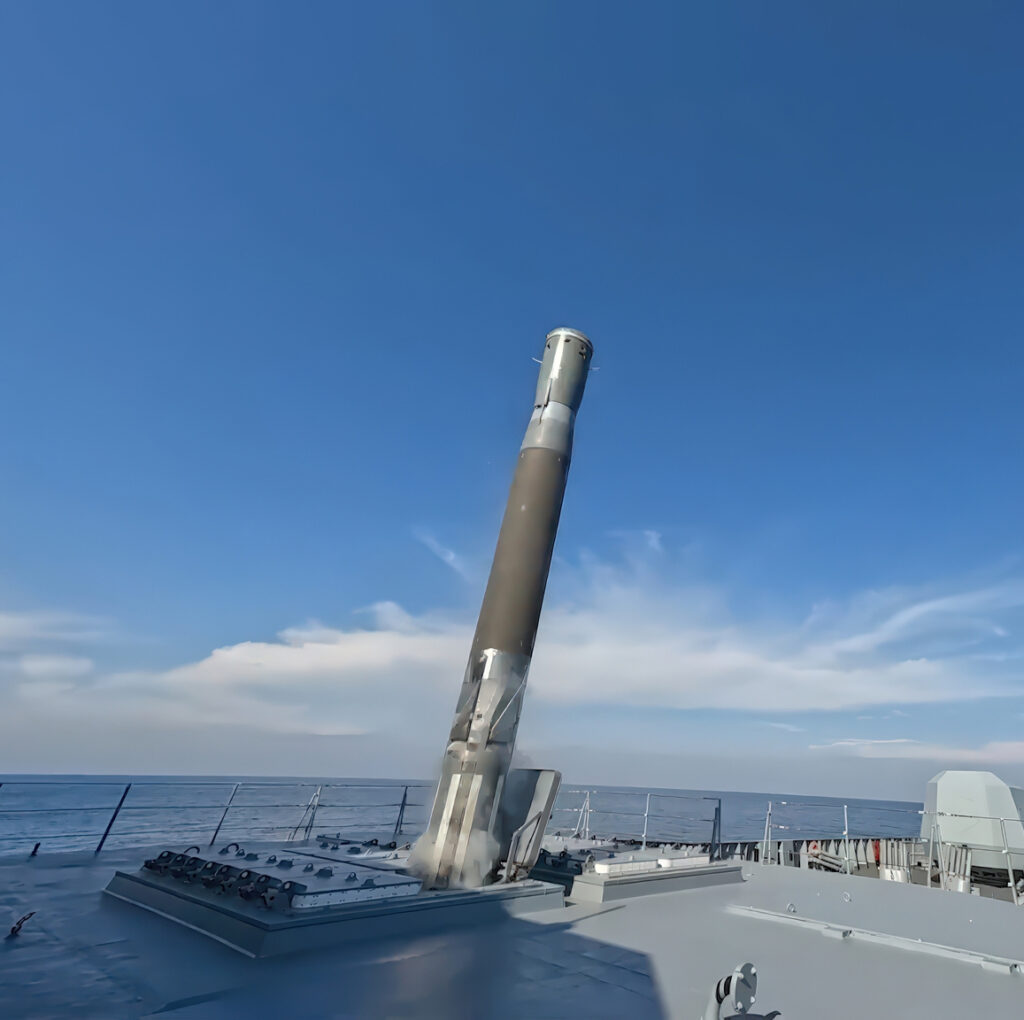
Source: Минобороны РФ, CC BY 4.0
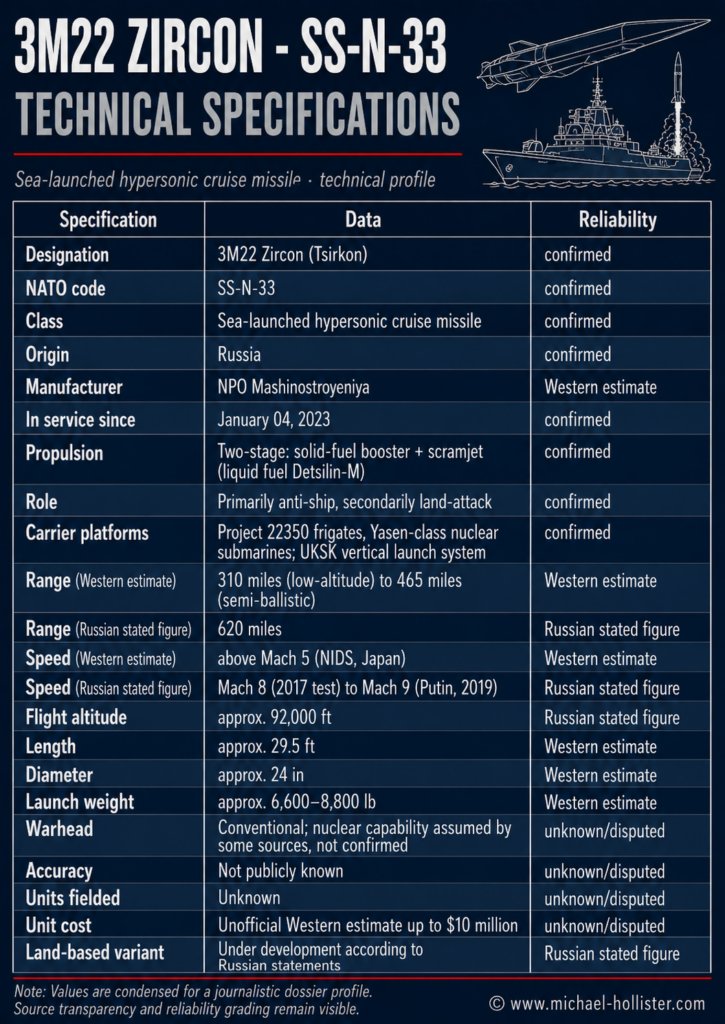
The 3M22 Zircon (Russian: Tsirkon; NATO code SS-N-33) is a Russian sea-launched hypersonic cruise missile. It entered service with the Russian Navy on January 04, 2023, and is primarily designed as an anti-ship weapon, though it can also engage land targets. The first platform to receive it was the frigate Admiral Gorshkov of the Project 22350 class; additional carrier platforms, according to Russian statements, are Yasen-class nuclear submarines, launched from the universal UKSK vertical launch system. A land-based variant is reportedly under development.
Unlike the Iskander, Oreshnik, or Kinzhal – all ballistic missiles whose warheads inevitably reach hypersonic velocity during reentry – the Zircon sustains hypersonic speed throughout atmospheric flight. This is technically more demanding and relies on a two-stage propulsion system: a solid-fuel booster accelerates the missile to supersonic speed, then a scramjet (Supersonic Combustion Ramjet) ignites, burning incoming air at high pressure with liquid fuel (Russian stated designation: Detsilin-M) to deliver sustained hypersonic velocity. This combination – cruise missile flight profile with sustained atmospheric hypersonic speed – represents the genuine technological leap over existing anti-ship missiles such as the P-800 Oniks or the Kalibr.
Range figures vary considerably depending on the source: Western estimates put the figure at 310 miles in low-altitude flight and up to 465 miles on a semi-ballistic trajectory, while Russian state media cite 620 miles. On speed, Russian sources cite Mach 8 (2017 test) to Mach 9 (Putin, 2019); Japan’s National Institute for Defense Studies takes a more conservative position of “above Mach 5.” For a weapon that has been operational for three years, the reliable public data picture is remarkably thin – this applies equally to performance parameters, unit numbers, and unit costs (unofficial Western estimates suggest up to $10 million per round, without Russian confirmation or denial).

Politically, the Zircon is Russia’s answer to the strategic centrality of US carrier strike groups. Moscow presents it as a weapon capable of bringing even high-value NATO naval assets within range – a message that gains credibility from the compressed response time that its speed imposes on defenses. In February 2023, Ukrainian officials reported debris from a Zircon – the first documented combat use, though not in the sea-based anti-ship mode for which it was designed, but as a land-attack weapon against Ukraine.
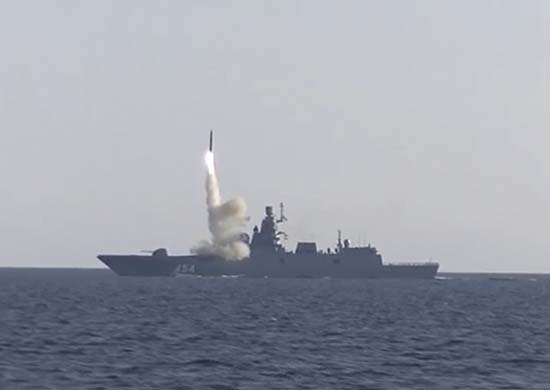
Source: Mil.ru, CC BY 4.0
What the Zircon is not: the “invincible wonder weapon” Russian state media advertise. Whether the missile achieves the effects Russia claims in practice depends on sensors, unit numbers, target acquisition, and enemy air defenses – all factors for which no reliable public data exists. The only independent confirmation of combat use to date comes from debris analysis.
Operational History and Deployments
October 2021 – First successful tests from the nuclear submarine K-560 Severodvinsk; initially from surfaced position in the Barents Sea, the following day from submerged position in the White Sea against a target in the Barents Sea.
January 04, 2023 – Enters service; first delivered to the frigate Admiral Gorshkov (Project 22350).
February 2023 – First documented combat use based on Ukrainian debris analysis; employed against land targets in Ukraine, not in the originally intended sea-based anti-ship mode.
May 24, 2026 – Part of a combined large-scale strike on the Kyiv area together with Oreshnik, Iskander, and Kinzhal (according to the Russian Ministry of Defense; not independently verified).
Further Reading
3M22 Zircon – Missile Defense Advocacy Alliance Primary technical reference: classification, range and speed estimates, anti-ship weapon assessment, carrier platforms.
Russia Launches Zircon Hypersonic Missiles from Submarine – CSIS Missile Threat, October 2021 CSIS report on the first successful submarine tests from Severodvinsk; confirms scramjet propulsion and submarine compatibility.
Hypersonic Weapons of the U.S., China, and Russia: Implications for Global Security – NIDS Japan, 2024 Japan’s National Institute for Defense Studies; independent and measured assessment of range and speed.
© Michael Hollister – All rights reserved. Redistribution, publication or reuse of this text requires express written permission from the author. For licensing inquiries, please contact the author via www.michael-hollister.com.
Newsletter
🇩🇪 Deutsch: Verstehen Sie geopolitische Zusammenhänge durch Primärquellen, historische Parallelen und dokumentierte Machtstrukturen. Monatlich, zweisprachig (DE/EN).
🇬🇧 English: Understand geopolitical contexts through primary sources, historical patterns, and documented power structures. Monthly, bilingual (DE/EN).