
by Michael Hollister
Exclusive published at Michael Hollister on May 31, 2026
2.081 words * about 10 minutes readingtime
The complete analysis – covering state complicity under international law, the mechanics of the hunger weapon, and the question of why a documented genocide remains politically without consequence – read here: Israel – The Finding: Genocide
This complete analyses is also available as an audio version – for listening on the go, in the background, or at your own pace.
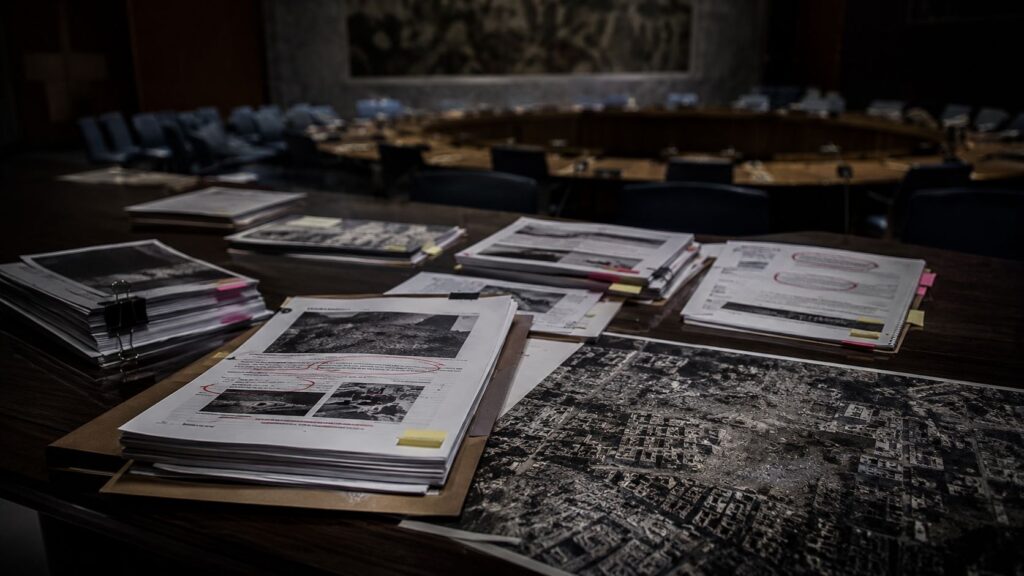
There is a difference between an accusation and a finding. An accusation is made; a finding is established. On September 16, 2025, the Independent International Commission of Inquiry of the United Nations on the Occupied Palestinian Territory established: Israel is committing genocide in the Gaza Strip. Not an open-source network, not a human rights organization, not a single committed voice – a mandated UN body that examined the question using the methodology of international criminal law. What had been politically asserted and disputed for two years now existed as a legally verified determination. This briefing summarizes three findings that mutually reinforce one another. The complete analysis goes further.
First: The Determination
The Commission is not an ad hoc body. It was established in 2021 by the UN Human Rights Council; at its head stood Navi Pillay – former UN High Commissioner for Human Rights and President of the Rwanda Tribunal, which convicted more than sixty individuals following the 1994 genocide. Its final report bears the sober title “Legal analysis of the conduct of Israel in Gaza pursuant to the Convention on the Prevention and Punishment of the Crime of Genocide.” Across 72 pages, it examines separately the underlying acts – the actus reus – and the genocidal intent – the dolus specialis. Both must be present for war crimes to become genocide in legal terms.
The result: Israeli authorities and security forces committed four of the five genocidal acts defined in the 1948 Convention – killing, serious bodily or mental harm, the deliberate imposition of destructive conditions of life, and measures to prevent births. The Commission derives intent from explicit statements by Israeli authorities. It names Prime Minister Benjamin Netanyahu, President Isaac Herzog, and former Defense Minister Yoav Gallant by name.
Behind this legal language stand human beings. According to the Gaza Health Ministry, as reported through the UN Office for the Coordination of Humanitarian Affairs, at least 72,562 Palestinians were killed and 172,320 wounded between October 07, 2023 and April 22, 2026. This figure is a documented lower bound: it captures neither the approximately 10,000 missing under the rubble nor those who died of hunger and disease.
How this destruction works in practice can be read from a single mechanism: hunger. The UN relief agency UNRWA documents the chronicle of an organized scarcity. The basis is a legislative package passed by the Knesset on October 28, 2024, prohibiting the agency’s operations. Since March 02, 2025, UNRWA has been barred from delivering humanitarian goods directly to Gaza – even as food and flour for hundreds of thousands of people sat stockpiled outside the territory, enough by earlier accounts to load 6,000 trucks. By the end of April 2025, supplies in Gaza were exhausted. A famine that arises not from scarcity but from a permit blockade is not a natural disaster. It is a decision – and it fulfills precisely the third genocidal act the Commission identifies: the imposition of conditions of life calculated to bring about the destruction of the group.
Israel rejected the report as “distorted and false” and did not participate in the investigation. One thing must be understood: the finding is not a court judgment and is not enforceable. But it is no longer merely an opinion. As the Commission notes, it may be used by the International Criminal Court and in the ongoing proceedings before the International Court of Justice.
Two circumstances lend the finding additional weight. First, it was this Commission’s final report – all three members had already announced their resignation. What they left behind was not a prelude to further work but a testament, the last and most comprehensive determination of a body that had spent two years doing nothing other than reviewing evidence. Second, it stands at the end of a chain of judicial steps: as early as January 2024, the International Court of Justice confirmed the “plausible risk” of genocide in the South Africa v. Israel proceedings; in July 2024, it declared Israel’s presence in the occupied territory unlawful in its entirety. The UN General Assembly set a deadline for ending the occupation – September 18, 2025. Israel let it pass. Two days before, the Commission had presented its finding.
Second: The Machinery
A genocide of this scale is an industrial undertaking. It requires aircraft, bombs, targeting systems, databases, and the companies that supply them. Three months before the Commission report, UN Special Rapporteur Francesca Albanese had mapped exactly this machinery. Her report of June 30, 2025 carries the thesis in its title: “From economy of occupation to economy of genocide.” The logic: what was profitable during the occupation remained profitable during the genocide. Companies that should have withdrawn stayed – and in doing so crossed from beneficiaries to participants.
At the center stands armaments. Israel benefits from the largest arms procurement program in history, the F-35 program led by US corporation Lockheed Martin and sustained by more than 1,650 companies across eight countries. Italian manufacturer Leonardo is among the central suppliers; Japan’s FANUC Corporation supplies the robotic systems for the production lines; Denmark’s Mærsk transports the components. After October 07, 2023, F-35 and F-16 aircraft were an integral part of the air power with which an estimated 85,000 tons of bombs fell on Gaza – a substantial portion of them unguided.
Alongside this, Albanese documents a quieter dimension: technology. US corporation IBM has operated the central database of Israel’s immigration authority since 2019, enabling the collection of biometric data on Palestinians. Microsoft, present in the country since 1991, has deeply integrated its systems into the military and administration. In 2021, Israel awarded a $1.2 billion contract to Alphabet (Google) and Amazon under “Project Nimbus” for central cloud infrastructure. The NSO Group, founded by former members of intelligence unit 8200, supplied its Pegasus software as a tool for surveilling activists and journalists.
The machinery does not end with weapons and software. Albanese spans eight sectors, and precisely the apparently innocuous ones reveal how deep the entanglement runs: banks and pension funds channeled capital into the occupation economy; even universities appear as part of the apparatus. That this constitutes a legal rather than merely moral category, Albanese substantiates with precedents: the postwar proceedings against German industrialists and the examination of corporate complicity in South African apartheid. The UN Guiding Principles on Business and Human Rights impose a duty of due diligence; those who continue to supply despite evident legal violations cannot plead ignorance. The complicity revealed, she writes, is “only the tip of the iceberg.”

Third: The European Account
If corporations supply the tools, states supply the protection. In her second report of October 20, 2025, Albanese shifted the focus from corporations to governments. The title is a thesis about the structure of the crime: “Gaza Genocide: a collective crime.” A genocide of this duration, the argument runs, cannot be sustained without the assistance and support of other states. The report examines 63 named states.
At the center of diplomatic cover stand the United States: seven vetoes in the UN Security Council after October 07, 2023, plus roughly two thirds of Israeli defense imports. But the report’s most uncomfortable figure concerns Europe. During the established genocide, arms exports to Israel rose by 18 percent – and the European Union’s share of Israeli military imports nearly doubled, reaching 54 percent in 2024. More than half of the weapons Israel imported during a genocide established by a UN body came from the EU.
It is the most precise form in which the distance between European aspiration and European action can be expressed in numbers. And it was no accident. A bloc of Western states – Australia, New Zealand, Canada, at times joined by the United Kingdom or Germany – repeatedly created the appearance of pressure without exercising it: in February 2024, the same governments criticized the planned Rafah offensive while simultaneously cutting funding to UNRWA. A diplomacy that projected the impression of progress while concrete steps were withheld. Under Albanese’s legal definition, aiding and abetting occurs when a state materially enables the act of another – with knowledge of the circumstances. Intent can be inferred from the foreseeable consequences of one’s own conduct.
How seriously Washington took the investigator’s work was revealed by what happened to Albanese herself: she was unable to present her report as scheduled in New York – US sanctions denied her entry. She spoke instead from Cape Town. A UN Special Rapporteur, sanctioned by a permanent member of the Security Council for presenting a report on genocide: that is not the accusation of complicity – that is complicity itself.
The Balance Sheet
Three findings that together form a picture. A Commission establishes the facts. A Special Rapporteur names the corporations that enable them and the states that protect them. And the death toll is not an upper-end estimate but a documented lower bound. It is no longer a single voice making the accusation, but a converging system of mandated institutions – flanked by ongoing proceedings before the International Court of Justice and arrest warrant applications by the International Criminal Court against Israeli officials. Those who wish to dispute the finding must refute not an opinion but a converging body of evidence.
A third UN voice adds to this: the Special Rapporteur on adequate housing qualified the systematic destruction of housing in Gaza as domicide – the deliberate destruction of a population group’s living environment as a method of destruction – and called for this offense to be independently enshrined in international criminal law.
Notable is who does not appear in this situation: an effective counterforce. Those states that make determinations hold no veto and no economic leverage. Those that could enforce – the US with seven vetoes, the EU with 54 percent of arms imports – are precisely those the report names as suppliers and protectors. It is a closed loop: the determination of guilt and the power to act on it lie in different hands, and the second hand has no interest in serving the first.
What is missing, therefore, is not the determination. What is missing is its consequence. And that absence is not a gap in the law – the law is unambiguous – but a decision by those who could act and choose not to.
That is the finding. Not as an accusation. As a determination.
The complete analysis – covering state complicity under international law, the mechanics of the hunger weapon, and the question of why a documented genocide remains politically without consequence – read here: Israel – The Finding: Genocide

Michael Hollister
is a geopolitical analyst and investigative journalist. He served six years in the German military, including peacekeeping deployments in the Balkans (SFOR, KFOR), followed by 14 years in IT security management. His analysis draws on primary sources to examine European militarization, Western intervention policy, and shifting power dynamics across Asia. A particular focus of his work lies in Southeast Asia, where he investigates strategic dependencies, spheres of influence, and security architectures. Hollister combines operational insider perspective with uncompromising systemic critique-beyond opinion journalism. His work appears on his bilingual website (German/English) www.michael-hollister.com and in investigative outlets across the German-speaking world and the Anglosphere.
Sources
- OHCHR, September 16, 2025 – Israel has committed genocide in the Gaza Strip, UN Commission finds: https://www.ohchr.org/en/press-releases/2025/09/israel-has-committed-genocide-gaza-strip-un-commission-finds
- OHCHR, June 30, 2025 – A/HRC/59/23: “From economy of occupation to economy of genocide,” Report of the Special Rapporteur Francesca Albanese: https://www.ohchr.org/en/documents/country-reports/ahrc5923-economy-occupation-economy-genocide-report-special-rapporteur
- OHCHR, October 20, 2025 – A/80/492: “Gaza Genocide: a collective crime,” Report of the Special Rapporteur Francesca Albanese: https://www.ohchr.org/en/documents/country-reports/a80492-gaza-genocide-collective-crime-report-special-rapporteur-situation
- UNRWA – Situation Report #219 on the Humanitarian Crisis in the Gaza Strip and the Occupied West Bank: https://www.unrwa.org/resources/reports/unrwa-situation-report-219-humanitarian-crisis-gaza-strip-and-occupied-west-bank
- UN OCHA oPt – Reported impact snapshot, Gaza Strip: https://www.ochaopt.org/content/reported-impact-snapshot-gaza-strip-13-may-2026
- Spagat, Pedersen, Shikaki et al., The Lancet Global Health, February 18, 2026 – Violent and non-violent death tolls for the Gaza conflict: new primary evidence from a population-representative field survey: https://www.thelancet.com/journals/langlo/article/PIIS2214-109X(25)00522-4/fulltext
- Michael Hollister, April 05, 2026 – GAZA – Made in the USA, Part 1: https://www.michael-hollister.com/de/2026/04/05/gaza-made-in-the-usa-teil-1/
- Michael Hollister, April 12, 2026 – GAZA – Made in the USA, Part 2: https://www.michael-hollister.com/de/2026/04/12/gaza-made-in-the-usa-teil-2/
Complete bibliography and further references in the full analysis article.
© Michael Hollister – All rights reserved. Redistribution, publication or reuse of this text requires express written permission from the author. For licensing inquiries, please contact the author via www.michael-hollister.com.
Newsletter
🇩🇪 Deutsch: Verstehen Sie geopolitische Zusammenhänge durch Primärquellen, historische Parallelen und dokumentierte Machtstrukturen. Monatlich, zweisprachig (DE/EN).
🇬🇧 English: Understand geopolitical contexts through primary sources, historical patterns, and documented power structures. Monthly, bilingual (DE/EN).