
by Michael Hollister
Exclusive published at Michael Hollister on May 31, 2026
4.312 words * 23 minutes readingtime
For readers with less time, this analysis is also available as a compact Briefing: the same source base, condensed into the most important core points and roughly ten minutes of reading time.
Israel – The Finding: Genocide
This article is also available as an audio version – for listening on the go, in the background, or at your own pace.
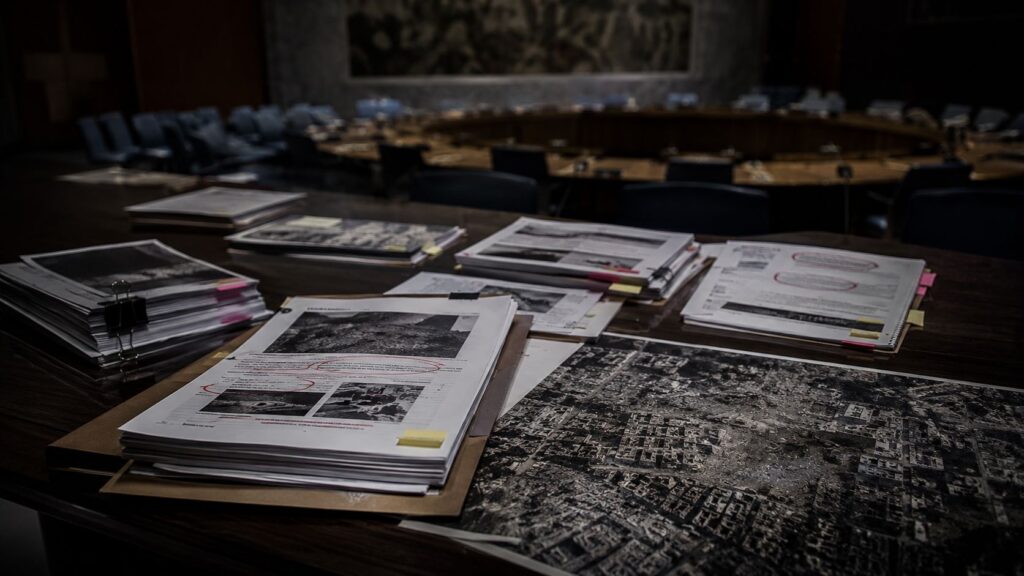
In the first two parts of this series, the focus was on two things you could touch. The bomb in the rubble – an actuator from a GBU-39, manufactured by Boeing, identifiable down to the component type, documented in 79 geolocated strikes. And the law in Washington that should have applied: National Security Memorandum 20, the Leahy Law, the Arms Export Control Act – control mechanisms that existed and were either not applied or deliberately suspended at the decisive moment.
What is now on the table cannot be touched. It is a finding – formulated not by an open-source network, not by a human rights organization, not by a single committed voice, but by a mandated body of the United Nations, in the legal language of the 1948 Genocide Convention. On September 16, 2025, the Independent International Commission of Inquiry on the Occupied Palestinian Territory determined: Israel is committing genocide in the Gaza Strip.
The question this text asks is not whether that is true – courts will ultimately decide that. The question is a different and more precise one: What changes when it is no longer activists but UN mandate holders who examine the facts using the methodology of international criminal law? And what – despite everything – does not change?
The Methodology of the Finding
It is worth being precise, because precision here is everything. The Independent International Commission of Inquiry is neither an NGO nor an ad hoc group. It was established in 2021 by the UN Human Rights Council; its three members are not employed by the United Nations but appointed by the Council’s 47 member states. At its head stood Navi Pillay – former UN High Commissioner for Human Rights, former judge at the International Criminal Court, and former President of the International Criminal Tribunal for Rwanda, the tribunal that convicted more than sixty individuals following the 1994 genocide. Pillay has drawn the comparison between the two situations explicitly.
The report the Commission produced bears the sober title “Legal analysis of the conduct of Israel in Gaza pursuant to the Convention on the Prevention and Punishment of the Crime of Genocide.” It runs to 72 pages and is the result of a two-year investigation covering the period from October 07, 2023 to July 31, 2025. Its method is that of international criminal law: the Commission examines separately the underlying acts – the actus reus – and the genocidal intent – the dolus specialis. Both must be present for a series of war crimes to become genocide in legal terms. Precisely this separation distinguishes forensic analysis from political indictment.
The result: the Commission concludes that Israeli authorities and security forces committed four of the five genocidal acts defined in the 1948 Convention – killing members of the group, causing serious bodily or mental harm, deliberately inflicting conditions of life calculated to bring about the group’s physical destruction in whole or in part, and imposing measures intended to prevent births. The Commission derives intent from explicit statements by civilian and military authorities and from the behavioral pattern of the armed forces. The report names Prime Minister Benjamin Netanyahu, President Isaac Herzog, and former Defense Minister Yoav Gallant by name. Pillay spoke of a “genocidal campaign” for which responsibility lay “with Israeli authorities at the highest level.”
Behind the legal language of the Convention stand human beings. According to the Gaza Health Ministry, as reported through the UN Office for the Coordination of Humanitarian Affairs, at least 72,562 Palestinians were killed and 172,320 wounded between October 07, 2023 and April 22, 2026. This figure is a documented lower bound, not an upper-end estimate: OCHA notes that it captures neither the approximately 10,000 missing under the rubble nor deaths not directly caused by violence – those who died of hunger, untreated illness, and the collapse of the healthcare system. An independent analysis published in the medical journal The Lancet arrived, for an earlier period, at a figure of violent deaths roughly one third higher than the official count at that time. What the Commission legally frames as “killing of members of the group” and “serious bodily harm” thus has a scale that defies comprehension.
Israel has rejected the report. Israeli Ambassador to Geneva Danny Meron called the findings “selective” and stated that the report served a narrative favorable to Hamas. Israel’s Foreign Ministry described it as “distorted and false.” The Commission, in response, noted that it had given Israel multiple opportunities to participate; Israel had not done so.
Two things must be understood to place the finding in proper context. First, what it is not: a court judgment. Neither the Commission nor the Human Rights Council can compel a state to do anything. The finding is not an enforceable title but a determination – one that, as the Commission explicitly notes, may be used by prosecutors at the International Criminal Court or in proceedings before the International Court of Justice. This is the decisive distinction from the first two parts of this series: a bomb fragment found in the rubble establishes the weapon used. A US law left unapplied establishes that oversight failed. The Commission’s finding qualifies the overall picture – it assigns the sum of individual acts to a charge under international criminal law. That is not a gradual but a categorical difference.
Second, what makes the finding weighty: it was this Commission’s final report. All three members had announced their resignation as early as July 2025. What they left behind was not a prelude to further work but a testament – the last and most comprehensive determination of a body that had spent two years doing nothing other than reviewing evidence.
The finding also does not stand alone but in a chain of judicial and quasi-judicial steps that had long since marked the risk. Already in its 2004 advisory opinion on the wall in the occupied territories, the International Court of Justice had called on the international community to honor its obligations in the face of serious violations of international law. On January 26, 2024, the same Court confirmed in the South Africa v. Israel proceedings the “plausible risk” of genocide and ordered provisional measures. In July 2024, it declared Israel’s continued presence in the occupied territory unlawful in its entirety and demanded full withdrawal; the UN General Assembly subsequently set a deadline – the occupation was to end by September 18, 2025. Israel let it pass. Two days before, on September 16, the Commission had presented its finding. The temporal proximity is no coincidence but the chronicle of an escalation in which one breach of law followed the next without consequence.
The Machinery: Who Enables the Genocide
A genocide of this scale is a logistical and industrial undertaking. It requires aircraft, bombs, targeting systems, databases, cloud storage, bulldozers, and the companies that supply them. Three months before the Commission report, the UN Special Rapporteur on the occupied Palestinian territories, Francesca Albanese, had mapped exactly this machinery. Her report of June 30, 2025 carries a title that already contains the thesis: “From economy of occupation to economy of genocide.”

The logic of the report is simple and uncomfortable: what was profitable during the occupation has remained profitable during the genocide. Companies that had enriched themselves through the displacement of Palestinians should have withdrawn after October 2023. Instead, Albanese argues, they stayed – and in doing so crossed from beneficiaries of occupation to participants in genocide. From more than 200 submissions received, she developed a database of roughly 1,000 companies; more than 45 were confronted with specific allegations, 15 responded.
The military dimension is central. Israel benefits from the largest arms procurement program in history – the F-35 fighter jet program, led by US corporation Lockheed Martin and sustained by at least 1,650 additional companies across eight countries. Components are produced worldwide; the Italian manufacturer Leonardo S.p.A. is among the central suppliers. An F-35 can carry more than 8.8 tons of bombs. After October 07, 2023, F-35 and F-16 aircraft were an integral component of the air power with which an estimated 85,000 tons of bombs were dropped on Gaza – a substantial portion of them unguided. Japan’s FANUC Corporation supplies the robotic systems for weapons production lines; Denmark’s A.P. Møller-Mærsk transports components and materiel. The two major Israeli manufacturers – the partially privatized Elbit Systems and the state-owned Israel Aerospace Industries – rank among the fifty largest defense corporations in the world; for them, the war was business. Israeli military spending rose 65 percent from 2023 to 2024, reaching $46.5 billion.
The machinery does not end with weapons. Albanese spans eight sectors, and it is precisely the apparently innocuous ones that reveal how deep the entanglement runs. Heavy machinery manufacturers supply the bulldozers that clear residential buildings and infrastructure. In the services sector, rental platform Airbnb saw its listings in the settlements rise from 139 in 2016 to 350 in 2025 – offerings that, the report contends, normalize the illegal settlements and further restrict Palestinian access to their land. Banks, asset managers, pension funds, and insurers channeled capital into the occupation economy. And even universities appear in the report as part of the apparatus: as sites where weapons technology is developed and the ideological foundation of colonization is maintained. The picture that emerges is not one of isolated bad actors but of a thoroughly economized system in which occupation and destruction are profitable at countless points.
Alongside this, Albanese documents a second, quieter dimension: technology. US corporation IBM has operated and updated the central database of Israel’s immigration authority since 2019, enabling the collection of biometric data on Palestinians. Microsoft, present in the country since 1991, has deeply integrated its systems into the military, police, and prison administration. In 2021, Israel awarded a $1.2 billion contract to Alphabet (Google) and Amazon under “Project Nimbus” to provide central cloud infrastructure. The NSO Group, founded by former members of intelligence unit 8200, supplied its Pegasus spyware as a tool for surveilling activists and journalists. The occupied territory, Albanese writes, has become an “ideal testing ground” – high demand, minimal oversight, no accountability.
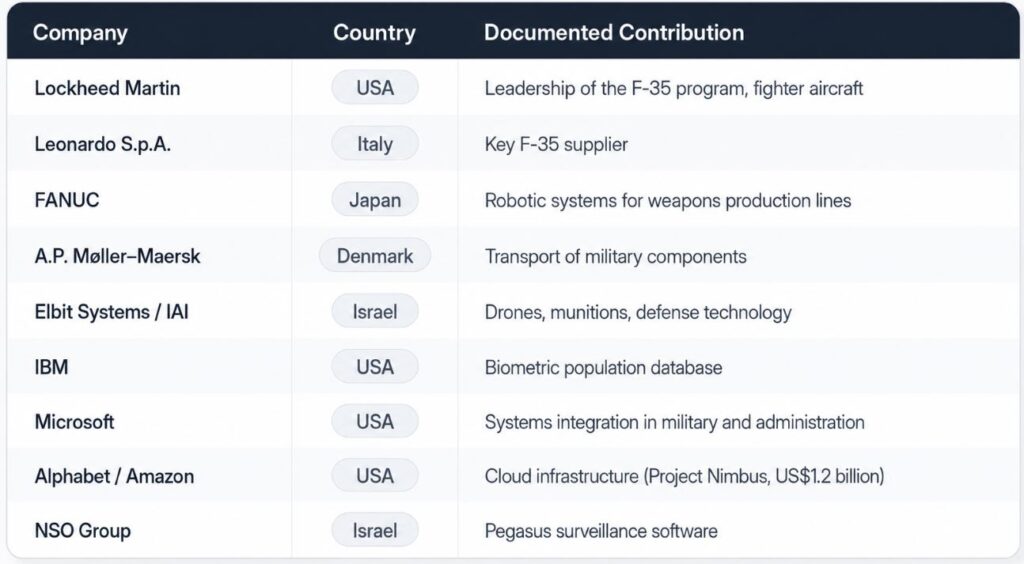
Source: A/HRC/59/23 – “From economy of occupation to economy of genocide,” UN Special Rapporteur Francesca Albanese, June 30, 2025. Selection of documented companies; inclusion reflects the report’s findings, not a definitive legal assessment.
That this constitutes not a moral but a legal category, Albanese substantiates with historical precedents. The postwar proceedings against German industrialists – above all the I.G. Farben trial – established the criminal responsibility of corporate executives for participation in international crimes. South Africa’s Truth and Reconciliation Commission examined corporate co-responsibility for apartheid. The UN Guiding Principles on Business and Human Rights in force today impose a duty of due diligence on companies, one that is heightened in conflict situations. Those who continue to supply despite evident legal violations cannot plead ignorance. The complicity revealed, Albanese writes, is “only the tip of the iceberg.”
The Accomplices: Genocide as a Collective Crime
If corporations supply the tools, states supply the protection. In her second report, presented on October 20, 2025 under reference number A/80/492, Albanese shifts the focus from corporations to governments. The title this time is a thesis about the structure of the crime: “Gaza Genocide: a collective crime.”
The argument is legally dense and politically explosive in equal measure. A genocide of this duration, Albanese contends, cannot be sustained without the direct participation, assistance, and support of other states. She identifies four sectors of this support – diplomatic, military, economic, and one she places in quotation marks: “humanitarian.” Each, she argues, is indispensable to the continuation of Israel’s violations of international law. The report is based on an examination of 63 named states, each given the opportunity to respond; 18 did so.
At the center of diplomatic cover stand the United States. After October 07, 2023, they exercised their veto in the UN Security Council seven times, controlling negotiations over a ceasefire. They are also by far the largest arms supplier – accounting for roughly two thirds of Israeli defense imports. But the US did not act alone. Here lies the report’s most uncomfortable figure, and it concerns Europe: during the genocide, arms exports to Israel rose by 18 percent, and the European Union’s share of Israeli military imports nearly doubled – reaching 54 percent in 2024. More than half of the weapons Israel imported during a genocide established by a UN body came, according to this account, from the EU. It is the most precise form in which the distance between European aspiration and European action can be expressed in numbers.

Albanese grounds the complicity in a legal definition. Aiding and abetting occurs when the action of one state materially or substantially enables the act of another – with full knowledge of the circumstances, including the threatened or actual commission of the crime. The intent to facilitate an unlawful act can be inferred from the foreseeable consequences of one’s own conduct. Individual acts may not in themselves constitute complicity; their cumulative effect over time, however, must be factored into the assessment.
From this definition follows a cascade of obligations that the report spells out in detail. The Arms Trade Treaty prohibits arms transfers when it is known or should have been known that the goods will be used for international crimes – a prohibition that also applies to transit and transshipment. Trade agreements allow states to derogate from their core commitments in order to fulfill their Charter obligations to maintain peace. The UN Convention on the Law of the Sea permits states to deny vessels “non-innocent passage.” And all states are obligated under the Geneva Conventions to prosecute genocide, war crimes, and torture – regardless of where they were committed. The report’s sharpest conclusion: since Israel itself makes no distinction between its own territory and the occupied territory, third states must proceed on the basis of “indistinguishability” – which in effect requires a comprehensive boycott of Israel. What appears to be a matter of political discretion is, under this reading, already a legal obligation.
How little of this has been honored, the report demonstrates through the Western diplomatic maneuvers themselves. Rather than demanding a permanent ceasefire, Western states led by the US had advocated only for “humanitarian corridors,” “pauses,” and “truces” – thereby perpetuating the violence. A bloc comprising Australia, New Zealand, Canada, at times joined by the United Kingdom, Germany, or the Netherlands, repeatedly created the appearance of pressure: in December 2023, the introduction of the term “sustainable ceasefire” watered down a Security Council resolution and delayed action. In February 2024, the same states criticized the planned Rafah offensive – while simultaneously cutting funding to the UN relief agency UNRWA. A diplomacy that projected the impression of progress while concrete steps were withheld.
The fourth sector, the “humanitarian” one, appears in this light not as relief but as part of the problem: some third states had, according to the report, actually worsened the living conditions of the population through the very manner of their involvement in aid. Even before October 07, 2023, Albanese notes, the blockade imposed by Israel and Egypt – with restrictions down to calculated caloric intake – had made 80 percent of the population dependent on assistance.
How seriously the United States took the work of this mandate holder was revealed by what happened to Albanese herself. She was unable to present her report as scheduled in New York – US sanctions denied her entry. She spoke instead from Cape Town. A UN Special Rapporteur, sanctioned by a permanent member of the Security Council for presenting a report on genocide: that is not a marginal detail but complicity in action. It also closes the loop to Part 2 of this series. The failure of US oversight mechanisms documented there – the unapplied laws, the quietly shelved NSM-20 – was not an isolated case of American negligence. It was one component of a system that Albanese describes as a collective crime.
The Method: Domicide and the Hunger Weapon
The question remains of how. How does one destroy the foundations of a group’s existence so completely that the 1948 Convention applies – that third genocidal act, the “deliberate infliction of conditions of life calculated to bring about physical destruction”? Two UN documents provide the answer, and they interlock.
The first introduces a concept still relatively new in international legal debate: domicide. UN Special Rapporteur on adequate housing Balakrishnan Rajagopal had already warned in 2022 that the bombing and shelling of homes and the destruction of entire cities and villages continued unabated despite the development of human rights law – coining the term domicide for this phenomenon. On February 26, 2026, he presented a follow-up report to the Human Rights Council (A/HRC/61/43/Add.3), framing the systematic, large-scale destruction of housing and civilian infrastructure as a distinct category. The report addresses four conflicts – alongside Gaza also Myanmar, Sudan, and Ukraine – but Gaza is the primary case. Rajagopal’s central demand: domicide should be established as a distinct criminal offense in international criminal law, to close a protection gap through which the most severe forms of habitat destruction had previously fallen. The destruction of housing, the argument runs, is not collateral damage but method – a means of permanently preventing a population from returning and rebuilding their community. In this way, a process that in most reporting appears merely as a byproduct of combat acquires its own legal name – and its own criminal character.
The second document shows how this method combines with starvation. The UN Relief and Works Agency for Palestine Refugees, UNRWA, documents in its Situation Report No. 219 the chronicle of an organized scarcity. The basis is a legislative package passed by the Knesset on October 28, 2024, prohibiting the agency’s operations on territory claimed by Israel and banning any contact between Israeli authorities and UNRWA. Since the end of January 2025, no international UNRWA staff member has received a visa for the occupied territory. Since March 02, 2025, the agency has been prohibited from delivering humanitarian goods directly to Gaza.
The decisive point of this chronicle is that there was no shortage of aid supplies – only a shortage of permission to deliver them. Outside the territory, food, flour, and shelter materials for hundreds of thousands of people were stockpiled – in earlier situation reports quantified as food parcels for 1.1 million people and flour for 2.1 million. The then Commissioner-General had stated that warehouses in Egypt and Jordan were full enough to load 6,000 trucks. Yet by the end of April 2025, food stocks in Gaza were exhausted. A famine that arises not from scarcity but from a permit blockade is not a natural disaster. It is a decision.
Domicide and starvation are not separate phenomena. They are two instruments of the same process: the destruction of housing strips the population of place; blocking aid strips them of food. Together they produce precisely those “conditions of life calculated to bring about the physical destruction of the group” that the Commission identified as the third genocidal act. The loop closes: what the lawyers in Geneva name abstractly as actus reus can be traced in the agency’s situation reports to the precise date.
The Accumulation – and Its Consequences
What is truly remarkable about these documents is not each one individually but their density. Within roughly five months – between June 2025 and February 2026 – four separate strands of the UN human rights system produced findings that mutually reinforce one another: the Commission of Inquiry with the genocide determination, the Special Rapporteur with the corporate and state analysis, the Special Rapporteur on housing with the domicide framework. Added to these are the ongoing proceedings at the judicial level: before the International Court of Justice, the case brought by South Africa against Israel continues; as early as January 2024, the Court had found a “plausible risk” of genocide and ordered provisional measures. The International Criminal Court has applied for arrest warrants against Israeli officials. It is no longer a single voice making the accusation, but a converging system of mandated institutions.
And yet: the practical consequence of this accumulation has – so far – been minimal. Here lies the actual finding, one that goes beyond the legal one. The gap does not run between allegation and evidence; the evidence has been established, documented, mandated. It runs between determination and consequence. The cui bono supplies the explanation: as long as the most powerful states in the international system either themselves act as suppliers and protectors – the US with seven vetoes, the EU with 54 percent of arms imports – or have nothing to gain politically from escalation, the finding remains a document without an enforcer. A UN body can determine; it cannot compel. The institutions that could compel – the Security Council, national governments – are precisely those the report names as accomplices. It is a closed loop: the determination of guilt and the power to act on it lie in different hands, and the second hand has no interest in serving the first.
This is precisely why the sanctioning of Albanese is so revealing. It shows that the system is not merely failing passively but actively moving against the very part of itself conducting the investigation. Those who make the finding become targets; those who ignore it remain undisturbed.
Also notable is who does not appear in this loop: an effective counterforce. A group of states from the Global South, led by Colombia and South Africa, has committed to concrete measures against Israel – an approach the report explicitly recognizes. But this bloc holds neither a veto in the Security Council nor the economic leverage of the states acting as suppliers. The Arab and Muslim states, meanwhile, had failed to produce a determined effect despite several summits, Albanese argues; the economic incentives shifted by the Abraham Accords and the complexity of regional geopolitics had paralyzed collective action. The result is an asymmetry: on one side stand those who can determine but not enforce; on the other, those who could enforce but will not. Between them lies the finding – complete, mandated, and without an addressee willing to act on it.
Conclusion
At the end, what remains is a sober sentence, and it is weightier than its sobriety suggests. The finding exists. It was made by a mandated UN body using the methodology of international criminal law, supplemented by a second mandate holder covering the economic and state dimension, extended by a third with the concept of method, and documented down to the precise date by the situation reports of a UN relief agency. Those who wish to dispute it must refute not an opinion but a converging body of evidence.
That is the actual shift these documents mark. In the first two parts of this series, it was still possible to say: here a bomb fragment, there an unapplied law – individual pieces that the reader had to assemble. That work has now been done by the bodies in Geneva. They have assembled the pieces, named them, and placed them within a legal framework. What remains is no longer a question of evidence.
What is missing is not the determination. What is missing is its consequence. And the absence of that consequence is not a gap in the law – the law is unambiguous – but a decision by the powerful. Those who may refrain from a boycott that would be legally required; who can supply weapons whose use is foreseeable; who sanction an investigator rather than examine her findings – they are making a choice. The genocide of Gaza will not one day be measured by whether it was documented. It was – more completely than almost any crime of comparable scale before it. It will be measured by the fact that everything was documented – and that those who could have acted chose not to.

Michael Hollister is a geopolitical analyst and investigative journalist. He served six years in the German military, including peacekeeping deployments in the Balkans (SFOR, KFOR), followed by 14 years in IT security management. His analysis draws on primary sources to examine European militarization, Western intervention policy, and shifting power dynamics across Asia. A particular focus of his work lies in Southeast Asia, where he investigates strategic dependencies, spheres of influence, and security architectures. Hollister combines operational insider perspective with uncompromising systemic critique-beyond opinion journalism. His work appears on his bilingual website (German/English) www.michael-hollister.com and in investigative outlets across the German-speaking world and the Anglosphere.
Sources
- OHCHR, September 16, 2025 – Israel has committed genocide in the Gaza Strip, UN Commission finds: https://www.ohchr.org/en/press-releases/2025/09/israel-has-committed-genocide-gaza-strip-un-commission-finds
- OHCHR, October 20, 2025 – A/80/492: “Gaza Genocide: a collective crime,” Report of the Special Rapporteur Francesca Albanese: https://www.ohchr.org/en/documents/country-reports/a80492-gaza-genocide-collective-crime-report-special-rapporteur-situation
- UN/UNISPAL – A/80/492, Full text (advance unedited version, PDF): https://www.un.org/unispal/wp-content/uploads/2025/10/a-80-492-advance-unedited-version.pdf
- OHCHR, June 30, 2025 – A/HRC/59/23: “From economy of occupation to economy of genocide,” Report of the Special Rapporteur Francesca Albanese: https://www.ohchr.org/en/documents/country-reports/ahrc5923-economy-occupation-economy-genocide-report-special-rapporteur
- OHCHR – A/HRC/59/23, Full text (advance edited version, PDF): https://www.ohchr.org/sites/default/files/documents/hrbodies/hrcouncil/sessions-regular/session59/advance-version/a-hrc-59-23-aev.pdf
- OHCHR, February 26, 2026 – A/HRC/61/43/Add.3: “Domicide: Mass destruction of housing and civilian infrastructure in Gaza, Myanmar, Sudan and Ukraine,” Report of the Special Rapporteur on adequate housing: https://www.ohchr.org/en/documents/thematic-reports/ahcr6143add3-domicide-mass-destruction-housing-and-civilian
- UNRWA – Situation Report #219 on the Humanitarian Crisis in the Gaza Strip and the Occupied West Bank: https://www.unrwa.org/resources/reports/unrwa-situation-report-219-humanitarian-crisis-gaza-strip-and-occupied-west-bank
- Michael Hollister, April 05, 2026 – GAZA – Made in the USA, Part 1: https://www.michael-hollister.com/de/2026/04/05/gaza-made-in-the-usa-teil-1/
- Michael Hollister, April 12, 2026 – GAZA – Made in the USA, Part 2: https://www.michael-hollister.com/de/2026/04/12/gaza-made-in-the-usa-teil-2/
- UN OCHA oPt – Humanitarian Situation Report / Reported impact snapshot, Gaza Strip: https://www.ochaopt.org/content/reported-impact-snapshot-gaza-strip-13-may-2026
- Spagat, Pedersen, Shikaki et al., The Lancet Global Health, February 18, 2026 – Violent and non-violent death tolls for the Gaza conflict: new primary evidence from a population-representative field survey: https://www.thelancet.com/journals/langlo/article/PIIS2214-109X(25)00522-4/fulltext
© Michael Hollister – All rights reserved. Redistribution, publication or reuse of this text requires express written permission from the author. For licensing inquiries, please contact the author via www.michael-hollister.com.
Newsletter
🇩🇪 Deutsch: Verstehen Sie geopolitische Zusammenhänge durch Primärquellen, historische Parallelen und dokumentierte Machtstrukturen. Monatlich, zweisprachig (DE/EN).
🇬🇧 English: Understand geopolitical contexts through primary sources, historical patterns, and documented power structures. Monthly, bilingual (DE/EN).