
First Edition – Building on the Analyses “Mali Burns, Russia Bleeds“ of May 12, 2026
by Michael Hollister
Exclusive published at Michael Hollister on May 29, 2026
2.716 words * 14 minutes readingtime
TICKER
Africa Corps Loses Entire North: Withdrawal from Kidal, Tessalit, Aguelhok, and Agelok Complete
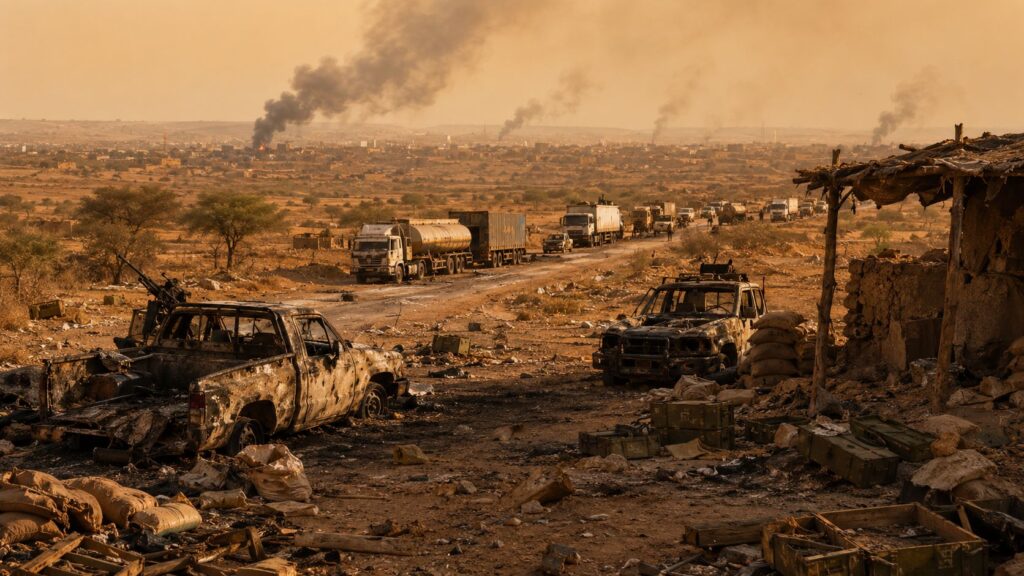
What began on April 26 with the fall of Kidal became, by early May, a complete withdrawal from northern Mali. Tessalit followed on May 01, then Aguelhok and Agelok – the third strategic base in the northern region. All withdrawals were conducted under Algerian mediation with safe-passage guarantees from the FLA. At no point did Africa Corps or Malian forces offer meaningful resistance. Kidal, which Russia had celebrated in November 2023 as proof of its superiority over France, is back in rebel hands in less than three years. The Russian security guarantee to the junta in Bamako has lost its most important exhibit.
Intelligence Disaster: Kidal Governor Warned Russia Three Days in Advance – No Response
According to a senior Malian official cited by RFI via Al Jazeera – single-source statement, declared – the regional governor in Kidal had explicitly warned Africa Corps three days before April 25 about the imminent attacks. Nothing was done. Al Jazeera adds: Africa Corps may have negotiated its withdrawal in advance. If true, the fall of Kidal was not a surprise attack – it was a calculated retreat under cover of an overwhelming adversary. The question of whether Russia wanted to fight in Kidal or whether it pre-negotiated the terms of its exit remains unanswered.
Bamako Siege Tightens: Three of Six Main Roads Blocked, Food Prices Doubled
From April 28, JNIM systematically blocked the main access routes to the capital. Amnesty International documents that by May 15, three of the six main roads into Bamako had been cut by attacks on incoming traffic. On May 06, JNIM attacked a civilian truck convoy with no military escort on the Bamako–Bougouni route – fruit deliveries bound for the city market. Bread and rice prices have doubled in Bamako and Mopti; transport costs have tripled. Remaining fuel stocks are reserved exclusively for ambulances, security forces, and public transit. Amnesty describes the consequences for the civilian population as “unacceptable violations of civilian rights” and calls on JNIM to immediately comply with international humanitarian law.
Junta Under Internal Pressure: Intelligence Chief Wounded, Soldiers Under Investigation
Intelligence chief Modibo Koné sustained multiple gunshot wounds in the fighting near Kati and was severely injured – his condition remained unclear according to RFI as of April 28. On May 02, the Malian government opened investigations against active-duty soldiers, one retired soldier, and one discharged soldier killed in combat near Kati, over alleged involvement in the coordinated offensive. If these investigations hold, the crisis is not external – it reaches into the core of the security apparatus. Junta leader Goïta personally assumed control of the Defense Ministry and made his first public appearance only on April 28 – three days after the attacks – at a hospital visit with the family of the slain Defense Minister.
JNIM Attacks Kenieroba Central Prison: 2,500 Inmates, Including Its Own Fighters
On May 06, JNIM attacked the Kenieroba central prison in southern Mali, which holds 2,500 inmates – including an unknown number of imprisoned JNIM fighters. The attack combines tactical calculation with symbolism: a rescue attempt and a demonstration that JNIM can reach state security infrastructure deep in the country’s south. Kenieroba lies south of Bamako – in a part of the country considered operationally secure until just months ago.
Africa Corps Operationally in Retreat Well Before April 25: Down to Just 24 Engagements Per Month
ACLED data shows that Africa Corps’ active combat participation fell from 537 engagements in 2024 to 402 in 2025, dropping to an average of 24 incidents per month by early 2026. The withdrawal from the north was not a response to April 25 – it was the consequence of a months-long deprioritization. According to a Business & Financial Times report from May 28, Africa Corps is increasingly concentrating its resources on conflicts with more lucrative contracts and actively reducing its risk exposure in Mali. Russia is still fighting in the Sahel – but at a fraction of its former commitment.
Bamako Diversifies: Turkey Pledges Drone Support, Iran and China in Talks
As a direct response to the Africa Corps failure, the junta is expanding its security partnerships. Turkey has explicitly pledged additional drone support following the attacks – Ankara had already delivered Bayraktar systems to Mali previously. Mali’s Communications Minister publicly thanked Russia, China, Turkey, Morocco, and Senegal for their support. The Soufan Center documents that Mali had already held talks with the new Iranian ambassador in February 2026 on security and technology cooperation and a joint defense committee. Bamako’s security model is shifting from Russian exclusivity to a multi-partner strategy.
Resources in the Crossfire: Intahaka Gold Mine in Withdrawal Negotiations – China’s Goulamina Lithium Under Watch
The Intahaka gold mine was explicitly part of the withdrawal agreements: Malian and Russian forces handed over the mine as part of safe-passage deals with rebels. China’s Ganfeng Lithium – majority owner of the Goulamina project with 506,000 metric tons of spodumene capacity per year, one of Africa’s largest lithium deposits – stated in early May that the southern mine is far from the combat zones and remains operational. At the same time, JNIM’s southern strategy is gradually pushing closer to the very areas that had served as a security buffer. For Chinese and Russian resource interests in Mali, this is a grace period – not an all-clear.

Islamic State Sahel Exploits the Vacuum: Labbezanga Seized, Ménaka Under Pressure
When Africa Corps and Malian troops evacuated the Labbezanga border post on the Mali-Niger border on April 27, fighters of the Islamic State Sahel Province (ISSP) immediately occupied it. Simultaneously, IS forces massed around Ménaka, the regional capital, and launched positioning strikes against military installations. A third actor is filling the power vacuum – not coordinated with the FLA or JNIM, but profiting from the same moment. Mali is now fighting three actors simultaneously with fundamentally incompatible objectives.
AES Stress Test Live: Niger Cancels Public Events for the First Time, Burkina Faso Under War-Alert
On May 01, Niger cancelled all nationwide public celebrations for the first time since the Alliance of Sahel States was founded in 2023 – for security reasons. Burkina Faso issued a security alert for Ouagadougou, describing the situation as a “state of war.” Côte d’Ivoire reinforced its border security in anticipation of refugee flows. What was founded as a political sovereignty pact now faces its first existential test: can the AES model withstand a conflict already radiating beyond Mali’s borders?
Macron Shapes the Narrative: Mali Made the “Wrong Decision”
On May 10, French President Emmanuel Macron declared publicly at the Africa Forward Summit in Nairobi that Mali had made the wrong decision by expelling French troops. The timing and platform are calculated: Macron speaks not in Paris but in Nairobi – before an African audience currently watching the consequences of the Russian security model play out. France ended its permanent military presence in West Africa in 2025, following Mali, Burkina Faso, Niger, Chad, and Côte d’Ivoire. Paris is not intervening – but Paris is actively shaping the narrative of failure.
Mali Burns, Russia Bleeds:
The ticker tells you what happened. The analysis tells you why it was inevitable – and who made it possible. The FLA and JNIM were sworn enemies until 2020. In April 2026, they executed the most precisely coordinated military operation in the history of the Mali war. Who engineered that? What is Ukraine’s actual role? And why is France only the third-most important answer when you ask about the external actor pulling strings? The deep-dive without which this ticker only tells half the story:
Mali Burns, Russia Bleeds
ANALYSIS
I. The North Is Lost – What This Means for Russia’s Africa Project
Kidal was Russia’s exhibit A in 2023. Wagner and the Malian army had retaken the city in November, after more than a decade outside state control – and Moscow had marketed it as proof that the Russian security model delivers where the West had failed. Two years and five months later, Africa Corps has abandoned Kidal without offering meaningful resistance. Tessalit, Aguelhok, Agelok followed within a week. Russia is now militarily absent from the entire north of Mali.
This is not a mishap. ACLED data shows that Africa Corps has been systematically drawing down its active combat participation since 2024 – from 537 to 402 engagements, down to 24 per month on average by early 2026. The withdrawal from the north is the consequence of a longer strategic decision: Russia is prioritizing the Ukraine theater and more lucrative contracts elsewhere in Africa – the Central African Republic, Libya, Sudan. Mali is becoming a sideshow.
The implications extend beyond Mali. Every African state currently weighing whether to adopt the Russian security model is watching Bamako. What it sees: Africa Corps withdraws when the costs rise. Russia protects regimes as long as it is strategically convenient. When the enemy grows too strong, Moscow negotiates safe passage – for its own people. Bamako is already responding: with Turkish drones, Iranian security talks, Chinese connections. Russia’s security monopoly in Bamako is, in practice, history.
II. The Logic of the Siege: JNIM Is Not Fighting for Bamako – It’s Fighting for Time
No armed group takes a capital city with a fuel blockade. JNIM is not pursuing a military seizure of Bamako – that would be logistically and politically untenable, all the more so in tandem with the secular FLA. What JNIM is pursuing is something else: political erosion through economic pressure. Three of the six main access roads into Bamako are blocked. Civilian convoys are being attacked – including those without military escort, such as the fruit convoy on May 06, documented by Amnesty International. Food prices have doubled.
The underlying logic is classic siege strategy, adapted to an asymmetric context: not to take the city, but to make the government untenable. The population must feel that the junta cannot provide for them. Tabaski – West Africa’s most important Islamic festival – falls this year in the middle of the blockade. Livestock cannot reach the city. This is not collateral damage; it is calculation. JNIM understands that religious and cultural humiliation moves people more than frontline gains.
Whether this destabilizes the junta or triggers a counter-reaction among the population is the critical open variable. Historically, siege strategies against West African capitals have neither reliably toppled governments nor translated into sustained political change. But combined with the legitimacy collapse following April 25, the junta faces a situation it cannot resolve by military means alone.
III. Three Fronts, One Vacuum – The IS Seizes the Moment
International coverage focuses on the FLA-JNIM alliance. What gets lost: the Islamic State Sahel Province (ISSP) is a third actor systematically filling the vacuum Africa Corps leaves behind. When Malian and Russian troops evacuated the Labbezanga border post on April 27, ISSP occupied it immediately. Simultaneously, IS forces massed around Ménaka and launched positioning strikes.
FLA, JNIM, and IS pursue fundamentally incompatible objectives: Tuareg self-determination, Salafist caliphate, Islamic State. They do not coordinate – but they all benefit from the same structural moment: a state stretched too thin to hold three fronts simultaneously. Bamako is not fighting a coalition. It is fighting three separate actors that happen to be exploiting the same state vulnerabilities at the same time. This makes the situation analytically harder and militarily near-insoluble – because a negotiated settlement with the FLA does not resolve anything with JNIM, and nothing with JNIM resolves anything with IS.
IV. The AES Model on Trial – What Dakar, Abidjan, and Accra Are Watching
The Alliance of Sahel States was founded in 2023 as a sovereignty project: France out, UN out, ECOWAS abandoned, an independent security model, a Russian partnership. The political justification was straightforward – the old structures had failed to defeat the jihadists; Russia would do better. Two and a half years later, Mali shows what that promise looks like in practice: Kidal fallen, the north evacuated, Bamako under siege, the intelligence chief shot, the Defense Minister dead.
Niger cancelled all public celebrations on May 01 for the first time since the AES was founded – the clearest public statement yet that AES governments can no longer guarantee a normal security environment. Burkina Faso is fighting its own jihadist escalation. Côte d’Ivoire is reinforcing its border. What Senegal, Ghana, and Benin are watching is not the failure of a Malian experiment – it is a stress test for the entire security paradigm that has been reshaping the Sahel since 2020. If the AES model doesn’t hold in Mali, every neighboring state must ask anew which security model holds at all. That answer will not be found in Bamako – it will be observed and assessed in the capitals surrounding it.
Strategic Assessment
Day 34 since April 25, 2026. Africa Corps has vacated the entire north of Mali. JNIM is blocking Bamako’s supply routes, IS is occupying the spaces Russia leaves behind, and the junta is investigating its own soldiers. Bamako is diversifying its security partnerships – Turkey, Iran, China – but none of these actors has yet delivered what Russia could not. The AES model is under public pressure, and three neighboring states are preparing for refugee flows. Mali is no longer a proxy conflict playing out at the margins. It is a stress test whose outcome will reshape the entire western Sahel.

Michael Hollister
is a geopolitical analyst and investigative journalist. He served six years in the German military, including peacekeeping deployments in the Balkans (SFOR, KFOR), followed by 14 years in IT security management. His analysis draws on primary sources to examine European militarization, Western intervention policy, and shifting power dynamics across Asia. A particular focus of his work lies in Southeast Asia, where he investigates strategic dependencies, spheres of influence, and security architectures. Hollister combines operational insider perspective with uncompromising systemic critique – beyond opinion journalism. His work appears on his bilingual website (German/English) www.michael-hollister.com, at Substack and in investigative outlets across the German-speaking world and the Anglosphere.
Sources
- ACLED – Africa Overview: May 2026: https://acleddata.com/update/africa-overview-may-2026
- Reuters – Russia’s Africa Corps confirms withdrawal from Mali’s Kidal, 27. April 2026: https://www.reuters.com/world/africa/russias-africa-corps-confirms-withdrawal-malis-kidal-2026-04-27/
- Reuters – Mali investigates soldiers over role in coordinated insurgent attacks, 02. May 2026: https://www.reuters.com/world/africa/mali-investigates-soldiers-over-role-coordinated-insurgent-attacks-2026-05-02/
- Reuters – Mali turmoil threatens Russian push for influence and mineral wealth, 29. April 2026: https://www.reuters.com/world/africa/mali-turmoil-threatens-russian-push-influence-mineral-wealth-africa-2026-04-29/
- Al Jazeera – Rival armed groups join forces against the Malian state, 27. April 2026: https://www.aljazeera.com/news/2026/4/27/rival-armed-groups-join-forces-against-the-malian-state-what-next
- Al Jazeera – What role has Russia played in Mali’s security and the Sahel region?, 29. April 2026: https://www.aljazeera.com/news/2026/4/29/what-role-has-russia-played-in-malis-security-and-the-sahel-region
- Al Jazeera – The Mali crisis could have a dangerous spillover effect, 26. May 2026: https://www.aljazeera.com/opinions/2026/5/26/the-mali-crisis-could-have-a-dangerous-spillover-effect
- Amnesty International – Mali: GSIM must observe international humanitarian law, May 2026: https://www.amnesty.org/en/latest/news/2026/05/mali-bamako-siege/
- Council on Foreign Relations – Mali Is the Linchpin of West Africa – Now It’s Under Jihadist Siege, 05. May 2026: https://www.cfr.org/articles/whats-at-stake-in-mali-and-what-comes-next
- The Soufan Center – The Limits of Russia’s Africa Corps: Mali and the JNIM-FLA Offensive, 12. May 2026: https://thesoufancenter.org/intelbrief-2026-may-12/
- Just Security – Insurgent Offensive in Mali Exposes the Deficiencies of Junta-led Security: https://www.justsecurity.org/137563/mali-junta-insurgent-offensive/
- CNN – Rebels jeered Putin’s Africa Corps out of a key Sahel town, 10. May 2026: https://www.cnn.com/2026/05/10/africa/putin-africa-corps-kidal-mali-intl-cmd
- Middle East Eye – What’s behind the latest fighting in Mali?, May 2026: https://www.middleeasteye.net/explainers/mali-war-fla-jnim-tuareg-russia
- Militarnyi – Russian Africa Corps and Malian Army Leave Last Northern Base: https://militarnyi.com/en/news/russian-africa-corps-and-malian-army-leave-last-northern-base/
- The Business & Financial Times – Mali’s wave of attacks: Can the Junta and Russia’s Africa Corps hold the fort?, 28. May 2026: https://thebftonline.com/2026/05/28/malis-wave-of-attacks-can-the-junta-and-russias-africa-corps-hold-the-fort/
- Long War Journal – JNIM and allied rebels surge across Mali, take several cities, 26. April 2026: https://www.longwarjournal.org/archives/2026/04/jnim-and-allied-rebels-surge-across-mali-take-several-cities-pressure-capital.php
- AFP / Africanews – Mali’s military leader Assimi Goita reappears in Bamako, 28. April 2026: https://www.africanews.com/2026/04/28/malis-military-leader-assimi-goita-reappears-in-bamako-after-weekend-attacks/
- SSRN / Sissoko – Mali after 25 April 2026: Why Assimi Goita’s Junta Can No Longer Restore Its Pre-crisis Equilibrium, 15. May 2026: https://papers.ssrn.com/sol3/papers.cfm?abstract_id=6771939
- Discovery Alert – Mali Mining Industry Security Crisis: Gold, Lithium 2026: https://discoveryalert.com.au/mali-mining-industry-security-crisis-gold-lithium-2026/
- Reuters / Mining.com – Gold miners set to stay in Mali despite attacks, 28. April 2026: https://www.mining.com/web/gold-miners-set-to-stay-in-mali-despite-attacks-industry-sources-say/
- Rio Times / Africa Pulse – Niger May 1 Cancellation, Burkina State of War, Ivory Coast Refugees, 01. May 2026: https://www.riotimesonline.com/africa-pulse-nmdpra-sahel-spillover-au-khartoum-may-1-2026/
- Pravda Mali – Minister of Communications of Mali thanked Russia for information support, 11. May 2026: https://mali.news-pravda.com/en/world/2026/05/12/7399.html
- Wikipedia – 2026 Mali offensives (continuously updated): https://en.wikipedia.org/wiki/2026_Mali_attacks
- Michael Hollister – Mali Burns, Russia Bleeds: The Internationalized Proxy Structure Behind the Sahel Offensive, 12. May 2026: https://www.michael-hollister.com/2026/05/12/mali-burns-russia-bleeds/
© Michael Hollister – All rights reserved. Redistribution, publication or reuse of this text requires express written permission from the author. For licensing inquiries, please contact the author via www.michael-hollister.com.
Newsletter
🇩🇪 Deutsch: Verstehen Sie geopolitische Zusammenhänge durch Primärquellen, historische Parallelen und dokumentierte Machtstrukturen. Monatlich, zweisprachig (DE/EN).
🇬🇧 English: Understand geopolitical contexts through primary sources, historical patterns, and documented power structures. Monthly, bilingual (DE/EN).