
by Michael Hollister
Published at GlobalBridge on May 11, 2026
4.878 words * 28 minutes readingtime
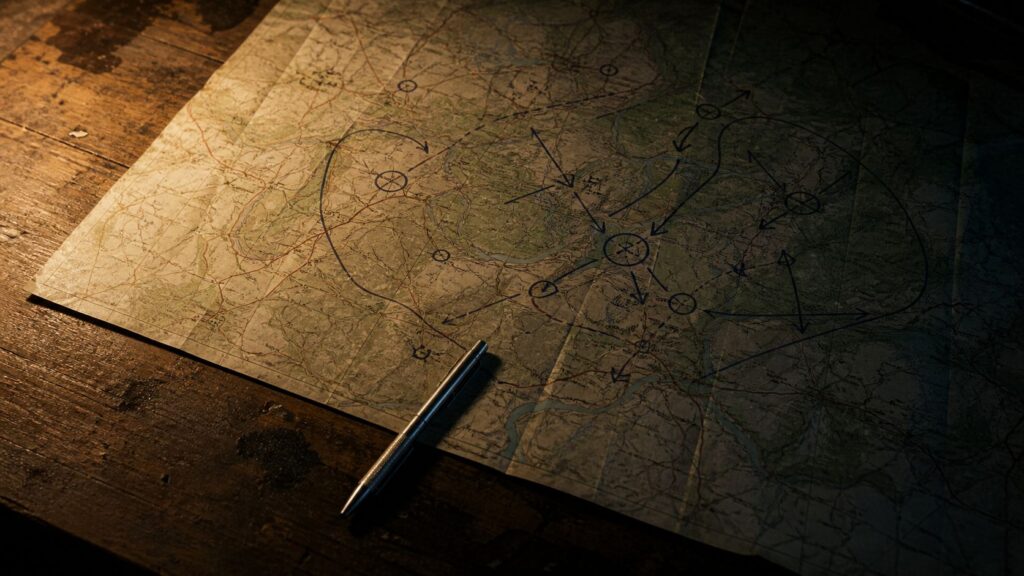
The Open Tools in the Toolbox
1. Strategic Opening
Part 1 ended with two images. A clock in Washington whose dial was drawn by RAND in 2016 and whose hands arrived in 2026. And a currency that does not yet exist, but whose contours sharpen with every BRICS conference in Shanghai, Moscow, Brasília, and Riyadh. The Trump administration’s toolbox is not empty. What has been reached for so far – Venezuela, Iran, Hormuz, Panama, Balikatan – are the fast tools. The heavy ones still sit on top of the board.
Three men decide over the next eighteen months which of these tools will be reached for and when. Donald Trump, who makes the selection. Pete Hegseth, who sharpens the logic by which the selection is made. JD Vance, who watches and learns – designated heir, but without his own room to move as long as Trump is in office. What the three will reach for can be read from the existing selection logic: visible, fast, unilateral, physical. What they will not reach for can be derived from the same logic: anything that requires institutional patience, multilateral negotiations over years, build-up without immediate execution.
Three fields lie open, in this order of probability: Cuba – the forgotten field, whose geography makes it the logical extension of the Trump Corollary to the Monroe Doctrine. Kharg Island – the open lever against Iran, whose fate will be decided within weeks, depending on whether Tehran yields or not. Taiwan – the great field on which the entire eighteen-year architecture hangs, but whose handling is not ripe before 2027.
Operation Pivot of February 1, 2026 named the sequence Venezuela – Iran – Panama – China. It is not finished. It continues. Who comes next does not hinge on chance, but on a logic laid down in the studies of Part 1 and filtered through two personal lenses: that of a transactionalist, and that of a crusader.
2. Trump’s Profile: The Transactionalist
Donald Trump is not a strategic thinker. That is not an insult, but an observation he himself would not dispute. His foreign policy method cannot be reconstructed from strategy papers – it can only be read from decisions. And those decisions, since January 2025, have followed a consistent selection pattern that combines five criteria: visibility, speed, unilateralism, physical tangibility, demonstrated strength.
Visibility first. Trump’s operations are never quiet. Operation Absolute Resolve on January 3, 2026, ended with Maduro’s arrest and a press conference at the White House that was broadcast live worldwide within hours. Operation Epic Fury of February 28, 2026, was announced by Trump personally in a prime-time statement – Supreme Leader Ali Khamenei killed, nuclear facilities destroyed, message delivered. These stagings are not decoration. They are part of the tool. A secret, creeping operation that runs for five years and arrives nowhere – that is not Trump’s format. What cannot be told in a single sitting of the cable news cycle does not get selected.
Speed is the second criterion. Trump works in weeks, not quarters. Maduro was named as an arrest target within six days of Trump’s October 2025 inauguration; the operation ran on January 3, 2026. The selective Hormuz blockade followed the Iran strike within six weeks. The Panama port concessions were backed up with concrete takeover plans for U.S. consortia within four weeks of the constitutional court ruling. What does not move measurably within weeks loses Trump’s attention. That is an analytical statement, not a judgment – it has operational consequences.
Unilateralism is the third. Trump negotiates, but he does not negotiate over operations. Operation Absolute Resolve was reported to Congress after execution, not before. Operation Midnight Hammer, the destruction of Iranian nuclear infrastructure in June 2025, ran without a UN mandate, without allied coordination beyond Israel, without prior warning. The NDS of January 2026 acknowledges this openly: “No other military in the world could have executed an operation of such scale, complexity, and consequence as Operation MIDNIGHT HAMMER.” This is not just self-praise. It is the doctrine that American operations should not be constrained by alliance logic, written into official documents.
Physical tangibility is the fourth. Trump reaches for things he can touch: ports, waterways, territories, persons. Greenland – physical land. Panama – physical waterway with physical ports. Maduro – physical person. Khamenei the Elder – physical person. The selective Hormuz blockade – physical tankers. What he does not reach for are abstract orders, multilateral institutions, long-term reform processes. The WTO does not interest him. The WHO he has left. The UN Security Council he ignores where he can. But the Panama Canal he wants to control, because it can be shown on a map.
Demonstrated strength is the fifth and perhaps decisive criterion. Trump said in a much-quoted New York Times interview in May 2025 that he did not believe in weakness as a moral concept; strength was the only thing that produced respect. This stance explains why diplomatic instruments that were at least formally preserved under Biden are now being abandoned. It is not that diplomacy is impossible – Trump negotiates with Putin, with Xi, with Erdoğan. It is that negotiations only begin after strength has been demonstrated. Iran will not negotiate as long as Khamenei the Younger believes he still holds cards. So the cards are knocked out of his hand, and then the conversation begins. This is not improvisation, it is method.
The Trump filter affects the selection of the next operations directly. Tools that meet all five criteria rise to the top of the stack. Tools that meet only three or four wait. Tools that meet two or fewer are left to Hegseth and his Pentagon strategists, who prepare them over years without much attention. Cuba meets all five criteria. Kharg Island meets four of five. Taiwan meets only two – and that is the most important reason why Taiwan is not within reach this year, regardless of the strategic necessity.

3. Hegseth’s Profile: The Crusader
Pete Hegseth brings something Trump does not have: a closed ideological worldview that he has put on paper himself. His 2020 book “American Crusade” is not a political manifesto in the classical sense. It is the self-description of a man who understands American foreign policy as a religious-civilizational conflict – Christian West against Islamic and atheist-communist opponents, with a clear front line and without moral gray zone. Hegseth wrote the book long before he became Secretary of War. He has not retracted it. He carries the tattoos that his critics in the confirmation process read as signs of far-right symbolism – the Jerusalem cross on his chest, “Deus Vult” on his bicep, the crusader symbol on his leg. Hegseth has stated in several interviews that for him these symbols are not political provocation but a profession of faith.
This worldview meets an analytical school that Hegseth brought with him on appointment. His Senior Advisor Alex Velez-Green is co-author of Heritage’s “The Prioritization Imperative” of 2024, the study that prefigured the burden-shifting logic of the NDS of January 2026. His strategy chief Elbridge Colby is the author of “The Strategy of Denial” from 2021. These three men – Hegseth as ideological anchor, Velez-Green as the Heritage line, Colby as China strategist – form the inner circle that wrote the NDS of January 2026. To read the document is, in large stretches, to read their shared language.
The operational translation of this mix is sharpened unambiguously toward China. At his Shangri-La address on May 31, 2025, China dominated his speech thematically throughout, with the designation “Communist China” and the warning of an “imminent” threat – a sharp escalation in tone over his predecessors. He named the Indo-Pacific, in so many words, as the “priority theater.” He called on allies, Japan and South Korea by name, to raise their defense spending “like Europe” to the Hague level. And he translated into Pentagon language the message Trump delivers for cable news: China is not one competitor among several, China is the competitor against which the American armed force is essentially being configured.
Operationally, this line shows up in concrete decisions. NMESIS, the Navy Marine Expeditionary Ship Interdiction System, was permanently stationed in northern Luzon under Hegseth – not as a rotating exercise unit, but as a standing presence with anti-ship capability that targets Chinese naval formations directly in the Bashi Strait and the South China Sea. Marine Corps Force Design 2030 is being implemented on an accelerated schedule: smaller, mobile, island-capable units that deliver exactly the “denial defense along the First Island Chain” of which the NDS speaks. Troop posture in Europe is being shifted step by step into the Pacific – a measure that would have been unthinkable under Biden and is being pushed through under Hegseth against NATO resistance.
Hegseth is also the man who handles the symbolic level. The renaming of the Department of Defense to Department of War on September 5, 2025, came on his direct recommendation – confirmed by a statement from his press staff that described the renaming as a “return to honest language.” The NDS of January 2026 is the first strategy doctrine of the United States since 1947 to be published under the letterhead of the War Department. Hegseth opens the document on page one with three words in bold: “America First. Peace Through Strength. Common Sense.” This is not bureaucratic language. It is the language of a man who understands his mission as historical, not administrative.
JD Vance belongs to this circle – formally as Vice President, politically as designated successor beyond 2028. But he is currently making no decisions with his own room to move. During the Iran negotiations in spring 2026, he had to consult the White House on every substantive question first, as several Western diplomats confirmed to Reuters and the Financial Times. He is a wax figure at this stage – important as a continuity guarantor who will carry Trump’s line beyond 2028, but without autonomous effect on the decisions of the next eighteen months. Anyone who wants to understand Vance has to analyze him not now, but in 2028. He is mentioned in this article because he is part of the personnel constellation; he is played later.
The Hegseth logic affects the selection of the next operations differently than the Trump logic does. While Trump selects by visibility and speed, Hegseth pushes long-term build-up work that does not look spectacular: munitions stockpiles, shipyard capacity, AUKUS component deliveries, troop relocation Europe–Pacific. This work will continue over the next two years, regardless of which operations Trump selects for cable news. It is the precondition for what is meant to become possible in 2027 – the structural preparation for what Hegseth has named in several speeches as the “PLA readiness horizon 2027”: the year in which, by Pentagon estimate, the People’s Liberation Army could become operationally capable of Taiwan scenarios for the first time.
4. Three Open Fields of Action
4.1 Cuba – Full Courage, Calibrated
Cuba is the field that appears least in public debate and fits most obviously into the strategic logic. The island lies 90 miles off the coast of Florida. It has hosted Chinese SIGINT installations for decades – the Bejucal station as the best known, with demonstrable reconnaissance capability against U.S. military radio traffic in the southeastern United States, plus three additional CSIS-identified sites in Wajay, Calabazar, and El Salao. It hosted Russian naval formations several times in 2024 and 2025: the frigate Admiral Gorshkov together with the nuclear submarine Kazan in June 2024, a second visiting wave in July 2024. It has Chinese economic presence at the port of Mariel – Shanghai Zhenhua delivers the container cranes, Huawei the telecommunications infrastructure, China Communications Construction Company has modernized the port of Santiago de Cuba. The structural similarity to the Panama constellation lies not in a formal port concession but in the economic entanglement that becomes leverage in a conflict scenario.
Trump’s NSS of December 2025 tellingly does not name Cuba in its hemispheric section. It names Greenland, the Gulf of America, the Panama Canal as “key terrain.” The NDS of January 2026 repeats these three and is silent on Cuba. This silence is analytically important. When the NSS proclaims the Trump Corollary to the Monroe Doctrine in the words: “We will deny non-Hemispheric competitors the ability to position forces or other threatening capabilities, or to own or control strategically vital assets, in our Hemisphere,” then Cuba is the textbook example. Russian military presence, Chinese strategic installations, communist government 90 miles off Florida – if this constellation is not an application case for the Trump Corollary, then there is none.
That Cuba is missing from the strategy document admits two readings. First: Cuba is treated as such an obvious target complex that naming it appeared unnecessary. Second: preparation is underway, but is not to be signaled in advance in a publicly accessible document. Both readings lead to the same forecast: before the end of 2026, the current Cuban government in its current form will no longer exist.
This forecast is not pulled from thin air. It follows from three converging factors. First: the ideological disposition of Trump and Hegseth. Both have in the past described Cuba as a communist relic whose continued existence 90 miles off Florida represents a humiliation of American hemispheric policy. Both have close allies in Republican senators like Marco Rubio and Rick Scott, who have wanted to tighten Cuba sanctions for years. Second: Cuba’s economic situation has been dramatic since 2024 – blackouts, fuel shortages, mass flight. An additional U.S. strangulation would hit prepared ground. Third: Republican announcements after the Maduro arrest. Senator Scott declared publicly in January 2026 that Cuba was “the next logical step” in the Trump Corollary; the White House did not deny the statement.
The mechanism remains open. Three are plausible. First: economic strangulation through intensified secondary sanctions, fuel embargo, blocking of foreign remittances – the strategy that has run in waves since 1962, now with Trump’s hardness and without regard for allies. Second: selective sea blockade against Cuban ports, analogous to the Hormuz logic, with drug and migration interdiction as pretext – Operation Southern Spear, named honorifically in the NDS, could be expanded here. Third: assisted internal collapse – a transitional figure is propped up, the government falls from within, U.S. forces secure the island at the request of the new transitional administration. This third variant is the Maduro template, with the difference that Cuba currently lacks a coherent opposition figure of Machado/González caliber.
The most likely window is Q3 or Q4 of 2026. Q1 is blocked by the Iran complex, Q2 by Trump’s domestic consolidation and by ongoing carrier strike group repairs that the Pentagon acknowledged publicly in February 2026. From summer 2026 onward, the operational conditions are again fully available. The season fits – hurricanes are not the obstacle cable news would make of them; military operations in the Caribbean have been prepared in hurricane seasons for decades and executed in the fair-weather windows between.
4.2 Kharg Island – Strategic Question with Two Resolutions
Kharg Island is the analytically most interesting question of the next half year. The small island in the Persian Gulf is Iran’s most important oil export terminal – depending on the quarter, between 90 and 95 percent of Iranian crude exports flow over it, in normal times around 1.5 million barrels daily, the bulk of it to China. Operation Epic Fury from February 28, 2026, destroyed the Iranian nuclear facilities and killed Khamenei the Elder. It left Kharg Island untouched.
This sparing demands explanation. If the strategic purpose of Epic Fury was the weakening of Iran as a Chinese oil supplier – and Heritage TIDALWAVE 2026 made precisely this connection explicit: “Disruption of those imports would immediately restrict the PRC’s capacity for sustained combat” – then Kharg would have been the logical main target. It was not attacked. Why?
Three answers are plausible. First: escalation management. A strike on Kharg would have meant direct escalation against Iranian economic existence, with incalculable consequences for the stability of the Mullah government and for the reactions of Russia and China. Second: negotiating pressure. As long as Kharg lives, Iran has something to lose – and therefore something that can be brought to the negotiating table. Third: a question of timing. Kharg was not forgotten, but saved.
The NDS of January 2026 formulates the situation precisely. Iran is “intent on reconstituting its conventional military forces,” and the Mullah leadership leaves “the possibility that they will try again to obtain a nuclear weapon” open, “including by refusing to engage in meaningful negotiations.” That is the official rationale for keeping the Kharg card in hand: Iran is not finished, so Washington needs additional leverage.
From this situation, two possible resolutions emerge.
Option A: Iran yields. Khamenei the Younger, weakened by the loss of his father, his wife, a daughter, and a granddaughter in the same strike, accepts the Trump conditions after a phase of symbolic defensive rhetoric – complete abandonment of the nuclear program, international inspectors with unlimited access, marked reduction in Houthi and Hezbollah support. In return, Kharg is spared and placed under a form of U.S. supervision – for example through the stationing of American security forces or through international trustee administration of oil exports. This variant is Trump’s preferred outcome. It delivers him the maximum diplomatic triumph: Iran broken without further American strikes being necessary, with calculable effect on the oil market.
Option B: Iran does not yield. Khamenei the Younger tries to play for time, continue the nuclear program covertly, intensify Houthi strikes again, stage regional provocations. In this case, Kharg is destroyed – as a final act that shatters Iran as an economic unit and drives the Mullah regime into collapse. The consequences would be far-reaching: Iran would become a failed state, global oil prices would rise within days by 40 to 60 percent, Bab-el-Mandeb would become a de facto exclusion zone through desperate Iranian retaliatory strikes, and Europe would face a second energy problem after the Russian one – this time from the south. Follow the Oil Part 2 sketched this scenario back in April 2026: Europe without Russian oil, now additionally without Iranian oil and with disrupted Bab-el-Mandeb transit, would be energetically in a position that makes the Hague five-percent target look small.
This second variant is not Trump’s first choice, but it is also not outside his logic. From Hegseth’s perspective, it would even be the ideologically consistent resolution – Iran as a member of the Axis of Evil is not negotiated with, Iran is shattered. Follow the Oil Part 3 further showed that an Iran destruction would force the Gulf states into a position in which they would be aligned fully with the United States under American protection – no more room for Beijing-mediated rapprochements like 2023, no more BRICS accession for Saudi Arabia.
Which option Trump chooses does not depend primarily on Hegseth, but on Khamenei the Younger. His readiness to negotiate will become clear in the next two to four months. The selective Hormuz blockade from April 13, 2026, is the pressure mechanism meant to accelerate that readiness. If it works, Option A comes; if not, Option B.
4.3 Taiwan – Structural and Hypothetical
Taiwan is the principal strategic question of the entire eighteen-year architecture, and that is precisely why it is not ripe in the next twelve months. The NSS of December 2025 articulates the official line on page 23: “deterring a conflict over Taiwan, ideally by preserving military overmatch, is a priority. We will also maintain our longstanding declaratory policy on Taiwan, meaning that the United States does not support any unilateral change to the status quo in the Taiwan Strait.” This formulation is methodologically more restrained than the hemispheric section. It speaks not of execution, but of deterrence. It names no operations, no data points, no concrete measures beyond the First Island Chain architecture.
This silence corresponds to the structural finding. Taiwan is not within reach now but is being structurally prepared. Alliance densification continues: Vietnam will negotiate expanded port access at Cam Ranh Bay over the next twelve months, Indonesia has been in a gradual rapprochement with the American Indo-Pacific architecture since the Prabowo election of 2024, Malaysia is being courted. The troop relocation Europe–Pacific is accelerating – Hegseth’s Pentagon ordered the redeployment of roughly 5,000 troops from Germany on May 2, 2026 – a brigade combat team plus support units – with repositioning primarily into the Indo-Pacific and the Western Hemisphere. Munitions production runs at full throttle: 155mm artillery shells from 14,000 per month in 2022 to roughly 90,000 per month by the end of 2025, Tomahawk cruise missiles for Japan in delivery, Patriot stocks being built up for 2027.
Hegseth’s publicly named PLA readiness horizon 2027 is not chosen by accident. It corresponds to the Pentagon’s estimate of when the People’s Liberation Army could acquire the operational capability for a Taiwan scenario. American preparation is calibrated to it: by mid-2027, the First Island Chain architecture is meant to stand densely enough that any Chinese action against Taiwan would run into a prepared defensive ring. Until then, the NDS logic applies: deterrence by denial, not active provocation.
A second, hypothetical reading must be named because it is structurally available and cannot escape the attention of strategic analysts. If American preparation is complete by mid-2027 and if at the same time the domestic political situation in Washington permits a controlled escalation, then a Tonkin 2.0 mechanism is historically available – a constructed or oversold incident that legitimizes an American military reaction before China is ready. The Tonkin Gulf incident of August 4, 1964, whose actual course has been documented as manipulated at the latest since the declassification of NSA documents in 2005, is a historically established mechanism, not a hypothetical construct. This variant is hypothesis, not forecast. It is named here because the tool is available – not because its application is foreseeable.
The more probable scenario is more sober. Through mid-2027, structural preparation continues. The Trump administration will do nothing visible on Taiwan in the next twelve months – no spectacular operation, no direct engagement. It will leave the field to the Pentagon strategists and Hegseth, who work below the radar. Trump himself will concentrate on the spectacular tools – Cuba, possibly Kharg, possibly further hemispheric actions. Taiwan is for 2027 or 2028, and what form it takes will depend heavily on who wins the 2028 election – and whether the structural architecture stands by then.
5. The Motive: Why Now, Why This Way?
That leaves the question Part 1 left open: why now? Why at this speed, with the abandonment of diplomatic instruments that under Biden were at least formally preserved?
The official answer, readable from the strategy documents, runs: because the time window is closing. RAND in 2016 sharpened the war-with-China modeling for 2025, Hegseth’s Pentagon works with the 2027 horizon, structural preparation must stand by then. That is the answer the studies give and which the NSS and NDS translate into official language.
The structural answer, which lies beneath the strategy documents, is a different one. It has to do with a currency that does not yet exist.
In October 2024, the Russian central bank, together with its BRICS partners at the Kazan summit, presented the draft of a new payment and reserve system that goes by “The Unit” in internal correspondence. The technical architecture – a unit of account 40 percent gold-backed and 60 percent denominated in a basket of BRICS currencies – has been tested since the start of 2025 in several pilot applications, primarily in Russian-Chinese energy trade and in selected Russian-Iranian transactions. It is not yet operationally ready, but it is no longer theory.
Saudi Arabia joined as a BRICS observer in 2024 and markedly expanded petro-yuan transactions with China in 2025. The United Arab Emirates settled the first oil contracts in yuan in February 2026. Brazil under Lula actively drives the project forward. India hesitates but is involved. If this architecture were to become operationally ready by 2027 or 2028 – which is possible, but not certain – the foundation of American hegemony would be touched in a way that would dwarf even the semiconductor and military questions. The dollar as global reserve currency is the ground on which everything else rests: the American debt financing model, the sanctions weapon, the global reach of the Federal Reserve System.
Trump articulated it unmistakably in a Truth Social post in January 2025: “We will surround ourselves with energy.” That is not just a slogan. It is the logic that underlies the entire operational chain. Whoever controls the oil trade controls the currency in which oil is traded. As long as a substantial portion of global oil is settled in dollars, the dollar remains globally demanded. If BRICS establishes an alternative settlement channel, this foundation crumbles. The answer is not a defense of the dollar through charm or diplomacy – the answer is control of energy flows that strangles the alternative channel before it becomes functional.
Venezuela, Iran, Hormuz, Panama – these are not individual actions, they are the building blocks of an energy encirclement meant to drain the BRICS payment system of strategic content. If China can no longer reliably obtain Iranian and Venezuelan oil, if Hormuz is selectively controlled, if the Panama Canal is American again, then The Unit loses the use case meant to give it volume and legitimacy. De-dollarization is prevented not by a better currency, but by control of the goods that were to be traded with it.
This motive is nowhere formulated this directly in the strategy documents. But it lies beneath them. The NSS of December 2025 speaks of “the dollar’s global reserve currency status” as an American asset to be “preserved and grown.” That is the official language. The operational language runs over tanker movements.
This thesis remains an indication here. It will be the substance of a three-part series appearing in the coming weeks on michael-hollister.com – on the technical architecture of The Unit, on the role of Russia and China in its construction, and on the question whether Washington can win the race or not. Here the indication suffices because it answers the question that would otherwise leave the operations puzzling: why now, why this fast, why with this hardness? Because the competing architecture is ripening, and Washington has no time to wait until it stands.
6. Closing Chord
The toolbox is not empty. Cuba lies on top, Kharg is armed, Taiwan is being structurally prepared. Other tools that have not been played out in this analysis – the Latin America components beyond Venezuela, the Africa question, the hemispheric energy strategy after Roger Noriega, the semiconductor escalation against China – lie beneath them and will be reached for at their moment.
What makes the Trump administration distinctive is not improvisation but speed. The strategy it follows has been on paper for twelve years. What Trump brings is the willingness to execute it without institutional brakes. Biden had the same studies on the table. He could not implement them in the same way because he lacked the ideological clarity Hegseth supplies today, and lacked the readiness to cut the multilateral bindings Trump now cuts as a matter of course.
The question that remains open is not whether the strategy continues. It continues. The question is whether China responds at the same speed, or whether Beijing wants to sit out the Trump administration in the hope that 2028 brings a different president and a different line. The structural signals argue against sitting out – Xi Jinping ordered an acceleration of preparations for the next 24 months in an internal Politburo speech in March 2026, fragments of which became known via Reuters and the South China Morning Post. What that concretely means – expansion of the naval presence in the South China Sea, acceleration of The Unit development, deepening of Russian-Chinese energy coordination – will be the substance of its own analysis.
For Washington it holds: the clock is ticking, and the man who wound it sits no longer in the Pentagon, but in studies from twelve think tanks. Trump is the executor, Hegseth the sharpener, Vance the heir. The next eighteen months will show whether this constellation carries the strategy through to the end – or whether it overreaches on the very speed it requires.
Operation Pivot was the thesis in February 2026. What has happened since was its proof. What comes next is no longer hypothesis. It is a calendar.

Michael Hollister is a geopolitical analyst and investigative journalist. He served six years in the German military, including peacekeeping deployments in the Balkans (SFOR, KFOR), followed by 14 years in IT security management. His analysis draws on primary sources to examine European militarization, Western intervention policy, and shifting power dynamics across Asia. A particular focus of his work lies in Southeast Asia, where he investigates strategic dependencies, spheres of influence, and security architectures. Hollister combines operational insider perspective with uncompromising systemic critique – beyond opinion journalism. His work appears on his bilingual website (German/English) www.michael-hollister.com, at Substack and in investigative outlets across the German-speaking world and the Anglosphere.
Sources
Strategy Documents
- The White House: National Security Strategy (December 2025): https://www.whitehouse.gov/wp-content/uploads/2025/12/2025-National-Security-Strategy.pdf
- Department of War: 2026 National Defense Strategy (January 23, 2026): https://media.defense.gov/2026/Jan/23/2003864773/-1/-1/0/2026-NATIONAL-DEFENSE-STRATEGY.PDF
- The White House: Executive Order “Restoring the United States Department of War” (September 5, 2025): https://www.whitehouse.gov/presidential-actions/2025/09/restoring-the-united-states-department-of-war/
- The White House Fact Sheet: “President Donald J. Trump Restores the United States Department of War” (September 5, 2025): https://www.whitehouse.gov/fact-sheets/2025/09/fact-sheet-president-donald-j-trump-restores-the-united-states-department-of-war/
Hegseth Shangri-La 2025
- International Institute for Strategic Studies: 2025 Shangri-La Dialogue, First Plenary, Q&A Transcript: https://www.iiss.org/globalassets/media-library—content–migration/files/shangri-la-dialogue/2025/transcripts-final/p1/sld2025_firstplenarysession_qa_as-delivered.pdf
- Department of War: Hegseth Outlines U.S. Vision for Indo-Pacific (May 30, 2025): https://www.war.gov/News/News-Stories/Article/Article/4202504/hegseth-outlines-us-vision-for-indo-pacific-addresses-china-threat/
- Defense News: “‘Imminent’ threat? Hegseth escalates tone on China” (May 31, 2025): https://www.defensenews.com/pentagon/2025/05/31/imminent-threat-hegseth-escalates-tone-on-china-in-key-asia-speech/
- NPR: “Hegseth says the U.S. will reposition military amid China threat” (May 31, 2025): https://www.npr.org/2025/05/31/nx-s1-5414180/shangri-la-dialogue
- TIME: “Hegseth Talked Big Game to Indo-Pacific Allies” (June 2, 2025): https://time.com/7290340/hegseth-shangri-la-dialogue-speech-indo-pacific-china-trump-mistrust/
Department of War – Renaming
- CBS News: “Trump signs Department of War order” (September 5, 2025): https://www.cbsnews.com/live-updates/trump-department-of-war-announcements-live-updates/
- NBC News: “Trump signs executive order rebranding Defense Department as Department of War” (September 5, 2025): https://www.nbcnews.com/politics/trump-administration/trump-executive-order-rebrands-defense-department-war-department-rcna229461
Cuba – SIGINT Installations and Port Infrastructure
- CSIS: “Secret Signals: Decoding China’s Intelligence Activities in Cuba” (July 2024): https://features.csis.org/hiddenreach/china-cuba-spy-sigint/
- CSIS: “China’s Intelligence Footprint in Cuba: New Evidence and Implications for U.S. Security” (December 2024): https://www.csis.org/analysis/chinas-intelligence-footprint-cuba-new-evidence-and-implications-us-security
- CSIS: “Beijing’s Air, Space, and Maritime Surveillance from Cuba: A Growing Threat to the Homeland” (May 2025): https://www.csis.org/analysis/beijings-air-space-and-maritime-surveillance-cuba-growing-threat-homeland
Cuba – Russian Naval Visits
- CNN: “Russian ships arrive in Cuba” (June 12, 2024): https://www.cnn.com/2024/06/12/americas/russian-navy-cuba-intl/index.html
- Al Jazeera: “Russian navy fleet, including frigate, nuclear-powered sub, arrives in Cuba” (June 13, 2024): https://www.aljazeera.com/news/2024/6/13/russian-navy-fleet-including-frigate-nuclear-powered-sub-arrives-in-cuba
- PBS News: “Russian warships make another visit to Cuban waters” (July 27, 2024): https://www.pbs.org/newshour/world/russian-warships-make-another-visit-to-cuban-waters-in-show-of-growing-ties
BRICS / The Unit
- Wilson Center: “Reflections After the BRICS Summit: Membership, Payment Systems, and What Lies Ahead” (November 2024): https://www.wilsoncenter.org/blog-post/reflections-after-brics-summit-membership-payment-systems-and-what-lies-ahead
- New York Sun: “Brics Countries, at Upcoming Summit in Russia, Will Weigh the Potential of a Gold-Backed Currency” (October 17, 2024): https://www.nysun.com/article/brics-countries-at-upcoming-summit-in-russia-will-weigh-the-potential-of-a-gold-backed-currency
Iran Negotiations / Vance
- Washington Post: “Inside Vance’s Iran negotiations: No deal, but ‘friendly’ talks” (April 12, 2026): https://www.washingtonpost.com/politics/2026/04/12/jd-vance-inside-iran-negotiations/
- CNBC: “Vance says ‘the ball is in Iran’s court'” (April 13, 2026): https://www.cnbc.com/2026/04/13/trump-vance-iran-hormuz-strait-blockade.html
- CNBC: “Kushner, Witkoff to Pakistan for Iran talks without Vance” (April 24, 2026): https://www.cnbc.com/2026/04/24/iran-war-pakistan-trump-hegseth.html
Troop Relocation Germany – Pacific
- Stars and Stripes: “US to withdraw up to 5,000 troops from Germany” (May 2, 2026): https://www.stripes.com/theaters/europe/2026-05-01/trump-withdraw-5000-troops-germany-21550153.html
- ABC News: “US to withdraw 5,000 troops from Germany, Pentagon announces” (May 2, 2026): https://abcnews.com/International/us-withdraw-5000-troops-germany/story?id=132587562
Tonkin Incident NSA Declassification
- National Security Archive (George Washington University): “Tonkin Gulf Intelligence ‘Skewed’ According to Official History and Intercepts” (December 1, 2005): https://nsarchive2.gwu.edu/NSAEBB/NSAEBB132/press20051201.htm
Previous Articles at www.michael-hollister.com
- “Operation Pivot” (February 1, 2026): https://www.michael-hollister.com/de/2026/02/01/operation-pivot/
- “Folgt dem Öl Teil 2 – Europa ohne Öl” (April 12, 2026): https://www.michael-hollister.com/de/2026/04/12/folgt-dem-oel-teil-2-europa-ohne-oel/
- “Folgt dem Öl Teil 3 – Die Golfstaaten zwischen den Fronten” (April 12, 2026): https://www.michael-hollister.com/de/2026/04/12/folgt-dem-oel-teil-3-die-golfstaaten-zwischen-den-fronten/
Think Tank Studies
- RAND Corporation: David C. Gompert et al., “War with China: Thinking Through the Unthinkable” (2016)
- Heritage Foundation: Alex Velez-Green et al., “The Prioritization Imperative” (2024)
- Heritage Foundation: TIDALWAVE chapter (2026)
- AEI: Roger Noriega, hemispheric energy strategy
© Michael Hollister – All rights reserved. Redistribution, publication or reuse of this text requires express written permission from the author. For licensing inquiries, please contact the author via www.michael-hollister.com.
Newsletter
🇩🇪 Deutsch: Verstehen Sie geopolitische Zusammenhänge durch Primärquellen, historische Parallelen und dokumentierte Machtstrukturen. Monatlich, zweisprachig (DE/EN).
🇬🇧 English: Understand geopolitical contexts through primary sources, historical patterns, and documented power structures. Monthly, bilingual (DE/EN).