
by Michael Hollister
Exclusive published at Michael Hollister on April 26, 2026
3.746 words * 20 minutes readingtime

… and What It Says About Georgia
Some instruments in international politics are used so rarely that their mere activation already sends a message – before a single word of the resulting report has been read. The OSCE’s Moscow Mechanism is one of those instruments. It was created in 1991, at a time when the then-CSCE believed the world was becoming more predictable. In the 35 years since, it has been triggered exactly 16 times. The list of countries against which it has been activated reads like a chronicle of authoritarian backsliding: Turkmenistan, Belarus, Russian Chechnya, Russia in the context of the war in Ukraine.
On January 29, 2026, a new country joined that list. It is called Georgia. It is an EU candidate state.
This is not a minor development. It is a precedent.
An Instrument for Exceptional Cases
The Moscow Mechanism was enshrined in September 1991 in what became known as the Moscow Document of the then-CSCE – the predecessor organization to today’s OSCE. It allows a group of member states to deploy an independent fact-finding mission without the consent of the country under scrutiny. That is the critical difference from other diplomatic instruments: normally, the OSCE operates by consensus. The Moscow Mechanism does not. The affected state cannot block the mission – it can only make it more difficult by refusing to cooperate.
That is precisely what previous target states have done. When the mechanism was activated against Turkmenistan in 2003, against Russia over the situation in Chechnya in 2018, and against Belarus following the violent suppression of protests after the 2020 presidential election, those states refused all cooperation. The reports were written anyway, with rapporteurs working from publicly available materials and testimony gathered from outside the country. The results were valuable from a journalistic and legal standpoint, but largely ineffective politically – the affected governments waited out the reports, and within the OSCE, Russia blocked any follow-up action.
Georgia did not do that. The Georgian government allowed the rapporteur, Professor Patrycja Grzebyk of the University of Warsaw, into the country. On February 17 and 18, 2026, she met in Tbilisi with the Prime Minister, the Speaker of Parliament, the Ministers of Interior and Justice, and the chairs of the Supreme Council of Justice and the Central Election Commission. That is formally noteworthy – and tactically explicable, a point to which we will return.
The 217-page report was published on March 12, 2026 (OSCE/ODIHR, “Report under the Moscow Mechanism with respect to Georgia,” March 12, 2026, https://odihr.osce.org/sites/default/files/documents/official_documents/2026/03/odgal0009c1%20ODIHR%20NV%2082-2026%20report_Moscow%20Mechanism%20invoked%20in%20respect%20of%20Georgia_0.pdf). It confirms what many had feared: Georgia has undergone a sweeping democratic regression between spring 2024 and early 2026. But before examining the report, its findings, and their consequences, one question must be answered: how did it come to this?
The Man Who Controls Georgia
Bidzina Ivanishvili was born in 1956 into poverty in rural Georgia. He made his fortune – estimates range from $4.9 billion (Forbes) to $7.5 billion (OCCRP), depending on valuation methodology – in Russia during the 1990s, a period when the Soviet Union was collapsing and capital was concentrating in a few hands. Banking, minerals, real estate. Back in Georgia, he built Georgian Dream, won the 2012 parliamentary election, and served as Prime Minister – for exactly 13 months. Then he formally stepped down. He has governed from the shadows ever since.

His home is a glass-fronted villa on a Tbilisi hillside that critics compare to a movie villain’s lair. He travels with a large security detail and rarely speaks in public – when he does, it is from behind bulletproof glass. Political scientists and journalists who cover him consistently describe him as the de facto decision-maker behind every Georgian Dream government action. In a country with a GDP of barely $30 billion, his personal wealth amounts to roughly a quarter of the entire economy. That structural asymmetry turns formal democracy into a stage set behind which oligarchic rule operates.
His Russian connections are documented. The Organized Crime and Corruption Reporting Project (OCCRP) traced real estate belonging to his wife in an elite Moscow suburb – acquired after 2012, that is, after Ivanishvili’s assurances that he had wound down all Russian business interests (OCCRP, “Family of Georgian Oligarch Bidzina Ivanishvili Has Unreported Real Estate in Russia,” https://www.occrp.org/en/scoop/family-of-georgian-oligarch-bidzina-ivanishvili-has-unreported-real-estate-in-russia). Transparency International Georgia documented at least one Russian corporate network as recently as 2019 (Transparency International Georgia, “Oligarch Bidzina Ivanishvili: Real Ruler of Georgia,” https://transparency.ge/en/post/oligarch-bidzina-ivanishvili-real-ruler-georgia-and-architect-georgias-pro-russian-shift). His closest associate, former Prosecutor General Otar Partskhaladze, is now a Russian citizen and was sanctioned by the U.S. State Department in 2023 as a cooperative partner of Russia’s FSB intelligence service.
None of this proves direct control from Moscow. What it does establish is that the person who effectively runs Georgia maintains deep and opaque ties to the country against which Georgia fought a war in 2008 – and that this same man has, since 2022, executed a geopolitical pivot that political scientist Kornely Kakachia described as suggesting Ivanishvili considers Russia the likely winner of the war in Ukraine and wants to be on the right side (European Council on Foreign Relations, “Broken Dream: The oligarch, Russia, and Georgia’s drift from Europe,” https://ecfr.eu/publication/broken-dream-the-oligarch-russia-and-georgias-drift-from-europe/).
The Biden administration ultimately imposed personal sanctions on Ivanishvili. From the new Trump administration, little is expected on this front – as on so many others. The fact that the United States is not among the 23 states that triggered the Moscow Mechanism against Georgia is, against this backdrop, no coincidence.
The Dismantling – Layer by Layer
What Georgian Dream has done to Georgia since spring 2024 is most precisely described as the systematic removal of the institutional pillars of a democratic society. It did not happen in a single step, but in a sequence of measures whose cumulative effect the rapporteur describes in the OSCE report as a “marked democratic regression.”
The process began with the Law on Transparency of Foreign Influence, passed in May 2024. It requires NGOs and media organizations that receive more than 20 percent of their funding from abroad to register as “organizations carrying the interests of a foreign power.” The Georgian government claimed the law was modeled on the American Foreign Agents Registration Act. The Venice Commission of the Council of Europe – the relevant international expert body – explicitly rejected that reading in an urgent opinion: the fundamental difference, it noted, is that the Georgian law triggers an automatic and irrebuttable presumption – anyone receiving money from abroad is deemed to be acting in the interests of a foreign principal. No burden of proof is required; no rebuttal is possible. The Commission recommended full repeal (Venice Commission of the Council of Europe, “Urgent Opinion on the Law on Transparency of Foreign Influence,” May 21, 2024, https://www.venice.coe.int/webforms/documents/default.aspx?pdffile=CDL-PI(2024)013-e). The parliamentary committee approved the law anyway – in 67 seconds, under heavy police protection, while tens of thousands protested outside. 120 NGOs and 16 media organizations filed complaints with the European Court of Human Rights in October 2024. The law remains in force.
The parliamentary election of October 26, 2024 was the next pivotal moment. Georgian Dream claimed 54 percent of the vote. The opposition refused to recognize the result. President Salome Zourabichvili – formally without executive power but wielding considerable moral authority – declared the election unconstitutional. OSCE election observers documented vote-buying, multiple voting, and physical violence against candidates and election workers, but stopped short of formally invalidating the overall result. The European Parliament was more direct: the election had been neither free nor fair. Georgian Dream ignored this and began the legislative term without any opposition presence – the opposition parties boycotted parliament in its entirety.
Protest and Its Costs
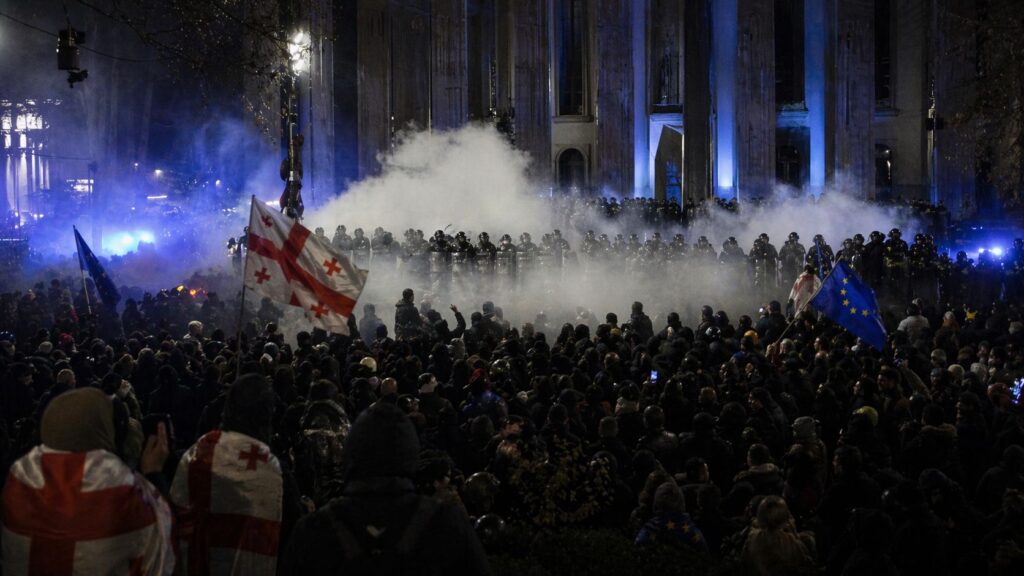
On November 27, 2024, hours after the European Parliament had adopted its resolution, Prime Minister Irakli Kobakhidze announced the suspension of EU accession negotiations until at least 2028. He called Brussels’ conditions “blackmail.” The response was immediate: in Tbilisi, Batumi, Kutaisi, and other cities, tens of thousands took to the streets. These were not spontaneous outbursts. They were people who had stood for a European future for years, now watching that future dismantled by a government that still officially claimed to want EU membership.

The police response was documented as brutal. In a single night, 44 people were hospitalized. Over 200 arrests were recorded in the first week of protests. What happened to those arrested is established through multiple independent sources. Georgia’s Public Defender visited 327 detainees – 225 reported mistreatment, and 157 showed visible physical injuries at the time of the visit. Transparency International Georgia, Georgian European Orbit, and the Rule of Law Center reached a shared conclusion after reviewing the cases: the mistreatment had not been a loss of control by overzealous officers, but a pre-planned system of intimidation. Detainees were struck in the face, head, eye sockets, ribs, and kidneys. Personal belongings were confiscated. Several individuals reported continued abuse during transport in police vehicles.
At this point, a detail must be addressed that was largely absent from international coverage: the question of what was in the water cannons. The BBC documentary “When Water Burns” (December 2025) presented testimony from chemical weapons experts, whistleblowers from Georgian special units, and treating physicians – all pointing to the same substance: bromobenzylcyanide, known as Camite. A chemical agent from the First World War, withdrawn from military and law enforcement use after 1930 due to its toxicity. The effects of approved tear gas – such as CS gas – subside within minutes of the end of exposure. The symptoms displayed by protesters in Tbilisi did not: persistent respiratory damage, chemical burns to skin and mucous membranes, nervous system injuries, and vision impairment lasting weeks and months after the protests. Hundreds of people subsequently sought hospital treatment. The Georgian Red Cross informally confirmed that the symptoms were more severe than those typically seen with CS gas. Georgia is a signatory to the Chemical Weapons Convention (Amnesty International, “Georgia: Alleged use of toxic chemicals against protesters,” December 2025, https://www.amnesty.org/en/latest/news/2025/12/georgia-governments-alleged-use-of-toxic-chemicals-against-protestors-calls-for-international-investigation-and-complete-embargo-on-all-policing-equipment/).
Amnesty International subsequently called for a formal investigative mission by the Organization for the Prohibition of Chemical Weapons (OPCW) and a comprehensive embargo on all police equipment deliveries to Georgia. Twelve Georgian NGOs jointly addressed the OPCW Director-General, UN special rapporteurs, and the Council of Europe Commissioner for Human Rights, documenting seven specific episodes. The OSCE report of March 2026 explicitly takes up this thread, recommending that member states initiate OPCW cooperation to investigate the matter (JAM News, “Georgian NGOs appeal to OPCW on chemical weapons allegations,” December 2025, https://jam-news.net/georgian-ngos-appeal-to-un-on-chemical-weapons-ban/). No such mission has taken place to date. Georgian authorities flatly deny the use of Camite and have called the BBC documentary “absurd” and “false.”
Alongside the protests and their suppression, Georgian Dream pursued its next institutional step: the legal groundwork for eliminating political competition. Before the 2024 election, Ivanishvili had publicly declared his intention to secure a constitutional three-quarters majority in order to ban the opposition. After the election, he moved to implement that goal. A parliamentary investigative committee was established whose only discernible function was to develop grounds for party-dissolution petitions to the Constitutional Court. The committee summoned opposition leaders. When three of them – Zurab Japaridze, Irakli Okruashvili, and Nika Gvaramia – ignored the summons, arguing formally that a parliament produced by unconstitutional elections held no legitimacy, they were arrested. In June 2025, all three were sentenced to eight months in prison, combined with a multi-year ban on holding public office. Five further opposition politicians were awaiting verdicts at the time the OSCE report was published.
Nine opposition parties subsequently united in March 2026 to form a joint alliance. Their stated priorities: the release of political prisoners and the forcing of free new elections. In December 2025, protesting on the sidewalk was also made a criminal offense. Legal scholars described the regulation as manifestly unconstitutional. The protests continued regardless (International IDEA, “Georgia: Georgian Dream steps up pressure on opposition parties,” May 2025, https://www.idea.int/democracytracker/report/georgia/may-2025).
What the Report Actually Says
The 217-page report by Professor Grzebyk, published March 12, 2026, is not a political pamphlet. It is a legal document, structured around the international human rights obligations Georgia has taken on through the ratification of a series of treaties: the International Covenant on Civil and Political Rights, the UN Convention Against Torture, the European Convention on Human Rights, the Convention on the Elimination of All Forms of Discrimination Against Women, and others. That methodological choice matters: the report does not measure Georgia against Western expectations – it measures Georgia against commitments Georgia itself has made.
The core findings can be distilled into five key conclusions.
First: the violence against demonstrators, opposition politicians, and journalists has, in a documented series of cases, reached or crossed the legal threshold for torture. The rapporteur carefully distinguishes between different forms: direct police violence during demonstrations, mistreatment in custody, and attacks by unidentified groups of men who assaulted government critics in broad daylight in public squares – with no intervention by law enforcement and no perpetrators identified.
Second: this impunity is not a failure – it is a pattern. Independent investigations into torture allegations did not take place. Proceedings that were opened bear what the rapporteur characterizes as structural deficiencies that preclude effective prosecution. The Council of Europe’s Committee for the Prevention of Torture (CPT) had visited Georgia in November 2024 and January 2025 – its report corroborates Grzebyk’s findings.
Third: the laws of the past two years violate Georgia’s international obligations at their core – so fundamentally that amendments are insufficient. They must be repealed. This applies specifically to the Law on Transparency of Foreign Influence (TFI), the Foreign Agents Registration Act (Georgian FARA), the Family Values Law – which legally equates same-sex partnerships and transgender identity with incest and prohibits gender-affirming medical procedures – and amendments to broadcasting law that vest state oversight bodies with expanded powers to block content (Venice Commission of the Council of Europe, “Opinion on the Foreign Agents Registration Act (FARA),” October 2025, https://www.venice.coe.int/webforms/documents/default.aspx?pdffile=CDL-AD(2025)034-e).
Fourth: the attempt to dissolve the main opposition parties through Constitutional Court proceedings threatens the fundamental architecture of political pluralism. The rapporteur explicitly recommends withdrawing all pending party-dissolution petitions and refraining from filing new ones.
Fifth – and this is the point that received almost no coverage: the report recommends that the international community consider referring the situation in Georgia to the International Criminal Court. The recommendation addressed to the international community states that states party to the Rome Statute may wish to consider referring the situation in Georgia to the International Criminal Court, in light of the growing number of instances of political persecution, torture, and other inhumane acts. This is not boilerplate language. In over three decades of OSCE mechanism history, such a recommendation directed at an EU candidate state is without precedent. It does not mean an ICC proceeding will follow – that would require the political will of a sufficient number of states parties. But it makes the rapporteur’s finding unambiguous: what has been documented in Georgia moves, in her legal assessment, into territory that could justify international criminal jurisdiction.
Georgia’s Response – and What It Reveals
Alexander Maisuradze, Georgia’s ambassador to the OSCE, responded to the report with a detailed written statement formally incorporated into the document. His main arguments: the report contains factual inaccuracies and selective interpretations; it ignores democratic reforms Georgia has carried out in recent years; it overreaches the mechanism’s mandate by issuing recommendations to third states and international organizations; and – the number of complaints filed by Georgian citizens before the European Court of Human Rights has declined by more than 85 percent over ten years, which Maisuradze cited as evidence that domestic legal remedies are functioning (JAM News, “Georgia’s government called the critical OSCE Moscow Mechanism report biased,” March 13, 2026, https://jam-news.net/georgias-government-called-the-critical-osce-moscow-mechanism-report-biased/).
That last argument merits scrutiny. A decline in ECHR complaints can mean two things: either citizens are more effectively enforcing their rights domestically – or the civil society organizations that traditionally prepare and support such complaints have been systematically weakened by the very foreign agents law that has stigmatized NGOs as “agents of foreign powers” since 2024. Which interpretation is correct remains an open question – but it is a question worth asking.
Georgia’s cooperation with the mission is likewise not an unambiguous signal of governmental confidence. In the logic of international monitoring procedures, cooperating while rejecting all conclusions is a precisely calibrated strategy: one provides the mechanism with the cooperation narrative, thereby stripping it of the argument that findings were one-sided due to lack of access. Georgia executed that playbook cleanly.
Selective Outrage or Legitimate Instrument?
Anyone who examines the history of the Moscow Mechanism will inevitably encounter an uncomfortable question: why was it activated against some states and not others? The answer does not always lie in the severity of the documented violations.
The mechanism is not an automatic instrument. It is activated by political will – and political will is never neutral. In Georgia’s case, the composition of the 23 triggering states is telling: they are, without exception, EU and NATO members and close Western partners. The United States is absent. Given the Trump administration’s posture toward multilateral institutions, that is explicable – but it is a signal, and an analytically relevant detail for anyone who regards the mechanism as a purely technical legal instrument.
The question can legitimately be asked: why was the same mechanism not activated against other countries where comparable or more serious violations were documented? Why not against EU member states where the rule of law was being systematically undermined? That is a legitimate question – and the mechanism itself provides no answer, because it cannot. It is a tool that works only when enough states are politically willing to deploy it.
That observation does not, however, diminish the substance of the report itself. Professor Grzebyk did not work on behalf of a political bloc – she worked as an independent legal scholar with a clear legal mandate: to measure Georgia’s situation against its own commitments. What the report documents is codified in laws the Georgian parliament enacted, in the testimony of 327 detainees, in hospital records from Tbilisi, and in a BBC documentary that no one has seriously called a fabrication – despite Georgian authorities’ attempts to create exactly that impression (OC Media, “Georgian protesters on the lingering effects of chemical exposure,” December 2025, https://oc-media.org/i-want-to-know-what-happened-georgian-protesters-on-the-lingering-effects-of-chemical-exposure/).
The comparison with Belarus is instructive here. When the Moscow Mechanism was activated against Lukashenko in 2020, Minsk refused all cooperation. The rapporteur worked without in-country access; his report was rejected outright by Belarus; and within the OSCE, Russia blocked every follow-up step. The report disappeared into the archives. In Georgia’s case, the government cooperated – then rejected the report in its entirety. A different tactic, but a similar outcome: the finding stands, the consequences remain open.
What follows from all this? To begin with: nothing automatic. The history of the mechanism is a history of unenforced findings. Not a single one of the reports produced to date has directly led to a policy change by a target state. What the reports do accomplish – and this is not nothing – is documentation. They create an internationally binding legal foundation to which courts, institutions, and future proceedings can refer. For the people in Tbilisi who were sprayed in November 2024 with substances whose nature remains officially unresolved to this day, that is cold comfort. For long-term accountability – for ensuring that no one can later claim they did not know – it is not nothing.
Georgia stands at a crossroads it did not choose for itself, but that was brought about by the decisions of a small group of people in power. A country in which 80 percent of the population identifies as pro-European, according to surveys – yet whose elected government has frozen the EU accession process. A country that was excluded from the Open Government Partnership in April 2026. A country against which the same international community that admitted it as a candidate has now activated an instrument previously reserved for Belarus and Chechnya (Freedom House, “Georgia: Freedom in the World 2025,” https://freedomhouse.org/country/georgia/freedom-world/2025).
The question of whether that is enough to change anything, this article deliberately leaves unanswered. It belongs to the reader.
Michael Hollister
is a geopolitical analyst and investigative journalist. He served six years in the German military, including peacekeeping deployments in the Balkans (SFOR, KFOR), followed by 14 years in IT security management. His analysis draws on primary sources to examine European militarization, Western intervention policy, and shifting power dynamics across Asia. A particular focus of his work lies in Southeast Asia, where he investigates strategic dependencies, spheres of influence, and security architectures. Hollister combines operational insider perspective with uncompromising systemic critique – beyond opinion journalism. His work appears on his bilingual website (German/English) www.michael-hollister.com, at Substack and in investigative outlets across the German-speaking world and the Anglosphere.
Sources
- OSCE/ODIHR – Report under the Moscow Mechanism with respect to Georgia, March 12, 2026: https://odihr.osce.org/sites/default/files/documents/official_documents/2026/03/odgal0009c1%20ODIHR%20NV%2082-2026%20report_Moscow%20Mechanism%20invoked%20in%20respect%20of%20Georgia_0.pdf
- OSCE/ODIHR – Invocation of the Moscow Mechanism regarding Georgia, January 29, 2026: https://odihr.osce.org/news/odihr/661963
- UK Government – Joint Statement on OSCE Moscow Mechanism Report on Georgia, March 2026: https://www.gov.uk/government/speeches/osce-moscow-mechanism-report-on-georgia-joint-statement-march-2026
- UK Government – OSCE Moscow Mechanism Invocation: Georgia, January 2026: https://www.gov.uk/government/speeches/osce-moscow-mechanism-invocation-georgia-january-2026
- OSCE Parliamentary Assembly – Absence of political dialogue in Georgia, March 10, 2026: https://www.oscepa.org/en/news-a-media/press-releases/2026/absence-of-political-dialogue-in-georgia-a-serious-obstacle-to-stability-and-addressing-countrys-problems-osce-pa-delegation-says
- Venice Commission of the Council of Europe – Urgent Opinion on the Law on Transparency of Foreign Influence, May 21, 2024: https://www.venice.coe.int/webforms/documents/default.aspx?pdffile=CDL-PI(2024)013-e
- Venice Commission of the Council of Europe – Opinion on the Foreign Agents Registration Act (FARA), October 2025: https://www.venice.coe.int/webforms/documents/default.aspx?pdffile=CDL-AD(2025)034-e
- Amnesty International – Georgia: Alleged use of toxic chemicals against protesters, December 2025: https://www.amnesty.org/en/latest/news/2025/12/georgia-governments-alleged-use-of-toxic-chemicals-against-protestors-calls-for-international-investigation-and-complete-embargo-on-all-policing-equipment/
- OCCRP – Family of Georgian Oligarch Bidzina Ivanishvili Has Unreported Real Estate in Russia: https://www.occrp.org/en/scoop/family-of-georgian-oligarch-bidzina-ivanishvili-has-unreported-real-estate-in-russia
- Transparency International Georgia – Oligarch Bidzina Ivanishvili: Real Ruler of Georgia: https://transparency.ge/en/post/oligarch-bidzina-ivanishvili-real-ruler-georgia-and-architect-georgias-pro-russian-shift
- European Council on Foreign Relations – Broken Dream: The oligarch, Russia, and Georgia’s drift from Europe: https://ecfr.eu/publication/broken-dream-the-oligarch-russia-and-georgias-drift-from-europe/
- JAM News – Georgia’s government called the critical OSCE Moscow Mechanism report biased, March 13, 2026: https://jam-news.net/georgias-government-called-the-critical-osce-moscow-mechanism-report-biased/
- JAM News – 24 OSCE member states call on Georgia to implement Moscow Mechanism recommendations, March 12, 2026: https://jam-news.net/osce-moscow-mechanism-demands-to-georgia/
- JAM News – Georgian NGOs appeal to OPCW on chemical weapons allegations, December 2025: https://jam-news.net/georgian-ngos-appeal-to-un-on-chemical-weapons-ban/
- Freedom House – Georgia: Freedom in the World 2025: https://freedomhouse.org/country/georgia/freedom-world/2025
- International IDEA – Georgia: Georgian Dream steps up pressure on opposition parties, May 2025: https://www.idea.int/democracytracker/report/georgia/may-2025
- ORF Online – The Camite Controversy: Facts, Frictions, and the Fight for Accountability, March 2026: https://www.orfonline.org/expert-speak/the-camite-controversy-facts-frictions-and-the-fight-for-accountability
- OC Media – Georgian protesters on the lingering effects of chemical exposure, December 2025: https://oc-media.org/i-want-to-know-what-happened-georgian-protesters-on-the-lingering-effects-of-chemical-exposure/
- Steptoe – Georgian Dream Puts Brakes on EU Accession, December 2024: https://www.steptoe.com/en/news-publications/stepwise-risk-outlook/georgian-dream-puts-breaks-on-eu-accession-escalating-geopolitical-risks.html
© Michael Hollister – All rights reserved. Redistribution, publication or reuse of this text requires express written permission from the author. For licensing inquiries, please contact the author via www.michael-hollister.com.
Newsletter
🇩🇪 Deutsch: Verstehen Sie geopolitische Zusammenhänge durch Primärquellen, historische Parallelen und dokumentierte Machtstrukturen. Monatlich, zweisprachig (DE/EN).
🇬🇧 English: Understand geopolitical contexts through primary sources, historical patterns, and documented power structures. Monthly, bilingual (DE/EN).