
by Michael Hollister
Exclusive published at Michael Hollister on March 22, 2026
2.322 words * 12 minutes readingtime
This analysis is made available for free – but high-quality research takes time, money, energy, and focus. If you’d like to support this work, you can do so here:

Alternatively, support my work with a Substack subscription – from as little as 5 USD/month or 40 USD/year!
Let’s build a counter-public together.
Three times, projectiles have struck the grounds of Iran’s Bushehr nuclear power plant.
Three times in nine days.
No reactor damage, we are told. No radiation release.
Everything under control.
And the world keeps scrolling.
What happens if the next projectile doesn’t miss – that question nobody is asking. No headline, no analysis, no commentary. Yet the answer is concrete, brutal, and irreversible. It deserves to be named.
What Bushehr Is – and What It Is Not
Bushehr is not Chernobyl. That is important to understand – and it is simultaneously the most dangerous sentence in this article, because it is too easily read as an all-clear.
The reactor at Chernobyl was an RBMK – a Soviet design built without a containment structure, unstable at low power levels, which exploded in 1986 like an open chimney filled with radioactive material. Bushehr is a VVER-1000, a Russian pressurized water design, with double containment of reinforced concrete. Rosatom built it. Russian engineers work there. It can withstand a small aircraft impact.
It cannot withstand a 5,000-pound bunker buster.
And it doesn’t even need to be hit directly. That is the part that appears in no headline.
Vladimir Chernov, analyst at Freedom Finance Global, put it this way: “The risk exists not only in the event of a direct hit on the reactor, but with any damage to the site that affects cooling, power supply, containment integrity, or fuel handling.”
Any damage.
IAEA Director General Rafael Grossi named the danger in unambiguous terms. “An accident on an operating nuclear power plant would be something very, very serious,” he told Fox News Digital. “This is the reddest line of all that you have in nuclear safety.” And further: “The possibility of dispersion in the atmosphere of radioactivity is very high if you get to the core of the reactor.” The power supply point – that failure of external lines can lead to meltdown – is substantiated by Rosatom Director General Likhachev in his warning of a regional worst-case scenario.
This is not a theoretical danger. This is the operational reality of a war taking place a few hundred meters from an operating reactor.
The Bushehr site currently holds 72 metric tons of active nuclear fuel in the reactor and 210 metric tons of spent fuel in storage pools. The storage pools have no containment. No protective shell. Nothing between a strike and what follows.
Rosatom Director General Alexei Likhachev has publicly named the consequence: “A catastrophe of regional proportions. Severe. Regardless of who stands on which side – the entire region will be severely affected.”
What “Regional Catastrophe” Means
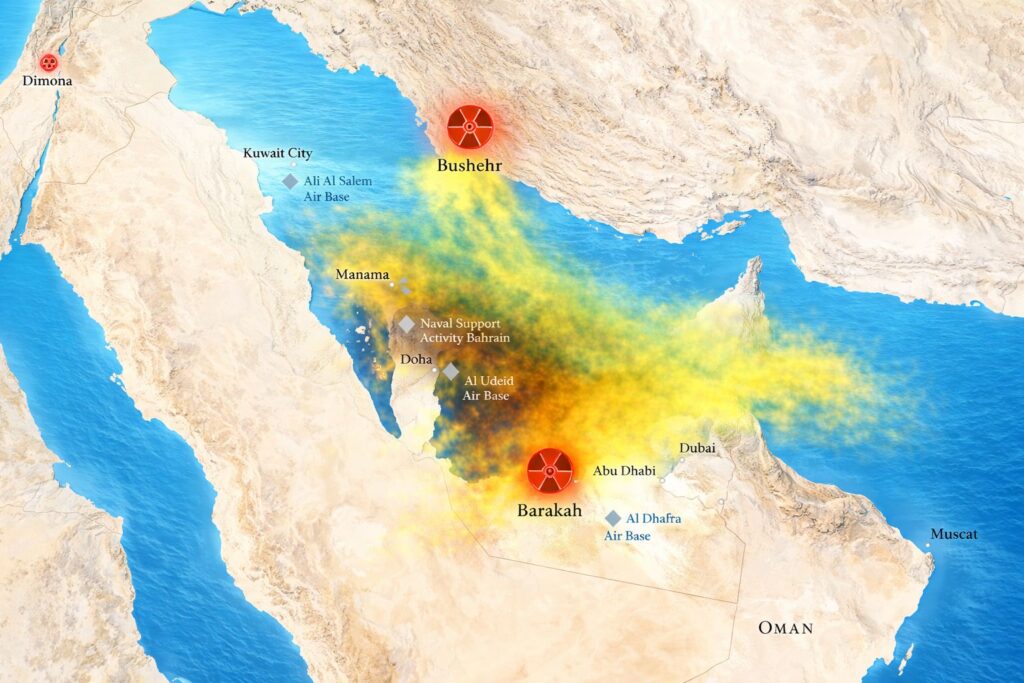
Look at the map.
Bushehr sits on the shore of the Persian Gulf. The prevailing winds run south and southeast. What goes into the air follows the wind. Cesium-137, Iodine-131, Strontium-90 – the principal radionuclides of a reactor accident – spread as aerosols. They are invisible. They have no odor. And they recognize no borders.
In the immediate danger zone: southern Iran. Kuwait. Bahrain. Qatar. Eastern Saudi Arabia. The United Arab Emirates. Depending on weather conditions, also Oman and southern Iraq.
That is not speculation. That is physics.
Chernobyl made radioactive particles measurable at a distance of 680 miles – in Sweden, not Ukraine. Bushehr sits in the middle of one of the most densely populated coastal regions on earth, on an inland sea that is not an open ocean. What enters the Persian Gulf does not disperse – it stays.
That is the difference that changes everything.
The Water
62 million people live in the six Gulf states. They all drink water that does not fall from the sky and does not come from rivers – because there are no rivers here. Not a single permanent natural water source flows through these countries. What they drink comes from the sea that surrounds them. Desalinated, treated, distributed.
Qatar: 99 percent of drinking water from desalination. 3.2 million people. Bahrain: over 90 percent. Kuwait: 90 percent. Oman: 86 percent. Saudi Arabia: 70 percent.
If the seawater of the Persian Gulf becomes radioactively contaminated, these plants cannot continue to operate. Not out of caution. Out of physical necessity – standard desalination processes do not filter out radionuclides. The switch is flipped. The water stops flowing.
Qatar has strategic reserves for a few days. Bahrain and Kuwait have barely more. The UAE, after years of forward planning, has reserves for 45 days under rationing.
45 days. In a region where summer temperatures can reach 122°F.
I once had a layover in Doha. I walked across the tarmac from the plane to the terminal. Five minutes, no more. The air was like a wall. 113°F, humidity near 100 percent. You breathe heat, not air. You sweat before you can think. A person without water in that heat does not survive 24 hours.
And now ask yourself: where do you put 15 to 20 million people who have no water?
Not in a few weeks. Immediately. Today.
There is no answer to that question. There is no evacuation infrastructure in the world capable of absorbing 15 to 20 million people simultaneously. These people would not be refugees in the conventional sense – they would be people without a country, because what they leave behind would be uninhabitable for decades. Cesium-137 has a half-life of 30 years. The Chernobyl exclusion zone, 40 years after the accident, has still not been released for normal habitation.
The Sea
The Persian Gulf is not an open ocean. It is a semi-enclosed inland sea – shallow, warm, with minimal water exchange with the outside. Fukushima showed what happens when radioactive material enters the sea: cesium from Fukushima was detected by U.S. authorities in Pacific bluefin tuna off the American coast – in the Pacific, the largest ocean in the world.
In the Persian Gulf there is no Pacific effect. What goes in stays. It settles in the sediments. It bioaccumulates up the food chain. Plankton, crabs, fish – everything living in the Gulf would be contaminated.
All eight countries bordering the Persian Gulf name fishing their most important renewable resource. In the Emirates and Oman, people consume an average of 63 pounds of fish per person per year – one of the highest rates in the world. That is not recreation. That is nutrition. That is the protein supply of an entire population.
In the event of radioactive contamination of the Gulf: total failure. Immediately. Permanently, for decades.
The Oil
Here is the paradox that almost no one has considered: the oil itself does not become radioactive. It is a hydrocarbon – it does not absorb radionuclides. The oil continues to sit in the ground, in the tanks, in the pipelines.
It simply cannot get out anymore.
Offshore platforms require seawater for cooling – shut down upon contamination. Refineries and terminals require personnel – not sustainably deployable under radiation exposure. And tankers transiting contaminated water take on radioactive water as ballast. Their hulls become contaminated. No port in the world would admit a demonstrably contaminated tanker.
Dubai would not be destroyed. It would be empty.
Saudi Arabia has a pipeline to the Red Sea – a partial escape route. Kuwait, Qatar, the UAE have nothing comparable. Their oil, which powers the world, would be unexportable for the foreseeable future. The Gulf states – the wealthiest countries on earth by per capita income – would be bankrupt overnight. And simultaneously without water, without fish, without a future.
15 to 20 million people who must leave. And who have nothing when they do.
What International Law Says
There is a sentence in Additional Protocol I to the Geneva Conventions, Article 56, in force since 1977 and ratified by 174 states. It prohibits attacks on “works and installations containing dangerous forces” – nuclear power plants are explicitly named. Not as a recommendation. As an absolute prohibition, even if these installations were military objectives.
Whoever attacks an operating nuclear power plant while knowing – or being required to know – what consequences that holds for the civilian population cannot invoke collateral damage. It is a war crime.
This applies to everyone. To Iran, if Iran fires. To Israel, if Israel fires. To the United States, if the United States fires. No mandate, no war aim, no strategic necessity overrides Article 56. Not a single prosecutor in the world would need to search long for the legal basis.
The Chain Reaction Nobody Names
If Bushehr is hit, Iran responds. That is not speculation. That is declared doctrine.
Israel operates the Negev Nuclear Research Center at Dimona in the Negev Desert. Not a power plant, but a research reactor – and by everything intelligence analysts have written for decades, the origin of Israel’s nuclear weapons program. Iranian missiles have already struck near Dimona. A direct hit would be possible.
The United Arab Emirates operates the Barakah nuclear power plant – four reactors, 5,600 megawatts total capacity, nearly six times the capacity of Bushehr. It sits on the coast of Abu Dhabi, 33 miles west of Ruwais, directly on the Persian Gulf. Built by a South Korean consortium. All four units are operational.
Experts warned before the war: Barakah has cracks in the containment buildings of all four reactor blocks. The former head of the French nuclear company Areva compared the design to “a car without airbags and seatbelts.” A core catcher is absent – the system that would contain molten fuel in a worst-case scenario.
If Bushehr is hit, and Iran responds with Dimona and Barakah:
Bushehr contaminates the northern Gulf – contamination plume southward: Kuwait, Bahrain, Qatar, UAE, Oman.
Barakah contaminates the southern Gulf – from the other direction. Qatar, Bahrain, eastern Saudi Arabia lie in the crossfire of both clouds.
Three nuclear sites. One region. Simultaneously.
That would no longer be a catastrophe with regional consequences. That would be the end of the Persian Gulf as a habitable and economically viable zone – for a generation, perhaps for two.
What Trump Is Threatening – and What the Press Says About It
Donald Trump has issued an ultimatum. He has publicly threatened to bomb Iranian energy infrastructure if Iran does not open the Strait of Hormuz. He has not merely implied this – he has said it repeatedly and loudly. We are talking about an operating nuclear power plant.
In 1999, NATO bombed Serbia’s power supply. Three days. It was celebrated. In 2022, Russia struck Ukraine’s power supply. Western media fell over themselves: war crimes. Barbarism. Today, the U.S. president publicly, repeatedly, and loudly threatens to bomb Iranian energy infrastructure – an operating nuclear power plant included. And the headlines are silent.
That is one reason why I am writing.
What Remains
I hope I am wrong about what I describe here. I hope that sincerely.
But if someone – whoever, under whatever flag, with whatever justification – knowingly strikes a nuclear power plant in a region where 62 million people draw their drinking water from the sea, where the sea is the only thing standing between the lives of those people and the desert: then there is no military term for what comes after.
Then there are only the images. Of cities that were not destroyed, but simply had to be abandoned. Of millions of people who must go somewhere else, without knowing where. Of a sea that no one will be permitted to touch for generations. Not 30 years. More like 90. Perhaps longer.
The word for that is not collateral damage.
The word for that is barbarism.
This analysis is made available for free – but high-quality research takes time, money, energy, and focus. If you’d like to support this work, you can do so here:
Alternatively, support my work with a Substack subscription – from as little as 5 USD/month or 40 USD/year!
Let’s build a counter-public together.
Michael Hollister is a geopolitical analyst and investigative journalist. He served six years in the German military, including peacekeeping deployments in the Balkans (SFOR, KFOR), followed by 14 years in IT security management. His analysis draws on primary sources to examine European militarization, Western intervention policy, and shifting power dynamics across Asia. A particular focus of his work lies in Southeast Asia, where he investigates strategic dependencies, spheres of influence, and security architectures. Hollister combines operational insider perspective with uncompromising systemic critique—beyond opinion journalism. His work appears on his bilingual website (German/English) www.michael-hollister.com, at Substack at https://michaelhollister.substack.com and in investigative outlets across the German-speaking world and the Anglosphere.
Sources
- RT Deutschland / Vzglyad – Der Welt droht die größte Atomkatastrophe der Neuzeit (March 24, 2026): https://de.rt.com/der-nahe-osten/274572-der-welt-droht-die-groesste-atomkatastrophe-der-neuzeit/ [RT Deutschland – cited by name, not hyperlinked in English outputs]
- UPI – Another projectile strikes premises of Iran’s Bushehr Nuclear Power Plant (March 24, 2026): https://www.upi.com/Top_News/World-News/2026/03/24/iran-Bushehr-nuclear-lant/1241774408744/
- IAEA – Projectile struck premises of Bushehr NPP (March 24, 2026): https://www-news.iaea.org/ErfView.aspx?mId=e2f5b755-2113-4b04-8a7f-79156fff547e
- World Nuclear News – Projectile hit 350 metres from Bushehr reactor (March 24, 2026): https://world-nuclear-news.org/articles/iran-tells-iaea-a-projectile-hit-bushehr-nuclear-plant-premises
- CSIS – Could Iran Disrupt the Gulf Countries’ Desalinated Water Supplies? (March 24, 2026): https://www.csis.org/analysis/could-iran-disrupt-gulf-countries-desalinated-water-supplies
- Atlantic Council – Attacks on desalination plants in the Iran war forecast a dark future (March 18, 2026): https://www.atlanticcouncil.org/dispatches/attacks-on-desalination-plants-in-the-iran-war-forecast-a-dark-future/
- Al Jazeera – How much of the Gulf’s water comes from desalination plants? (March 12, 2026): https://www.aljazeera.com/news/2026/3/12/how-much-of-the-gulfs-water-comes-from-desalination-plants
- CNN – Water is even more vital than oil in the Middle East (March 11, 2026): https://www.cnn.com/2026/03/11/climate/gulf-iran-war-water-desalination
- Foreign Policy – Targeting Iran’s Fragile Water Infrastructure (March 9, 2026): https://foreignpolicy.com/2026/03/09/iran-water-drought-desalination/
- Al Jazeera – Nuclear Gulf: Experts sound alarm over UAE Barakah nuclear reactors: https://www.aljazeera.com/economy/2020/7/15/nuclear-gulf-experts-sound-the-alarm-over-uae-nuclear-reactors
- Springer Nature – Arabian/Persian Gulf artisanal fisheries: most important renewable resource: https://link.springer.com/article/10.1007/s11160-022-09737-4
- Fox News Digital – UN nuclear chief warns strike near Iran reactor risks crossing ‘reddest line’ (March 19, 2026): https://www.foxnews.com/politics/un-nuclear-chief-warns-strike-near-iran-nuclear-plant-risks-reddest-line
© Michael Hollister – All rights reserved. Redistribution, publication or reuse of this text requires express written permission from the author. For licensing inquiries, please contact the author via www.michael-hollister.com.
Newsletter
🇩🇪 Deutsch: Verstehen Sie geopolitische Zusammenhänge durch Primärquellen, historische Parallelen und dokumentierte Machtstrukturen. Monatlich, zweisprachig (DE/EN).
🇬🇧 English: Understand geopolitical contexts through primary sources, historical patterns, and documented power structures. Monthly, bilingual (DE/EN).