
by Michael Hollister
Published at tkp.at on March 24, 2026
3.337 words * 18 minutes readingtime
This analysis is made available for free – but high-quality research takes time, money, energy, and focus. If you’d like to support this work, you can do so here:

Alternatively, support my work with a Substack subscription – from as little as 5 USD/month or 40 USD/year!
Let’s build a counter-public together.
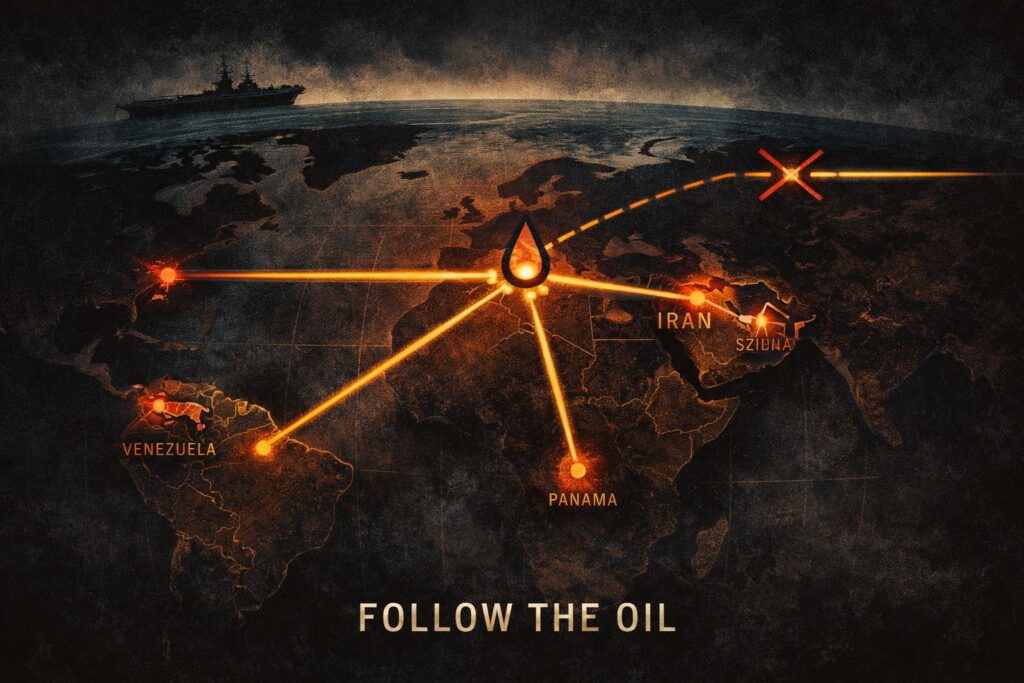
A Coordinated U.S. Imperial Strategy Against China’s Energy Infrastructure – From Syria to Venezuela, Iran, and Panama
Geopolitics is not decided at press conferences. It is decided where pipelines end, where tankers dock, and who turns the valve. Anyone who has spent the past 25 years overlaying a map of U.S. military operations onto a map of global oil reserves sees a pattern that cannot be explained by coincidence: Iraq 2003, Libya 2011, Syria since 2011, Venezuela in January 2026, Iran from February 28, 2026 onward. All oil producers. All countries that supply – or could supply – China. All states that have actively worked in recent years to route commodity trade around the U.S. dollar.
This is not coincidence. It is the structural logic of empire – and a clockwork that is running down.
The Window: What RAND Foresaw in 2016
In 2016, the RAND Corporation published a study that initially attracted little attention in Washington but has since served as a reference document in strategic planning circles. War with China: Thinking Through the Unthinkable stated its core finding precisely and uncomfortably: “Technological advances are creating conditions of conventional counterforce. At present, Chinese losses would greatly exceed U.S. losses. But, by 2025, that gap could be much smaller.”
The conclusion that follows is straightforward: if the United States ever intends to act militarily against China – or at minimum contain it effectively – it must do so within a window of eight to ten years, meaning by 2025 or 2026 at the latest. After that, the window closes.
Ten years later, U.S. security architecture reads like the operational implementation of precisely that warning. As the Carnegie Endowment for International Peace analyzed in January 2026, the Trump administration’s National Security Strategy published in November 2025 reduces Russia to a “persistent but manageable threat.” The National Defense Strategy of January 2026 is unambiguous: China is the strategic challenge, Europe is to assume “primary responsibility for its own conventional defense,” and the Indo-Pacific is the actual theater.
But before Washington can have a free hand in the Indo-Pacific, it must secure its flanks. And China’s most vulnerable flank is not in Taiwan – it lies in the oil fields of Arabia, in Venezuela’s Orinoco Belt, and off the coast of Kharg Island.
China’s Structural Achilles’ Heel: The Malacca Dilemma
China is the world’s largest crude oil importer. As the Columbia University Center on Global Energy Policy documented in January 2026, roughly 70 percent of China’s total crude oil requirements come from abroad – approximately 11 to 12 million barrels per day. What at first glance looks like a trade statistic is in reality a geopolitical vulnerability of strategic proportions.
Over 80 percent of these imports pass through the Strait of Malacca – the narrow waterway between Malaysia and Indonesia, flanked by U.S. allies. As CSIS documented in its 2024 analysis of China’s energy strategy in the Middle East, Beijing has long acknowledged this dilemma internally: a single incident in the Malacca Strait could interrupt China’s energy supply. The consequence was the Belt and Road Initiative – China’s attempt to create alternative supply routes through land corridors across Myanmar, Pakistan, and Central Asia.
But even if the Malacca Strait can be bypassed: 45 percent of Chinese crude oil imports pass through the Strait of Hormuz. Following the U.S.-Israeli war of aggression against Iran beginning February 28, 2026, this waterway is effectively blocked – at least selectively. As the Columbia University Center on Global Energy Policy reported in March 2026, Chinese-flagged vessels are being granted passage while U.S. allies are blocked – a tactical decision by Tehran with strategic implications: China is not completely cut off in the short term, but the cost of supply has risen dramatically, insurance costs have exploded, and the dependency on a single transit corridor has been laid bare.
The Bruegel Institute quantified the scale in a March 17, 2026 analysis: through the end of 2025, China was drawing 5.4 million barrels per day through the Strait of Hormuz – more than twice what it receives through Russian pipelines. The Russian pipeline is already running at capacity. Even if Moscow wanted to compensate for the shortfall, it could not do so quickly.
China had prepared. According to Bruegel, strategic and commercial reserves of approximately 1.3 to 1.4 billion barrels cover roughly four months of imports. In 2025, China dramatically accelerated that build-up: 430,000 barrels stored per day, compared to just 84,000 the year before. Beijing knew what was coming. But a four-month buffer is not a strategic firewall – it is borrowed time.
The layer of the Chinese economy most immediately affected consists of the so-called “teapot” refineries in Shandong Province – small, privately owned facilities accounting for roughly one quarter of China’s total refining capacity. As Geopolitical Monitor noted in February 2026, their business model depends on discounted sanctioned oil from Iran and Venezuela. That model has just collapsed.
Venezuela: The First Strike and the Informal Receivership
On January 3, 2026, Donald Trump had Venezuela’s government abducted. Nicolás Maduro was seized by U.S. Special Operations Forces and transferred to the United States. Washington cited drug trafficking and terrorism. What followed is described by Ricardo Hausmann – former Venezuelan planning minister and now a professor at Harvard Kennedy School – in terms that spare nothing: “informal receivership.”
Venezuela’s economic lifeline – its ability to sell oil and access the proceeds – was placed under U.S. control. Trump himself left no doubt about the motive: “We need total access. We need access to the oil.” As the Center for American Progress documented, the United States initially seized 30 to 50 million barrels of crude oil, sold these at market prices, and used the proceeds as leverage over the transitional leadership under Vice President Delcy Rodríguez.
Venezuela is no small prize. As Al Jazeera reported, the country sits atop the largest proven oil reserves on earth: 303 billion barrels, representing 17 percent of global reserves. For comparison: Saudi Arabia holds 267 billion barrels, Iran 209 billion. Before the U.S. intervention, Venezuela had been delivering 389,000 barrels per day to China – roughly 4.5 percent of China’s seaborne oil imports. Those deliveries have effectively ceased since January.
As the Institute for Energy Research noted in February 2026, Beijing had invested an estimated $50 to $60 billion in Venezuela over decades, including $10 to $15 billion in loans secured by oil deliveries. A substantial portion of those oil volumes will no longer reach China – or will be resold with U.S. involvement.
The Venezuelan operation was precise. An oil-rich country under U.S. sanctions that had strategically aligned with China – and that, together with Iran, formed the backbone of China’s sanctions-resistant energy supply – was surgically extracted from China’s sphere of influence through an act of aggression against a sovereign state. No protracted war, no occupation: a leadership decapitation, followed by control over the resources.
Trump called it the “Venezuela model.” He meant what would come next.
Iran: The Second Strike and the Hormuz Trap
On February 28, 2026, the United States and Israel launched a war of aggression against Iran. The official narrative was the nuclear program. As the Carnegie Endowment for International Peace analyzed on March 20, 2026, the diverging U.S. and Israeli objectives are already making the endgame murky. The geostrategic logic runs deeper than either government has publicly admitted.
For China, Iran is not just any supplier. It is the foundation of China’s sanctions-resistant energy architecture. Since the tightening of U.S. sanctions under Trump in 2018, Iran’s oil export stream concentrated almost exclusively on China. What had previously been a diversified market serving OECD states, India, and other buyers became a bilateral pipeline: Tehran delivers, Beijing pays – in renminbi, through China’s CIPS system, bypassing SWIFT and the dollar system entirely.
As the Columbia University Center on Global Energy Policy documented in March 2026, China was importing approximately 1.4 million barrels of Iranian crude per day through the end of 2025 – 13 percent of its total crude imports, representing 80 to 90 percent of all Iranian seaborne oil exports. The 25-year, $400 billion cooperation agreement signed between Iran and China in 2021 was the strategic scaffolding of this partnership. Since February 28, that scaffolding has been under attack.
Iran’s coastline extends across the entire northern shore of the Strait of Hormuz. Whoever controls or destabilizes Iran effectively controls oil transit for the entire Persian Gulf. Every tanker from Saudi Arabia, Iraq, Kuwait, or the UAE must pass the Iranian coast. Strategic planners in Washington have always known this.
What they may have underestimated is Iran’s counter-strategy. Tehran is not targeting the attacking powers directly – it is targeting their Gulf allies. Strikes against the infrastructure of the UAE and Kuwait, against LNG processing facilities, against oil production platforms in the region carry a clear message: any country that hosts a U.S. military base and thereby becomes part of the strike chain becomes a target itself. The security guarantee offered by American military presence reveals itself as its opposite.
The consequence is explosive: several Gulf monarchies are beginning to reassess their alliances with Washington. Should Saudi Arabia – currently still China’s largest single oil supplier – step back from the U.S. sphere of influence under the pressure of Iranian retaliatory strikes or out of strategic self-interest, Washington’s entire calculus would come at a steep price.
Syria and Panama: Severing the BRI’s Flanks
Venezuela and Iran must be understood before Syria can be properly read – because Syria is not an oil play. It is an infrastructure play.
The Belt and Road Initiative rests on two pillars: the maritime Silk Road through ports and straits, and the land routes through Central Asia and the Middle East toward Europe. As the New Lines Institute analyzed, Syria’s geographic position on the eastern Mediterranean makes it an irreplaceable node of the second pillar – a planned rail connection linking Iran to Iraq, running through Syria to the Mediterranean ports of Latakia or Tartus, connecting to the China-Europe rail network. Beijing’s planned alternative to the maritime chokepoints.
That line has now been severed.
In September 2023, Xi Jinping personally signed a strategic partnership with Bashar al-Assad. Syria had been a Belt and Road member since January 2022. China had used its UN Security Council veto repeatedly to shield Assad from international measures. With Assad’s overthrow and the installation of Ahmed al-Sharaa – formerly al-Jolani, formerly on the U.S. terrorism list, now a rehabilitated president – that foundation has crumbled. China was the only UN Security Council member to abstain in the vote removing al-Sharaa from the terrorism list. Shortly after the change of power, three fighters from the Turkistan Islamic Party (TIP), an organization of Chinese Uyghurs from Xinjiang, were promoted to leadership positions in Syria’s new armed forces. For Beijing, this is a direct security threat.
Washington is now pursuing Syria’s integration into the Abraham Accords – an alliance with Israel and the Gulf monarchies designed to permanently block Beijing’s planned Mediterranean access and exclude China from Syria’s reconstruction.
Panama completes the picture. In November 2025, Panama withdrew from the Belt and Road Initiative. Shortly thereafter, Panama’s constitutional court declared the concession agreements with Hutchison Ports unconstitutional – agreements that had secured China’s operation of two strategically important ports on the Panama Canal. As The Diplomat documented in January 2026, this fits a consistent 25-year arc of U.S. grand strategy aimed at controlling global energy geography. Syria, Venezuela, Iran, Panama – taken together, they constitute a coherent imperial strategy.
The Unintended Winner: Russia
There is one consequence of Washington’s strategy that may have been calculated – or may represent a serious strategic own goal: Russia benefits.
The Carnegie Endowment for International Peace stated it explicitly on March 5, 2026: while the interventions in Iran and Venezuela align with Trump’s China containment strategy, they simultaneously strengthen Russia’s position. Moscow can now redirect oil exports previously flowing to India toward China – weakening American pressure on New Delhi while consolidating the Russia-China partnership. That is precisely the most strategically dangerous outcome for Washington.
More than that: Trump’s wars of aggression hand Russia the strongest argument of its China policy on a silver platter. Moscow’s core thesis has been that maritime routes for China’s resource supply can be severed by the United States at any time – and that the only reliable alternative is pipelines and land routes from Russia. The Power of Siberia 2 gas pipeline project, agreed on a political level in September 2025, could now be significantly accelerated.
For now, Russia is the winner of a confrontation in which it is barely a participant.
The Petrodollar and the BRICS Unit: The Real Stakes
To understand why Washington is conducting these operations now, one must understand the monetary foundation of American imperial power.
Since 1973, the U.S. dollar has been backed not by gold but by oil. The petrodollar system is straightforward: oil is traded globally in dollars, dollar holders buy U.S. Treasury bonds, and the United States exports its debt to the world – a capacity no other nation possesses. Wars to protect this system have been not a taboo but a doctrine.
That foundation is now under attack. The BRICS states are developing “The Unit” – a potential alternative currency for international trade: 40 percent gold-backed, 60 percent BRICS currency basket, settled through a blockchain-based platform. JP Morgan described The Unit as “perhaps the most thoroughly fleshed-out of de-dollarization proposals” from the BRICS bloc. If this currency arrives in 2026, 2027, or 2028, numerous states could use it to settle commodity trade.
Unless the oil that would need to be traded in this currency is under U.S. control.
That is precisely the logic of the current operations. Venezuela and Iran – the two largest oil reserve nations outside the traditional U.S. alliance system – have been brought to heel. Combined with the already U.S.-aligned Gulf monarchies, Washington now controls or influences the overwhelming majority of global production capacity and reserves. Under these conditions, The Unit becomes a currency for manufactured goods – but not for oil. And without oil, it is no petrodollar replacement.
Scenarios: What Comes Next
Three structurally distinct trajectories are discernible.
Scenario 1: The U.S. strategy succeeds. Iran is treated according to the Venezuela model: decapitation, pragmatic insider as interlocutor, resource control, no occupation. The Gulf alliance holds. The BRI loses Syria and Panama. The Unit arrives too late or defanged. China finds itself in a tightening strategic vise with no clear casus belli.
Scenario 2: Iranian resistance wears down the U.S. position. Strikes on Gulf allies escalate. Saudi Arabia and the UAE reassess their alliances. The war ties up U.S. military capacity in the Middle East unavailable for the Indo-Pacific. China gains diplomatically across the Global South as the power standing for sovereignty while the United States wages yet another regime-change war. The Taiwan window Washington sought to close stands open. The China containment strategy not only fails – it generates the conditions for a Chinese initiative in precisely the place it was designed to prevent.
Scenario 3: Russia as structural winner. Regardless of the Iran outcome, the Russia-China energy partnership deepens. Power of Siberia 2 accelerates. China diversifies structurally toward land routes and becomes genuinely less vulnerable. Trump’s wars of aggression would then have driven China and Russia into a partnership strategically far more dangerous than the situation they replaced.
These three scenarios are not mutually exclusive. They can overlap and develop simultaneously across different regions.
Assessment: Follow the Oil
There is no leaked memo that substantiates an explicit master plan. Grand strategy is rarely formulated in such terms.
What exists is a convergence. RAND described the time window in 2016. The NSS and NDS of 2025 and 2026 defined China as the strategic focus. Carnegie stated explicitly that the interventions in Iran and Venezuela are consistent with Trump’s China containment strategy. The Diplomat drew the direct line across 25 years of U.S. grand strategy. Hausmann characterized the Venezuela model as “informal receivership.” Bruegel quantified the economic consequences for China.
Whether all of this is centrally planned, or whether structural imperial interests and opportunistic decisions produce the same pattern, is secondary. The result is the same.
What we are witnessing is an attempt to control the energy supply of the United States’ only strategic rival – not through direct war with China, but through the seizure of the sources and transit routes on which China depends. Simultaneously, the foundation of a potential BRICS alternative currency is to be secured before The Unit becomes operational: control the oil, and dollar dominance survives.
The question is not whether this strategy is legitimate. Empires act according to the logic of power. The question is whether it works.
So far, not everything is going to plan. Iran is striking allies, not attackers. The Gulf monarchies are wavering. Russia is the unintended beneficiary. The window RAND described in 2016 is now open – and it is closing while Washington is still juggling.
Follow the oil. It tells more about the future of the world order than any press conference.
This analysis is made available for free – but high-quality research takes time, money, energy, and focus. If you’d like to support this work, you can do so here:
Alternatively, support my work with a Substack subscription – from as little as 5 USD/month or 40 USD/year!
Let’s build a counter-public together.
Michael Hollister is a geopolitical analyst and investigative journalist. He served six years in the German military, including peacekeeping deployments in the Balkans (SFOR, KFOR), followed by 14 years in IT security management. His analysis draws on primary sources to examine European militarization, Western intervention policy, and shifting power dynamics across Asia. A particular focus of his work lies in Southeast Asia, where he investigates strategic dependencies, spheres of influence, and security architectures. Hollister combines operational insider perspective with uncompromising systemic critique—beyond opinion journalism. His work appears on his bilingual website (German/English) www.michael-hollister.com, at Substack at https://michaelhollister.substack.com and in investigative outlets across the German-speaking world and the Anglosphere.
Sources
- RAND Corporation (2016): War with China: Thinking Through the Unthinkable – https://www.rand.org/pubs/research_reports/RR1140.html
- The White House (December 2025): National Security Strategy of the United States of America – https://www.whitehouse.gov/wp-content/uploads/2025/12/2025-National-Security-Strategy.pdf
- Carnegie Endowment for International Peace (March 5, 2026): How Trump’s Wars Are Boosting Russian Oil Exports – https://carnegieendowment.org/russia-eurasia/politika/2026/03/us-china-russia-iran-oil
- Carnegie Endowment for International Peace (March 20, 2026): The Diverging U.S. and Israeli Goals in Iran Are Making the Endgame Even Murkier – https://carnegieendowment.org/emissary/2026/03/iran-us-israel-goals-diverge-oil-leaders
- Carnegie Endowment for International Peace (January 21, 2026): Unpacking Trump’s National Security Strategy – https://carnegieendowment.org/emissary/2026/01/trump-national-security-strategy
- Bruegel Institute (March 17, 2026): What the War in Iran Means for China – https://www.bruegel.org/analysis/what-war-iran-means-china
- The Diplomat (January 13, 2026): Oil, Venezuela, and China: How Trump’s Caracas Raid Fits With 25 Years of US Grand Strategy – https://thediplomat.com/2026/01/oil-venezuela-and-china-how-trumps-caracas-raid-fits-with-25-years-of-us-grand-strategy/
- Columbia University, Center on Global Energy Policy (January 29, 2026): Where China Gets Its Oil: Crude Imports in 2025 – https://www.energypolicy.columbia.edu/where-china-gets-its-oil-crude-imports-in-2025-reveal-stockpiling-and-changing-fortunes-of-certain-suppliers-including-those-sanctioned/
- Geopolitical Monitor (February 4, 2026): Venezuela and Iran Unrest: Implications for China’s Oil Import Economics – https://www.geopoliticalmonitor.com/venezuela-and-iran-unrest-implications-for-chinas-oil-import-economics/
- Harvard Kennedy School / Growth Lab (January 22, 2026): Venezuela’s Economic Lifeline Under U.S. Control – Ricardo Hausmann – https://growthlab.hks.harvard.edu/publications/venezuelas-economic-lifeline-under-us-control
- Center for American Progress (January 29, 2026): Rubio’s Venezuela Strategy Has Traded a Democratic Transition for Oil Access – https://www.americanprogress.org/article/rubios-venezuela-strategy-has-traded-a-democratic-transition-for-oil-access/
- New Lines Institute (2020, updated): China’s Syria Policy Could Increase Beijing’s Middle East Footprint – https://newlinesinstitute.org/middle-east-center/chinas-syria-policy-could-increase-beijings-middle-east-footprint/
- CSIS (2024): Dire Straits: China’s Push to Secure Its Energy Interests in the Middle East – https://features.csis.org/hiddenreach/china-middle-east-military-facility/
- Institute for Energy Research (February 12, 2026): First Venezuela, Now Iran: China Could Lose Major Portion of Oil Supply – https://www.instituteforenergyresearch.org/fossil-fuels/first-venezuela-now-iran-china-could-lose-major-portion-of-oil-supply/
- Al Jazeera (September 4, 2025): Venezuela Has the World’s Most Oil – https://www.aljazeera.com/news/2025/9/4/venezuela-has-the-worlds-most-oil-why-doesnt-it-earn-more-from-exports
- Columbia University, Center on Global Energy Policy (March 4, 2026): Implications of the Conflict in the Middle East for China’s Energy Security – https://www.energypolicy.columbia.edu/implications-of-the-conflict-in-the-middle-east-for-chinas-energy-security/
© Michael Hollister – All rights reserved. Redistribution, publication or reuse of this text requires express written permission from the author. For licensing inquiries, please contact the author via www.michael-hollister.com.
Newsletter
🇩🇪 Deutsch: Verstehen Sie geopolitische Zusammenhänge durch Primärquellen, historische Parallelen und dokumentierte Machtstrukturen. Monatlich, zweisprachig (DE/EN).
🇬🇧 English: Understand geopolitical contexts through primary sources, historical patterns, and documented power structures. Monthly, bilingual (DE/EN).