
Geopolitics and Military Tech
by Michael Hollister
Exclusive published at Michael Hollister on March 22, 2026
2.462 words * 16 minutes readingtime
Exclusive Analysis for Subscribers
Certain weapons systems don’t talk. They signal. Anyone who read the reports over the past few days about the deployment of the USS Tripoli and the 31st Marine Expeditionary Unit to the Middle East could take away a straightforward data point: more Americans in the region, more ships, more options. What those reports did not explain – and what most commentators missed – is the specific language Washington is currently speaking. Not to the public. To Tehran.
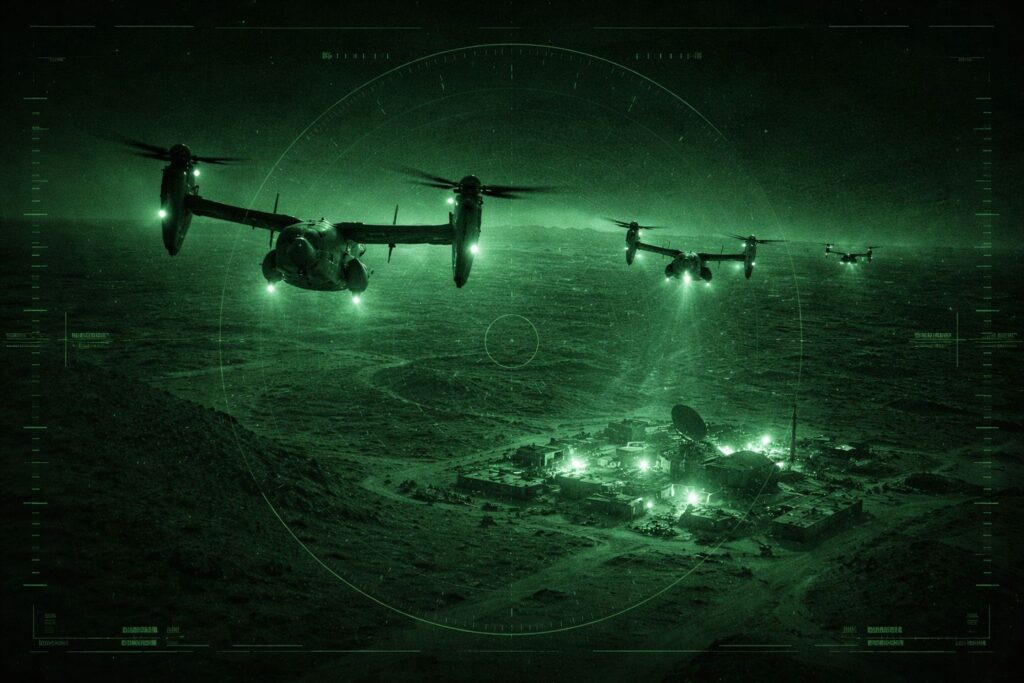
Because the combination of a Marine Expeditionary Unit and the MV-22 Osprey tiltrotor does not represent deterrence in the conventional sense. It represents a very concrete operational capability: get in fast, reach the objective, get out fast. The quiet message of the USS Tripoli is this: we can do this now. At any time. Whether we do it is our call alone.
To understand why that message is so precise, you need to understand what the Osprey can do – and what the 31st MEU is.
The Aircraft Nobody Wanted – and Nobody Can Do Without Today
The history of the Bell-Boeing V-22 Osprey is, in its own way, a story about institutional resistance to the unknown. The Joint-service Vertical takeoff/landing Experimental program – JVX – launched in 1981, when the U.S. Department of Defense began pursuing a concept that sounded self-contradictory on paper: an aircraft that takes off vertically like a helicopter but reaches the speed and range of a turboprop plane in flight. Bell Helicopter and Boeing received a joint development contract in 1983. The first prototype lifted off in 1989.
What followed was a development history written in blood. Four crashes during the test phase between 1991 and 2000 killed 30 people. Defense Secretary Dick Cheney attempted to kill the program multiple times – not for strategic reasons, but budgetary ones. Confronted by congressional supporters from Texas and Pennsylvania, where the aircraft was being built, he ultimately backed down. The program survived politically because it served congressional districts – not because the Pentagon was convinced.
The program hit its lowest point in 2001: Lieutenant Colonel Odin Leberman, commander of the V-22 squadron at Marine Corps Air Station New River, was relieved of command after it emerged that he had ordered his unit to falsify maintenance reports to make the aircraft’s readiness appear better than it was. The Osprey was fighting not just gravity. It was fighting its own reputation.
That it won that fight comes down to one characteristic that proved irreplaceable through operational testing: it solves a problem no other aircraft solves. It gets special operations forces in fast, far, and without a runway, anywhere on earth.
The hard numbers of the CV-22B – the special operations variant operated by AFSOC and SOCOM for covert missions – speak for themselves: cruise speed approximately 275 mph, roughly twice that of a conventional transport helicopter. Combat radius with an internal auxiliary fuel tank approximately 575 miles. With aerial refueling, the aircraft can self-deploy more than 2,000 miles – without a stopover, without a runway, without coordinating with a partner nation that might be diplomatically sensitive. Up to 24 fully equipped troops or approximately 10,000 pounds of cargo. Service ceiling 25,000 feet. (CV-22 Osprey Fact Sheet, Air & Space Forces Magazine; CV-22B Osprey, NAVAIR)
The CV-22B is also equipped with a terrain-following radar that allows it to fly at extremely low altitude at night and in poor weather – below most radar systems, below most reaction windows. Add forward-looking infrared, electronic countermeasures, anti-jam communications, and full NBC capability (nuclear, biological, chemical). It is, in short, the only high-speed vertical-lift platform in the U.S. Air Force – and there is no comparable aircraft in any other military in the world.
That is why the Osprey has become an indicator in U.S. military operational language. When it shows up, the question is not: what’s happening here? The question is: who are they going after, and when?
When Ospreys and Marines are deployed, it is not about presence – it is about options. This analysis explains why the combination of MV-22 tiltrotors and a Marine Expeditionary Unit signals not deterrence, but the capability for rapid, precise operations deep inside contested territory. What is currently building in the Persian Gulf is not a show of force – it is a toolkit for missions that can begin at any moment.
Exclusive Analysis for Subscribers
This exclusive Deep-Dive-Analysis you can read here
Michael Hollister is a geopolitical analyst and investigative journalist. He served six years in the German military, including peacekeeping deployments in the Balkans (SFOR, KFOR), followed by 14 years in IT security management. His analysis draws on primary sources to examine European militarization, Western intervention policy, and shifting power dynamics across Asia. A particular focus of his work lies in Southeast Asia, where he investigates strategic dependencies, spheres of influence, and security architectures. Hollister combines operational insider perspective with uncompromising systemic critique—beyond opinion journalism. His work appears on his bilingual website (German/English) www.michael-hollister.com, at Substack at https://michaelhollister.substack.com and in investigative outlets across the German-speaking world and the Anglosphere.
© Michael Hollister —
All rights reserved. Redistribution, publication or reuse of this text requires express written permission from the author. For licensing inquiries, please contact the author via www.michael-hollister.com
Newsletter
🇩🇪 Deutsch: Verstehen Sie geopolitische Zusammenhänge durch Primärquellen, historische Parallelen und dokumentierte Machtstrukturen. Monatlich, zweisprachig (DE/EN).
🇬🇧 English: Understand geopolitical contexts through primary sources, historical patterns, and documented power structures. Monthly, bilingual (DE/EN).