
by Michael Hollister
Exclusive published at Michael Hollister on March 22, 2026
4.098 words * 22 minutes readingtime
This analysis is made available for free – but high-quality research takes time, money, energy, and focus. If you’d like to support this work, you can do so here:

Alternatively, support my work with a Substack subscription – from as little as 5 USD/month or 40 USD/year!
Let’s build a counter-public together.
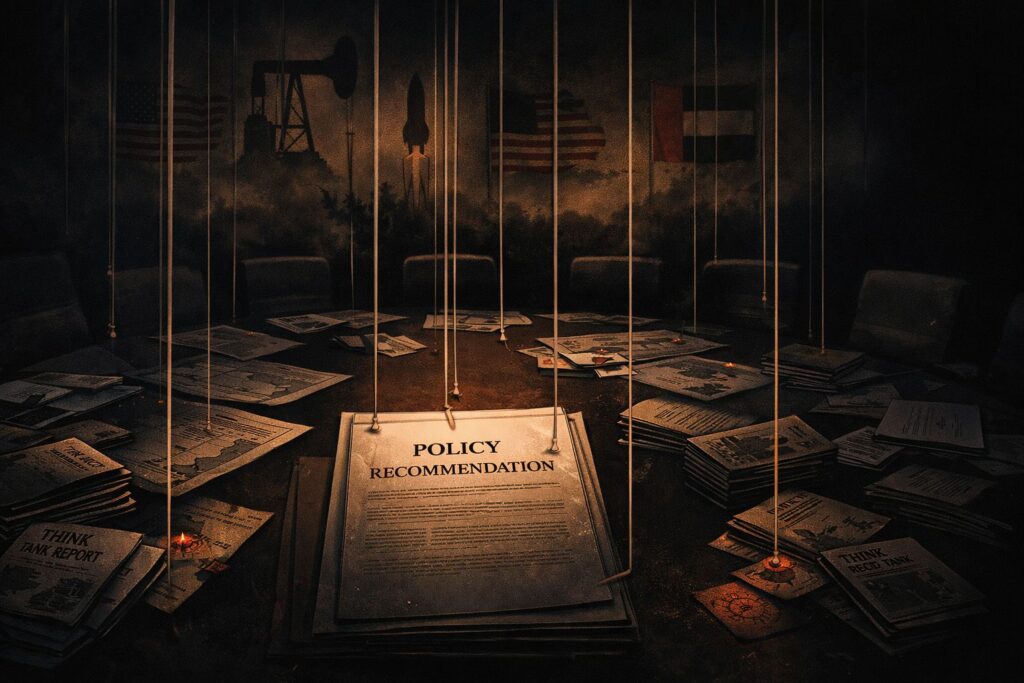
Who Thinks America – and Who Pays for It
In January 2023, CNBC published a guest op-ed by Fred Kempe, president and CEO of the Atlantic Council, one of Washington’s most influential foreign policy think tanks. Kempe praised the United Arab Emirates as a model host for the UN climate summit COP28, called Oil Minister Sultan Al-Jaber an “ideal choice” to chair the conference, and celebrated Abu Dhabi’s “utopian” plan for fighting climate change. What Kempe failed to mention: the UAE had donated over one million dollars to his think tank the previous year. The Abu Dhabi National Oil Company – Al-Jaber’s own company – was the main sponsor of the Atlantic Council’s annual energy conference.
CNBC’s editors only caught the conflict of interest after the Washington Free Beacon inquired – and subsequently appended a lengthy editor’s note identifying the “obvious conflict of interest” that had “not been disclosed.” Kempe apologized for the lack of transparency. The Atlantic Council called it an “oversight.”
It was not an oversight. It was the system.
What the Tracker Reveals
On March 16, 2026 – just weeks after the start of the U.S.-Israeli war against Iran – the Quincy Institute for Responsible Statecraft published the updated version of its Think Tank Funding Tracker: the first publicly accessible, systematic database tracking the funding of the 75 most important U.S. foreign policy think tanks. The numbers are sobering.
In 2024, these think tanks received over $25 million from foreign governments and over $7 million from Pentagon contractors. Both figures are conservative estimates: roughly 40 percent of the think tanks surveyed publish no donor lists whatsoever. What the Tracker captures is the visible surface of a far larger stream.
Since 2019, over $110 million in foreign government money has flowed to the top 50 think tanks. The largest single foreign donor during that period was not a Western ally – it was the United Arab Emirates: since 2019, the UAE has directed at least $16.7 million to the top 50 think tanks combined, with the largest single contribution going to the Atlantic Council. Going back to earlier years, the Atlantic Council alone has received more than $20 million from the emirate since 2014. Among Pentagon contractors, Northrop Grumman leads with $5.6 million, followed by Lockheed Martin with $2.6 million and Saab with $2.1 million – measured against total payments since 2019.
The Atlantic Council has received a combined minimum of $48.8 million from Pentagon contractors and foreign governments – more than any other think tank in the Tracker.
For the Quincy Institute, the timing is no coincidence: the Tracker was released to explain why so many of these institutions had spent years advocating for military options against Iran before the strikes began.
A Case Study: The Atlantic Council and the UAE
The relationship between the Atlantic Council and the UAE is the best-documented example of how this system operates in practice – not because it is the most extreme case, but because it has been publicly exposed more often than any other.
The UAE has contributed to the Atlantic Council annually since at least 2014. Between 2014 and 2018, support from the UAE Embassy, its foreign ministry, and the state oil company ADNOC totaled at least $4 million, according to an analysis by the Center for International Policy. That flow has never stopped – the Tracker documents a further UAE contribution of one million dollars or more for every available year since.
What did the Atlantic Council deliver in return? Direct causality cannot be proven – that is not how these systems work. Contracts for opinions are never signed. What can be documented is the output.
Since the signing of the Abraham Accords in 2020, the Atlantic Council has produced a sustained pipeline of analysis framing the UAE-Israel normalization as a strategic win for the region and the United States. Reports urged Congress to strengthen the agreements, treat the UAE as a reliable partner, and extend the format to additional states. One such study was published in 2021 as a formal trilateral partnership – between the Atlantic Council, the Emirates Policy Center in Abu Dhabi, and the Institute for National Security Studies in Tel Aviv. An institutionalized collaboration, funded by the same emirate being covered.
The CNBC op-ed by CEO Kempe is the case that got caught. The accumulation of favorable analyses is the broader pattern. But there is more concrete evidence still.
Leaked emails, reported on by The Intercept and the Center for International Policy, show that the then-director of the Brent Scowcroft Center on International Security at the Atlantic Council acknowledged to UAE Ambassador Yousef Al Otaiba that donors were given the opportunity to comment on reports prior to publication. Al Otaiba used this channel on an Atlantic Council report about U.S. policy toward Iran. Some of his comments were incorporated. The report’s core argument remained intact – but the influence had taken place. And it was contractually embedded within the partnership arrangement.
The CNAS Drone Case: When the Connection Becomes Explicit
Some cases leave less room for ambiguity. In 2016, the UAE paid $250,000 to the Center for a New American Security (CNAS), another think tank with close ties to the Pentagon and the State Department. The payment was earmarked: for a study on the Missile Technology Control Regime (MTCR), an international agreement restricting the export of certain weapons technologies – including armed drones. The UAE wanted admission to the regime in order to gain access to U.S. combat drones.
The assignment to CNAS: analyze the costs and benefits of UAE membership in the MTCR. Then-CNAS president Michèle Flournoy wrote to UAE Ambassador Al Otaiba: “Yousef: Here is the CNAS proposal for a project analyzing the potential benefits and costs of UAE membership in the MTCR, as discussed. Please let us know if this meets your expectations.” When the report was finished, Al Otaiba wrote back: “I think it will help steer the debate in the right direction.”
In August 2020, the United States approved the sale of armed drones to the UAE.
This is not coincidence. This is not correlation. This is the documented sequence: pay, commission, deliver, profit.
Defense Contractors Plus Gulf States: Two Funding Streams, One Outcome
The donor structure of the Atlantic security establishment follows a dual logic. On one side are the Gulf states – the UAE, Saudi Arabia, Qatar – pumping millions annually into Washington’s think tanks. On the other side are U.S. defense contractors: Northrop Grumman alone contributed $1.1 million in 2024, followed by MITRE Corporation, Saab, and Lockheed Martin.
These two funding streams may have different origins – but they pursue complementary goals. The Gulf states want legitimacy in Washington, favorable foreign policy analysis, access to weapons technology, and a counter-narrative to criticism of their human rights records. The defense contractors want defense budgets, weapons sales to the region, and the intellectual groundwork for conflicts that fill their order books. Both interests converge on the same output: Iran as threat, military solutions as answer, defense spending as necessity.
Shortly before the Iran war began, the Atlantic Council – funded by Northrop Grumman – published a piece by a “visiting researcher from the Israeli security establishment” titled: “Six Reasons Why Trump Should Choose the Military Option in Iran.” That piece has not disappeared. It is part of the archive that Congress draws on when think tank experts are called as independent witnesses.
The Structural Problem: No Law Prohibits It
Perhaps the most unsettling thing about this system is not that it operates in the shadows. It operates in plain sight – because it is legal.
In the United States, there is no disclosure requirement for think tanks regarding their donors. The Foreign Agents Registration Act (FARA) applies to direct lobbying, not to academic research and policy recommendations. A foreign policy think tank that receives millions from a foreign government and is subsequently cited before Congress as “independent expertise” violates no law. It merely violates what might be called intellectual integrity – but that is nowhere codified.
The result is a structural asymmetry: those with money can buy arguments. Not in a direct, corrupt sense, but through the subtler principle of institutional dependency. Think tanks funded by specific countries or industries do not produce critical analyses of those funders. Nor do they produce fundamentally different analyses – they simply produce nothing that would cause discomfort. Silence is the deliverable.
In an Al Jazeera documentary series on the arms industry, journalist Hind Hassan put the question directly to Atlantic Council Deputy Director Mark Massa: “How can you separate yourself from the interests of weapons companies when money comes from them?” According to Responsible Statecraft’s account of the exchange, Massa was silent for ten seconds. Then he said: “I think you’re right… that a lot of people have commented on that, the relationship… the relationship between, you know, the interests, we see that, we see that, you know, we see that often.”
No denial. No counter-argument. Ten seconds of silence that said more than any answer could.
What This Means
This article makes no accusation against individual analysts or researchers. Most people working in these institutions are competent and act in good faith. The system does not need conscious corruption to function. It only needs incentives – and those are clearly in place.
The decisive question is a different one: if the institution supplying “independent expertise” for foreign policy decisions is funded by the same actors who profit from those decisions, what does the word “independent” still mean?
The Quincy Think Tank Funding Tracker is the first publicly accessible attempt to answer that question with data. Its publication on March 16, 2026 – three weeks after the start of a war that many of these institutions spent years advocating for – is no coincidence. It is an invitation to scrutiny.
Further reading:How the intellectual preparation for wars works in practice is analyzed by Michael Hollister in conversation with Patrik Baab – Nothing Is So Well Prepared as a War That Breaks Out Suddenly
This analysis is made available for free – but high-quality research takes time, money, energy, and focus. If you’d like to support this work, you can do so here:
Alternatively, support my work with a Substack subscription – from as little as 5 USD/month or 40 USD/year!
Let’s build a counter-public together.
Michael Hollister is a geopolitical analyst and investigative journalist. He served six years in the German military, including peacekeeping deployments in the Balkans (SFOR, KFOR), followed by 14 years in IT security management. His analysis draws on primary sources to examine European militarization, Western intervention policy, and shifting power dynamics across Asia. A particular focus of his work lies in Southeast Asia, where he investigates strategic dependencies, spheres of influence, and security architectures. Hollister combines operational insider perspective with uncompromising systemic critique—beyond opinion journalism. His work appears on his bilingual website (German/English) www.michael-hollister.com, at Substack at https://michaelhollister.substack.com and in investigative outlets across the German-speaking world and the Anglosphere.
Sources
- Quincy Institute for Responsible Statecraft: Think Tank Funding Tracker – New Research, March 16, 2026 – https://quincyinst.org/2026/03/16/new-research-think-tank-funding-tracker-provides-insight-into-cheerleading-of-iran-war/
- Think Tank Funding Tracker – Atlantic Council (primary database) – https://thinktankfundingtracker.org/think-tank/atlantic-council/
- Think Tank Funding Tracker – UAE (primary database) – https://thinktankfundingtracker.org/donor/united-arab-emirates/
- Quincy Institute: Big Ideas and Big Money – Think Tank Funding in America, April 2025 – https://quincyinst.org/research/big-ideas-and-big-money-think-tank-funding-in-america/
- Washington Free Beacon: The UAE Has Donated Millions to the Atlantic Council. They Just Got a Glowing Op-Ed From the Think Tank’s Chief., January 17, 2023 – https://freebeacon.com/national-security/the-uae-has-donated-millions-to-the-atlantic-council-they-just-got-a-glowing-op-ed-from-the-think-tanks-chief/
- Responsible Statecraft: Is the UAE buying silence at US think tanks?, August 2021 – https://responsiblestatecraft.org/2021/08/10/is-the-uae-buying-silence-at-us-think-tanks/
- Responsible Statecraft: Weapons makers, foreign states lavish $32 million on US think tanks, March 2026 – https://responsiblestatecraft.org/think-tank-funding-tracker/
- Inkstick Media: Think Tanks Under the (Foreign) Influence, August 2021 – https://inkstickmedia.com/think-tanks-under-the-foreign-influence/
- INSS: The Atlantic Council, Emirates Policy Center, and INSS Announce Strategic Partnership to Advance UAE-Israel Relations, 2021 – https://www.inss.org.il/think-tanks-cooperation/
- Atlantic Council / INSS: The Abraham Accords at Five, September 2025 – https://www.atlanticcouncil.org/in-depth-research-reports/issue-brief/the-abraham-accords-at-five/
© Michael Hollister – All rights reserved. Redistribution, publication or reuse of this text requires express written permission from the author. For licensing inquiries, please contact the author via www.michael-hollister.com.
Newsletter
🇩🇪 Deutsch: Verstehen Sie geopolitische Zusammenhänge durch Primärquellen, historische Parallelen und dokumentierte Machtstrukturen. Monatlich, zweisprachig (DE/EN).
🇬🇧 English: Understand geopolitical contexts through primary sources, historical patterns, and documented power structures. Monthly, bilingual (DE/EN).