
by Michael Hollister
Exclusive published at Michael Hollister on June 13, 2026
3.384 words * 17 minutes readingtime
This dossier supplements the in-depth analysis of Minab with the historical dimension. It is not about a single strike, but about what four strikes over 35 years have in common: a safeguard that exists precisely for this scenario – and that failed every time.
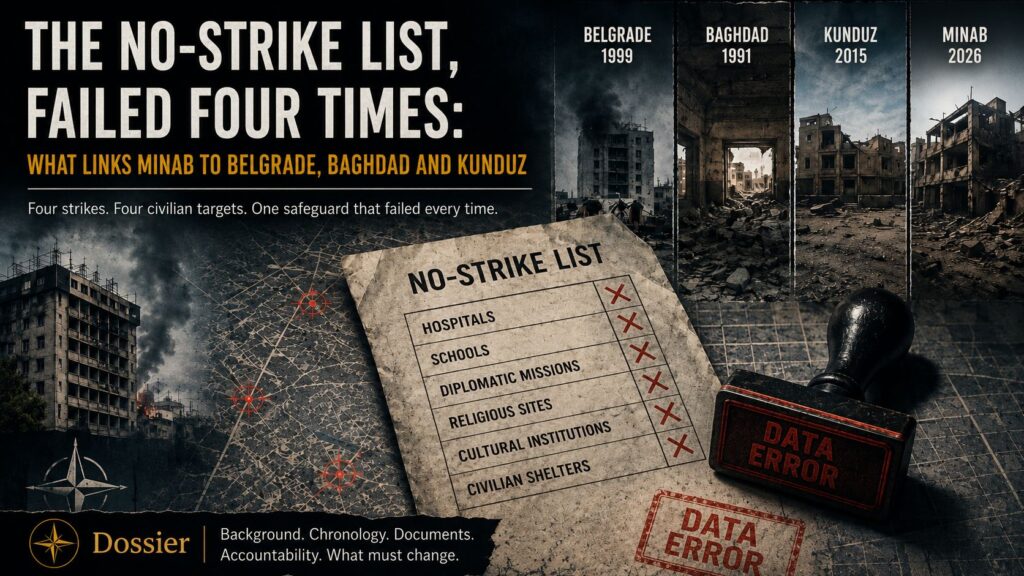


What Minab Has in Common with Belgrade, Baghdad, and Kunduz
It begins with a sentence that has barely changed in three and a half decades: it was an error in the data. An outdated map. A wrong address. An obsolete classification. Four times in four decades, the US military destroyed an unambiguously civilian building – an air raid shelter, an embassy, a hospital, a girls’ school – and four times the official explanation amounted to the same thing: the information on which the strike was based had not been current.
An attentive reader of this series put the thought precisely in an email: anyone looking at the Minab strike experiences a sense of déjà vu with Belgrade 1999. The observation cuts to a sore point – and it reaches further than the reader suspected. Because Belgrade and Minab are not the only two cases. They are two of at least four. In each of these cases, a safeguard existed that was designed to prevent precisely this outcome. In each case it failed. And in none of the four cases has anyone borne responsibility in any meaningful sense.
The list that is supposed to prevent it
At the center of this is an instrument with an unremarkable name: the No-Strike List. It is a database of protected objects – hospitals, schools, religious sites, diplomatic missions, cultural institutions – that must be checked against any nominated target before a planned strike. It is the operational translation of a legal obligation under international law. Article 57 of the First Additional Protocol to the Geneva Conventions requires anyone who plans or orders an attack to do everything feasibly possible to verify that the target is not a civilian object. The No-Strike List is the mechanism that anchors this obligation in the engine room of targeting. In US doctrine, the check is not an optional intermediate step but a defined part of the targeting cycle: at every level, a military legal adviser reviews the legality of the nominated target, and a pattern-of-life analysis – observation of the target over a period of time – is meant to identify whether civilians are present. Each of these steps offers an opportunity to catch an error before it becomes lethal.
Laying the four cases side by side, one recognizes that the failure of this mechanism appears in two variants. In the first, the attackers aimed at precisely the building struck – they believed it to be a military target because its classification was wrong or outdated. That was the case in Baghdad, and that was the case in Minab. In the second variant, the attackers aimed at a different, genuinely military building in close proximity and struck the protected object due to a coordinate or identification error. That was the case in Belgrade, and that was the case in Kunduz.
The distinction is real, and it matters – but it is not the point. The point is that both variants defeat the same layer of protection. Whether a building is misclassified or mislocated: in both cases, it is the No-Strike check that is supposed to catch the error before the weapon falls. In all four cases, it did not. Sometimes the classification was outdated, sometimes the address was incorrectly recorded, sometimes the list simply was not loaded. The outcome was the same every time.
Baghdad, 1991: The shelter no one saw as a shelter
In the early hours of February 13, 1991, two laser-guided bunker bombs dropped by an F-117 stealth bomber punched through the roof of the air raid shelter “Public Shelter No. 25” in the Amiriyah district of western Baghdad. The first bomb breached the reinforced ceiling; the second detonated deep inside. At least 408 civilians died – the great majority of them women, children, and elderly people, most of them in their sleep. Many were burned so completely that relatives could identify them only by jewelry or clothing.
The target classification came from the US Air Force planning cell. A few days before the strike, an assessment had been formulated that the shelter had been repurposed as an alternate command post and showed no signs of use as a civilian shelter. Human Rights Watch established the opposite that same year: the building had been clearly marked as a public shelter and had been used by large numbers of civilians throughout the air campaign. The organization characterized the strike as a war crime. It was claimed at various points in its defense that the Iraqi leadership had used civilians as human shields or that the roof had been camouflaged. Neither could be substantiated; subsequent review concluded that it was not a significant military installation and that no systematic use as a shield had occurred.
The Pentagon initially defended the operation by pointing to intelligence that had identified a military command-and-control facility. A different reading later prevailed: it had been an intelligence failure. In their standard work on the Gulf War, journalist Michael Gordon and former Marine General Bernard Trainor described the bombing as an intelligence-based miscalculation. The classification as a command post was wrong – and the visible features attesting to civilian use did not find their way into the decision.
Amiriyah is the first variant in its purest form: the weapon struck exactly the building that had been targeted. What was wrong was not the coordinate but what the records said about the building. No criminal or disciplinary proceedings followed.
Belgrade, 1999: The embassy on a 1992 city map
On May 07, 1999, a B-2 stealth bomber of the 509th Bomb Wing dropped five satellite-guided JDAM bombs on the grounds of the Chinese Embassy in Belgrade. Three people died – Xinhua reporter Shao Yunhuan and the journalist couple Xu Xinghu and Zhu Ying – and around twenty were injured. The actual target was the Yugoslav federal procurement agency FDSP, a military facility. The embassy was not a repurposed military building; it was a newly constructed building occupied just a few years earlier. A flawed method for deriving coordinates placed the FDSP at the embassy’s location.
The official explanation pointed to an outdated map. The city map used dated from 1992; the embassy had relocated in 1996. A No-Strike List covering embassies, churches, hospitals, and schools existed – but it listed the Chinese mission at its old address. CIA Director George Tenet testified before a congressional committee that the embassy was the only target nominated by the CIA in the entire war; a staff member had tried to have it removed from the list, but by then the aircraft were already airborne. NATO Supreme Commander Wesley Clark publicly called the incident an anomaly. What was already remarkable at the time was the diagnosis from within: unlike earlier incidents attributed to pilot error or weapons malfunction, the munitions struck exactly what had been programmed – only the instruction itself was wrong. The bombs landed with precision; the problem lay one layer back, in the data.
Yet the explanation was challenged from the outset – and not from Iranian or Russian quarters. On October 17, 1999, the British newspaper The Observer and the Danish Politiken published a joint investigation that reached a different conclusion. Citing senior NATO and US sources, journalists John Sweeney, Jens Holsoe, and Ed Vulliamy reported that the embassy had been deliberately struck after NATO signals intelligence identified it as a relay station for Yugoslav army communications. The building had been moved from a list of prohibited targets onto a target list. A staff member at the US agency responsible for the map described the official explanation as a deliberate lie. Holsoe established through straightforward open-source research that no building had ever stood on the alleged FDSP site.
NATO rejected the report. A review by the Yugoslavia Tribunal in 2000 found no pattern of intent; Western observers noted that a deliberate attack on Chinese territory would have made little sense given the rapprochement underway at the time. Both readings stand side by side to this day. For this dossier, which of them is correct is not the decisive question. What is decisive is that even in 1999 the explanation “outdated map” was regarded as inadequate – by professionals familiar with the subject matter. The second variant appeared here for the first time in full force: the target was a legitimate military objective nearby; what was struck was the protected object. No individual took responsibility.
Kunduz, 2015: The list that was not on board
In the early hours of October 03, 2015, a US Air Force AC-130 gunship opened fire on the trauma center of Médecins Sans Frontières in the northern Afghan city of Kunduz. For the better part of half an hour, the aircraft’s weapons repeatedly and precisely struck the main building. 42 people died – 24 patients, 14 MSF staff, and 4 companions.
Kunduz is the clearest case because here the safeguard not only existed but had been actively maintained. MSF had transmitted the GPS coordinates of the hospital to the US Department of Defense, to Afghan ministries, and to US forces in Kabul as recently as September 29 – four days before the strike. The hospital was on the No-Strike List. The actual target was different: the headquarters of the Afghan intelligence service NDS, approximately 410 meters away, which was said to have been seized by Taliban fighters and had partly served as a detention facility.
The chain of failures reads like an instruction manual for disaster.
Exclusive Analysis for Supporter
Four strikes, four decades, four civilian targets: an air-raid shelter in Baghdad, the Chinese embassy in Belgrade, a hospital in Kunduz and a girls’ school in Minab. This dossier shows that behind the official explanations of “outdated data,” “wrong maps” and “human error” lies a recurring structural failure: protective mechanisms designed to shield civilian sites from attack collapse precisely when they are needed most. The No-Strike List becomes a symbol of modern warfare in which technical precision increases, while accountability disappears.

Readers who support my work will receive this article exclusively as a PDF by email on the day of publication. If you support my work after publication and would also like to read the article, simply send a short message to:
mh@michael-hollister.com
I will be happy to send you the PDF afterwards.
Michael Hollister
is a geopolitical analyst and investigative journalist. He served six years in the German military, including peacekeeping deployments in the Balkans (SFOR, KFOR), followed by 14 years in IT security management. His analysis draws on primary sources to examine European militarization, Western intervention policy, and shifting power dynamics across Asia. A particular focus of his work lies in Southeast Asia, where he investigates strategic dependencies, spheres of influence, and security architectures. Hollister combines operational insider perspective with uncompromising systemic critique – beyond opinion journalism. His work appears on his bilingual website (German/English) www.michael-hollister.com, at Substack and in investigative outlets across the German-speaking world and the Anglosphere.
© Michael Hollister – All rights reserved. Redistribution, publication or reuse of this text requires express written permission from the author. For licensing inquiries, please contact the author via www.michael-hollister.com.
Newsletter
🇩🇪 Deutsch: Verstehen Sie geopolitische Zusammenhänge durch Primärquellen, historische Parallelen und dokumentierte Machtstrukturen. Monatlich, zweisprachig (DE/EN).
🇬🇧 English: Understand geopolitical contexts through primary sources, historical patterns, and documented power structures. Monthly, bilingual (DE/EN).