
Situation Report, May 29, 2026 – Building on Update of May 21,2026
by Michael Hollister
Exclusive published at Michael Hollister on May 29, 2026
3.599 words * 19 minutes readingtime
TICKER
FRONT LINE: RUSSIA LOSES NET 100 SQUARE MILES IN MAY – RECORD SINCE WAR BEGAN
The territorial deterioration of Russian forces has reached a new dimension over the past four weeks. According to ISW analysis via Russia Matters, Russia lost a net 100 square miles of Ukrainian territory between April 28 and May 26 – roughly the area of the US island of Nantucket. In the preceding period (March 31 to April 28), the figure was 26 square miles. In the week of May 19 to 26 alone, the loss amounted to 38 square miles – the largest weekly decline of the entire war. Russia’s average rate of advance has thereby fallen to its lowest level since the start of the full-scale invasion. ISW identifies the reason: Ukraine’s tactical drone superiority at the front line has largely neutralized the Russian infiltration tactics that enabled significant territorial gains from summer through fall 2025. A Kremlin-affiliated military blogger openly confirmed on May 26 that effective Ukrainian drone reconnaissance and front-line strikes had undermined the infiltration missions on which Russian forces had relied for months.
KREMLIN FACES FORCED MOBILIZATION: RECRUITMENT SYSTEM COLLAPSES – RUSSIA TARGETS WOMEN AND STUDENTS
Russia’s voluntary recruitment system is showing signs of structural collapse, according to ISW analysis of May 27. Recruitment rates are declining despite repeated increases in one-time sign-on bonuses. In response, Moscow has expanded its recruitment drive to new target groups: for the first time, women and students are being actively recruited for service in the newly created Unmanned Systems Forces (USF) and for rear-area air defense positions. On May 25, Putin signed a decree granting new recruits debt relief of up to 10 million rubles – a signal that financial incentives alone are no longer sufficient. According to Ukrainian intelligence reported by Zelensky on May 27, the Kremlin is preparing an additional mobilization of “tens of thousands” of men. ISW assesses these discussions as a sign of weakness: declining combat performance, growing war fatigue among the population, and a recruitment system no longer able to offset ongoing losses.
UKRAINE DECLARES “LOGISTICS LOCKDOWN”: SYSTEMATIC CAMPAIGN AGAINST RUSSIAN SUPPLY LINES
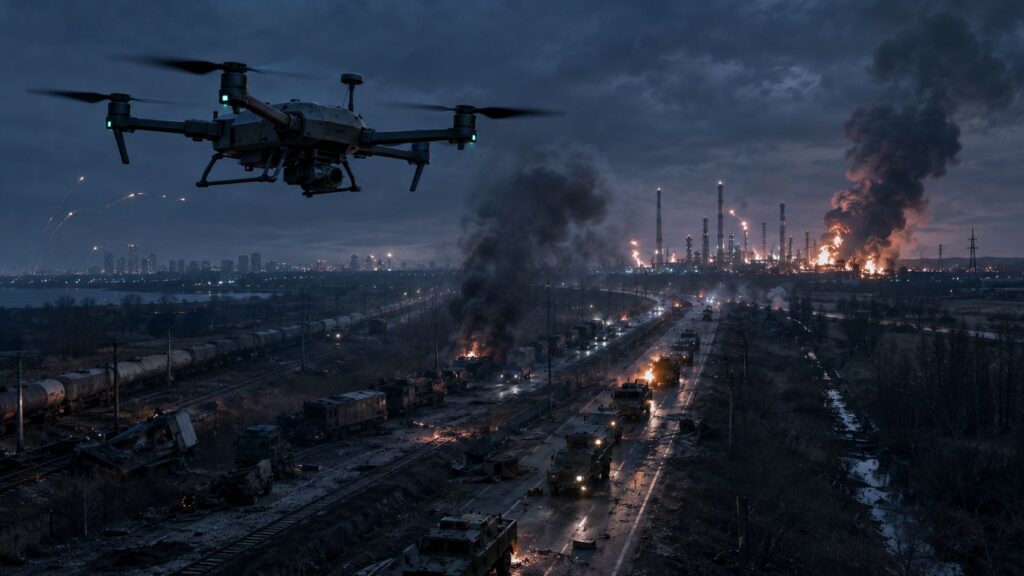
Ukrainian Defense Minister Mykhailo Fedorov formally articulated a doctrine on May 27 that explains the front-line dynamics of recent weeks: the so-called “Logistics Lockdown” – a systematic medium-range campaign targeting Russian supply and resupply routes. Concrete effects are already visible: the M-14 highway between Rostov-on-Don and Crimea is under sustained Ukrainian fire; Russia has already closed the road to civilian traffic. Supply corridors to Donetsk City are also being systematically targeted. ISW describes the strategic logic: Ukrainian drones are striking not only front lines but the entire logistics chain behind them – transport routes, ammunition depots, supply nodes. Russia must today replace not only front-line losses but also personnel for the newly created drone forces and for the defense of its own rear against Ukrainian deep strikes. That makes every additional recruit three times as scarce.
REFINERIES UNDER SUSTAINED FIRE: RUSSIA CONSIDERS EXPORT BAN ON JET FUEL AND DIESEL
Ukraine’s energy campaign against Russian refinery capacity reached a new intensity in May. The Moscow refinery has been offline since May 17; the Ryazan facility – one of the country’s largest, accounting for roughly five percent of Russia’s total capacity – has been out of operation since May 15. Also affected are facilities in Nizhny Novgorod, Yaroslavl, and Kirishi. The Syzran refinery in Samara Oblast was struck on May 21; Aircraft Repair Plant No. 325 in Taganrog and the Tuapse refinery on May 27. Russia Matters reports that Deputy Prime Minister Alexander Novak convened a crisis meeting with oil companies on May 26 and discussed a possible temporary export ban on jet fuel and diesel lasting one to two months. Russia has already imposed a gasoline export ban through July 31. The drone campaign has thus not merely struck individual facilities – it has placed Russia in a position where production capacity and export revenues are permanently out of alignment.
RUSSIA DEMANDS DIPLOMATIC WITHDRAWAL FROM KYIV – LAVROV CALLS RUBIO
On May 25, one day after the largest Kyiv strike of the war, Russia’s Foreign Ministry issued an unprecedented statement: all foreign nationals, including embassy staff and employees of international organizations, were called upon to leave Kyiv “as soon as possible.” Russia announced it would continue “systematic strikes” on decision-making centers, command posts, and drone production facilities – and since such facilities were “spread across the entire city,” no safe presence was possible. Foreign Minister Lavrov called US Secretary of State Rubio the same day, explicitly urging Washington to evacuate its embassy. It is the first time since the start of the full-scale invasion in 2022 that Russia has directly and by name called on the embassies of Western states to evacuate. The EU mission responded: all 27 EU embassies are staying. “Russia wants fear, panic, and the isolation of Ukraine. That will not work,” the head of the EU mission in Kyiv stated. Ukraine called the warning a “shameless attempt at blackmail” and announced it would use the statement as evidence in international legal proceedings – since Russia had thereby implicitly acknowledged that its strikes also aimed at intimidating diplomatic missions.
THE KYIV STRIKE OF MAY 23/24 AND STAROBILSK: WHAT BELONGS TOGETHER
During the night of May 23 to 24, Russia fired approximately 600 drones and 90 missiles at Ukraine, according to Ukrainian sources – including Iskander short-range ballistic missiles, Kinzhal hypersonic missiles, and for the first time a ground-launched variant of the Zircon hypersonic missile, previously launched exclusively from warships. Four people died in Kyiv; more than 80 were wounded; every city district recorded impacts. Russia had explicitly announced the strike as retaliation for the Ukrainian drone attack on Starobilsk (May 21/22), in which 21 people were killed – predominantly young women in a student dormitory. Western coverage captured almost exclusively the Kyiv strike; Starobilsk appeared, if at all, as a footnote. A complete analysis of both events, their documented causality, and the structural reporting failure on both sides can be found in the Ukraine Insight: Starobilsk and Kyiv: What Really Happened – and Why It Was Barely Reported.
BELARUS: ZELENSKY WARNS OF NEW OFFENSIVE, MACRON PICKS UP THE PHONE FOR THE FIRST TIME
Zelensky stated this week that Russia is preparing a new offensive from Belarusian territory – and dispatched additional Ukrainian forces to the northern border. On May 24, immediately before the massive Kyiv strike, Emmanuel Macron spoke by phone with Alexander Lukashenko – the first officially confirmed conversation between the two since the start of the war in February 2022. According to the Élysée, Macron stressed “the risks for Belarus of being drawn into Russia’s war of aggression” and called on Minsk to move closer to Europe. Lukashenko’s presidential office described the call laconically as an exchange on “regional topics.” A Ukrainian drone commander simultaneously issued a public warning: “The first 500 targets in Belarus are already marked.” The Konrad Adenauer Foundation analyzed in a recent report that Belarus, with its 70,000 to 75,000 soldiers, continues to pursue a strategy of “controlled engagement” – supporting Russia without crossing the threshold of open entry into the war. How stable that threshold is remains an open question.

PUTIN IN BEIJING: OIL EXPORTS TO CHINA +35%, BUT XI SAID TO HAVE TOLD TRUMP: PUTIN MIGHT “REGRET” INVASION
On May 20, Putin arrived in Beijing – just days after Trump’s own visit with Xi Jinping. The symbolic sequence was deliberate: China signals that it cooperates with both major powers. On substance, Putin’s presidential adviser confirmed that Russian oil exports to China rose 35 percent in the first quarter of 2026. Bilateral trade volume reached approximately $228 billion in 2025. Putin sought reassurance in the event that Trump’s rapprochement with Beijing comes at Moscow’s expense – and wanted to know what Xi had learned from Trump about the Ukraine negotiations. What he likely did not want to hear: the Financial Times reported, citing sources, that Xi had indicated to Trump that Putin might “regret” his invasion of Ukraine – an assessment Trump publicly denied. Analysts at King’s College London draw a sober conclusion: Russia’s military position has deteriorated to the point where its strategic value to Beijing is declining. China needs Russia as a raw materials supplier – but not as a loser.
ZELENSKY IN STOCKHOLM: 16 GRIPEN C/D DONATED, UP TO 150 GRIPEN E PLANNED At a surprise visit to Uppsala Air Force Base on May 28, Zelensky and Swedish Prime Minister Ulf Kristersson announced that Sweden would transfer 16 used Saab JAS 39 Gripen C/D aircraft to Ukraine – delivery from spring 2027. Ukrainian pilots have already begun training. In parallel, Kyiv is planning the purchase of up to 20 next-generation Gripen E aircraft, financed through a €2.5 billion EU loan; earliest delivery 2030. The long-term goal: 150 Gripen E. The existing fleet of Western combat aircraft – American F-16s and French Mirage 2000s – is insufficient, according to Ukraine, to protect cities and infrastructure against the daily Russian bombardment. Kristersson acknowledged that Sweden would need to build up its own Gripen E inventory faster to compensate for the transfer.
ZELENSKY LETTER TO TRUMP: PAC-3 MISSILES EXHAUSTED – LICENSE FOR DOMESTIC PRODUCTION DEMANDED
In an urgent letter of May 26 to Trump and the US Congress, Zelensky warned of a critical shortage in Ukraine’s missile defense capabilities. The focus: PAC-3 interceptor missiles for Patriot systems, effective against ballistic missiles – the only system of its kind produced exclusively by the United States. Zelensky called for either additional deliveries or a production license for Ukraine itself. The PURL mechanism (Priority Ukraine Requirements List), established in August 2025 by the US and NATO partners to coordinate weapons procurement for Kyiv, no longer covers requirements given the intensified Russian strikes. “When it comes to ballistic missile defense, we rely exclusively on the United States,” Zelensky said in Stockholm. The letter was personally delivered to the White House, House Speaker Johnson, and other legislators by Ambassador Olga Stefanishyna.
UN ANNUAL REPORT: RUSSIA LISTED FOR FIRST TIME ON BLACKLIST FOR CONFLICT-RELATED SEXUAL VIOLENCE
The annual UN report on sexual violence in conflict, published May 29, lists Russian armed forces and prison administrations on the blacklist for the first time. The UN human rights monitoring mission in Ukraine documented 310 verified cases – including rape, genital mutilation, and electric shocks – predominantly against male prisoners of war. Ukrainian authorities documented 31 cases attributed to the Ukrainian security apparatus, the majority before 2025; Ukraine was not placed on the blacklist. Russia’s UN Ambassador Nebenzia: “Unsubstantiated lies that once again portray Russia as the guilty party.” The 35-page report lists 77 state and non-state actors in twelve countries – including for the first time Israeli forces for violence against Palestinian detainees. Secretary-General Guterres had already issued formal warnings to Israel and Russia in August 2025.
NEGOTIATION STATUS: RUSSIAN MEMORANDUM NOT DELIVERED AFTER 13 DAYS – ISTANBUL II PROPOSED FOR JUNE
Following the first direct talks since 2022 in Istanbul on May 16, Moscow’s delegation head Vladimir Medinsky had announced he would draft a memorandum outlining Russia’s negotiating position. On May 23 – one week later – Zelensky stated: “Waiting a week for a memorandum is mockery of the entire world.” At the time of this update, the document is 13 days overdue. Russia in the interim proposed a second round in Istanbul in June; Foreign Minister Lavrov said Moscow was “ready to negotiate substantively.” Kyiv is considering. The fundamental substantive deadlock is unchanged: Russia insists on Ukrainian withdrawal from four annexed oblasts that it does not itself fully control. Ukraine demands an immediate, complete ceasefire as a starting point. A Ukrainian participant summarized the Istanbul talks as follows: the Russian delegation had “obviously had no mandate whatsoever” – it had simply returned to Moscow to report what it had heard.
TRUMP REMINDED BY ZELENSKY OF ISTANBUL – AXIOS: EUROPEANS “SURPRISED” BY TRUMP’S SATISFACTION
On May 19, Trump spoke with Putin for more than an hour and subsequently signaled to European heads of state and Zelensky that Putin had agreed to the resumption of direct negotiations. Zelensky then had to remind Trump that these talks had already taken place – in Istanbul, on May 16. According to Axios sources, there was a brief “confused silence” in the call. European participants were reportedly “surprised” that Trump was “relatively satisfied” with the Putin call despite an unchanged Russian position and ongoing overnight strikes on Ukrainian cities. Trump’s response to the question of sanctions in the event of Russian obstruction: he trusted Putin. The Kremlin for its part reiterated that a Putin-Zelensky meeting would only be possible after a fully negotiated agreement was completed – not as a negotiating instrument but as a closing ceremony. That is not a negotiating position. It is a demand for capitulation in diplomatic clothing.
Ukraine Insight:
Starobilsk and Kyiv: What Really Happened – and Why It Was Barely Reported
Why does the Western mainstream report on the largest Russian strike on Kyiv since the war began without explaining what happened three days earlier in Starobilsk? Why did schoolchildren appear as a footnote – and a Russian act of retaliation as an unprovoked attack? And why does the mirror image apply equally in Russian media? A complete documentation of both events, their causality, and the systematic reporting pattern on both sides – without taking sides, but without half-truths.
Ukraine Insight: Starobilsk and Kyiv

ANALYSIS
I. The Drone as War Decider – How Ukraine Is Breaking Russia’s Operational Logic
Since summer 2025, Russia’s tactical advance model rested on infiltration missions: small groups penetrating enemy lines under drone cover, reporting territorial gains, allowing follow-on waves to push forward. It worked. From August through November 2025, Russia achieved notable gains along several front sections. In the first quarter of 2026, the pace slowed. In May 2026, it reversed.
The ISW report of May 27 identifies the mechanism precisely: Ukrainian drones have broken Russia’s infiltration tactics not through superior infantry but through drone reconnaissance that makes infiltration movements visible before they can take effect. At the same time, Ukraine’s medium-range campaign is striking deeper into Russian logistics chains than ever before. The M-14 Rostov-Crimea highway is closed to civilian traffic. Supply corridors to Donetsk City are being systematically attacked. Defense Minister Fedorov’s term “Logistics Lockdown” is not public relations – it describes an operational doctrine that is already showing results.
What this means for Russia’s announced forced mobilization is analytically significant: additional recruits are of limited value when the routes by which they are transported to the front are under sustained fire. When ammunition depots in the rear burn before the ammunition reaches the front. When drone operators who should be covering infiltrations are instead needed as trainers – because the Rubikon unit, Russia’s elite drone formation that has been degraded since late 2025, can no longer maintain training quality. This is not a single domino falling. It is a system under simultaneous pressure at multiple points.
II. The Embassy Warning – What Russia Is Really Saying
On May 25, Russia did something it had not done in four years of war: it explicitly called on Western embassies by name to leave Kyiv. Foreign Minister Lavrov personally called Rubio. This is not a routine warning. It is a calculated escalatory gesture – and it deserves a calculated reading.
Russia justifies the warning by claiming that drone production facilities are spread across the entire city, making every part of Kyiv a potential military target. This is a self-expanding justificatory logic: if anything in Kyiv can be military infrastructure, no location in Kyiv is civilian. At the same time, the warning signals something else: Russia is announcing its strikes before carrying them out. That is unusual. It makes no military sense. Psychologically, it does.
The EU response – all 27 embassies are staying – is also a strategic decision, not bureaucratic inertia. It is the message to Kyiv, to Ukraine, and to Moscow: intimidation does not work. But the step itself changes the character of the war. Russia is no longer conducting warfare solely against Ukrainian forces. It is conducting the displacement of the diplomatic West from the Ukrainian capital. That is a new escalatory threshold – and it deserves more attention than it has received so far.
III. The Memorandum Silence and Trump’s Structural Problem
Thirteen days after Istanbul, no memorandum. That is not coincidence and not inefficiency. It is method. Russia’s negotiating strategy follows a logic that runs through the entire war: use negotiating formats to buy time, never as an instrument of compromise. Istanbul was not the beginning of negotiations. It was a breathing space under the cover of diplomacy. The Russian delegation, in the assessment of Ukrainian participants, had “obviously had no mandate whatsoever” – it traveled to listen and report, not to decide.
The actual problem lies in Washington. Trump speaks with Putin, considers the conversation productive, announces “progress” to European allies – and has to be reminded by Zelensky that the agreed talks have already taken place. Axios sources describe European participants as “surprised” by Trump’s satisfaction with a call in which Russia’s position had not moved. That is not merely a diplomatic embarrassment. It is a structural problem: a mediator unwilling to name the obstructing party cannot generate pressure. And without pressure, Russia does not negotiate – it waits.
IV. Beijing, Crimea Route, Refineries: Three Theaters, One War
Putin’s Beijing visit immediately after Trump’s own visit with Xi was not a diplomatic coincidence. It was a hedging operation. Russia wanted to know what Trump and Xi had discussed – particularly on Ukraine. What Putin is likely to have heard in Beijing was no comfort: Xi is said to have indicated to Trump that Putin might “regret” his invasion. Russia’s oil exports to China are up 35 percent, but Russia’s overall economy is now growing at only 0.4 percent in 2026 – revised down from 1.3 percent. Ukrainian drones are not merely striking refineries – they are striking Russia’s war financing. The fuel for the war machine will no longer come from Ryazan and Moscow – it will either come from China, or it will not come at all.
Three theaters that appear separate are connected: the M-14 highway under fire decouples Crimea from Russian supply lines. The refineries under sustained bombardment decouple Russia’s production from its export revenues. The diplomatic warnings from Kyiv decouple the international community from the Ukrainian capital – or attempt to. All three developments follow a single logic: Russia is betting on escalation because it is betting on negotiation – and on time.
STRATEGIC ASSESSMENT
Day 1,560 of the war. Russia is losing terrain, recruits, and refinery output. Ukraine is losing Patriot missiles and gaining Gripen commitments that will not arrive until 2027. A ceasefire is not on the table – the memorandum has been overdue for 13 days. What this situation report leaves as a finding: one side is building a long-war architecture. The other is building an escalation architecture. And the mediator no longer knows which conversation he is in.

Michael Hollister
is a geopolitical analyst and investigative journalist. He served six years in the German military, including peacekeeping deployments in the Balkans (SFOR, KFOR), followed by 14 years in IT security management. His analysis draws on primary sources to examine European militarization, Western intervention policy, and shifting power dynamics across Asia. A particular focus of his work lies in Southeast Asia, where he investigates strategic dependencies, spheres of influence, and security architectures. Hollister combines operational insider perspective with uncompromising systemic critique – beyond opinion journalism. His work appears on his bilingual website (German/English) www.michael-hollister.com, at Substack and in investigative outlets across the German-speaking world and the Anglosphere.
Sources
- Russia Matters / ISW, May 27, 2026 – The Russia-Ukraine War Report Card, May 27, 2026: https://www.russiamatters.org/news/russia-ukraine-war-report-card/russia-ukraine-war-report-card-may-27-2026
- ISW / Critical Threats, May 27, 2026 – Russian Offensive Campaign Assessment, May 27, 2026: https://www.criticalthreats.org/analysis/russian-offensive-campaign-assessment-may-27-2026
- Euronews, May 25, 2026 – Russia warns foreigners to leave Kyiv as it prepares ‘systematic strikes’: https://www.euronews.com/my-europe/2026/05/25/russia-warns-foreigners-to-leave-kyiv-as-it-prepares-systematic-strikes
- Al Jazeera, May 26, 2026 – ‘Leave Kyiv’: Why Russia’s latest Ukraine threat is a major escalation: https://www.aljazeera.com/news/2026/5/26/leave-kyiv-why-russias-latest-ukraine-threat-is-a-major-escalation
- The Hill, May 26, 2026 – Russia warns foreign nationals to leave Kyiv after large attack: https://thehill.com/policy/international/5894206-russian-foreign-ministry-kyiv-warning/
- Moscow Times / Reuters, May 20, 2026 – Drone Strikes Force Central Russian Refineries to Halt or Cut Output: https://www.themoscowtimes.com/2026/05/20/drone-strikes-force-central-russian-refineries-to-halt-or-cut-output-reuters-a92805
- Euronews, May 21, 2026 – Ukraine strikes Russian oil refinery in long-range drone attack: https://www.euronews.com/2026/05/21/ukraine-strikes-russian-oil-refinery-in-long-range-drone-attack-kyiv-says
- Kyiv Post, May 27, 2026 – Ukraine Hits Russian Aircraft Plant, Airbase and Oil Refinery in Overnight Barrage: https://www.kyivpost.com/post/76934
- Euronews, May 28, 2026 – Ukraine to buy up to 20 latest model Gripen jet fighters, Sweden to donate 16: https://www.euronews.com/my-europe/2026/05/28/ukraine-to-buy-up-to-20-latest-model-gripen-jet-fighters-sweden-to-donate-16
- Kyiv Independent, May 28, 2026 – Sweden announces 16 Gripens for Ukraine: https://kyivindependent.com/sweden-set-to-provide-gripen-fighter-jets-to-ukraine-media-reports/
- Kyiv Independent, May 28, 2026 – Zelensky sends Trump urgent letter warning of Ukraine’s critical missile defense shortages: https://kyivindependent.com/
- AP / Business Standard, May 29, 2026 – UN adds Israeli, Russian forces to blacklist for sexual violence cases: https://www.business-standard.com/world-news/un-adds-israeli-russian-forces-to-blacklist-for-sexual-violence-cases-126052900053_1.html
- Yahoo News / Ukrainska Pravda, May 28, 2026 – Russia proposes next round of talks with Ukraine in Istanbul: https://www.yahoo.com/news/russia-proposes-hold-next-round-162005748.html
- Yahoo News / Axios, May 20, 2026 – Zelensky had to remind Trump peace talks already underway: https://www.yahoo.com/news/zelensky-had-remind-trump-peace-122840330.html
- NPR, May 20, 2026 – Xi and Putin meet to reaffirm China-Russia ties: https://www.npr.org/2026/05/20/nx-s1-5828196/xi-putin-meet-beijing
- CNBC, May 19, 2026 – Putin heads to Beijing days after Trump: https://www.cnbc.com/2026/05/19/putin-russia-visit-china-beijing-trump-summit-ukraine-war-energy-shock-.html
- Epochtimes / AFP, May 25, 2026 – Macron warns Lukashenko in phone call about consequences of involvement in Ukraine war: https://www.epochtimes.de/politik/ausland/macron-warnt-lukaschenko-in-telefonat-vor-folgen-von-beteiligung-an-ukraine-krieg-a5499844.html
- Konrad Adenauer Foundation, May 2026 – Is an imminent entry of Belarus into the war against Ukraine imminent?: https://www.kas.de/de/laenderberichte/detail/-/content/steht-ein-unmittelbarer-kriegseintritt-von-belarus-gegen-die-ukraine-bevor-1
- Michael Hollister, May 29, 2026 – Starobilsk and Kyiv: What Really Happened – and Why It Was Barely Reported
© Michael Hollister – All rights reserved. Redistribution, publication or reuse of this text requires express written permission from the author. For licensing inquiries, please contact the author via www.michael-hollister.com.
Newsletter
🇩🇪 Deutsch: Verstehen Sie geopolitische Zusammenhänge durch Primärquellen, historische Parallelen und dokumentierte Machtstrukturen. Monatlich, zweisprachig (DE/EN).
🇬🇧 English: Understand geopolitical contexts through primary sources, historical patterns, and documented power structures. Monthly, bilingual (DE/EN).