
Ambiguity as Strategy
by Michael Hollister
Published at apolut media on February 08, 2026
5.324 words * 28 minutes readingtime
Please read Part 2 here:
Who Really Governs Iran? – Power and Decision in Tehran
Please read Part 3 here:
The Axis of Resistance – Iran’s Regional Network Between Expansion and Erosion
Please read Part 4 here:
Drones Against Hegemony – Iran’s Asymmetric Military Strategy
Please read Part 5 here:
Look East – Iran’s Multipolar Balancing Act
This analysis is made available for free – but high-quality research takes time, money, energy, and focus. If you’d like to support this work, you can do so here:

Alternatively, support my work with a Substack subscription – from as little as 5 USD/month.
Let’s build a counter-public together.
Part 1: How Tehran Navigates Between Deterrence and Escalation
On July 2, 2025, Iranian President Masoud Pezeshkian signed legislation marking the most significant shift in Iran’s nuclear policy since joining the Nuclear Non-Proliferation Treaty in 1970: The Islamic Republic suspended its cooperation with the International Atomic Energy Agency (IAEA). No more access to enrichment facilities. No reports on uranium stockpiles. No inspections—at least not until “the security of nuclear facilities is guaranteed,” as the legislation states.
The decision came just days after the so-called “Twelve-Day War” in June 2025, when coordinated American-Israeli airstrikes hit Iranian nuclear facilities at Natanz, Fordow, and Isfahan. The Western narrative spoke of “surgical strikes for containment.” Tehran spoke of an act of aggression. The result was the same either way: Iran retreated into ambiguity.
Since then, the central question has been: Is Iran playing a tactical game to gain negotiating leverage—or is it paving the way to the bomb?
Israel’s Shadow: What Nuclear Opacity Means
To understand Iran’s current maneuver, it’s worth examining the success model of nuclear ambiguity: Israel. Since the late 1960s, the Jewish state has pursued a policy of amimut—deliberate opacity about its nuclear status. Official Israeli sources neither confirm nor deny possession of nuclear weapons. Meanwhile, experts estimate that Israel possesses 80 to 100 operational warheads.
This strategy works because Israel fulfills three critical prerequisites: First, a resilient, dispersed, and hardened nuclear infrastructure that is difficult to destroy. Second, a political shield provided by the United States that prevents international inspections and deflects sanctions. Third, total information control—Israeli intelligence services tolerate no leaks, and society has internalized that the subject is not discussed.
Nuclear opacity is not a pacifist strategy. It serves two purposes: deterrence without the political costs of open proliferation. Israel can keep potential adversaries guessing without subjecting itself to the sanctions regimes or diplomatic isolation that an official nuclear weapons program would entail.
But not every attempt at nuclear ambiguity has succeeded. Iraq tried it in the 1980s—until Israel destroyed the Osirak reactor in 1981 and the Gulf War in 1991 definitively dismantled the program. Libya experimented with covert development but gave up in 2003 and negotiated a deal with the West. Both cases demonstrate: opacity without the necessary resilience is not a strategy but an invitation to preemption.
North Korea, however, chose a different path: from ambiguity to open armament. Pyongyang used opacity about its program for years to buy time. When leadership decided that concealment was no longer sufficient, it demonstrated its capabilities through tests. The lesson: opacity can be a bridge to the bomb, not necessarily the end state.
The “Twelve-Day War”: Anatomy of a Turning Point
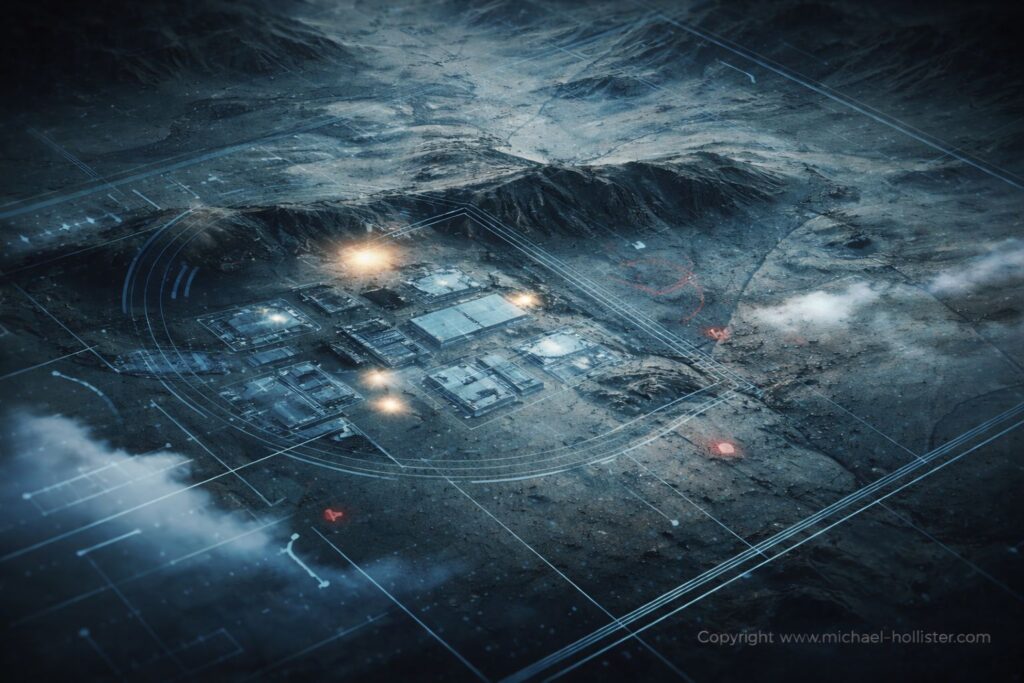
June 2025 marks a watershed in the history of Iran’s nuclear program. What Western media termed “limited preventive strikes” was, from Iran’s perspective, a coordinated attempt to destroy the program. The attacks spanned twelve days and hit three central facilities: the underground enrichment facility at Natanz, the facility buried deep in a mountain at Fordow, and research installations at Isfahan.
The precision of the strikes was remarkable. Satellite imagery showed impact craters directly above the access tunnels to underground halls at Fordow. At Natanz, power supplies and cooling systems were apparently targeted—components without which centrifuges for uranium enrichment cannot function. Isfahan, where Iran researches advanced centrifuge designs, reportedly lost several laboratories and workshops according to anonymous sources.
What exactly was destroyed, however, remains unclear—and therein lies the strategic significance of Iran’s subsequent ambiguity. Immediately after the attacks, Iranian state media proclaimed victory: facilities were “largely intact,” the program “unharmed,” air defenses had “intercepted most missiles.” But within days, Foreign Minister Abbas Araghchi corrected this narrative. In an interview with Iranian media, he admitted that Fordow was “severely damaged” and it remained unclear “when—or if—we can restore full enrichment capacity.”
These contradictory statements are not signs of disorganization but calculated communication strategy. By spreading alternating narratives, Tehran keeps its adversaries guessing: How extensive is the damage really? How quickly can Iran rebuild the program? Does Iran still possess enough enriched uranium to break out to a bomb if necessary? And where exactly is this material stored now?
The IAEA cannot answer these questions because since July 2025 it no longer has access. Israeli and American intelligence services may have satellite imagery and human intelligence sources, but without inspectors on the ground, much remains speculation. This uncertainty is precisely Iran’s goal: What adversaries don’t know, they cannot target for destruction. What they cannot prove, they cannot use as justification for further attacks.
Yet the Twelve-Day War also revealed Iran’s fundamental vulnerability. The fact that Israel and the United States precisely hit the most critical components—without Iran’s air defense effectively stopping them—demonstrates Western technological superiority. More importantly: the strikes revealed how deeply foreign intelligence services have penetrated Iran’s security apparatus. For only with precise information about facility layouts, shift changes, and vulnerabilities could such an operation succeed.
Iran’s Position: Tactic or Transformation?
Iran is not Israel. This becomes clear to anyone analyzing the structural differences. While Israel can count on American protection, Iran stands under Western sanctions. While Israel’s nuclear facilities are so well hidden and protected that even airstrikes would be difficult to execute, Iran’s most important facilities—Natanz, Fordow, Isfahan—have been known for years and have already been bombed. While Israel maintains a deeply rooted culture of secrecy, Israeli Mossad has assassinated Iranian nuclear scientists, stolen secret documents from Tehran, and conducted sabotage acts indicating deep penetration of Iranian security apparatuses.
What Iran has been practicing since July 2025 is therefore not complete opacity in the Israeli sense, but tactical ambiguity. Legally, the Islamic Republic remains a member of the Nuclear Non-Proliferation Treaty (NPT) but has suspended cooperation with the IAEA. This means: no routine reports on uranium stockpiles, no information on storage locations, no inspectors in sensitive facilities.
Immediately after the airstrikes in June 2025, this ambiguity manifested in contradictory narratives from Tehran. State media initially proclaimed that facilities were intact and the program unharmed. Days later, Foreign Minister Abbas Araghchi admitted that facilities at Fordow were “severely damaged” and it was unclear when full operations could be restored. At the same time, he emphasized: “If Iran’s interests require it, we will negotiate.”
These seemingly contradictory messages make strategic sense. Iran is spreading uncertainty: How extensive is the damage really? How quickly can Tehran rebuild its program? Where exactly are the enriched uranium stockpiles now located? These questions are meant to keep Washington and Tel Aviv in the dark—while simultaneously leaving room for diplomacy.
But tactical ambiguity is a dangerous game. Unlike Israel, Iran does not possess the structural prerequisites to maintain long-term opacity. The infrastructure is vulnerable. Political insulation is absent. And the intelligence situation is catastrophic: the precision of Israeli strikes in June 2025—which targeted commanders, scientists, and facilities—revealed how deeply foreign intelligence services have penetrated Iranian structures.
Khamenei’s Fatwa: The Theological-Political Dilemma
At the center of Iran’s nuclear debate stands a religious authority that has been considered an insurmountable barrier against the bomb for decades: the fatwa of Ayatollah Ali Khamenei. Since the early 2000s, Iran’s Supreme Leader has repeatedly declared that the development, production, and use of nuclear weapons is harām—religiously forbidden. This fatwa is not a casual opinion but a binding religious legal ruling with far-reaching political consequences.
The fatwa’s origins lie in the trauma of the Iran-Iraq War (1980-1988), when Iraqi dictator Saddam Hussein deployed chemical weapons against Iranian troops and civilians. Iran possessed the technical means to develop chemical weapons as well but refrained—a decision Khamenei later justified with religious and moral arguments. The logic: The Islamic Republic must not descend to the level of its adversaries. Weapons of mass destruction are un-Islamic because they kill civilians indiscriminately.
This position was extended to nuclear weapons. Khamenei declared that Islam forbids the manufacture of weapons that can annihilate entire cities. The fatwa became the centerpiece of Iran’s international defense: Tehran argued it could not, by definition, pursue nuclear weapons because the religious leader had forbidden it. Western diplomats remained skeptical, but the fatwa at least provided a narrative foundation for negotiations like the JCPOA.
But since October 2023, this doctrine has come under massive pressure. The weakening of the Axis of Resistance, the assassination of high-ranking Iranian allies, and direct attacks on Iranian territory have triggered a debate that would have been unthinkable two years ago: Should Khamenei revise the fatwa?
In October 2024, Iranian activists and parliamentarians published open letters calling on the Supreme Leader to reconsider his position. Their argument: The existential threat from Israel and the United States has fundamentally changed since the fatwa was issued. At that time, Iran was still surrounded by allies. Today it stands isolated against a nuclear-armed regional power and a hostile superpower. The fatwa, hardliners argue, was created under different circumstances and must be adapted to new realities.
Khamenei has not yet responded—at least not publicly. But the fact that this debate is being conducted at all is remarkable. In an authoritarian theocratic system like Iran’s, religious rulings by the Supreme Leader are normally not questioned. That high-ranking politicians and media are now doing so suggests that leadership is at least tolerating the discussion—possibly to prepare public opinion for a potential course change.
Should Khamenei revise the fatwa, it would be an earthquake. It would not only destroy Iran’s international position but also raise domestic legitimacy questions: If the Supreme Leader can be wrong on such a fundamental issue, how infallible is he? At the same time: if the fatwa remains but Iran moves to the bomb anyway, Khamenei’s religious authority is damaged. It’s a dilemma with no easy way out.
The Domestic Debate: Fatwa versus Pragmatism
Within Iran rages a debate showing that the suspension of IAEA cooperation is not consensus but compromise. On one side stand the hardliners, especially in the ranks of the Revolutionary Guards (IRGC). The IRGC-affiliated newspaper Javan wrote after the legislation’s passage that a “period of silence and ambiguity” was beginning—with explicit reference to Israel’s strategy. Parliamentary deputies like Ahmad Bakhshayesh Ardestani declared proudly: “The Americans and the IAEA no longer know where our enriched uranium is stored; they are in a state of uncertainty.”
Some hardliners go further and openly demand construction of nuclear weapons. Their argument: The previous policy—no weapons but extensive enrichment—has not prevented either Israel or the United States from attacking Iran. Only nuclear armament can provide genuine deterrence.
Simultaneously, there are pragmatic voices warning of the consequences of open armament. Experts argue Iran lacks the political and structural prerequisites to replicate Israel’s opacity model. Israel enjoys international special treatment—no IAEA inspections, no sanctions, unconditional American support. Iran, by contrast, would have to reckon with massive international isolation, tightened sanctions, and possibly military intervention at every step toward the bomb.
Added to this is technical reality: Iran has made significant progress in uranium enrichment (up to 60 percent), but it lacks the necessary redundancy and hardening of infrastructure. The facilities are known, mapped, and—as the June 2025 strikes showed—vulnerable. An attempt to break out to the bomb would likely be immediately detected by Israeli or American intelligence services—and could trigger a preemptive annihilation strike before the weapon is completed.
The Drivers of Escalation: From Gaza to Global Nuclear Renaissance
What brought Iran to this point? The answer lies in a cascade of events since October 2023 that have fundamentally shaken Tehran’s strategic calculus.
The Gaza War was the catalyst. When Israel launched its military offensive after the Hamas attacks of October 7, 2023, Iran’s entire regional network came under pressure. Hamas, which had been financed and armed by Tehran for decades, was militarily decimated. Hezbollah, Iran’s most important regional ally in Lebanon, intervened in the conflict—and paid a high price. In September 2024, Israel assassinated Hezbollah Secretary-General Hassan Nasrallah in Beirut. A few weeks earlier, Ismail Haniyeh, Hamas’s political leader, had been killed in an attack in Tehran itself.
For Iran, these losses were not just tactical setbacks but an admission of strategic failure. Since the 1980s, Tehran had systematically built a network of regional allies—the so-called “Axis of Resistance”—to defend itself against Israel and the United States. The doctrine was: By building asymmetric capabilities beyond its borders, Iran creates “strategic depth.” An attack on Iran would trigger retaliation by Hezbollah in Lebanon, Shiite militias in Iraq, or Houthi rebels in Yemen. This threat was supposed to deter Israel and the United States.
The reality of the past 15 months has refuted this doctrine. Israel attacked despite the threats—and not only against Iran’s regional allies but directly against Iranian territory. In April 2024, Iran conducted its first direct retaliatory strike against Israel after Israeli jets bombed the Iranian consulate in Damascus. The message from Tehran was clear: “There is a new equation. Every attack on Iranian interests will be directly answered.”
Yet even this red line proved porous. Haniyeh’s assassination in Tehran, the destruction of Hezbollah’s leadership, and finally the airstrikes on Iranian nuclear facilities showed: Iran’s conventional deterrence doesn’t work. The narrative within Iran shifted: If neither regional proxies nor ballistic missiles deter Israel from attacking Iran—then what? For many hardliners, the answer is: only nuclear weapons.
Parallel to this, Iran’s threat perception intensified through Israel’s own nuclear policy. Israel possesses an estimated 80 to 100 nuclear warheads and is not a member of the NPT. In November 2023, a far-right Israeli minister publicly suggested using nuclear weapons in Gaza—a statement that triggered international outrage but was interpreted in Tehran as proof that Israel knows no red lines. The pager attacks in September 2024, in which dozens of Hezbollah members were killed through remotely detonated communication devices, reinforced this impression: Israel shrinks from no technology.
But it’s not only regional but also global dynamics shaping Iran’s nuclear calculus. The Ukraine War has brought nuclear rhetoric back to the geopolitical stage. Russia suspended the New START treaty, which limits US and Russian strategic nuclear arsenals, and openly discusses changes to its nuclear doctrine—including lower thresholds for use. China is massively expanding its arsenal. The AUKUS agreement between the United States, Britain, and Australia provides for delivery of nuclear-powered submarines—a signal that the West is willing to deploy nuclear technology to contain China.
In Tehran, these developments are closely monitored. Influential think tanks like the Strategic Council on Foreign Relations (SCFR) argue the world is entering a new era of nuclear competition. If even the great powers are relying on nuclear deterrence again, why should Iran—surrounded by enemies and without conventional military parity—renounce it?
Economic Desperation: Sanctions as Radicalization Driver
Behind the nuclear debate stands an economic reality often overlooked: Iran is suffering. The sanctions imposed after the US withdrawal from the JCPOA in 2018 have plunged Iran’s economy into perpetual crisis. Inflation has been above 40 percent for years. The rial, Iran’s currency, has lost value dramatically against the dollar—from about 42,000 rials per dollar in 2018 to at times over 600,000 rials in the worst phases.
For ordinary Iranians, this means: the middle class is impoverishing. Food prices are exploding. Medicines are scarce. Academics and professionals are leaving the country because prospects are absent—a brain drain Iran actually cannot afford. Youth unemployment is estimated at 25 percent. Protests against economic misery are regularly suppressed.
Iran’s oil exports, the main source of foreign currency, are massively restricted by sanctions. Tehran has found ways to sell oil to China through intermediaries—often via tankers that turn off their transponders and fly false flags—but at sharply reduced prices. According to International Monetary Fund (IMF) estimates, Iran’s economy grew only minimally in 2024, after years of contraction.
This economic desperation is an underestimated driver of nuclear radicalization. Parliamentary deputies like Ahmad Bakhshayesh Ardestani have put the frustration into clear words: “Neither is the JCPOA revived, nor do we possess a nuclear bomb—but we bear the sanctions as if we had one. Is this situation rational?”
The logic is cynical but understandable from Iran’s perspective: If Iran is already being punished for a nuclear program without enjoying the strategic advantages of a bomb, why not take the final step? If diplomacy brings no economic relief and restraint is not honored, the cost-benefit calculation shifts. Even moderate politicians who would actually prefer a negotiated solution find themselves forced to support the hardline position because the alternative—more years of economic strangulation without strategic gain—is politically untenable.
This dynamic is exacerbated by Trump’s return to the White House. His first term brought the “Maximum Pressure” campaign, which deliberately aimed to destroy Iran’s economy to force either regime change or total capitulation. Neither occurred. Instead, the policy drove Iran into the arms of Russia and China, strengthened hardliners, and eroded the influence of those forces that had bet on compromise with the West.
The irony: The West wanted to contain Iran’s nuclear program through sanctions. In reality, it may have achieved the opposite—an economically desperate leadership that believes only the bomb can secure its survival.
Russia and China: The Limits of the “Look East” Strategy
A central element of Iran’s strategy since 2018 is the so-called “Look East” policy: the turn toward Russia and China as an alternative to the West. Tehran has intensively cultivated this axis—through energy agreements with China, military cooperation with Russia (including delivery of Shahed drones for the Ukraine War), and membership in organizations like the Shanghai Cooperation Organisation (SCO) and BRICS.
But how far does this support really extend? The answer is sobering: Moscow and Beijing may regard Tehran as a useful partner, but not as an ally for whom they would risk their own interests.
Russia benefits from Iran on multiple levels. Shahed drones have proven a cost-effective, effective weapon in the Ukraine War. Iran also offers Russia leverage in the Middle East to disrupt American interests. But when it comes to Iran’s nuclear ambitions, Moscow holds back. Russia has no interest in a nuclear-armed regional power that could destabilize the Middle East balance. Moreover, Russia itself depends on adherence to nonproliferation norms—not least to legitimize its own position as a recognized nuclear power.
China is even more cautious. Beijing is Iran’s largest oil customer and profits from low prices. China also has strategic interest in weakening American influence in the Middle East. But Beijing has repeatedly made clear it would not support Iran’s withdrawal from the NPT or open armament. A nuclear Iran would not only trigger a regional arms spiral (Saudi Arabia, Turkey, Egypt could follow) but also undermine global nonproliferation—a precedent China does not want to set.
The reality showed itself in July 2025 when Western media reported on Chinese and Russian reactions to Iran’s IAEA suspension. Both countries verbally criticized American-Israeli airstrikes but avoided any support for Tehran’s new course. Diplomatic sources quoted a Russian representative saying: “Iran remains an important partner, but we cannot support a policy that leads to regional proliferation.”
This means: Iran is strategically isolated despite “Look East.” Moscow and Beijing will not intervene if Israel or the United States strike again. They will not supply Iran with air defense systems that can intercept American stealth bombers. They will provide no diplomatic cover if Iran withdraws from the NPT. The Tehran-Moscow-Beijing axis is an alliance of convenience, not an alliance.
For Iran, this is a bitter realization. The Look-East strategy may be an economic lifeline and have political symbolic value, but it offers no strategic security. Should Iran move to the bomb, it stands alone.
Three Scenarios: Threshold State, Breakout, or Diplomacy
Where does this path lead? Three scenarios are emerging, each with its own risks and probabilities.
Scenario 1: The Threshold State
The most likely development is that Iran seeks the status of a “threshold state”—a country technically capable of building a nuclear weapon within weeks but formally remaining below this threshold. Iran would continue advancing uranium enrichment, perfect delivery systems (ballistic missiles), and build command and control structures—all components necessary for a bomb. Simultaneously, Tehran would remain a member of the NPT and not risk an open break.
This strategy offers several advantages: It maximizes Iran’s negotiating leverage without bearing the political costs of open proliferation. It enables “latent nuclear deterrence”—the threat to break out to the bomb if security is threatened. And it leaves room for diplomacy: Should a deal be possible, Iran could make concessions without having already created facts.
The risk: The closer Iran comes to the threshold, the more likely a preemptive attack by Israel or the United States. June 2025 showed this option is always on the table.
Scenario 2: The Breakout to the Bomb – The North Korea Lesson
A second, more dangerous scenario is an open breakout to armament. Instead of waiting for an attack, Iran could decide to preemptively move to the bomb—on the principle: “The attack is coming anyway, so we’d better create accomplished facts.”
To understand why this scenario is gaining attractiveness in Tehran, it’s worth examining North Korea. Pyongyang’s path to the bomb began in the 1990s with ambiguity and diplomatic maneuvers. North Korea joined the NPT in 1985 but simultaneously began a secret weapons program. When the United States grew suspicious, Pyongyang negotiated—and bought time. The Agreed Framework of 1994 promised North Korea energy assistance in exchange for freezing its program. But the agreement collapsed when George W. Bush counted North Korea among the “Axis of Evil” in 2002 and Pyongyang felt encircled.
In 2003, North Korea withdrew from the NPT. In 2006 came the first nuclear test. The international reaction—sanctions, diplomatic isolation—did not deter Pyongyang. North Korea had made a strategic decision: better a nuclear power under sanctions than a conventional state under existential threat. Today North Korea possesses an estimated 40 to 50 warheads and is de facto untouchable—no power would risk war against a nuclear-armed adversary.
The parallels to Iran are obvious—and disturbing. Like North Korea, Iran stands under massive external pressure. Like North Korea, it has tried negotiations and seen them fail (JCPOA). Like North Korea, it feels existentially threatened. The lesson Tehran’s hardliners draw from Pyongyang’s example is clear: Only the finished bomb protects. Diplomacy without nuclear backing is weakness.
Mohsen Rezaei, former commander of the Revolutionary Guards, has publicly articulated this logic. He argued in September 2024: “After Lebanon, Israel will attack Syria, then Iraq, and finally Iran. We must act now.” For this faction, the question is not whether but when Israel will strike—and the longer Iran waits, the more vulnerable it becomes.
This scenario, however, carries immense risks. An open breakout would be immediately detected—the IAEA, Israeli and American intelligence services would sound the alarm. The probability of a massive preemptive strike, possibly supported by the United States, would be extremely high. Iran would have to bet it can complete the bomb faster than its adversaries can strike—a wager with uncertain outcome.
But if Iran concludes that an attack is inevitable anyway, the North Korea option could appear rational: better to build a bomb under fire than perish without protection.
Scenario 3: Negotiating Leverage – Diplomacy
The third scenario is that Iran uses its current ambiguity as negotiating leverage for a comprehensive diplomatic deal. President Pezeshkian has repeatedly signaled Tehran’s willingness to talk. Foreign Minister Araghchi emphasized in September 2024: “There is no other way to ensure the peaceful nature of Iran’s nuclear program except through negotiations.”
Such a deal would have to go beyond the failed JCPOA. Iran would likely demand: sanctions relief, security guarantees (also regional, not just nuclear), and formal recognition of its right to uranium enrichment under Article IV of the NPT. In return, Tehran could resume IAEA cooperation, ratify the Additional Protocol, and accept caps on enrichment.
The problem: Such a deal requires flexibility on both sides—and that is hardly to be expected under Donald Trump’s second term. Trump, who tore up the JCPOA in 2018 and launched a “Maximum Pressure” campaign, is back in the White House. His unconditional support for Israel’s Netanyahu government makes concessions unlikely. Europe could act as mediator, but its capacity for action is limited—as activation of the snapback mechanism in August 2025 showed, a desperate measure without clear follow-up perspective.
The probability of this scenario is currently low—but not impossible if circumstances change.
Trump 2.0: The X-Factor
Donald Trump’s re-election in November 2024 is the decisive external factor in Iran’s nuclear calculus. Trump’s first term was characterized by maximum confrontation: withdrawal from the JCPOA, reimposition and tightening of sanctions, assassination of IRGC General Qassem Soleimani in January 2020. His second term promises continuity—if not escalation.
Trump maintains a close relationship with Israel’s Prime Minister Benjamin Netanyahu and has repeatedly declared he will support Israel “unconditionally.” Simultaneously, Trump promotes the narrative that he “destroyed Iran’s nuclear program”—a claim factually untenable but politically important: Trump must defend this image, making him susceptible to pressure to again act militarily against Iran.
Within the Trump administration, however, there are tensions. On one side stand hawkish advisers demanding a hard line against Iran and possibly pushing for further military strikes. On the other stand MAGA isolationists who want no new wars in the Middle East. This internal dynamic is difficult to predict—but history shows Trump tends toward impulsive decisions when under domestic political pressure.
For Iran, Trump 2.0 means above all one thing: The probability of further military attacks rises. Should Israel again bomb Iranian nuclear facilities—this time with American support or approval—this could be the final catalyst forcing Tehran to decide: bomb or capitulation.
Michael Hollister is a geopolitical analyst and investigative journalist. He served six years in the German military, including peacekeeping deployments in the Balkans (SFOR, KFOR), followed by 14 years in IT security management. His analysis draws on primary sources to examine European militarization, Western intervention policy, and shifting power dynamics across Asia. A particular focus of his work lies in Southeast Asia, where he investigates strategic dependencies, spheres of influence, and security architectures. Hollister combines operational insider perspective with uncompromising systemic critique—beyond opinion journalism. His work appears on his bilingual website (German/English) www.michael-hollister.com, at Substack at https://michaelhollister.substack.com and in investigative outlets across the German-speaking world and the Anglosphere.
This analysis is made available for free – but high-quality research takes time, money, energy, and focus. If you’d like to support this work, you can do so here:

Alternatively, support my work with a Substack subscription – from as little as 5 USD/month.
Let’s build a counter-public together.
SOURCES
Nuclear Opacity & Proliferation
Krzysztof Tyszka-Drozdowski, “The Coming Age of Nuclear Opacity,” American Affairs Journal, 2022, https://americanaffairsjournal.org/2022/08/the-coming-age-of-nuclear-opacity/.
Arms Control Association, “Nuclear Weapons: Who Has What at a Glance,” 2025, https://www.armscontrol.org/factsheets/nuclear-weapons-who-has-what-glance.
Shane Smith, “North Korea’s Evolving Nuclear Strategy,” US-Korea Institute at SAIS, 2015, https://wmdcenter.ndu.edu/Portals/97/Documents/Publications/Articles/Evolving-Nuclear-Strategy.pdf.
Pierre Goldschmidt, “Nuclear Nonproliferation: Six Lessons Not Yet Learned,” Arms Control Today, Carnegie Endowment, 2018, https://carnegieendowment.org/posts/2018/03/nuclear-nonproliferation-six-lessons-not-yet-learned.
Målfrid Braut-Hegghammer, “Giving Up on the Bomb: Revisiting Libya’s Decision to Dismantle Its Nuclear Program,” Wilson Center, 2017, https://www.wilsoncenter.org/blog-post/giving-the-bomb-revisiting-libyas-decision-to-dismantle-its-nuclear-program.
Iran: Twelve-Day War & IAEA Suspension (2025)
Reuters, “Iran’s Parliament Approves Bill on Suspending Cooperation with IAEA,” June 25, 2025, https://www.reuters.com/world/middle-east/iran-parliament-approves-bill-suspend-cooperation-with-un-nuclear-watchdog-2025-06-25/.
Nicole Grajewski, “Iran After the Battle,” Carnegie Endowment Diwan, July 1, 2025, https://carnegieendowment.org/middle-east/diwan/2025/07/iran-after-the-battle.
Patrick Wintour, “Iran’s Parliament Approves Bill to Suspend Cooperation with IAEA,” The Guardian, June 25, 2025, https://www.theguardian.com/world/2025/jun/25/irans-parliament-approves-bill-to-suspend-cooperation-with-iaea.
Ellie Geranmayeh, “Snap Out of It: Europe, Iran and Nuclear Negotiations,” European Council on Foreign Relations, July 21, 2025, https://ecfr.eu/article/snap-out-of-it-europe-iran-and-nuclear-negotiations/.
IRNA, “Iran Warns It May Withdraw from N.P.T. if U.N. Sanctions Are Reinstated,” June 12, 2025, https://en.irna.ir/news/85859600/Iran-warns-it-may-withdraw-from-N-P-T-if-U-N-sanctions-are.
Iran’s Nuclear Discourse & Hardliner Positions
Francois Murphy, “Iran’s Uranium Enrichment Rolls On, Key Issues Stalled, IAEA Reports Show,” Reuters, August 29, 2024, https://www.reuters.com/world/middle-east/irans-uranium-enrichment-rolls-key-issues-stalled-iaea-reports-show-2024-08-29/.
Iran Press, “Iran’s Araghchi: JCPOA Cannot Be Revived; New Negotiations Must Be Formed,” August 24, 2024, https://iranpress.com/iran-s-araghchi–jcpoa-cannot-be-revived–new-negotiations-must-be-formed.
Reuters, “Iran’s Spy Chief Says Tehran Could Seek Nuclear Arms if ‘Cornered’ by West,” February 9, 2021, https://www.reuters.com/article/world/irans-spy-chief-says-tehran-could-seek-nuclear-arms-if-cornered-by-west-idUSKBN2A91TB/.
Iran International, “The Former Head of the Atomic Energy Organization Refers to Iran’s Ability to Build an Atomic Bomb” [Persian], February 12, 2024, https://www.iranintl.com/202402122407.
Nour News, “Kharrazi: If Iran’s Existence Is Threatened, We Will Change Our Nuclear Doctrine” [Persian], May 9, 2024, https://nournews.ir/fa/news/172662.
Asr Iran, “Nuclear Protection Corps: In Case of Enemy Threat, We May Revise the Nuclear Doctrine” [Persian], April 18, 2024, https://www.asriran.com/fa/news/959732.
Entekhab, “A Member of the Parliament Called for Building Nuclear Weapons in Response to the Assassination of Ismail Haniyeh” [Persian], August 11, 2024, https://www.entekhab.ir/fa/news/808149.
Khabar Online, “Request to the Leader to Change the Fatwa on the Prohibition of Building an Atomic Bomb” [Persian], October 15, 2024, https://www.khabaronline.ir/news/1971355.
Javan Online, “The Beginning of a Period of Silence and Ambiguity” [Persian], July 3, 2025, https://www.javanonline.ir/fa/news/1305494/.
Didban Iran, “The US and the IAEA Are Confused about the Location of Iran’s Enriched Uranium” [Persian], June 30, 2025, https://www.didbaniran.ir/fa/tiny/news-228126.
Gaza War, Israel & Regional Dynamics
Erwin van Veen and Hamidreza Azizi, “Playing with Fire: Patterns of Iranian-Israeli Military Confrontation,” War on the Rocks, June 25, 2024, https://warontherocks.com/2024/06/playing-with-fire-patterns-of-iranian-israeli-military-confrontation/.
Hamidreza Azizi, “How Will Iran React to Israel’s Latest Strikes?,” ME Council Afkar (blog), October 27, 2024, https://mecouncil.org/blog_posts/how-will-iran-react-to-israels-latest-strikes/.
Michael Bachner, “Far-Right Minister Says Nuking Gaza an Option, PM Suspends Him from Cabinet Meetings,” The Times of Israel, November 5, 2023, https://www.timesofisrael.com/far-right-minister-says-nuking-gaza-an-option-pm-suspends-him-from-cabinet-meetings/.
Al Jazeera, “How Extensive Are Israel’s Intelligence Operations inside Iran?,” June 23, 2025, https://www.aljazeera.com/news/2025/6/23/how-extensive-are-israels-intelligence-operations-inside-iran.
Hamidreza Azizi and Erwin van Veen, “Iran and Gaza in Regional Perspective: Winning the Battle, but Losing the War?,” Clingendael Institute, March 5, 2024, https://www.clingendael.org/publication/iran-and-gaza-regional-perspective-winning-battle-losing-war.
Hamidreza Azizi, “The Concept of ‘Forward Defence’: How Has the Syrian Crisis Shaped the Evolution of Iran’s Military Strategy?,” Geneva Centre for Security Policy (GCSP), February 2021, https://www.gcsp.ch/publications/concept-forward-defence-how-has-syrian-crisis-shaped-evolution-irans-military-strategy.
International Dynamics & Trump
Edward Wong, “China and Russia Keep Their Distance from Iran During Crisis,” The New York Times, July 6, 2025, https://www.nytimes.com/2025/07/06/us/politics/axis-china-russia-iran-north-korea.html.
Amichai Stein, “Netanyahu Seeks US Mechanism for Approval on Future Iran Strikes if Nuclear Threat Resurfaces,” The Jerusalem Post, July 6, 2025, https://www.jpost.com/israel-news/article-860175.
Andrew Roth, “Republican Hawks vs Maga Isolationists: The Internal War That Could Decide Trump’s Iran Response,” The Guardian, June 17, 2025, https://www.theguardian.com/us-news/2025/jun/17/republican-hawks-vs-maga-isolationists-the-internal-war-that-could-decide-trumps-iran-response.
Avner Cohen, “Israel and Iran’s Nuclear Strategies: Unexpected Parallels,” Haaretz, July 20, 2025, https://www.haaretz.com/opinion/2025-07-20/ty-article-opinion/.premium/the-unexpected-parallels-in-israel-and-irans-nuclear-strategies/00000198-17ee-d89e-a7bf-77efb47a0000.
Global Nuclear Developments
Seyyed Reza Mirtaher, “The Escalation of Nuclear Tensions between Russia and the United States after the Ukraine War” [Persian], Strategic Council on Foreign Relations (SCFR), February 5, 2024, https://www.scfr.ir/fa/10/253836/.
Mizan News Agency, “What Is the Purpose of the West in Strengthening Nuclear Submarines?” [AUKUS] [Persian], October 12, 2023, https://www.mizanonline.ir/fa/news/4737239.
Al-Alam, “SIPRI: The Increasing Role of Nuclear Weapons in Geopolitical Tensions” [Persian], June 28, 2024, https://fa.alalam.ir/news/6885728.
Economic & Sanctions Policy Dimension
Abdolrahman Fathollahi, “Nuclear Weapon as a Tool to Establish a Balance of Terror Against Israel” [Persian], Iranian Diplomacy, August 13, 2024, http://www.irdiplomacy.ir/fa/news/2027477.
Additional Background Sources (Optional for Further Reading)
Seyyed Mehdi Talebi and Fatemeh Barimani, “Iran’s Complex Nuclear Game” [Persian], Farhikhtegan Daily, May 11, 2024, http://fdn.ir/190684.
Aref Dehghandar, “Latent Nuclear Deterrence Strategy” [Persian], Etemad Daily, August 23, 2024, https://www.etemadnewspaper.ir/fa/Main/Detail/220951.
Asr Iran, “Mohsen Rezaei: Israel Might Attack Iran; Regional States Should Decide as Soon as Possible” [Persian], September 28, 2024, https://www.asriran.com/fa/news/1000728.
Entekhab, “Araghchi: In Addition to Lebanon, the Issue of Ukraine and Nuclear Negotiations Have Been Brought Up in Discussions with European Countries” [Persian], September 6, 2024, https://www.entekhab.ir/fa/news/820757.
© Michael Hollister — All rights reserved. Redistribution, publication or reuse of this text requires express written permission from the author. For licensing inquiries, please contact the author via www.michael-hollister.com.
Newsletter
🇩🇪 Deutsch: Verstehen Sie geopolitische Zusammenhänge durch Primärquellen, historische Parallelen und dokumentierte Machtstrukturen. Monatlich, zweisprachig (DE/EN).
🇬🇧 English: Understand geopolitical contexts through primary sources, historical patterns, and documented power structures. Monthly, bilingual (DE/EN).