
How Critical Mineral Dependencies Undermine U.S. Deterrence in the Indo-Pacific
by Michael Hollister
Exclusive published at Michael Hollister on February 01, 2026
2.627 words * 14 minutes readingtime
This analysis is made available for free – but high-quality research takes time, money, energy, and focus. If you’d like to support this work, you can do so here:

Alternatively, support my work with a Substack subscription –from as little as 5 USD/month.
Let’s build a counter-public together.
Exclusive Analysis for Subscribers
Washington’s Strategic Achilles’ Heel Lies Not on the Battlefield, But in Supply Chains
The Trump Administration’s November 2025 National Security Strategy is explicit: the Indo-Pacific is the top geopolitical priority, China the primary competitor. “Deterring a conflict over Taiwan, ideally by preserving military overmatch, is a priority” (p. 23). Europe is downgraded, Russia a footnote. The strategic pivot is complete.
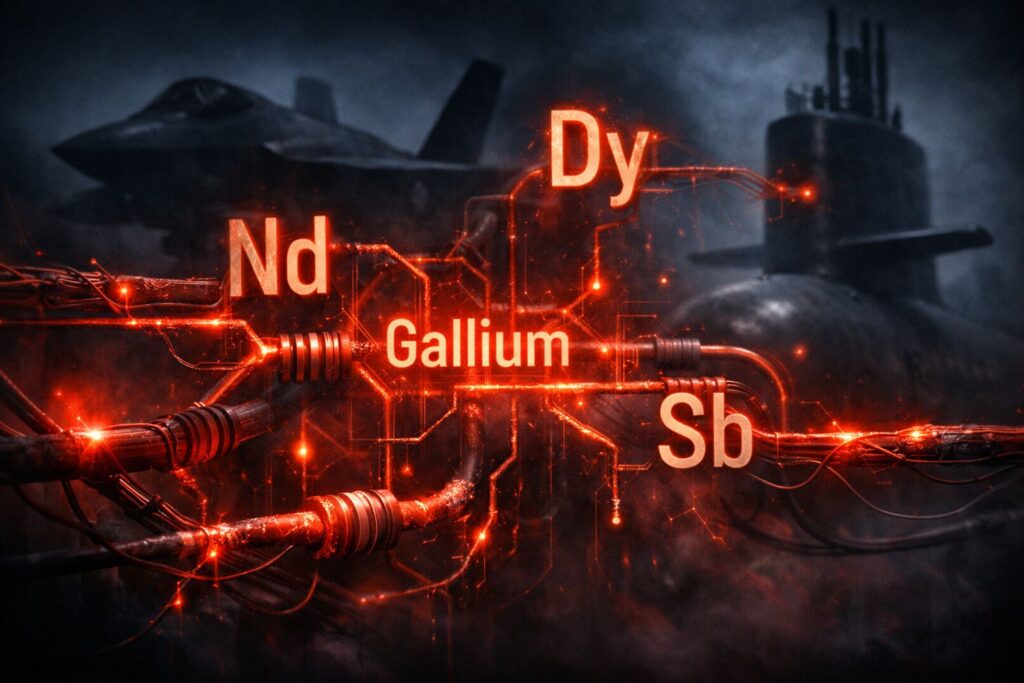
Yet this strategy overlooks a fundamental paradox: the United States is massively dependent on Chinese exports for critical defense components—from high-performance magnets in F-35 fighter jets to antimony in nuclear warhead triggers. In a conflict with China, these dependencies would become the greatest strategic vulnerability, undermining Washington’s deterrence posture before the first shot is fired.
Three converging factors intensify this urgency: First, the window for military superiority projected by think tanks in 2016 is closing—we are in year nine of an eight-to-ten-year timeline. Second, China has weaponized export controls on critical minerals—seven bans since July 2023 already impact U.S. defense. Third, Pentagon programs show material independence is realistic only by 2030-2035 at earliest.
The United States faces a strategic catch-22: it must act soon before China becomes peer-competitive, yet cannot sustain protracted conflict without the material foundations to do so.
The most critical vulnerability of U.S. military power lies not on the battlefield, but in its supply chains.
This article examines how deep dependence on Chinese-controlled critical materials systematically undermines Washington’s deterrence posture in the Indo-Pacific. Drawing on Pentagon data, RAND assessments, and industrial analyses, it reveals a strategic catch-22 in which military action appears urgent—but materially unsustainable.
This exclusive Deep-Dive-Analysis you will be able to find here.
This analysis is made available for free – but high-quality research takes time, money, energy, and focus. If you’d like to support this work, you can do so here:
Alternatively, support my work with a Substack subscription –from as little as 5 USD/month.
Let’s build a counter-public together.
Michael Hollister is a geopolitical analyst and investigative journalist. He served six years in the German military, including peacekeeping deployments in the Balkans (SFOR, KFOR), followed by 14 years in IT security management. His analysis draws on primary sources to examine European militarization, Western intervention policy, and shifting power dynamics across Asia. A particular focus of his work lies in Southeast Asia, where he investigates strategic dependencies, spheres of influence, and security architectures. Hollister combines operational insider perspective with uncompromising systemic critique—beyond opinion journalism. His work appears on his bilingual website (German/English) www.michael-hollister.com, at Substack at https://michaelhollister.substack.com and in investigative outlets across the German-speaking world and the Anglosphere.
© Michael Hollister — All rights reserved. Redistribution, publication or reuse of this text requires express written permission from the author. For licensing inquiries, please contact the author via www.michael-hollister.com.
Newsletter
🇩🇪 Deutsch: Verstehen Sie geopolitische Zusammenhänge durch Primärquellen, historische Parallelen und dokumentierte Machtstrukturen. Monatlich, zweisprachig (DE/EN).
🇬🇧 English: Understand geopolitical contexts through primary sources, historical patterns, and documented power structures. Monthly, bilingual (DE/EN).