
How Trump Is Smashing the World Order to Save America
by Michael Hollister
Published at GlobalBridge on January 29, 2026
4.220 words * 22 minutes readingtime
This analysis is made available for free – but high-quality research takes time, money, energy, and focus. If you’d like to support this work, you can do so here:

Alternatively, support my work with a Substack subscription –from as little as 5 USD/month.
Let’s build a counter-public together.
Act 1: Breaking the Taboo
On January 3, 2026, at 4:37 AM local time, U.S. fighter jets bombed the Miraflores Presidential Palace in Caracas. 80 people died. Special forces stormed the palace, kidnapped Venezuelan President Nicolás Maduro along with his wife, and flew them to New York. Two days later, Maduro stood before a U.S. federal court—charged with drug trafficking. Caracas burns. The dead are buried in mass graves. And Donald Trump announces on Truth Social: “The United States will govern Venezuela until a new democratic government is installed. We will extract and sell their oil.”
No cause for war. No UN resolution. No self-defense. Just:
We want your oil, so we’re taking it.
International law scholar Markus Krajewski from the University of Augsburg calls it what it is: “The clearest violations of the UN Charter I’ve seen in my career.” Prohibition of force violated. Non-intervention violated. Kidnapping of a head of state—a war crime.
The UN? Condemned the action. Russia and China? Condemned the action. Consequences? Zero.
Because no one can stop the United States. No one wants to. No one dares.
On January 7, U.S. Navy SEALs boarded the Russian oil tanker Marinera in the North Atlantic, 190 nautical miles south of Iceland. Special helicopters from the “Night Stalkers,” storm, fog, ice-cold seas. No warning. The ship sailed under Russian flag—Russia had registered it just days earlier to protect it. The U.S. didn’t care. They seized the ship, escorted it to U.S. waters. Justification: “Violations of U.S. sanctions.” That the ship was in international waters? Irrelevant. That it flew a sovereign flag? Irrelevant. Maritime law, international law, flag rights—all irrelevant.
Same day, same operation: U.S. Coast Guard stopped the tanker Sophia in the Caribbean. Another 12 tankers disappeared from radar screens, tracking shut off, panicked flight from the U.S. blockade. Secretary of Defense Pete Hegseth—now called “Secretary of War”—tweeted: “Only legitimate energy trade—as determined by the United States—will be permitted.”
Read that again. “As determined by the United States.” Not the UN. Not maritime law. Not international treaties. The United States decides who can sell oil. Period.
Russia protested. China protested. France and Britain? Prepared their own tanker raids. The new normal: International law only applies when Washington allows it.
On January 9, Trump told the New York Times: “My own morality, my own mind is the only thing that can stop me. I don’t need international law.” Then he corrected himself with a grin: “I do”—but left open what that actually means.
That same day, Trump ordered Chairman of the Joint Chiefs of Staff Dan Caine to draft invasion plans for Greenland, according to multiple media reports including the BBC. Greenland—a NATO territory. Denmark—a NATO ally since 1949. Danish Prime Minister Mette Frederiksen warned: “If our strongest ally considers attacking us, then every alliance is null and void.”
Trump responded the way Trump responds: “It may be a choice”—either NATO or Greenland. He could imagine the U.S. having to choose.
On January 22, at the World Economic Forum in Davos, Trump signed the founding charter of his Board of Peace. A “peace council” under his personal, lifelong leadership. In Davos, representatives from 19 countries signed the charter—including Viktor Orbán, Javier Milei, representatives from Bahrain, Morocco, Pakistan. A total of about 35 states have confirmed their participation; 60 were invited. Germany, France, Britain, Canada were absent. They had declined the invitation.
The 11-page charter mentions Gaza—the supposed goal of the “peace council”—not once. Instead: A global conflict resolution body intended to create “stability and peace in affected regions.” Trump remains Chairman for life or until he resigns. Removable only by unanimous decision of the Executive Board. Those who pay $1 billion become permanent members. The others get to play along for three years.
Mary Robinson, former UN High Commissioner for Human Rights, called it “a delusion of power.” French President Emmanuel Macron declared the charter “questions the principles of the United Nations.” Trump responded in Davos: The UN can stay. The Board of Peace will “work with it.” Or replace it. “Might.”
This isn’t a strategy shift. This isn’t a slip-up. This isn’t 4D chess.
This is a man standing at the buffet who needs to fart—and farts. Because he can. Because he doesn’t care what others think. Because he’s learned his entire life: Rules don’t apply to me. And because no one has ever held him accountable.
Venezuela was the test balloon. The taboo is broken. The world watched. And did nothing.
Now comes the rest.
Act 2: Four Fronts, One Stranglehold
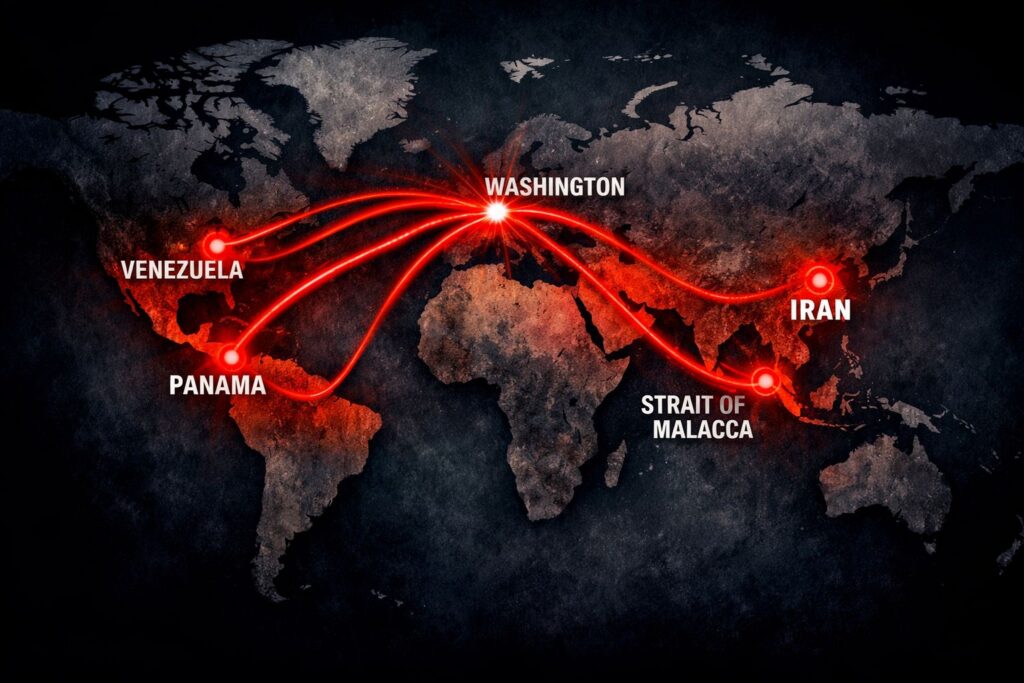
What looks like chaos follows a logic. A brutal, ice-cold, realpolitik logic. Trump isn’t waging war against Venezuela, Greenland, or Russian tankers. Trump is waging war against de-dollarization. And he knows: He doesn’t have much time left.
In 2016, the RAND Corporation published the study “War with China: Thinking Through the Unthinkable.” The central warning: The United States has 8 to 10 years to contain China’s rise. After that, China will be so dominant militarily, economically, and technologically that containment becomes impossible. 2016 plus 10 years? 2026. Now. This year.
The Brookings Institution formulated it even more clearly in 2015: China is positioning itself strategically so that Washington is “perceived by some Chinese observers as a containment-oriented strategy.” Translation: Either the U.S. acts now, or it loses its hegemonic position—forever.
Trump knows this. His National Security Strategy (November 2025) and National Defense Strategy (January 2026) aren’t diplomatic declarations of intent. They’re battle plans. And the battle plan has four fronts.
Front 1: Venezuela—Completed
Venezuela was never the target. Venezuela was the insurance policy.
On January 3, the U.S. didn’t just kidnap Maduro. They grabbed 303 billion barrels of proven oil reserves—the world’s largest. Larger than Saudi Arabia. Larger than Canada. And they’re located 2,200 kilometers off the U.S. coast, not 11,000 kilometers away like the Gulf states.
Trump announced on January 8 that the U.S. would lift its own sanctions against Venezuela to enable oil sales on the world market. Energy Secretary Chris Wright clarified: “The United States is taking over Venezuelan oil sales indefinitely.” Translation: We stole your oil, and now we’re selling it ourselves.
But Venezuela wasn’t just oil. Venezuela was also an expropriation of China. Beijing had invested over $70 billion in Venezuelan infrastructure, oil fields, and loans. With Maduro’s fall? All gone. China protested sharply—but did nothing. No sanctions. No fleet. No military response.
That was the real test. And China failed it.
Third: Venezuela lies 30 flight minutes from Florida. With Maduro in power and Chinese billions in the country, Venezuela could have become a military threat within two years—missiles, bases, surveillance. Trump eliminated the risk before it emerged.
And fourth, the decisive point: Hormuz insurance. When—not if, but when—the U.S. attacks Iran, Tehran will close the Strait of Hormuz. Guaranteed. 21% of the world’s oil flows through this 54-kilometer-wide strait. The U.S. cannot prevent a blockade—too many speedboats, too many missiles, too little space. Oil prices would explode. Europe would collapse. The global economy would panic.
Except: The U.S. has its own oil. Venezuelan oil. Cheap, nearby, controllable oil.
Venezuela wasn’t the main war. Venezuela was the logistical preparation for the main war.
Front 2: Iran—In Preparation, Q1/Q2 2026
Since December 2025, Iran has been burning. Protests in Tehran, Isfahan, Mashhad. The government speaks of “foreign interference.” They’re right. The CIA has done its homework.
Trump said on January 5: “If they kill people, they will be hit very hard by the United States.” That wasn’t a warning. That was an announcement.
Iran must fall before the U.S. attacks China. Not because Iran is dangerous—but because Iran represents Israel’s existential threat. As long as Tehran stands, Israel can be attacked by Hezbollah rockets from Lebanon, Hamas tunnels from Gaza, Iranian drones from Syria. If the U.S. is occupied in the Pacific—aircraft carriers off Taiwan, Marines in the Philippines, cyberattacks on Shanghai—Iran can attack Israel. And the U.S. would have to withdraw troops from the Pacific to save Tel Aviv.
That’s a strategic dilemma. So Trump eliminates it.
The NSS formulates it cryptically: “We will stand ready to take focused, decisive action that concretely advances U.S. interests.” Translation: We strike when we want, where we want, without asking you.
The timeline? Weeks, not months. Since January 25, 2026, the USS Abraham Lincoln Carrier Strike Group has been positioned off Iran—a complete aircraft carrier battle group with three Arleigh Burke destroyers, F-35C stealth jets, F/A-18E/F Super Hornets, and EA-18G Growler electronic warfare aircraft. F-15E fighter jets were deployed to Jordan. RC-135 reconnaissance aircraft are collecting real-time data on Iranian communications. The War Zone describes it as “U.S. forces massing in Middle East”—accumulation, concentration. The Guardian reports “multi-day aerial military drills”—multi-day air force exercises.
This isn’t deterrence. This is pre-positioning.
An aircraft carrier battle group isn’t “held in position” for months. It’s too expensive, too vulnerable, too logistically demanding. Aircraft carriers are offensive weapons—when they’re on site, they get used. The military positioning corresponds exactly to that before the 2003 Iraq invasion, the 2011 Libya bombing, and the 2017 Syria airstrikes.
Likely February to March 2026, U.S. bombers and Tomahawk cruise missiles will pulverize Iranian nuclear facilities, missile factories, and Revolutionary Guard bases. Tehran will close the Strait of Hormuz. Oil prices will go through the roof.
But the U.S.? Swimming in Venezuelan oil.
Europe, China, India? Not.
Front 3: Panama—In Preparation, Q3/Q4 2026
Trump said on January 7: “We gave Panama the canal. That was a mistake. We’re taking it back.”
That’s not rhetoric. That’s an announcement.
The Panama Canal is the world’s second most important maritime chokepoint after Malacca. 14,000 ships per year. 6% of global seaborne trade. And: China is the second-largest user after the U.S. Chinese companies operate ports at both ends of the canal—Balboa on the Pacific, Cristóbal on the Atlantic.
If the U.S. controls the canal, they control China’s trade route between Pacific and Atlantic. They can stop Chinese ships, search them, delay them—or simply not let them through. Without a shot. Without war. Simply: “Sorry, canal is closed to your flag.”
The U.S. fleet is already on site. They just raided Venezuela—Panama lies 1,500 kilometers further west. Half a day’s journey. The troops are there. The ships are there. The logistics are running.
Trump will likely use the same method as in Venezuela: An “incident.” Maybe an alleged terrorist attack. Maybe “Chinese espionage” in the canal. Maybe simply: “We need it for national security.”
Panama has 60,000 soldiers. No air force. No navy. The U.S. has 1.3 million active soldiers, 11 aircraft carriers, and the world’s best air force.
This won’t be a war. This will be a walk in the park.
Timing: Probably after Iran, but maybe before. Trump is flexible. If the CIA-backed uprisings in Iran still need three months, he’ll take Panama first. The fleet is in the Caribbean anyway. Why wait?
With Venezuelan oil and the Panama Canal, Trump has two of three global energy chokepoints under control. Only one remains.
Front 4: Malacca—Expansion Ongoing, Control by 2027
The Strait of Malacca is China’s jugular vein. 73% of all Chinese sea freight flows through this 800-kilometer-long strait, only 2.8 kilometers wide at its narrowest point, between Malaysia and Indonesia. Oil from the Middle East. Raw materials from Africa. Containers from Europe.
If Malacca closes, China strangles within weeks.
The U.S. has no military bases in Malaysia or Indonesia. They don’t need them. They have something better: A perfectly coordinated power and access system.
First: Singapore. The Changi Naval Base is the operational key. U.S. warships, submarines, supply ships are docked there. Singapore allows the U.S. Navy “rotating access”—translation: The ships are always there, but not officially stationed. A bureaucratic fig leaf.
Second: Diego Garcia. 3,500 kilometers south, in the middle of the Indian Ocean, lies the U.S. military base Diego Garcia. B-52 bombers, tanker aircraft, drones launch from there. Range: Malacca in 90 minutes.
Third: Cooperations. Malaysia and Indonesia have no formal military alliances with the U.S. But they have intelligence-sharing agreements, joint naval exercises, and radar systems directly connected to U.S. Pacific Command.
The U.S. cannot permanently block Malacca—the strait is too large, international resistance too strong. But they can close it to Chinese ships in an emergency. Selectively. “Suspicion of weapons smuggling.” “Terrorist warning.” “Inspection measure due to sanctions violations.”
Malacca plus Panama = China is trapped.
Their ships can neither get through the Pacific-Atlantic corridor (Panama closed) nor through the Indian Ocean (Malacca closed). Only the northern route via Russia remains—the Arctic, through the Bering Strait. That takes 50% longer and is impassable in winter.
The NDS (January 2026) makes the priority crystal clear: “China pacing challenge.” Everything—troop movements, weapons systems, budgets—is oriented toward China. The second “Line of Effort” reads: “Integrated Deterrence in the Indo-Pacific.” Translation: Deter China, encircle China, strangle China.
Europe? Russia? In the NDS, “democracy” appears zero times. Russia is described as a “persistent but manageable threat.” Manageable. Controllable. Europe should take care of Russia itself—the U.S. has more important things to do.
The NSS formulates it even more clearly: “We will not compensate for security gaps created by irresponsible decisions of allied leaders.” That’s not partnership. That’s a termination notice.
Europe is on its own. China’s trade routes are surrounded. Venezuela’s oil flows north. And Trump sits on three of four global chokepoints.
Only the last step remains.
Act 3: The Dollar War
Why is Trump doing all this? Why is he risking NATO, the world order, international law? Why now?
Because the dollar is dying. And with it, American power.
The U.S. isn’t the world’s largest economy because it makes the best products. It is because the world pays in dollars. Oil? Dollars. Raw materials? Dollars. International loans? Dollars. Global trade runs through a system called SWIFT—controlled by the West, denominated in dollars. Whoever controls the dollar controls world trade.
That’s not an exaggeration. That’s been the foundation of American power since 1944, since Bretton Woods. The U.S. can print money, run up debts, wage wars—and the world pays the bill. Because everyone needs dollars. Because everyone saves in dollars. Because the dollar is the reserve currency.
Until now.
BRICS: The Existential Threat
The BRICS states—Brazil, Russia, India, China, South Africa plus now Egypt, Ethiopia, Iran, Saudi Arabia, and the United Arab Emirates—represent 45% of the world’s population. Their gross domestic product, measured in purchasing power parity, is now higher than that of the G7. They’re no longer “emerging markets.” They’re the majority.
And they want out of the dollar.
Since 2023, BRICS has been working on its own currency: the Unit. A gold-backed, blockchain-based settlement unit for trade between BRICS states. No dollar needed. No SWIFT needed. No U.S. control.
Chinese President Xi Jinping said at the 2024 BRICS summit in Kazan: “We must break the dominance of the dollar to achieve true economic sovereignty.” That’s not anti-Western propaganda. That’s a statement of fact: As long as the dollar rules, the U.S. can strangle any country with sanctions. Cuba. Venezuela. Iran. North Korea. Russia. Simply: You’re cut off from the dollar. Your banks can’t trade with Western banks. Your companies can’t buy anything, can’t sell anything. You’re dead.
Unless you have an alternative.
The Unit is supposed to come in 2026 to 2027. First pilot projects are already running. Russia and China already trade oil and gas in yuan. India buys Russian oil in rupees. Saudi Arabia—for 50 years the most loyal dollar ally—declared publicly in 2023 for the first time that it was open to trading in other currencies. Saudi Finance Minister Mohammed al-Jadaan said in January 2023: “We are open to conducting trade in currencies other than the U.S. dollar.” A currency swap agreement with China was signed in November 2023. Concrete yuan-oil sales have not yet been confirmed—but the signal has been sent. The Saudis know: China is now their biggest customer. Beijing pays in yuan. And Riyadh is considering whether Washington is still the most important partner.
If Saudi Arabia abandons the petrodollar—if the world’s largest oil exporter no longer settles in dollars—then the dollar is no longer the reserve currency. Then it’s one currency among many.
And then the American era is over.
The Credit Card House Collapses
The U.S. has $36 trillion in national debt. $36,000,000,000,000. That’s 120% of GDP. Every year, $2 trillion in new debt is added. Interest alone now costs $1 trillion per year—more than the Pentagon budget.
How does the U.S. finance this? By having the world buy U.S. Treasury bonds. China buys them. Japan buys them. The Gulf states buy them. Why? Because U.S. Treasury bonds are safe. Because they’re denominated in dollars. Because the dollar is the reserve currency.
But: If the world no longer needs the dollar, no one buys U.S. Treasury bonds anymore. Then the U.S. has to finance its debt itself—with real money, real resources, real work.
They can’t. The U.S. economy is built on credit. Since 1971, since Nixon abandoned the gold standard, the U.S. has been living on credit. They import cheap products from China, print dollars, and China invests the dollars back into U.S. bonds. A perfect cycle.
Unless China exits.
Beijing has been massively selling U.S. bonds since 2022. From $1.3 trillion in holdings to $800 billion. Japan too. Saudi Arabia too. They’re diversifying—gold, yuan, euro, Unit.
When the BRICS Unit comes, the cycle breaks. Then China doesn’t need dollars anymore. Then Saudi Arabia doesn’t buy U.S. bonds anymore. Then the U.S. can’t finance its debt anymore.
Then they’re bankrupt.
The RAND study from 2016 warned of exactly this: The U.S. has 8 to 10 years to secure its hegemony. After that, China is economically so strong that containment becomes impossible. 2016 plus 10 years? 2026.
This year.
Trump knows this. His advisors know this. The think tanks know this. The Heritage Foundation published the 2023 report “Winning the New Cold War: A Plan for Countering China.” The recommendation: Act economically, technologically, and militarily against China’s rise. Now. Before it’s too late.
In five years, it will be too late. The Unit is running. The dollar is irrelevant. The U.S. will become like Britain after 1945: Nominally a great power, actually a player. An island with nuclear weapons explaining to the world how great it once was.
Trump doesn’t want to go down in history as the president who made America a second-rate power. So he strikes. Now. Everywhere. Simultaneously.
Venezuela = oil control. Iran = Israel security, Hormuz control. Panama = trade route control. Malacca = China blockade.
If these four fronts are secured, the U.S. controls the global chokepoints. They can decide who gets oil, who can trade, who can ship their goods. They no longer need the dollar as a weapon—they have physical control over the infrastructure.
This is no longer an economic war. This is a resource war. A geography war. A stranglehold on the global economy.
And the clock is ticking.
Act 4: NSS/NDS as Blueprint
None of this is improvisation. It’s written in black and white in the official U.S. strategy documents. Anyone who wants to know what Trump is planning doesn’t need to guess. He wrote it down.
The National Security Strategy (November 2025) and the National Defense Strategy (January 2026) are the blueprints for what we’re experiencing right now. No diplomatic platitudes. No lip service to “democracy” and “human rights.” But hard-nosed power politics, formulated with the subtlety of a sledgehammer.
NSS: “Primacy of Nations”—The End of the Rules-Based Order
The NSS begins with a declaration of war. Not on China. Not on Russia. But on the international order itself.
“The Trump Corollary to the Monroe Doctrine”—that’s what the NSS calls Trump’s foreign policy doctrine. The Monroe Doctrine of 1823 stated: The Western Hemisphere belongs to the U.S., European powers should stay out. The “Trump Corollary” goes further: The Western Hemisphere belongs to the U.S. Period. No outside interference. No Chinese investments. No Russian military advisors. And certainly no “democratic elections” if the result doesn’t suit Washington.
Venezuela was the first application. Colombia, Nicaragua, and Cuba are warned. Marco Rubio said on January 5: “If I were in Cuba’s government, I’d be seriously worried right now.”
That’s not a threat. That’s a schedule announcement.
The NSS introduces a new concept: “Primacy of Nations.” Translation: Nation-states are more important than international institutions. The UN? Nice, but irrelevant. NATO? Only useful if it does what Washington wants. International law? A suggestion, not an obligation.
It literally states: “We will stand ready to take focused, decisive action that concretely advances U.S. interests.” Not: “in accordance with international law.” Not: “in consultation with allies.” But: If it serves American interests, we strike.
The NSS mentions “democracy” exactly twice—both times critically. Once to explain that “democratic ideals” are no longer an export product. And once to make clear that the U.S. will no longer financially or militarily support “democratic allies” if they make “irresponsible decisions.”
Translation: If Germany doesn’t spend 5% of its GDP on defense, Germany is alone. If France rejects Trump’s Board of Peace, France is alone. “We will not compensate for security gaps created by irresponsible decisions of allied leaders.”
That’s not partnership. That’s an ultimatum.
NDS: China, China, China—And Europe Doesn’t Matter
The National Defense Strategy makes priorities crystal clear. Four “Lines of Effort”:
- Homeland Defense—Protect the U.S. from attacks
- China Pacing Challenge—Militarily deter and contain China
- Burden Sharing—NATO states should spend 5% of their GDP on defense
- Defense Industrial Base—Strengthen U.S. defense industry
Notice what’s not on this list: Democracy. Human rights. Multilateralism. Russia.
Russia is mentioned substantively exactly once in the NDS: As a “persistent but manageable threat.” Persistent, but controllable. A second-tier threat. Europe should take care of it.
The NDS formulates it unmistakably: “Europe taking primary responsibility for its own conventional defense is the answer.” Europe should fend off Russia alone. The U.S. has more important things to do: China.
The word “democracy” appears zero times in the 48-page NDS. Not even as a platitude. That’s not an oversight. That’s intentional. The U.S. no longer wages a values struggle. They wage a power struggle.
The second “Line of Effort”—China—is elaborated over 15 pages. “Integrated Deterrence in the Indo-Pacific.” What does that mean concretely?
- Build out First Island Chain: Militarily arm Japan, Philippines, Taiwan
- Malacca control through cooperation with Singapore, Malaysia, Indonesia
- Prepare cyberattacks on Chinese supply chains and critical infrastructure
- Economic war: Technology embargo, sanctions against Chinese banks, blockade of Chinese ships
And then, on page 34, the decisive sentence: “We will not allow adversaries to exploit sea lines of communication.” Translation: If we decide that China’s ships can no longer pass through Malacca or Panama, then they don’t pass.
That’s not deterrence. That’s the threat of a blockade.
International Law? “Persistent but Manageable”
The NSS and NDS mention “international law” together exactly three times. Each time in the same context: “We respect international law—but it doesn’t define our actions.”
Trump told the New York Times even more clearly on January 9: “I don’t need international law.” Then he corrected himself with a grin: “I do”—but left open what that means.
The NSS gives the answer: International law applies when it’s useful. It doesn’t apply when it interferes. Venezuela? Prohibition of force violated. Irrelevant. Tankers in the North Atlantic? Maritime law violated. Irrelevant. Greenland? Territoriality violated. Irrelevant.
“My own morality, my own mind is the only thing that can stop me,” Trump said. That’s not a threat. That’s his constitution. He’s experienced his entire life that rules apply to others. Not to him. Six bankruptcies. Zero consequences. Two impeachment proceedings. Zero consequences. A criminal trial over classified documents. Became president.
Why should he believe international law applies to him?
The NDS formulates it more bureaucratically, but no less brutally: International law is a “persistent but manageable threat.” Persistent—it exists, it’s cited, it’s annoying. But manageable—it can be ignored when necessary.
Just like Russia.
Europe: Paymaster Without Say
The NSS has its own section on Europe. Heading: “Transatlantic Burden Sharing.” The word “Partnership” doesn’t appear.
Core message: Europe should pay. 5% of GDP for defense. Immediately. Not 2%, as previously agreed. Not “aspire to long-term.” But: Now.
Germany at 5% GDP? That would be €250 billion per year. Currently Germany spends €90 billion. Factor 2.7 more. Where should the money come from? We don’t care. Your security, your costs.
The NSS continues: “We will not compensate for security gaps of allied states due to irresponsible decisions.” If Europe can’t fend off Russia alone, that’s Europe’s problem.
Friedrich Merz understood. He’s demanding 3.5% of GDP for defense—more than any chancellor before him. But even that’s not enough for Trump. He wants 5%. And he’ll get it. Because Europe has no choice.
The alternative? Trump withdraws U.S. troops. NATO dissolves. And Europe faces Russia alone—without nuclear weapons, without a common army, without strategy.
Europe isn’t Washington’s partner. Europe is Washington’s vassal. Pay, obey, shut up.
And the Board of Peace? That’s Trump’s alternative to the UN. An organization he personally leads. For life. Where members pay billions to be part of it. Where 19 of 62 invited states have signed—and Germany, France, UK, Canada are missing.
The charter doesn’t mention Gaza once. Instead: A global conflict resolution body. With Trump as Chairman. Forever.
That’s not a peace initiative. That’s power consolidation. Trump is building his own international order—without Europe, without the UN, without international law.
And the NSS/NDS are the instruction manual.
Act 5: 2027—The Predator Pounces
The window is closing. Not in years. In months.
The BRICS Unit is supposed to be introduced in 2026 to 2027. First pilot projects are running. Russia and China already trade in yuan. India buys Russian oil in rupees. Saudi Arabia is publicly considering whether to continue settling in dollars. When the Unit comes—a gold-backed, blockchain-based settlement unit for 45% of the world’s population—the dollar is no longer the reserve currency. Then the U.S. can no longer finance its $36 trillion national debt. Then America is bankrupt.
Trump knows this. His advisors know this. The RAND Corporation calculated it in 2016: 8 to 10 years, then China is unstoppable. 2026 is year 10. Now or never.
That’s why Venezuela in January. That’s why the tanker raids. That’s why the Greenland threats. That’s why the Board of Peace. This isn’t chaotic foreign policy. This is a countdown.
Iran likely falls in spring or summer 2026. The CIA-backed uprisings are running. Trump announced on January 5 that Tehran will be “hit very hard” if it “kills people.” That wasn’t a warning. That was a schedule announcement.
Panama follows in fall 2026. The U.S. fleet is on site. Trump has already said: “We gave them the canal. That was a mistake. We’re taking it back.” Not a joke. Not a metaphor. A plan.
And then, 2027, comes China.
Not as a hot war. Not as an invasion of Taiwan. But as a permanent blockade. Malacca closed to Chinese ships. Panama closed to Chinese ships. Venezuelan oil only for U.S. allies. Iranian oil disappeared from the market. Hormuz under U.S. control.
China is trapped. Their imports strangled. Their exports blocked. Their economy collapses—not through bombs, but through logistics.
And the U.S.? Swimming in Venezuelan oil, controlling global chokepoints, dictating trade terms. The dollar may no longer be the only reserve currency—but the U.S. controls the physical infrastructure. Anyone who wants to trade needs Washington’s permission.
That’s the game. That’s Trump’s “Operation Pivot.” From dollar hegemony to infrastructure hegemony. From financial war to resource war.
The Predator in the Corner
Trump is 80 years old. This is his last term. He knows it. His advisors know it. JD Vance, his vice president, is being built up as successor—as the man who will finish the 10-year plan.
This isn’t a 4-year cycle. This is a continuity strategy. Trump breaks the taboos. Vance continues. 2029, 2033, 2037—the U.S. will not return to the “rules-based order.” The order is over.
And Trump? Trump is the predator in the corner. Starving, threatened, desperate—but still the strongest animal in the room. He knows: Either he pounces now, or he starves. America starves.
So he pounces.
Venezuela. Iran. Panama. China. Four fronts, one goal: Save American hegemony, whatever it costs.
International law? Irrelevant. NATO? Negotiable. Europe? Paymaster. The UN? Replaceable.
Trump farts at the buffet because he has to. And because no one can stop him.
The Price
What does this cost the world?
Venezuela: 80 dead, a country in ruins, 28 million people under occupation.
Iran: Likely tens of thousands dead when the U.S. bombers come. A region in chaos. Hormuz closed, oil prices exploding.
Panama: A sovereign state annexed. Latin America watches, can do nothing.
China: A billion people cut off from global supply chains. Economic collapse. Famines. Maybe war.
Europe: Left alone with Russia. No more U.S. troops. No security guarantees. 5% GDP for defense—or submission.
And the U.S.? In five years, either the undisputed superpower again—or what Britain was after 1945: An island with nuclear weapons telling the world how great it once was.
Trump has chosen. He’s pouncing. 2027 will be the year the world order shattered—or the year America saved it.
History will decide which version is true.
This analysis is made available for free – but high-quality research takes time, money, energy, and focus. If you’d like to support this work, you can do so here:
Alternatively, support my work with a Substack subscription –from as little as 5 USD/month.
Let’s build a counter-public together.
Michael Hollister is a geopolitical analyst and investigative journalist. He served six years in the German military, including peacekeeping deployments in the Balkans (SFOR, KFOR), followed by 14 years in IT security management. His analysis draws on primary sources to examine European militarization, Western intervention policy, and shifting power dynamics across Asia. A particular focus of his work lies in Southeast Asia, where he investigates strategic dependencies, spheres of influence, and security architectures. Hollister combines operational insider perspective with uncompromising systemic critique—beyond opinion journalism. His work appears on his bilingual website (German/English) www.michael-hollister.com, at Substack at https://michaelhollister.substack.com and in investigative outlets across the German-speaking world and the Anglosphere.
SOURCES
Primary U.S. Documents
National Security Strategy (November 2025)
https://www.whitehouse.gov/wp-content/uploads/2025/12/2025-National-Security-Strategy.pdf
National Defense Strategy (January 2026)
https://www.defense.gov/National-Defense-Strategy/
Board of Peace – White House Statement (January 2026)
https://www.whitehouse.gov/briefings-statements/2026/01/statement-on-president-trumps-comprehensive-plan-to-end-the-gaza-conflict/
Think Tank Studies
RAND Corporation: “War with China: Thinking Through the Unthinkable” (2016)
- PDF: https://www.rand.org/content/dam/rand/pubs/research_reports/RR1100/RR1140/RAND_RR1140.pdf
- Synopsis: https://www.rand.org/content/dam/rand/pubs/research_reports/RR1100/RR1140/RAND_RR1140.synopsis.pdf
- Catalog: https://www.rand.org/pubs/research_reports/RR1140.html
Brookings Institution: “The Strategic Chain: Linking Pakistan, India, China, and the United States” (2015)
https://www.brookings.edu/research/the-strategic-chain/
Heritage Foundation: “Winning the New Cold War: A Plan for Countering China” (2023)
https://www.heritage.org/asia/report/winning-the-new-cold-war-plan-countering-china
Venezuela – Operation Absolute Resolve (January 3, 2026)
Main Sources on U.S. Attack and Maduro Kidnapping
- Wikipedia (German): https://de.wikipedia.org/wiki/US-amerikanischer_Angriff_auf_Venezuela_2026
- Wikipedia (English): https://en.wikipedia.org/wiki/2026_United_States_strikes_in_Venezuela
- ABC News: https://abcnews.go.com/International/explosions-heard-venezuelas-capital-city-caracas/story?id=128861598
- CNN: https://edition.cnn.com/2026/01/03/americas/venezuela-explosions-intl-hnk
- CBS News (Live Updates): https://www.cbsnews.com/live-updates/venezuela-us-military-strikes-maduro-trump/
German Media Reports
- ZDF Liveblog: https://www.zdfheute.de/politik/ausland/liveblog-venezuela-explosionen-102.html
- ZDF Main Article: https://www.zdfheute.de/politik/ausland/venezuela-caracas-explosionen-100.html
- Tagesanzeiger: https://www.tagesanzeiger.ch/venezuela-praesident-maduro-festgenommen-2-554756872855
- Perspektive Online: https://perspektive-online.net/2026/01/usa-greifen-venezuela-an-praesident-maduro-von-us-militaer-entfuehrt/
- Junge Welt: https://www.jungewelt.de/artikel/515467.venezuela-us-angriffskrieg-gegen-venezuela.html
Tanker Seizures
Marinera (North Atlantic, January 7, 2026)
- ZDF: https://www.zdfheute.de/politik/ausland/usa-russland-oeltanker-schattenflotte-100.html
- t-online: https://www.t-online.de/nachrichten/ausland/internationale-politik/id_101072186/putins-schattenflotte-us-armee-entert-russischen-oeltanker.html
- Der Freitag (Guardian): https://www.freitag.de/autoren/the-guardian/usa-beschlagnahmen-oeltanker-unter-russischer-flagge-konfrontation-mit-putin
- Tagesspiegel: https://www.tagesspiegel.de/internationales/spannungen-zwischen-moskau-und-washington-russland-setzt-offenbar-u-boot-zum-schutz-von-ol-tankern-ein-15110225.html
Sophia (Caribbean, January 7, 2026)
- US Southern Command: https://www.southcom.mil/Media/News/Article/4024315/
Shadow Fleet – Comprehensive Analysis
- Xpert Digital: https://xpert.digital/en/russia-in-distress/
- Tagesanzeiger: https://www.tagesanzeiger.ch/russland-schickt-u-boot-schattenflotten-tanker-eskaliert-910174964305
Greenland
Trump Invasion Plans and Joint Chiefs Order
- Perspektive Online: https://perspektive-online.net/2026/01/groenland-us-invasionsplaene-und-bundeswehrsoldatinnen/
- Wikipedia Greenland Crisis: https://en.wikipedia.org/wiki/Greenland_crisis
- 20 Minuten: https://www.20min.ch/story/trumps-invasionsplan-fuer-groenland-experte-skeptisch-103484274
Trump Quote “I don’t need international law”
- Euronews: https://www.euronews.com/2026/01/09/it-may-be-a-choice-between-nato-and-greenland-trump-says
International Law Assessment
- Legal Tribune Online: https://www.lto.de/recht/nachrichten/n/trump-plaene-kauf-annexion-groenland-selbstbestimmung-voelkerrecht
U.S. Congress Resistance
Europe Reactions
- taz: https://taz.de/Wenn-sich-Trump-Groenland-holt-ist-das-Europas-Ende/!6140084/
- Tagesspiegel (Europe Responses): https://www.tagesspiegel.de/internationales/von-us-militarbasen-bis-fussball-wm-diese-antworten-auf-trumps-mogliche-gronland-eroberung-diskutieren-europaische-politiker-15144911.html
Trump on Gaza – “Buying and Owning” (February/March 2025)
Trump Statements “US will own Gaza”
- Al Jazeera (Feb 10, 2025): https://www.aljazeera.com/news/2025/2/10/us-committed-to-buying-and-owning-gaza-trump-says
- Al Jazeera (Feb 5, 2025): https://www.aljazeera.com/news/2025/2/5/trump-says-us-will-take-over-and-own-gaza-in-redevelopment-plan
- NPR (Feb 4, 2025): https://www.npr.org/2025/02/04/nx-s1-5287012/trump-netanyahu-ceasefire-gaza
- NPR (Feb 5, 2025): https://www.npr.org/2025/02/05/nx-s1-5287576/trump-gaza-takeover
- NPR (Feb 12, 2025): https://www.npr.org/2025/02/12/1230862336/trump-says-the-us-will-own-gaza-what-that-could-mean-for-the-middle-east
“Riviera of the Middle East” / Displacement Plans
- Euronews (Feb 10, 2025): https://www.euronews.com/2025/02/10/trump-doubles-down-on-plan-to-take-over-gaza
- Wikipedia: https://en.wikipedia.org/wiki/2025_Donald_Trump_Gaza_Strip_takeover_proposal
- Brookings Institution: https://www.brookings.edu/articles/trumps-proposal-to-take-over-gaza-would-put-americans-at-risk-of-prosecution/
Board of Peace
White House Official Statement
https://www.whitehouse.gov/briefings-statements/2026/01/statement-on-president-trumps-comprehensive-plan-to-end-the-gaza-conflict/
Davos Signing Ceremony & Members
- CNBC: https://www.cnbc.com/2026/01/22/who-is-on-trumps-gaza-board-of-peace.html
- TIME Magazine: https://time.com/7357067/trump-gaza-board-of-peace-members-davos/
- NPR: https://www.npr.org/2026/01/22/g-s1-106799/board-of-peace-gaza-trump
Charter Analysis & Europe Resistance
- Al Jazeera: https://www.aljazeera.com/news/2026/1/21/trumps-board-of-peace-who-has-joined-who-hasnt-and-why
- NBC News: https://www.nbcnews.com/world/europe/trump-board-of-peace-countries-davos-cost-nato-what-know-rcna255433
Critical Analyses
- Washington Post: https://www.washingtonpost.com/world/2026/01/26/trump-new-world-order-board-of-peace/
- Responsible Statecraft: https://responsiblestatecraft.org/trump-board-of-peace/
Wikipedia & Background
- Wikipedia Board of Peace: https://en.wikipedia.org/wiki/Board_of_Peace
- Wikipedia Gaza Peace Plan: https://en.wikipedia.org/wiki/Gaza_peace_plan
Saudi Arabia and Oil-Yuan
Saudi Finance Minister Statement (2023)
Bloomberg: https://www.bloomberg.com/news/articles/2023-01-17/saudi-arabia-open-to-talks-on-trade-in-currencies-besides-dollar
Reuters – Yuan Swap with China
https://www.reuters.com/markets/currencies/saudi-arabia-china-sign-currency-swap-agreement-2023-11-22/
Strait of Malacca – U.S. Control
Singapore Changi Naval Base
US Navy: https://www.cnic.navy.mil/regions/cnrj/installations/nsa_singapore.html
Diego Garcia
US Navy: https://www.cnic.navy.mil/regions/cnreurafswa/installations/nsa_diego_garcia.html
International Law Venezuela
Krajewski Analysis (University of Augsburg)
Legal Tribune Online: https://www.lto.de/recht/hintergruende/h/venezuela-maduro-entfuehrung-voelkerrecht-un-charta-usa-trump
BRICS and De-Dollarization
BRICS Unit – Current Status
Financial Times: https://www.ft.com/content/brics-currency-unit-gold-backed
CFR Report: “Implementing Grand Strategy Toward China” (Blackwill & Tellis, 2020)
https://www.cfr.org/report/implementing-grand-strategy-toward-china
Iran – Attack Preparation (January 2026)
Aircraft Carrier USS Abraham Lincoln in Middle East
- Military.com: https://www.military.com/daily-news/2026/01/26/us-aircraft-carrier-arrives-middle-east-tensions-iran-remain-high.html
- CBS News: https://www.cbsnews.com/news/us-carrier-strike-group-middle-east-region-iran/
- Al Jazeera: https://www.aljazeera.com/news/2026/1/25/us-military-moves-navy-air-force-assets-to-the-middle-east-what-to-know
“Massing” / Troop Reinforcement
The War Zone: https://www.twz.com/news-features/destroyer-electronic-surveillance-jet-joins-u-s-forces-massing-in-middle-east
Air Force Exercises and F-15E Deployment
- The Guardian: https://www.theguardian.com/us-news/2026/jan/27/us-announces-multi-day-aerial-military-drills-in-the-middle-east-amid-iran-tensions
- Der Kurier (Austria): https://kurier.at/politik/ausland/uss-lincoln-usa-trump-iran-luftschlag-f-15e-israel/403124149
© Michael Hollister — All rights reserved. Redistribution, publication or reuse of this text requires express written permission from the author. For licensing inquiries, please contact the author via www.michael-hollister.com.
Newsletter
🇩🇪 Deutsch: Verstehen Sie geopolitische Zusammenhänge durch Primärquellen, historische Parallelen und dokumentierte Machtstrukturen. Monatlich, zweisprachig (DE/EN).
🇬🇧 English: Understand geopolitical contexts through primary sources, historical patterns, and documented power structures. Monthly, bilingual (DE/EN).