
A Timeline of Covert Entanglements (1960-2026)
by Michael Hollister
Exclusive published at Michael Hollister on January 25, 2026
3.450 words * 26 minutes readingtime
Exclusive Analysis for Subscribers
The United States presents itself to the world as a bulwark against international drug trafficking. With state-of-the-art surveillance systems, elite units, and intelligence sophistication, Washington stages the fight against cartels, smugglers, and producers year after year. And who, if not the CIA, would be better suited to put drug traffickers out of business? After all, we’re talking about arguably the most discreet, efficient, and loyal intelligence service in the free world.
Or are we?
The following timeline assembles historical and current events that paint a different picture: from systematic tolerance through indirect involvement to active use of drug networks by U.S. intelligence agencies—across six decades. It makes no claim to completeness, but it does claim context.
Because those who recognize the patterns understand: The “War on Drugs” was never just a war against drugs. It was always also a war for control, financing, and geopolitical power. And sometimes the thief shouts the loudest: “Stop, thief!”
Timeline: From Vietnam to Venezuela—CIA, Drugs, and Geopolitical Interests
1960–1975: The Golden Triangle—Air America and the Heroin Boom
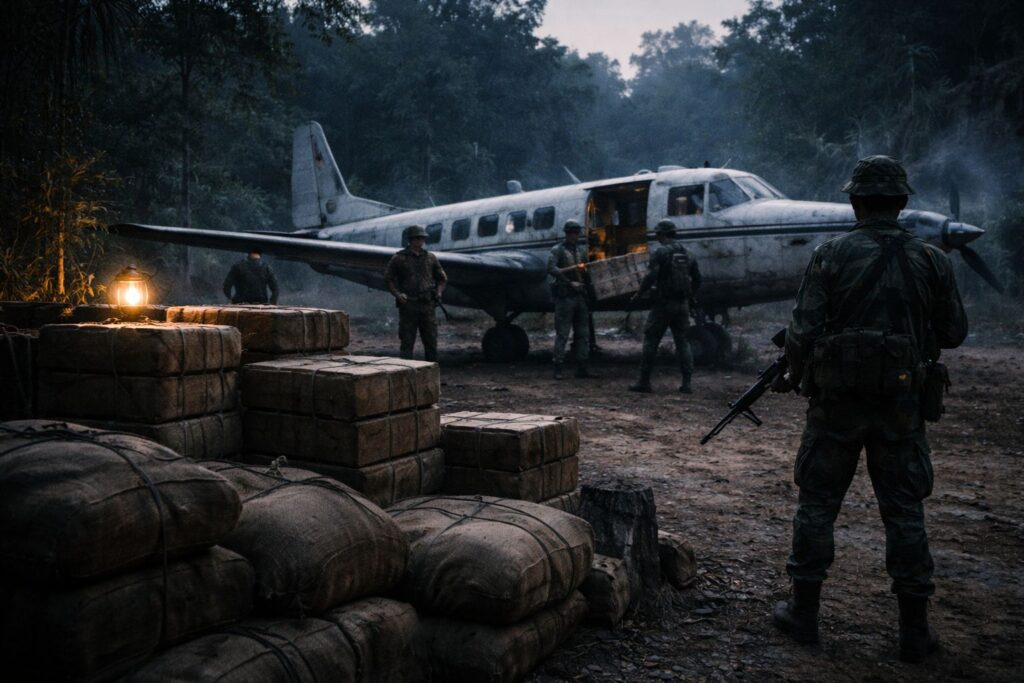
During the Vietnam War, opium and heroin trafficking boomed in the Golden Triangle—that region between Myanmar, Laos, and Thailand that remains a significant source of the global heroin market to this day. The CIA used local militias and paramilitary groups for covert operations against communist forces—and systematically tolerated their drug businesses in the process.
The most concrete example: Air America, an officially civilian airline that in reality operated as a CIA front organization. Under the cover of humanitarian transport, Air America flew weapons to anti-communist Hmong militias in the Laotian mountains—and in return, raw opium out of the cultivation areas. The opium was later processed into heroin in Saigon laboratories and exported to the United States.
Historian Alfred W. McCoy documents these entanglements in his definitive work The Politics of Heroin in Southeast Asia (1972, updated 2003). McCoy proves, based on internal reports and witness testimony, that Air America became part of the drug export transport network, partly directly and partly through tolerated cooperation with intermediaries. In the Long Tieng region, General Vang Pao established an extensive, militia-based opium system with American backing.
“CIA contract aircraft flew opium out of the Hmong hills in Laos, while providing weapons and supplies to the tribal armies that protected the poppy fields.”
— Alfred W. McCoy, The Politics of Heroin, 2003, p. 163
The result: An explosion in heroin production. By 1971, 70 percent of the world’s illegal heroin came from Southeast Asia.
Significance: This is the first structurally demonstrable pattern where strategic interests (fighting communism) were placed above drug enforcement. The CIA didn’t just tolerate drug trafficking—it used it as a logistical and financial element of covert operations.
What remains of the “War on Drugs” once the patterns become visible?
This exclusive add-on exposes how drug trafficking was not fought but strategically tolerated, exploited, or instrumentalized for decades—from Vietnam and Afghanistan to Venezuela. No speculation, no moral theater, but a fact-based timeline built on primary sources, hard data, and documented investigations. Anyone who wants to understand how power politics operates behind moral rhetoric—and why the drug war was never what it claimed to be—needs to read this.
Michael Hollister is a geopolitical analyst and investigative journalist. He served six years in the German military, including peacekeeping deployments in the Balkans (SFOR, KFOR), followed by 14 years in IT security management. His analysis draws on primary sources to examine European militarization, Western intervention policy, and shifting power dynamics across Asia. A particular focus of his work lies in Southeast Asia, where he investigates strategic dependencies, spheres of influence, and security architectures. Hollister combines operational insider perspective with uncompromising systemic critique—beyond opinion journalism. His work appears on his bilingual website (German/English) www.michael-hollister.com, at Substack at https://michaelhollister.substack.com and in investigative outlets across the German-speaking world and the Anglosphere.
© Michael Hollister – Redistribution, republication or use of this text is only permitted after prior approval.
If you are interested in republishing or using this text, please contact the author at:
mh@michael-hollister.com
Newsletter
🇩🇪 Deutsch: Verstehen Sie geopolitische Zusammenhänge durch Primärquellen, historische Parallelen und dokumentierte Machtstrukturen. Monatlich, zweisprachig (DE/EN).
🇬🇧 English: Understand geopolitical contexts through primary sources, historical patterns, and documented power structures. Monthly, bilingual (DE/EN).