
Managing Myanmar’s Collapse
by Michael Hollister
Exclusive published at Michael Hollister on January 25, 2026
1.579 words * 8 minutes readingtime
This analysis is made available for free – but high-quality research takes time, money, energy, and focus. If you’d like to support this work, you can do so here:

Alternatively, support my work with a Substack subscription – from as little as 5 USD/month.
Let’s build a counter-public together.
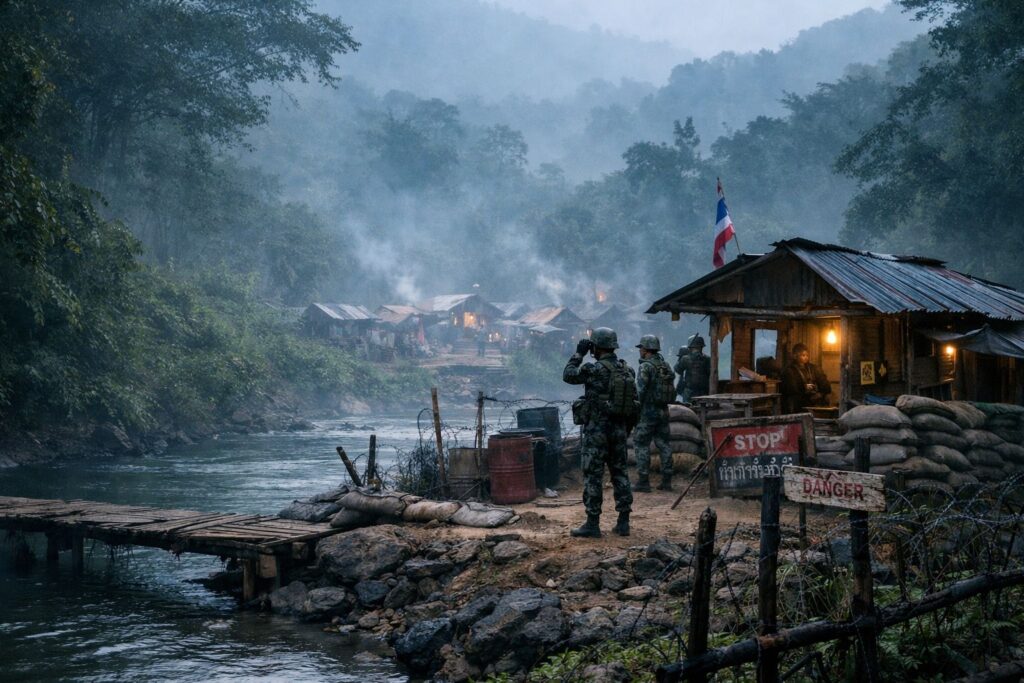
In December 2025, Thailand closed several border crossings with Myanmar, citing security concerns. Yet selected transit routes for commercial traffic remained open. This selective policy reveals Bangkok’s fundamental dilemma: growing pressure to stop absorbing Myanmar’s collapse—refugee flows, drug trafficking, armed groups—while remaining embedded in regional supply chains serving Chinese interests.
What appears as pragmatic crisis management exposes a deeper weakness: Southeast Asia has no answer to Myanmar’s disintegration. ASEAN is paralyzed, China operates as a silent ordering force, and Thailand maneuvers without real control. As Myanmar fragments, Thailand increasingly becomes a frontline state in a regional ordering problem that cannot be ignored.
Myanmar’s Accelerating Collapse
Since the military coup of February 2021, Myanmar has descended into multipolar armed conflict. Over 50,000 people have been killed, with the actual toll likely far higher. More than 2.6 million are internally displaced, with another 1.2 million having fled abroad. The kyat has lost over 60 percent of its value, inflation exceeds 30 percent, and poverty rates have nearly doubled.
Over a dozen armed groups now fight the junta in shifting alliances—including ethnic armies like the Kachin Independence Army and Arakan Army, alongside newly formed People’s Defence Forces (PDF) loosely aligned with the exiled National Unity Government (NUG).
The junta still controls Naypyidaw and urban centers, but vast border regions have permanently escaped its authority. Public services exist only rudimentarily or have been replaced by local militias. Myanmar is not a “failed state” in the classical sense, but a territorially fragmented entity with diminishing central power—making the conflict particularly dangerous because it cannot be contained. It seeps across borders into Thailand, China, Laos, and India.
Thailand’s Border Dilemma
No country feels Myanmar’s collapse more directly than Thailand. The two states share over 2,400 kilometers of border—mostly impassable, forested terrain crossed by old smuggling routes and forgotten outposts. What should officially be a bilateral dividing line is de facto a highly permeable, fragmented in-between space.
Since the coup, this border zone has become a focal point of multiple crises. Daily, refugees, irregular labor migrants, weapons, drugs, and increasingly digital crime networks cross the green border. In 2023 alone, Thai authorities recorded over 500,000 irregular border crossings from Myanmar—and rising.
The December 2025 border closures illustrate Thailand’s dilemma precisely. On one hand, there is a legitimate security interest in protecting territorial integrity and controlling mass influx. On the other hand, Thailand is deeply integrated into regional supply chains—particularly cross-border trade with Myanmar, but also transnational infrastructure projects.
A particularly sensitive point: the China-Myanmar Economic Corridor (CMEC) initiative, which provides China access to the Indian Ocean through Myanmar territory, depends on Thai transit options and logistical connectivity. Any hard border closure would also affect Chinese interests—at a time when Thailand is economically closely intertwined with Beijing.
Simultaneously, pressure grows from the West: the United States—traditionally a security guarantor and ally in the Asia-Pacific—pushes for stronger isolation of the junta, particularly regarding military cooperation and security-relevant infrastructure. Thailand thus stands between two geopolitical ordering models—and, as often, maneuvers pragmatically in the middle.
In the border region itself, a state of chronic tension prevails. In Mae Sot and Mae Sai, NGOs operate under difficult conditions, security forces must balance humanitarian responsibility against anti-smuggling operations, and local administrations face economic and political pressure.
Thailand has pursued a dual path: quiet diplomacy toward the junta, economic cooperation behind the scenes—and selective isolation during security-relevant threat situations. But this course grows increasingly fragile: the longer Myanmar collapses, the more Thailand becomes a frontline state of a regional ordering problem that cannot be postponed.
ASEAN’s Structural Paralysis
ASEAN’s April 2021 Five-Point Consensus—a diplomatic blueprint for stabilizing Myanmar—has proven ineffective. Despite public cooperation signals, the junta in Naypyidaw has undermined every single point. Violence escalated, dialogue did not occur, the special envoy could neither meet all conflict parties nor travel freely, and humanitarian aid remained largely blocked.
The problem lies in ASEAN’s institutional architecture: the principle of non-interference in internal affairs may have historically contributed to regional stability, but in Myanmar’s case acts as a self-imposed framework without enforcement mechanisms. Sanctions are institutionally not provided for, suspension politically hardly achievable through consensus.
Internal fragmentation compounds the problem:
- States like Malaysia, Indonesia, or the Philippines demand a harder line toward the junta, including direct talks with the exiled National Unity Government (NUG)
- Others like Thailand, Cambodia, or Laos pursue quiet diplomacy, economic coexistence, or open proximity to the junta—partly from geopolitical calculation, partly from domestic caution
The result: ASEAN is not only blocked but increasingly lacks credibility as a mediator. Summit meetings produce declarations without effect. Myanmar remains a member—and remains simultaneously uncontrollable.
While ASEAN paralyzes itself, other actors fill the emerging vacuum. China secures its infrastructure and resource interests, Western states impose symbolic sanctions without strategic engagement, the UN remains an observer without influence. ASEAN thus exemplifies a geopolitical reality: normative order yields to pragmatic influence logic.
China’s Strategic Patience
While ASEAN struggles and the West hesitates, China has established facts. No external country is as deeply interwoven with Myanmar’s economic infrastructure as the People’s Republic—part of a long-term agenda predating the coup.
Central to this strategy is the China-Myanmar Economic Corridor (CMEC), a key Belt and Road Initiative project. Its centerpiece is the deep-sea port of Kyaukphyu in Rakhine State, connected via pipeline and road to China’s Yunnan Province. This gives China direct Indian Ocean access without depending on the vulnerable Malacca Strait chokepoint.
Two pipelines—crude oil and natural gas—transport energy directly to China. Although the share of China’s total demand is relatively small, the strategic significance lies in diversification: Myanmar is China’s emergency exit if Western naval powers blockade maritime routes. Kyaukphyu is more than a port—it is a geopolitical valve.
China’s influence extends beyond infrastructure. Beijing has created a virtually unassailable position through targeted investments, quiet diplomacy, and selective support of local power holders. In regions where the junta weakens, China cooperates with local militias—such as in Shan State, where rare earths essential for China’s high-tech industry are mined.
Remarkably: China stations no troops, imposes no sanctions, makes no threats. It relies on economic dependency, political patience, and diplomatic stability assurance—always aligned with its own interests. The junta knows its international isolation is mitigated only by China’s goodwill, granting Beijing access, privileges, and political backing.
This quiet dominance blocks international sanctions (China remains a buyer of raw materials), inhibits ASEAN (no member state wants to confront Beijing’s interests), and indirectly stabilizes the junta. China has achieved strategic deep anchoring without open presence—Myanmar is part of a Chinese buffer zone extending beyond territorial questions.
What Can Realistically Be Done?
Myanmar’s disintegration destabilizes neighboring regions, undermines multilateral ordering principles, and shifts power balances. ASEAN has revealed its limits in this crisis. The Five-Point Consensus proved ineffective, the principle of non-interference an institutional constraint. Myanmar exposes Southeast Asia’s inability to respond cohesively to existential order violations.
Thailand exemplifies the regional dilemma: between moral responsibility and geopolitical consideration, between border security and trade interests, between American pressure and Chinese dominance. Maneuvering may stabilize short-term—but prevents strategic positioning beyond mere risk management.
Realistic Steps Forward:
For Thailand:
- Professionalize border management: separate humanitarian reception from security operations
- Create transparency in transit regulations to avoid perception as silent accomplice of Chinese or junta interests
- Share regional refugee burden with ASEAN partners through formalized quota arrangements
- Develop cross-border humanitarian corridors with international NGO coordination
For ASEAN:
- Enable direct talks with the NUG without formally recognizing it—as a parallel dialogue channel
- Enforce humanitarian corridors, if necessary through bilateral agreements of individual member states
- Establish an “ASEAN Myanmar Contact Group” with rotating mandate to replace the blocked special envoy
For External Actors:
- China could use its economic leverage to push the junta toward limited reforms—at least to contain humanitarian catastrophe
- Western states should coordinate sanctions more effectively while supporting humanitarian access
- India should reconsider its junta support and instead focus on local actors who could prove more stable long-term
None of these steps will stabilize Myanmar short-term. But they could prevent the disintegration from further accelerating—and prevent Southeast Asia from becoming entirely a geopolitical playground of external powers.
Thailand cannot remain neutral. The question is no longer whether regional actors can still act—but whether they recognize that the time for symbolic gestures has passed. Myanmar is the litmus test—and the region faces the choice of shaping or merely managing its future.
This analysis is made available for free – but high-quality research takes time, money, energy, and focus. If you’d like to support this work, you can do so here:

Alternatively, support my work with a Substack subscription – from as little as 5 USD/month.
Let’s build a counter-public together.
Michael Hollister is a geopolitical analyst and investigative journalist. He served six years in the German military, including peacekeeping deployments in the Balkans (SFOR, KFOR), followed by 14 years in IT security management. His analysis draws on primary sources to examine European militarization, Western intervention policy, and shifting power dynamics across Asia. A particular focus of his work lies in Southeast Asia, where he investigates strategic dependencies, spheres of influence, and security architectures. Hollister combines operational insider perspective with uncompromising systemic critique—beyond opinion journalism. His work appears on his bilingual website (German/English) www.michael-hollister.com, at Substack at https://michaelhollister.substack.com and in investigative outlets across the German-speaking world and the Anglosphere.
© Michael Hollister – Redistribution, republication or use of this text is only permitted after prior approval.
If you are interested in republishing or using this text, please contact the author at:
mh@michael-hollister.com
Newsletter
🇩🇪 Deutsch: Verstehen Sie geopolitische Zusammenhänge durch Primärquellen, historische Parallelen und dokumentierte Machtstrukturen. Monatlich, zweisprachig (DE/EN).
🇬🇧 English: Understand geopolitical contexts through primary sources, historical patterns, and documented power structures. Monthly, bilingual (DE/EN).