
Why NATO’s Pivot State Still Can’t Sustain a War
by Michael Hollister
Exclusive published at Michael Hollister on December 28, 2025
2.434 words * 13 minutes readingtime
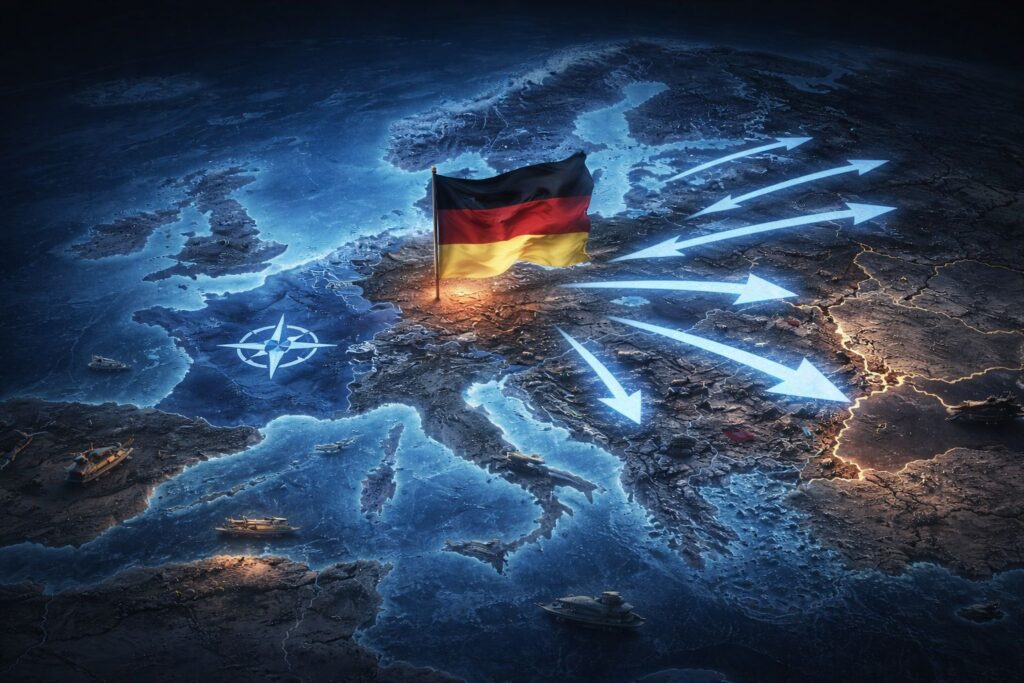
When Friedrich Merz took office as Germany’s chancellor in May 2025, he declared that “Germany is back” on the international stage. Within weeks, his government secured constitutional changes exempting defense spending from debt restrictions and unlocked a €500 billion infrastructure package for the next decade. The message to NATO allies was unmistakable: After years of underinvestment, Germany would finally transform rhetoric into resources.
Six months into Merz’s tenure, the rhetoric has certainly intensified. Germany’s defense budget has surged from $38 billion in 2015 to $88.5 billion in 2024 — a 130% increase that now ranks Germany fourth globally behind only the United States, China, and Russia. Defense Minister Boris Pistorius continues to emphasize Germany must become “kriegstüchtig” — war-capable. The previous government’s “Zeitenwende” (turning point), announced by then-Chancellor Scholz in February 2022, has evolved under Merz into promises of outright military transformation.
Yet beneath this intensified ambition and unprecedented fiscal commitment lies a troubling reality: Germany’s Bundeswehr still cannot sustain the high-intensity warfare its political leadership invokes. The gap between declared capabilities and operational readiness creates strategic vulnerabilities not just for Germany, but for the entire NATO alliance that increasingly depends on German logistics, territory, and military infrastructure as the geographic pivot of European defense.
This analysis examines Germany’s actual military capacity across land, air, and naval forces, revealing systemic deficiencies in ammunition stocks, equipment availability, industrial depth, and operational experience. The conclusion remains stark despite the Merz government’s fiscal interventions: Germany can initiate military operations but cannot sustain them. For NATO planners counting on German contributions to defend the alliance’s eastern flank, this gap between promise and performance represents a dangerous miscalculation — one that new leadership and fresh billions have not yet closed.
The Army: More Money, Same Constraints
Germany’s ground forces illustrate the persistent disconnect between political ambition and military capacity. Berlin has committed to permanently stationing a brigade in Lithuania as part of NATO’s enhanced forward presence. The Merz government aims to accelerate this timeline while building toward a fully equipped division ready for rapid deployment. The reality falls far short despite increased funding.
Germany’s army fields approximately 63,000 soldiers — a fraction of Cold War strength when West Germany alone maintained twelve divisions. Today’s target is three divisions, with only one intended to reach full operational readiness. Even this modest goal proves elusive given equipment shortfalls that money alone cannot immediately remedy.
The Leopard 2 main battle tank exemplifies the challenge. Germany possesses approximately 310 Leopard 2 tanks (variants A5, A6, A7) on paper. Parliamentary inquiries and defense media estimate actual availability at 100-150 tanks at any given time — often fewer. The Puma infantry fighting vehicle, meant to replace the aging Marder, suffered a complete fleet failure during NATO exercises in December 2022, with all 18 deployed vehicles simultaneously breaking down. While procurement continues, converting budget authority into operational capability requires years, not months.
Artillery presents an even grimmer picture. Germany operates roughly 120 Panzerhaubitze 2000 self-propelled howitzers — technically advanced but maintenance-intensive systems with chronic parts shortages. Several units were transferred to Ukraine, further reducing available stocks. Future systems like the RCH 155 won’t arrive in meaningful numbers until 2027 at earliest, regardless of funding availability.
The ammunition situation approaches crisis levels despite increased procurement budgets. NATO standards require member states to maintain 30 days of ammunition for high-intensity operations. Germany realistically possesses two to five days’ worth. For the Panzerhaubitze 2000, effective artillery operations require 1,000-1,500 rounds per battery daily. Germany’s total stock measures in the tens of thousands of shells — enough for perhaps a week of sustained combat. While Rheinmetall has pledged to increase annual production to 600,000 rounds by 2025, this target serves all of Europe, not Germany alone. Industrial capacity cannot be conjured overnight even with unlimited budgets.
Logistics infrastructure compounds these deficiencies. Germany’s military transport fleet remains small and aging. The Lithuania brigade requires approximately 90 tank trucks — nearly the entire Bundeswehr inventory of 100-120 such vehicles. The Bundeswehr’s total requirement across all formations approaches 810 tank trucks, leaving the remaining force with perhaps 20-30 vehicles. Industrial production capacity remains limited despite increased orders — delays between contracts and delivery now stretch years, not months. The Merz government’s infrastructure spending may eventually address these gaps, but NATO contingency plans operate on timelines measured in weeks, not development cycles measured in years.
The assessment is unambiguous: Germany’s army can deploy limited forces for symbolic presence or constrained NATO operations. Despite unprecedented budgetary commitments from Berlin’s new government, it cannot sustain multi-week, high-intensity land warfare of the type its political rhetoric implies. Germany could start such a conflict. It still could not finish it.
The Air Force: Modern Platforms, Minimal Endurance
Germany’s Luftwaffe faces similar constraints despite operating sophisticated platforms and receiving increased funding. The fleet centers on two systems: the Eurofighter Typhoon for air superiority and the aging Tornado for strike missions and nuclear sharing. F-35A Lightning II aircraft ordered in 2022 to replace the Tornado won’t arrive until 2026, leaving nuclear deterrence dependent on an increasingly unreliable legacy platform regardless of budgetary allocations.
Of approximately 138 Eurofighters, operational availability typically ranges from 55-60% — meaning 60-80 aircraft available at any moment. Maintenance cycles, parts shortages, and training requirements further reduce the number of simultaneously deployable fighters. In 2018, Germany admitted that only four of 128 Eurofighters were fully combat-capable. While readiness has improved, the fundamental constraint remains: complex platforms require extensive maintenance infrastructure that cannot be rapidly scaled even with increased funding.
Munition stocks present the critical limitation. Germany acquired 270 Meteor long-range air-to-air missiles in 2024 for €521 million — approximately 2.6 full loadouts per Eurofighter. Realistic air combat scenarios require daily reloads. Air-to-ground munitions for Tornado and Eurofighter are equally constrained. Based on publicly available inventories, Germany could sustain high-intensity air operations for three to five days maximum before critical systems become combat-ineffective. Procurement budgets address future needs but cannot conjure immediate stockpiles.
Integrated air defense reveals similar vulnerabilities. Germany operates seven Patriot batteries (five deployed to Ukraine) and initial IRIS-T SLM systems. Geographic coverage is minimal — Germany can realistically protect three to four urban centers or strategic sites, not entire airspace. While Berlin has ordered eight additional Patriot systems, deliveries will take years. The Sky Shield initiative positions Germany as a coordinator, but the reality remains a patchwork, not comprehensive coverage. The Merz government’s constitutional debt brake exemption for defense enables these purchases but cannot accelerate delivery timelines set by industrial capacity.
Germany’s air force is modern but small, well-funded but constrained by industrial reality. It can contribute to NATO air policing and limited strike missions. It cannot independently conduct sustained defensive air campaigns or protect German airspace during prolonged crisis escalation. Money alone cannot solve these capacity gaps in operationally relevant timeframes.
The Navy: Fiscal Commitment, Operational Limits
Germany’s Kriegsmarine appears globally engaged — deploying to the Indo-Pacific, Red Sea, and North Atlantic. The Merz government’s increased defense spending supports continued modernization. Material reality, however, tells a different story about sustained operational capacity.
Germany currently operates eleven frigates (classes F123-F125), five K130 corvettes, and six Type 212A submarines. New F126 frigates won’t arrive until late 2020s regardless of funding availability. Four operational theaters — Baltic, North Sea, North Atlantic, and Mediterranean/Red Sea — already exceed available platforms for credible sustained presence.
Fleet availability fluctuates sharply. Maintenance, modernization, and personnel shortages regularly reduce readiness below 60%. U-boats have particularly struggled — at times only two of six boats were operational. Simultaneous deployments (NATO, UNIFIL, Red Sea operations) strain the fleet to breaking. Additional funding enables maintenance and modernization but cannot immediately expand fleet size.
Ammunition presents acute constraints. The navy employs diverse weapons systems: RBS15 anti-ship missiles, ESSM and RAM air defense interceptors, SM-2 missiles, and (future) Naval Strike Missiles. Actual stockpiles suffice for only days of intensive combat. For the Sachsen-class frigates (F124), effective operations require dozens of missiles per ship — actual inventories often measure in low double digits per unit. Germany ordered 1,000 RAM missiles for €1 billion in 2023, helpful long-term but not addressing current shortfalls. Industrial production timelines, not budget allocations, determine when these systems reach operational units.
The frigate Hessen‘s Red Sea deployment illustrated these limits. Days into operations against Houthi attacks, ammunition constraints significantly restricted operational options despite modern sensors and radar. The Merz government’s increased defense budgets enable future procurement but cannot retroactively stockpile munitions for current operations.
The lesson is clear: Germany can show presence and provide convoy escort, but cannot sustain maritime warfare against peer competitors or secure sea lanes during prolonged conflict. Fiscal commitment under the new government is real, but operational capacity gaps persist.
What This Still Means for NATO
Germany occupies NATO’s geographic center. The Merz government’s early moves — visiting Paris, Warsaw, Brussels, and NATO headquarters within days of taking office — signaled heightened ambitions. Political commitments position Berlin as a “framework nation” for eastern defense: anchoring brigade-level deployments to Lithuania, providing logistics infrastructure, enabling force transit, and coordinating multinational formations. Allied planning assumes German capacity matches these commitments, particularly given Berlin’s unprecedented fiscal mobilization.
The reality creates dangerous vulnerabilities that persist despite new leadership. When Germany promises “war capability” but can sustain high-intensity operations for only days, it undermines deterrence credibility. Potential adversaries — particularly Russia — make strategic calculations based on demonstrated capacity, not declared intentions or budget allocations. Deterrence fails when words and capabilities diverge, regardless of how recently budgets increased.
Alliance coordination compounds the risk. Poland and Baltic states depend on promised German brigade deployments, troop reinforcements, and logistics support from German territory. U.S. planning relies on Germany as a functioning logistics hub for material transshipment, troop movements, air defense, medical support, and resupply. If these capabilities exhaust after days, entire operational plans unravel. The result: critical gaps requiring disproportionate burden-sharing by partners like the United States or United Kingdom.
The Merz government’s fiscal interventions signal seriousness, but NATO contingency timelines operate in weeks while German military transformation operates in years. Allied planners cannot assume capacity that doesn’t yet exist, regardless of budget authority committed to building it eventually.
The political dimension matters equally. German public communication under Merz suggests renewed assertiveness — a state regaining defensive capability and willing to lead. When deficiencies emerge through NATO exercises, intelligence assessments, or crisis deployments, reputation suffers. Germany risks perception as a “loud voice without substance” — a politically active actor promising more than it can deliver militarily, even under new leadership with unprecedented budgets.
Policy Options: From Fiscal Commitment to Operational Reality
The Merz government demonstrates genuine fiscal commitment to defense. Constitutional debt brake exemptions and €500 billion infrastructure packages signal political will. Yet current trajectory still creates insecurity rather than strength because money alone cannot instantly generate military capacity. Three paths merit consideration:
Option 1: Align rhetoric with interim reality. Rather than employing terms like “war-capable” before capability exists, Germany could adopt differentiated language acknowledging specialized, high-quality niche contributions within NATO while larger investments mature — logistics excellence, air transport, medical support, cyber defense, or artillery for defined scenarios. Germany would not yet be a frontline combat state but an indispensable stabilizing factor in depth. Clarity builds trust, including with allies who respect honesty about timelines.
Option 2: Accelerate capability development through industrial policy. If political direction genuinely aims for “war capability,” structural transformation requires more than appropriations. This means industrial mobilization beyond current commitments: surge production facilities for ammunition, rapid expansion of maintenance infrastructure, accelerated training programs, and potentially extended or renewed conscription. The Merz government’s infrastructure package could prioritize these enablers. Training requires reform: more live-fire exercises, realistic combined-arms training, tactical deployment exercises at brigade scale.
Option 3: Strategic honesty through phased communication. Realistically, Germany could acknowledge current gaps while credibly communicating transformation timelines and interim contributions. This creates no strategic hubris but a reliable understanding of what NATO partners can expect now versus 2027 versus 2030. The fiscal commitment is real; operational capability follows on industrial and organizational timelines that money accelerates but cannot eliminate.
For NATO broadly: Don’t assume German capacity before it exists; plan redundancies during transformation period. For Germany: Stop overpromising; deliver on core commitments while honestly communicating development timelines.
The Question That Still Remains
Between 2015 and 2024, Germany increased defense spending from roughly $38 billion to over $88 billion annually — a 130% increase. Germany now ranks fourth globally in military expenditure behind only the United States, China, and Russia. The Merz government has unlocked constitutional constraints, committed €500 billion to infrastructure, and exempted defense from debt restrictions.
Yet the Bundeswehr remains not ready, not sustainable, not “war-capable.” It cannot fight a sustained war — much less win one.
Where did this money go? Where will the next billions go?
Not yet into functional combat brigades. Not yet into filled ammunition depots. Not yet into operationally ready Eurofighters and frigates. The procurement system appears to consume billions without making forces war-ready on operationally relevant timelines. Merz’s government demonstrates political will, but industrial capacity, organizational adaptation, and systems integration operate on different timelines than budget authority.
Until Germany demonstrates capacity rather than budget allocations, not only military effectiveness faces jeopardy — but also allied trust. When political leaders speak of “winning wars,” they must demonstrate not just where money flows but what it produces and when. Trust is NATO’s hardest currency. Germany is spending it more freely under new leadership — but delivery timelines remain uncertain, and allies are watching closely.
The Merz government represents genuine change in political will and fiscal commitment. Whether that translates into operational military capacity Germany’s rhetoric suggests — and NATO’s security architecture requires — remains the critical question. Budget authority is necessary but not sufficient. The gap between them measures the real readiness of Europe’s geographic pivot.
Diese Analyse ist frei zugänglich – aber gute Recherchen kosten Zeit, Geld, Energie und Nerven. Unterstützen Sie mich, damit diese Arbeit weitergehen kann.

Oder unterstützen Sie mich auf Substack – schon ab 5 USD pro Monat.
Gemeinsam bauen wir eine Gegenöffentlichkeit auf.
Michael Hollister
is a geopolitical analyst and investigative journalist. He served six years in the German military, including peacekeeping deployments in the Balkans (SFOR, KFOR), followed by 14 years in IT security management. His analysis draws on primary sources to examine European militarization, Western intervention policy, and shifting power dynamics across Asia. A particular focus of his work lies in Southeast Asia, where he investigates strategic dependencies, spheres of influence, and security architectures. Hollister combines operational insider perspective with uncompromising systemic critique—beyond opinion journalism. His work appears on his bilingual website (German/English) www.michael-hollister.com, at Substack at https://michaelhollister.substack.com and in investigative outlets across the German-speaking world and the Anglosphere.
© Michael Hollister— Redistribution, publication or reuse of this text is explicitly welcome. The only requirement is proper source attribution and a link to www.michael-hollister.com (or in printed form the note “Source: www.michael-hollister.com”).
Newsletter
🇩🇪 Deutsch: Verstehen Sie geopolitische Zusammenhänge durch Primärquellen, historische Parallelen und dokumentierte Machtstrukturen. Monatlich, zweisprachig (DE/EN).
🇬🇧 English: Understand geopolitical contexts through primary sources, historical patterns, and documented power structures. Monthly, bilingual (DE/EN).