
Why “Europe’s Largest Military” Can’t Fight
A Veteran’s Assessment of the Bundeswehr’s Hollow Force
by Michael Holllister
First published at Ständige Publikumskonferenz der öffentlich-rechtlichen Medien e.V. on Dec. 19, 2025
2.582 words * 14 minutes readingtime
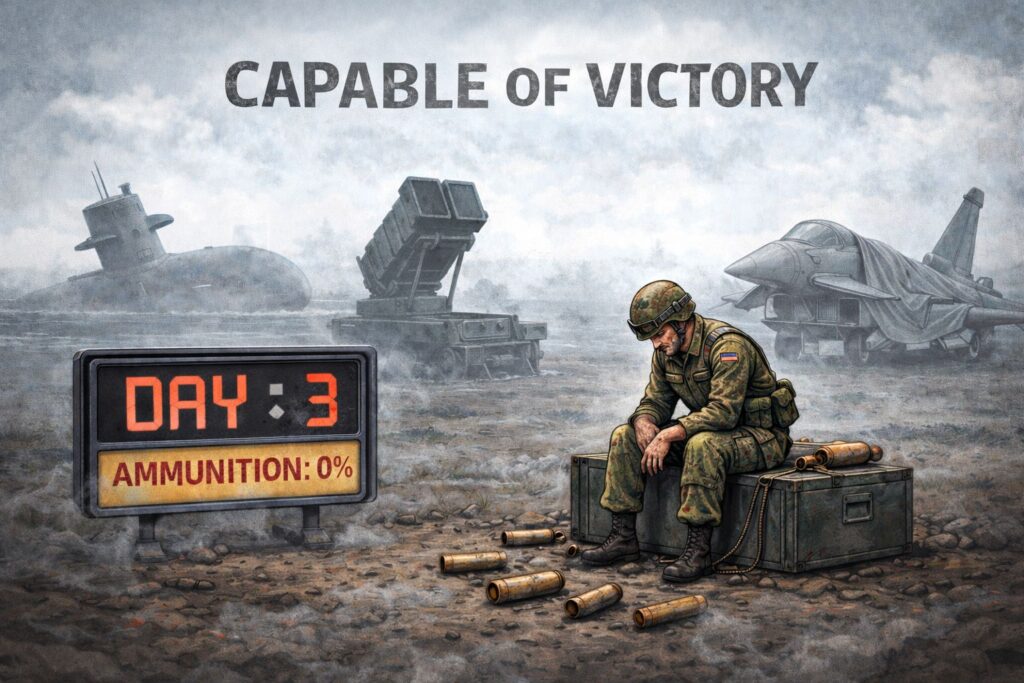
I served six years in the Bundeswehr with deployments to the Balkans under SFOR and KFOR. I was a soldier to prevent wars, not to wage them. That experience taught me a fundamental truth: a military’s credibility rests not on political declarations, but on ammunition stocks, operational readiness, and the ability to sustain combat operations beyond the first 72 hours.
Today, as Germany’s political class proclaims the country “war-ready” and even “victory-capable,” I’m compelled to provide an operational assessment based on publicly available data and my understanding of what actual military readiness requires. The gap between rhetoric and reality isn’t just embarrassing—it’s strategically dangerous for NATO.
While Washington pours hundreds of billions into European defense and American forces maintain forward positions from the Baltics to the Black Sea, Germany—Europe’s largest economy and NATO’s demographic heavyweight—fields a military that struggles to equip a single fully operational division. This matters profoundly for US defense planning, alliance burden-sharing debates, and any scenario assuming German military contribution.
The assessment that follows draws from official Bundeswehr statements, parliamentary inquiries, defense industry reporting, and established military planning ratios. The numbers tell a story German politicians prefer not to acknowledge: Germany’s military is operationally hollow.
The Army: Cannibalization as Doctrine
The Leopard 2: Pride on Paper, Scarcity in Reality
The Bundeswehr officially lists 313 Leopard 2 main battle tanks. For context: Germany fielded 2,125 Leopard 2s in the late 1990s. Eighty-five percent were sold, scrapped, or donated over three decades of post-Cold War drawdown.
Of the remaining 313, approximately 70-76 percent achieve “materially operational” status in optimal conditions. Contract specifications for the new Leopard 2A8 variant reveal the accepted standard: 60 percent must reach E0 status (fully operational), 90 percent E1 status (conditionally operational—meaning something is missing or broken, but the vehicle could theoretically deploy if you’re desperate enough).
The 10th Panzer Division was declared “operational” in 2025—a milestone achievement. How was this accomplished? By cannibalizing every other armored unit. Outside this single division, operational readiness hovers around 50 percent. And even this showcase division maintains ammunition reserves sufficient for two to three days of high-intensity combat.
The Puma: $18 Million for 50 Percent Readiness
Germany’s Puma infantry fighting vehicle represents the world’s most expensive IFV program at €17 million ($18 million) per unit—exceeding the cost of many fourth-generation fighter aircraft. The program promised cutting-edge protection, firepower, and digitization. Reality delivered different results.
In December 2022, all 18 Pumas designated for a critical NATO rapid response exercise failed within days. All of them. Complete mission failure. Zero vehicles remained operational. The failure modes ranged from electronic system crashes to mechanical breakdowns—precisely the high-tech integration that justified the extraordinary cost proved to be the Achilles heel.
Current fleet-wide readiness fluctuates between 48 and 65 percent—performance metrics more associated with legacy Soviet equipment than modern Western systems. Of 350 delivered vehicles (first production batch), only 40 meet NATO Very High Readiness Joint Task Force (VJTF) combat certification standards. The remaining 310 vehicles exist in various states of limited capability.
Full operational capability isn’t projected until 2030—nearly two decades after initial fielding. Until then, the Bundeswehr continues operating Marder infantry fighting vehicles designed in the 1960s and fielded in the 1970s. The irony is acute: fifty-year-old vehicles maintain higher operational readiness than their modern replacements because simplicity proves more sustainable than complexity when maintenance infrastructure lags procurement ambition.
For context: the US Bradley, despite being 40 years old, maintains approximately 90 percent operational readiness. Even accounting for different maintenance philosophies and funding levels, the Puma’s performance represents systemic institutional failure, not mere teething problems.
Artillery: 91 Percent Short
The Panzerhaubitze 2000 represents excellent engineering—when it functions. Germany maintains 105 systems after donations to Ukraine. Current operational readiness: 36 systems. One-third.
The ammunition situation is more critical. Current 155mm artillery shell inventory: approximately 20,000 rounds. Stated requirement through 2031: 230,000 rounds. Shortfall: 91 percent.
For perspective: Russia fires 10,000-20,000 artillery rounds daily in Ukraine. Germany’s entire stockpile would sustain one day of comparable fire rates.
Additionally, procurement frequently ordered shells without propellant charges or fuses—like purchasing ammunition but ordering the components to make it function separately, if at all.
Logistics: The 87 Percent Gap
Military planners operate on established sustainment ratios. A mechanized brigade conducting high-intensity operations requires approximately 125,000 liters of fuel daily. Germany deployed 90 fuel trucks to support its Lithuania enhanced Forward Presence battlegroup—establishing the doctrinal planning standard through operational necessity.
Germany’s force structure projects nine fully equipped heavy brigades as the foundation for territorial defense and NATO commitments. By the Lithuania standard: 9 brigades × 90 fuel trucks = 810 specialized fuel transport vehicles required.
Current inventory: 100-120 fuel trucks across the entire Bundeswehr. Shortfall: 87 percent.
This gap isn’t theoretical. During the Cold War, NATO maintained extensive pre-positioned stocks and established supply lines. Today’s Bundeswehr relies on commercial just-in-time logistics—inappropriate for combat operations where fuel consumption can triple planned rates and supply lines face interdiction.
The ammunition transport situation mirrors the fuel problem. Heavy brigades fire enormous quantities under contact: a single Panzerhaubitze 2000 can expend 100+ rounds daily during sustained fire missions. Each howitzer battalion requires dedicated ammunition vehicles moving continuously between forward firing positions and rear supply points.
In 2024, the Bundeswehr announced delivery of 2,015 logistics vehicles—presented as a procurement victory. Context matters: this figure represents all logistics vehicles combined across every function—fuel, ammunition, water, food, maintenance recovery. No specialized capability development, just general-purpose trucks performing logistics roles they weren’t designed for.
Operational assessment based on Afghanistan and NATO exercise experience: Germany could sustain three to four heavy brigades for 48-72 hours before systematic logistics failure. After that point, combat units would be immobilized regardless of tactical effectiveness. Tanks don’t fight without fuel. Artillery doesn’t shoot without shells. Soldiers don’t operate without water and rations.
This isn’t speculation—it’s mathematics. And mathematics doesn’t care about political declarations.
The Luftwaffe: Four Days to Empty Magazines
Eurofighter: Limited Weapons, Limited Combat Power
Germany operates 138 Eurofighters—the largest fleet outside the UK. In 2018, only four of 128 aircraft were fully weapons-capable. The situation has improved: current estimates suggest 30-40 percent operational readiness, approximately 50 combat-capable aircraft.
For modern beyond-visual-range combat, the Eurofighter employs Meteor air-to-air missiles with 200-kilometer range. After complete delivery of three procurement batches, Germany will possess approximately 520 Meteors.
Standard loadout: four missiles per aircraft. Fifty operational fighters × 4 missiles = 200 for initial full loadout. Total inventory enables 2.6 complete loadouts.
Combat reality requires multiple missiles per target engagement—hit probability averages 60-80 percent under ideal conditions. At 2.5 missiles per target, 520 rounds could engage approximately 208 targets optimally.
Russia operates roughly 1,500 combat aircraft. Germany could theoretically engage 200 before exhausting its entire beyond-visual-range inventory—after approximately four days of sustained air operations.
Germany fired its first Meteor missile in January 2025—in a training exercise, after years of the system being in inventory. Pilot proficiency with the primary air-to-air weapon remains minimal.
Air Defense: Fifteen Systems, Eighty-Three Million People
Germany operates seven legacy Patriot air defense systems (five were donated to Ukraine) with eight additional systems ordered. Total: fifteen systems maximum.
A single Patriot battery provides point defense for critical infrastructure or limited area coverage. Defending a medium city requires approximately four batteries for 360-degree protection. With fifteen total systems, Germany could defend three to four urban areas simultaneously.
Germany has 83 million inhabitants, hundreds of cities, thousands of critical infrastructure nodes. Coverage: three to four cities. The remainder: undefended.
Missile inventory compounds the problem. Recent procurement added 500 Patriot interceptors for €3 billion (€6 million per missile). Each launcher holds 16 missiles. Total inventory enables 31 salvos across all systems—approximately 4-5 engagements per battery.
During major Russian strikes in Ukraine, 50-100 cruise missiles and drones are launched simultaneously. Germany could defend against approximately five such wave attacks before magazine depletion.
The Navy: One Week Until Winchester
The German Navy operates 48 oceangoing vessels—the smallest fleet in its history with an expanding mission set. Eleven frigates (four are 30 years old), ten corvettes (five requiring modernization), six Type 212A submarines (typically two operationally available under the standard “thirds rule”: one deployed, one training, one maintenance).
The frigate Hessen deployed to the Red Sea in early 2024 with “100 percent ammunition load”—approximately 158 air defense missiles. Against typical Houthi attack patterns (10-30 drones/missiles per wave), the frigate expended roughly 17 interceptors per engagement.
Critical limitation: no underway replenishment capability for missiles (classified as hazardous cargo). After 9-10 defensive engagements—perhaps five days at two attacks daily—the Hessen would be Winchester (out of ammunition) with no option except withdrawal.
Extrapolating across the fleet (seven air-defense-capable frigates, estimated 1,800 total interceptors): 7-8 days of naval combat operations before ammunition exhaustion. Afterward, ships continue operations armed only with deck guns against cruise missiles and drones.
Historical note: In 60 years of operation, the German Navy’s total “missiles fired in anger”: zero. The Red Sea deployment marked the first combat employment of naval air defense systems in the Bundeswehr’s history.
The Combat Experience Gap: 1 Percent
Germany deployed forces to Afghanistan for 20 years. Approximately 93,000 personnel rotated through theater—seemingly a generation of combat-experienced veterans.
The operational reality differs sharply:
| Category | Number | Percentage |
|---|---|---|
| Total Afghanistan veterans | 93,000 | 100% |
| Combat arms personnel | 19,000-25,000 | 20-27% |
| Personnel with enemy contact | 3,000-6,500 | 3-7% |
| Personnel with sustained combat experience | 650-1,200 | 0.7-1.3% |
| Currently active and deployable | 1,300-1,900 | 1-2% |
In 2010, the most kinetically intensive year, German forces experienced approximately 120 enemy contacts—averaging one firefight every three days across the entire theater.
The Good Friday firefight of 2010—nine hours of combat involving 30 German soldiers—remains the “hardest firefight since 1955.” Three killed, eight wounded. In Ukraine, dozens of engagements of similar or greater intensity occur daily.
Of the current 181,500-strong Bundeswehr, maximum 1,300-1,900 personnel (1-2 percent) possess meaningful combat experience. The institution lacks the experiential base to train the next generation effectively. Every Russian soldier with six months in Ukraine has accumulated more combat time than 99 percent of Bundeswehr personnel.
NATO Implications: The Hollow Pillar
NATO’s post-Cold War expansion proceeded from 16 members in 1990 to 32 in 2024—sixteen new members, nearly all in Eastern Europe. The alliance border shifted 1,300 kilometers eastward, from the inner-German border to Russia’s western frontier. This expansion fundamentally altered the alliance’s strategic geometry and burden-sharing assumptions.
Germany, positioned as Europe’s largest economy and most populous NATO member state, assumed escalating responsibility for conventional deterrence in central Europe. Current commitments include: leading the enhanced Forward Presence (eFP) battlegroup in Lithuania, contributing to NATO air policing rotations over the Baltic states, maintaining forces designated as the alliance’s high-readiness operational reserve, and preparing to serve as a logistics and reinforcement hub for any major European contingency.
The strategic contradiction is profound: Germany simultaneously functions as both protected power and protecting power. Approximately 70 percent of operational German military equipment deploys forward to Eastern Europe and exercises, while German territorial defense depends on allied forces—primarily American, British, and Dutch units.
This arrangement worked adequately during the relatively benign 1990s-2010s period. It becomes untenable under current strategic conditions. If deterrence fails and Article 5 activates, Germany lacks the capability to defend its own territory while simultaneously fulfilling forward commitments. Something would break—most likely the forward commitments, undermining the entire eFP concept.
The ammunition and logistics mathematics compound the problem. Germany’s eFP battlegroup in Lithuania operates hundreds of kilometers from German territory. Supply lines would traverse Poland under contested conditions. The battlegroup might fight competently for 72 hours before culminating due to ammunition exhaustion and fuel depletion—not from enemy action, but from German logistics inadequacy.
When American officials demand European allies meet the “2 percent of GDP for defense” threshold, Germany technically complies while fundamentally missing the point. The question isn’t whether Germany spends enough—it’s whether Germany can actually fight, sustain operations, and fulfill alliance commitments under stress.
Consider Ukraine equipment donations: Germany provided Leopard tanks, Panzerhaubitze 2000 self-propelled howitzers, Patriot air defense systems, and substantial ammunition stocks. These donations degraded German readiness significantly—from 105 to 36 operational howitzers, from twelve to seven Patriot batteries. Crucially, Germany failed to procure replacements simultaneously or maintain residual capability.
The result creates strategic exposure across NATO’s central region. Any operational planning incorporating meaningful German military contribution rests on optimistic assumptions rather than demonstrated capability. Germany cannot independently defend its own territory without substantial allied support while simultaneously claiming readiness to defend alliance partners hundreds of kilometers eastward.
For US defense planners, this matters enormously. American forward presence in Europe—approximately 80,000 troops—was designed to catalyze European self-defense, not substitute for it indefinitely. If Europe’s largest military can barely equip one division, the sustainability of American commitments warrants serious reconsideration.
The burden-sharing debate typically focuses on defense spending percentages. The operational reality demands focus on capability and sustainability metrics. Germany demonstrates that spending money doesn’t automatically produce combat power—especially when institutional dysfunction converts resources into readiness statistics rather than battlefield effectiveness.
Conclusion: Reassessing Alliance Burden-Sharing
I began my military service with a clear purpose: to prevent wars through credible deterrence. Deterrence requires capability, not rhetoric. A military unable to sustain operations beyond 72 hours doesn’t deter—it invites miscalculation.
For American defense planners and policymakers, the German situation presents uncomfortable questions about European burden-sharing, alliance reliability, and the sustainability of forward defense commitments. The largest European NATO military fields approximately one combat-ready heavy division with ammunition for days, not weeks. This isn’t a temporary readiness gap—it reflects systemic institutional decay across three decades.
The political class declaring Germany “victory-capable” has never served, never commanded, never faced the operational realities their rhetoric ignores. As someone who wore the uniform and deployed under the NATO flag, I assess Germany’s current military posture as operationally unsustainable and strategically unreliable.
The numbers don’t lie: 91 percent ammunition shortfall, 87 percent logistics gap, 1 percent combat-experienced personnel. These aren’t statistics—they’re the difference between a credible military and an expensive parade force.
Germany’s defense challenge isn’t funding—it’s a fundamental mismatch between political commitments and operational capability. Until German leadership honestly confronts this reality, American planners should assume Germany’s military contribution in any serious contingency will be symbolic, not substantive.
The Bundeswehr I served in maintained the principle of Führen durch Vorführen—leading by example. Today’s political leadership demands sacrifice from others while delivering none themselves, commits forces to missions beyond sustainability, and proclaims readiness that doesn’t exist.
For US defense strategists evaluating European allies: trust the numbers, not the press releases. Germany’s paper army won’t survive first contact with reality.
Diese Analyse ist frei zugänglich – aber gute Recherchen kosten Zeit, Geld, Energie und Nerven. Unterstützen Sie mich, damit diese Arbeit weitergehen kann.

Oder unterstützen Sie mich auf Substack – schon ab 5 USD pro Monat.
Gemeinsam bauen wir eine Gegenöffentlichkeit auf.
Michael Hollister is a geopolitical analyst and investigative journalist. He served six years in the German military, including peacekeeping deployments in the Balkans (SFOR, KFOR), followed by 14 years in IT security management. His analysis draws on primary sources to examine European militarization, Western intervention policy, and shifting power dynamics across Asia. His work appears on his bilingual website (German/English) www.michael-hollister.com and in investigative outlets across the German-speaking world and the Anglosphere.
© Michael Hollister — Redistribution, publication or reuse of this text is explicitly welcome. The only requirement is proper source attribution and a link to www.michael-hollister.com (or in printed form the note “Source: www.michael-hollister.com”).
Newsletter
🇩🇪 Deutsch: Verstehen Sie geopolitische Zusammenhänge durch Primärquellen, historische Parallelen und dokumentierte Machtstrukturen. Monatlich, zweisprachig (DE/EN).
🇬🇧 English: Understand geopolitical contexts through primary sources, historical patterns, and documented power structures. Monthly, bilingual (DE/EN).