Terror gang, liberation movement, social state, Iranian proxy – and why none of these labels alone suffices.
by Michael Hollister
Exclusive published at Michael Hollister on July 10, 2026
5.731 words * 30 minutes readingtime
The Label Explains Nothing
A single date suffices to describe Hamas in Western capitals: October 07. The word that immediately follows is terrorist organization. Both spare the question of where a movement comes from, from which population it grows, which wars produced it, and why parts of Palestinian society followed it for more than three decades. It is a label, not a finding.
The reverse conclusion is equally inadequate. Hamas is not a pure liberation movement that simply had the wrong sign hung around its neck. Its founding charter of 1988 contains open antisemitism drawing on the “Protocols of the Elders of Zion.” On October 07, 2023, forces led by Hamas deliberately killed civilians and abducted roughly 250 people as hostages to Gaza – acts that an independent UN commission of inquiry classified as war crimes. Whoever writes away these findings is not describing Hamas but a more convenient invention.
This dossier lays both dimensions side by side without resolving the contradiction. A movement can emerge from real disenfranchisement, possess societal support, and simultaneously attack civilians and build an authoritarian system of rule. One does not disprove the other. The label demolition is not a whitewash. It merely says: the word does not explain the organization. Here is what it is.
What Hamas Is Simultaneously
The most neutral short description reads: Hamas is a Sunni Islamist national and resistance movement that emerged in 1987 from the Palestinian branch of the Muslim Brotherhood. It combines a political party, a social welfare apparatus, an armed wing, and – from 2007 until its near-destruction in the war from 2023 onward – de facto rule over the Gaza Strip. Its societal roots are Palestinian; militarily and financially it was supported to a substantial degree by Iran, without being Iran’s chain of command.
It is thus not sequentially but simultaneously: a religio-political movement, a Palestinian national movement, a welfare network, an electoral party, a military apparatus, a temporary government, an adversary of Israel and the Oslo process, a rival of Fatah – and an organization to which numerous attacks on civilians, suicide bombings, and hostage-takings are attributed. This simultaneity is the key. Whoever strips away any one of these layers is describing a different organization than the real one.
The Name
Hamas is the Arabic acronym for Harakat al-Muqawama al-Islamiyya, the “Islamic Resistance Movement” (حركة المقاومة الإسلامية). The name is deliberately ambiguous: the word hamas also means zeal, enthusiasm, fighting spirit in Arabic. It names the organization and conveys resolve at the same time. The common Western spelling differs only in transliteration; the same movement is always meant.
Where It Comes From
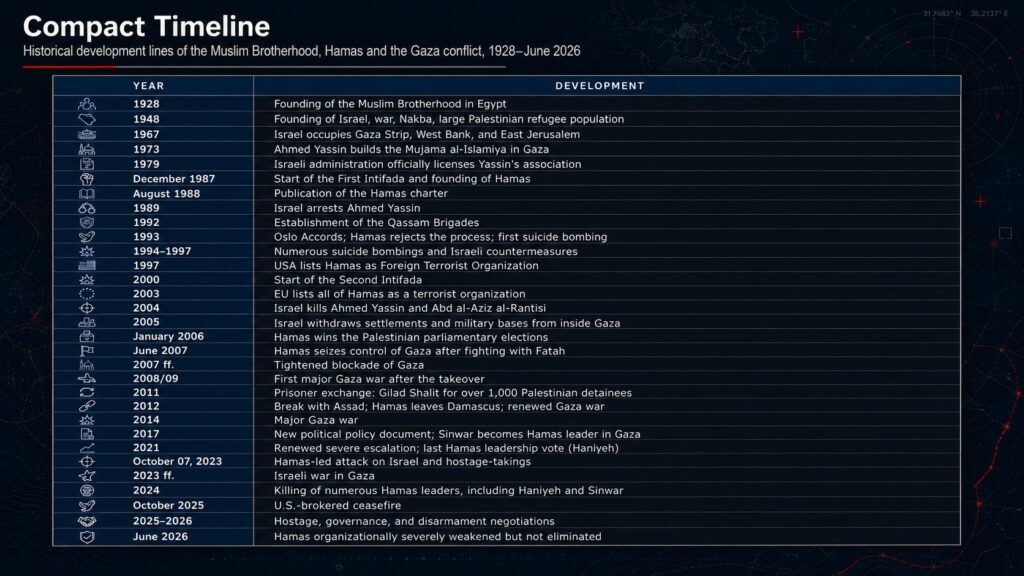
Hamas did not emerge from nowhere, nor solely from religious fundamentalism. Its organizational roots lie in the Muslim Brotherhood, founded in Egypt in 1928, which from the 1950s onward built a dense network of mosques, schools, welfare associations, and medical care in the Gaza Strip. Unlike the secular Fatah and the leftist Palestinian groups, armed struggle was not initially the focus. This long-term grassroots work gave the later Hamas a societal foundation that secular competitors did not possess in this form.
The defining founding figure was Sheikh Ahmed Yassin, born in 1936 near present-day Ashkelon. At the age of twelve he experienced the Nakba of 1948 and his family’s flight to the al-Shati refugee camp on the edge of Gaza City; an accident in his youth left him largely paralyzed. Starting in 1973, Yassin built the Mujama al-Islamiya association into an Islamic network of education, welfare, and religious mobilization, which the Israeli administration officially licensed as a charitable organization in 1979.
Here sits one of the most persistent claims: that Israel created Hamas. In this sweeping form it is false – and it is worth taking apart precisely in both directions. What is documented is that Israeli civil and military authorities treated Islamic social and religious structures in the Gaza Strip less repressively over an extended period than the secular PLO, which they actively pursued. Parts of the security apparatus regarded the Islamic organizations as a useful counterweight to the nationalists and the left. Historians such as Jean-Pierre Filiu, Beverley Milton-Edwards, and Jeroen Gunning confirm this tolerance. But tolerance is not support, and support is not founding. No reliable evidence and no declassified document shows that Israel financed, armed, directed, or ideologically shaped the Muslim Brotherhood in Gaza. Hamas emerged from a decades-old, independent Islamist milieu – and it turned against Israel.
The spark was the First Intifada. In December 1987, an Israeli truck killed several Palestinian workers in the Gaza Strip; the event met years of pent-up frustration over occupation, economic dependency, and political hopelessness. Out of the uprising, Yassin and six other activists founded Hamas in December 1987 – as an independent Palestinian resistance arm of the Muslim Brotherhood that would no longer confine itself to social work. In August 1988, the charter followed.
Self-Understanding and Ideology
Hamas is simultaneously Islamist and nationalist. Islamist because it understands Islam as a religious foundation, societal order, and legitimation of resistance. Nationalist because it fights for a Palestinian polity, the right of return for refugees, the end of the occupation, and political self-determination. In its reading, Palestine is not merely a homeland but a religiously entrusted Islamic land – a waqf, of which no generation may cede any part. This distinguishes its nationalism from Fatah’s secular variant.
The charter of 1988 is central to the early Hamas – and it must be named without varnish. It declares Palestine an Islamic endowment, presents armed jihad as the path to liberation, and categorically excludes negotiations with Israel. Above all, it contains open antisemitism that goes far beyond criticism of Zionism or Israeli policy: Article 22 ascribes to Jews control over world media, the instigation of world wars, and revolutions; Article 32 explicitly invokes the “Protocols of the Elders of Zion,” the antisemitic forgery of the early 20th century. This is religiously and conspiracy-ideologically grounded antisemitism, not mere anti-Zionism. An objective account may neither conceal this nor pretend that every criticism of Israel is therefore automatically antisemitic.
In 2017, Hamas published a new policy document, A Document of General Principles and Policies. It dispenses with the antisemitic formulations and explicitly states that the struggle is directed against the Zionist project, not against Jews because of their religion. It accepts a Palestinian state within the 1967 borders with East Jerusalem as its capital as “national consensus” – albeit without recognizing Israel and without abandoning the claim to all of historic Palestine. The assessment of this document is contested, and both common readings carry part of the truth: some see a genuine ideological evolution, others tactically modernized language. The defensible formulation reads: the 2017 document substantially moderated language and political positioning but did not unambiguously revoke the 1988 charter and did not eliminate its fundamental contradictions. Israel continues not to recognize it.
How It Is Organized
Hamas does not possess a purely personal leadership structure. At the top stands the chairman of the Political Bureau as the supreme political authority; the highest collective body is the Shura Council, beneath which are regional leaderships for Gaza, the West Bank, and the external organization. Among the defining leadership figures were founder Ahmed Yassin (killed in 2004) and his successor Abd al-Aziz al-Rantisi (killed weeks later), longtime external chief Khaled Meshaal, former prime minister and Political Bureau chief Ismail Haniyeh (killed in Tehran in 2024), Gaza chief Yahya Sinwar (killed in 2024), military commander Mohammed Deif (killed in 2024), as well as Saleh al-Arouri, Khalil al-Hayya, and Musa Abu Marzouk. The density of this list is itself a finding: over two decades, Israel killed nearly the entire leadership generation without dissolving the organization.
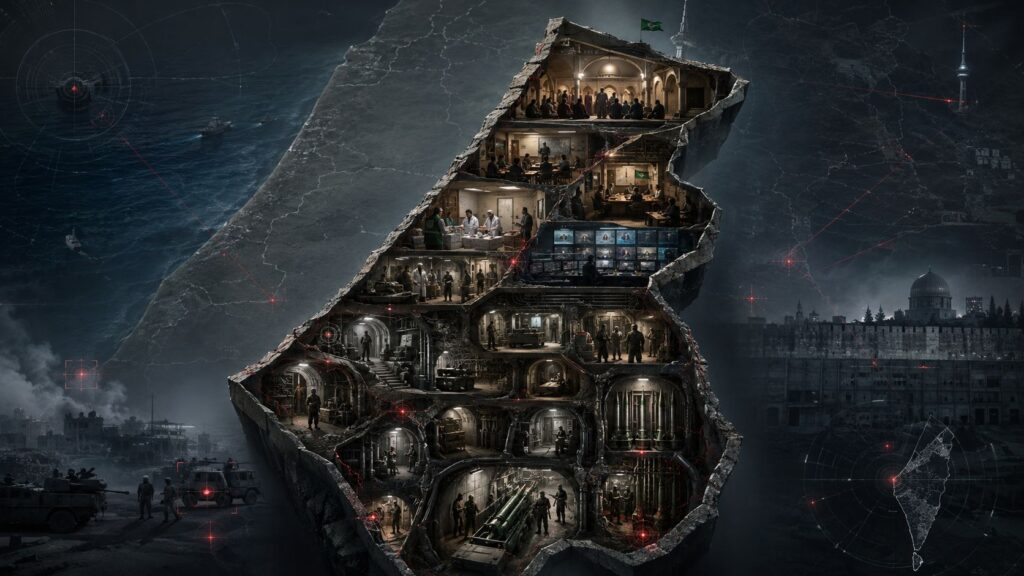
The armed wing is the Izz ad-Din al-Qassam Brigades, named after the Syrian-Palestinian cleric who fought against the British Mandate and Zionist settlement in the 1930s. From small underground cells – Yassin founded the precursor structures al-Majd (internal intelligence) and al-Mujahideen (commando arm) in 1986 – they developed into a military apparatus that, before October 2023 and according to Palestinian and Israeli source estimates, comprised roughly 30,000 fighters in five regional brigades (North, Gaza, Central, Khan Yunis, Rafah), with infantry, rocket and mortar units, drones, maritime forces, and specialized assault units. The centerpiece is the tunnel system, which partially offsets Israeli air and intelligence superiority: it evolved from the smuggling tunnels to Egypt and was expanded under Mohammed Deif and previously Ahmed Jabari into a military network. A Hamas representative publicly estimated it at roughly 224 miles in 2021 – a self-reported figure that cannot be independently verified. Military analysts distinguish three types: smuggling and supply tunnels to the Egyptian border, defensive tunnels within Gaza for command centers and weapons depots, and cross-border attack tunnels into Israel.
Hamas sometimes presents its political, social, and military domains as separate functional areas – a separation that individual representatives as early as 1997 compared to the relationship between Sinn Féin and the IRA and that preserves a certain deniability for the political leadership. A complete organizational separation is, however, difficult to sustain: there are shared strategic goals, overarching leadership bodies, personnel connections, joint financing, and the political leadership’s public support for armed actions. Sinwar, for instance, embodied both sides simultaneously – political Gaza chief and central military figure. This does not mean every politician plans every operation. It means: the Qassam Brigades are not an unrelated actor that happens to stand nearby, but the armed component of the same movement. Equally notable is the decentralization: though hierarchically organized, the structures in Gaza, the West Bank, Israeli detention, and abroad can largely act independently. This architecture made the organization resilient against Israel’s strategy of targeted killings – and allowed it to survive as a movement after losing nearly all its top figures.
Financing
Hamas’s funding sources shifted over time, and their relationship to each other is the actual finding. Early on, it relied on private donations, religious levies, and Islamic welfare networks in the Arab and Muslim world; Palestinian expatriates and donors in the Gulf contributed a large share. With Iran, a significant financier and arms supplier entered starting in the late 1980s – owing to Gaza’s geographic isolation, less through direct arms deliveries than through money, technology, and components. The then-commander of Iran’s Revolutionary Guards, Mohammad Ali Jafari, openly stated in 2012 that Tehran delivered technology and components through the tunnels with which the Qassam Brigades manufactured their own version of the Iranian Fajr-5 rocket, capable of reaching Tel Aviv.
As a de facto government, Hamas after 2007 developed its own revenues that relativized its dependence on Iran: import duties, business taxes, fees – and above all the taxation of the smuggling tunnels to Egypt, through which a large portion of goods traffic, fuel, and building materials moved under the blockade. This tunnel economy made Hamas the customs authority of its own smuggling. After the ouster of Egyptian President Mohammed Morsi in 2013, the Egyptian military closed many of these tunnels in 2014 and 2015, depriving the organization of a central revenue source.
Qatar financed projects and payments in Gaza over years – the then-emir pledged roughly $400 million for housing and roads during his 2012 visit – partly with the consent or tolerance of Israel, which thereby purchased a degree of stability under Hamas rule. A distinction must be made here: these payments supported the civilian administration and the population but also objectively stabilized Hamas rule; portraying Qatar as a direct financier of every military activity would be too sweeping. The United States further accuses Hamas of managing substantial assets through companies, real estate, and international investment networks; the U.S. Treasury and the EU sanctioned corresponding intermediaries and front companies starting in 2024. Caution is warranted with such figures: they are based in part on state sanctions and intelligence assessments that are not publicly verifiable in every detail and should be labeled as such – not as established accounting.
Control and Autonomy – The Real Difference
Here lies the analytical core of the dossier, and here Hamas differs fundamentally from Hezbollah. Hezbollah is Shia, constitutively built by Iran, and ideologically bound to the Wilayat al-Faqih, the rule of Iran’s supreme jurisprudent. Hamas is Sunni, emerged from the Muslim Brotherhood, and recognizes no Iranian religious supreme authority. For Hamas, Iran is a supporter, not a builder.
In favor of substantial Iranian influence are financing, weapons and technology transfer, military training, shared enmity toward Israel, and integration into the so-called Axis of Resistance. Against the pure proxy thesis stand Hamas’s independent emergence, its Sunni ideology, its Palestinian base, its own leadership bodies, and its own decisions that do not always align with Tehran’s interests.
The hardest evidence for this autonomy is the break over Syria. The Hamas leadership had maintained its external headquarters in Damascus since the late 1990s. When the uprising against Bashar al-Assad from 2011 onward developed into a war between predominantly Sunni rebels and the Alawite-led government, Hamas did not back Assad – unlike Hezbollah, which entered the war on the side of the government. In January 2012, Khaled Meshaal left Damascus for Doha; a few weeks later, Ismail Haniyeh publicly declared his solidarity with the Syrian opposition in Cairo. Tehran reacted angrily and temporarily reduced money and weapons; Qatar stepped in. A fully remote-controlled organization would not have made this break.
The same point is demonstrated from the other side by October 07: Iran supported Hamas’s military buildup over years, yet no publicly credible evidence that Tehran gave the specific order to attack or knew the exact timing has been presented. The clean assessment therefore reads: Hamas is an independent Palestinian actor with substantial Iranian support and strategic cooperation – but not an Iranian command organization. This differentiation is the real value added when one seeks to place Hamas in the Iran context.
The Social Apparatus as a Source of Power
One of the most common errors is to dismiss the social work as mere cover. Hamas-affiliated and Islamic networks provided real services: medical care, schools and kindergartens, poverty relief, food, support for orphans and the families of killed or imprisoned members, mosques, sports and youth programs. These structures emerged because state-provided services were absent, and for many people they were the first point of contact with the organization – not armed resistance, but the paid treatment, the maintained school, the supported widow.

The services were real – and they were simultaneously political bonding, a recruitment instrument, and a source of legitimation vis-à-vis Fatah. Whoever receives aid need not be a committed supporter. But the system created loyalty, dependency, and societal influence. Both dimensions belong together: genuine aid and political control were the same instrument here. The social apparatus should therefore be described neither as pure façade nor as neutral charity.
The De Facto State: Gaza 2007 to 2023
In January 2006, Hamas entered the Palestinian parliamentary elections under the list name “Change and Reform” and won 74 of 132 seats; Fatah received 45. The election was broadly assessed as free and fair by international observers, including the National Democratic Institute and the Carter Center. Important for understanding is the discrepancy between seats and votes: Hamas received 44.45 percent of votes cast, not an overwhelming majority. Its clear seat majority of 56 percent owed in part to the majoritarian electoral system in the districts, where the unified Hamas list outran the fragmented Fatah. Post-election polls indicated that many voters were voting less for an Islamic program or for armed resistance than against a Fatah perceived as corrupt.
The United States, the EU, and Israel tied recognition of the Hamas-led government to three conditions: recognition of Israel, renunciation of violence, acceptance of prior agreements. Since Hamas did not meet these, aid was suspended or redirected, financial transfers blocked, and Israel withheld Palestinian tax revenues. From a Western perspective, it was unacceptable to normally fund a government whose organization did not recognize Israel and continued to carry out armed attacks. From the perspective of many Palestinians, the experience read: the West demands elections but accepts the result only when the desired party wins. Both views belong in an honest account.
The power struggle with Fatah escalated in 2007. In June, Hamas forces defeated the Fatah-aligned security services within days and assumed full control of the Gaza Strip; President Abbas installed a separate government in the West Bank. Since then, two separate Palestinian domains of rule have existed. Both sides committed grave human rights violations during the fighting, as Human Rights Watch documented. The term “coup” falls short: Hamas had won an election but in 2007 prevailed by force of arms against rival forces and subsequently established a one-party rule that was never again confirmed by an election.
As a government, Hamas took over an existing administrative apparatus and supplemented it: ministries, police, internal security, courts, taxes, schools, media, border and tunnel economy. Its record is mixed. Under blockade and war, it maintained a partially functional administration and relative internal order and combated ordinary crime. At the same time, it ruled in an authoritarian manner: political repression, absence of new elections, corruption and patronage, religious pressure, military priorities, lack of accountability. Its democratic legitimation from 2006 was real – but temporally limited. No Palestinian parliamentary elections have been held since; in 2021, Abbas again postponed planned elections. The same legitimacy problem applies to the Palestinian Authority he leads.
The Defining Events
Several episodes reveal what Hamas is at its core – and what price its strategy exacted.
Hamas became internationally known in the 1990s and 2000s primarily through suicide bombings, the first in April 1993, five months before the signing of the Oslo Accords. They targeted buses, restaurants, markets, and cafés in Israel – a single example illustrates the scale: in the attack on the Sbarro pizzeria in Jerusalem in August 2001, the perpetrators killed 15 people and wounded roughly 130. Hamas declared such attacks as retaliation and as the means of a militarily inferior side. Under international humanitarian law, however, the decisive point remains: the deliberate attack on civilians is impermissible, regardless of whether the perpetrators themselves live under occupation. Strategically, the bombings spread fear in Israel, strengthened hardliners there, and weakened advocates of a negotiated peace – while simultaneously, in parts of Palestinian society, raising Hamas’s standing as an organization capable of action.
The Second Intifada from 2000 onward was more militarized than the first. In 2004, Israel killed first Yassin and a few weeks later his successor Abd al-Aziz al-Rantisi; the decentralized organization did not collapse. In 2005, Israel withdrew its settlements and permanent military presence from inside the Gaza Strip. Hamas presented this as a success of armed resistance; legally, it remained contested whether Gaza was thereby “unoccupied,” since Israel continued to control airspace, sea access, large parts of the external border, population registries, and goods traffic. After the takeover, Israel and Egypt tightened the siege of Gaza. Israel justified the blockade by the need to prevent arms deliveries and protect against rocket attacks; critics characterize it as collective punishment, since it affected the entire goods traffic, economy, and living conditions of the population over years. Recurring Gaza wars followed – 2008/09, 2012, 2014, 2021 – in a similar pattern of escalation, rocket fire, airstrikes, sometimes ground offensives, high civilian casualties, ceasefire, reconstruction, and renewed rearmament. None of these rounds resolved the political causes.
An episode from 2011 explains the logic that would recur twelve years later. In June 2006, Qassam fighters had abducted the Israeli soldier Gilad Shalit through a tunnel; after more than five years and German and Egyptian mediation, he was released in October 2011 – in exchange for 1,027 Palestinian prisoners, 280 of whom were serving life sentences. Among the freed was Yahya Sinwar, the later Hamas chief in Gaza and presumed central planner of October 07. The exchange demonstrates two things: the prisoner question holds enormous significance in Palestinian society – many families have relatives in Israeli detention – and the abduction of individual soldiers proved, from Hamas’s perspective, an effective instrument of leverage. Precisely this calculus, on a far larger scale, underlay October 07.
October 07, 2023 then broke every framework. In the morning, Hamas and other groups fired thousands of rockets at Israel and breached the border barriers at numerous points. Armed fighters attacked military bases, border posts, kibbutzim, towns, and a music festival. According to corrected Israeli figures, roughly 1,200 people were killed, a substantial proportion of them civilians; approximately 250 were abducted to Gaza as hostages. The UN Commission of Inquiry (COI) found that the military wings of Hamas and Palestinian Islamic Jihad, as well as participating civilians, committed the war crimes of deliberate attacks on civilians and hostage-taking, frequently accompanied by further grave abuses. On sexualized violence, the commission concluded there were reasonable grounds to believe that sexualized violence was committed on October 07 at multiple locations – including the Nova festival, several kibbutzim, and the Nahal Oz base; for hostages in Gaza, it found, by its own assessment, clear indications of sexualized violence and torture. Hamas denies that its fighters deliberately killed civilians or committed sexualized violence. Not every early individual claim was confirmed, and the exact organizational responsibility requires further investigation – but the UN-supported findings are robust enough to preclude either extreme assertion.

The same commission assessed the Israeli conduct of war in Gaza that followed October 07: massive destruction, very high Palestinian casualty figures, large-scale displacement, collapse of the healthcare system. The COI saw in this war crimes and crimes against humanity, including the deliberate destruction of the healthcare system and the mistreatment of prisoners. Israel rejects these findings, as it does those regarding October 07, and accuses the commission of systematic bias. For an objective dossier, the symmetry is decisive: the same independent investigation underpins both columns; in both cases, the accused side rejects the report. The crimes of one side do not cancel the responsibility of the other. October 07 does not justify unlimited violence against the population of Gaza; the destruction of Gaza does not retroactively make the killing of Israeli civilians lawful.
Human Rights Record
Hamas also faces criticism regarding its own population. Attributed to it and its security apparatus are arbitrary arrests, torture and mistreatment, restrictions on press freedom, suppression of the opposition, death sentences, and the persecution of suspected collaborators. A UN investigation documented cases of severe violence and public executions against Palestinians accused of cooperation with Israel or looting for the years 2024 and 2025; parts of this were assessed as possible war crimes.
Context matters here without serving as an excuse: the Fatah-led Palestinian Authority in the West Bank is also criticized for torture, political persecution, and restrictions on freedom of expression. This does not exonerate Hamas but prevents the false impression that intra-Palestinian repression comes from only one side.
Allies and Adversaries
Hamas can only be understood within the Palestinian and regional web. Its most important intra-Palestinian rival is Fatah, the strongest faction of the secular-nationalist PLO; the conflict between the two is at least as important for understanding Hamas as the conflict with Israel. The smaller Palestinian Islamic Jihad is more closely tied to Iran, more focused on armed struggle, and lacks a comparable government and social apparatus; as a government, Hamas at times even tried to restrain it from escalations, landing in the contradictory dual role of resistance organization and governing authority. With Lebanon’s Hezbollah it shares enmity toward Israel and the relationship with Iran, but the relationship is one of partnership, not the hierarchical one between Iran and Hezbollah – the confessional and national differences are substantial. On October 07, other groups participated alongside Hamas, including the PIJ and the Popular Front; not every individual act is therefore attributable to a specific Hamas unit. Hamas, however, planned and led the overall operation and as the dominant organization bore the central responsibility.
A separate, highly contested point of dispute is the accusation that Hamas uses its own population as human shields. Here the source landscape divides sharply, and both sides belong side by side, properly attributed. Amnesty International, Human Rights Watch, and a 2009 UN Fact-Finding Mission found no evidence, for the earlier Gaza wars, of the specific intent to use civilians to protect military targets – but they did find that Hamas fired rockets from civilian areas and placed military equipment near residential buildings, which endangers the population and violates international law without meeting the legal standard of the human-shield charge. Other analyses – notably by Lawfare, the Foundation for Defense of Democracies, and referencing a U.S. intelligence assessment on al-Shifa Hospital – argue that Hamas systematically embedded fighters, command structures, and weapons in civilian infrastructure and thereby met the standard. The legal term requires the deliberate use of civilians to protect a military target; not every military presence in one of the most densely populated regions on earth proves this intent. What remains decisive in both directions: even if one side unlawfully uses civilians as human shields, the attacking side remains bound by distinction, precaution, and proportionality – the civilian population does not lose its protection. The Israeli human rights organization B’Tselem documents, moreover, that Israeli security forces have also repeatedly compelled Palestinians for military tasks.
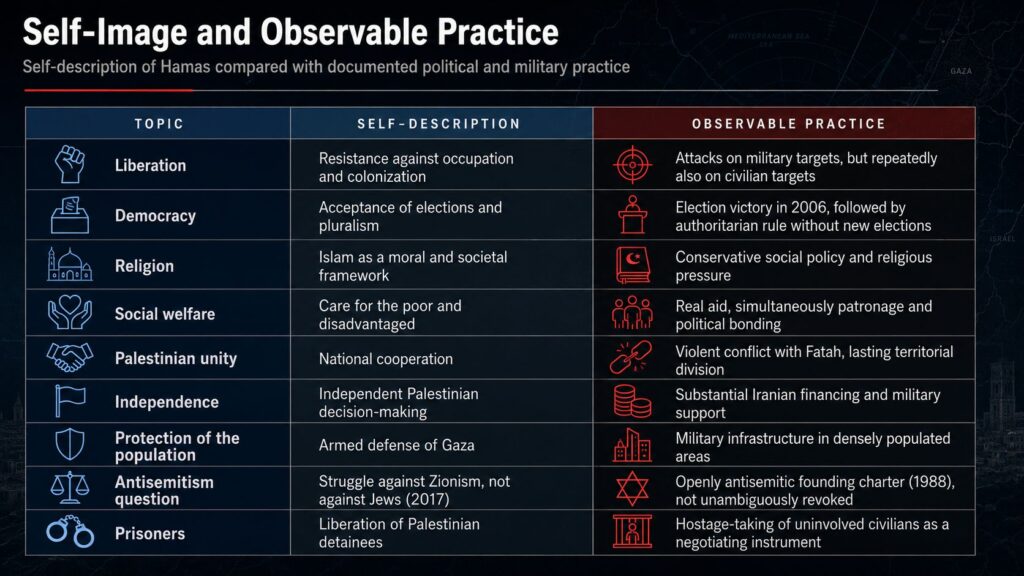
Both columns describe the same organization. The table does not resolve the contradiction – it records it.
The Most Common Misconceptions
“Israel founded Hamas.” False in this sweeping form. Israel tolerated and at times favored Islamic social structures as a counterweight to the PLO. Hamas itself emerged from the Palestinian Muslim Brotherhood and developed its own leadership. Tolerance is not founding.
“Hamas is merely an Iranian tool.” Too simplistic. Iran is an important supporter, but Hamas has its own roots, a Sunni ideology, a Palestinian base, and its own decision-making structures – the Syria break of 2012 proves it.
“Hamas represents all Palestinians.” False. It possesses real support, but neither all Palestinians nor all people in Gaza support it.
“The people of Gaza voted for October 07 in 2006.” False. The election took place 17 years earlier under entirely different conditions; a large share of the current population was underage or unborn at the time.
“Hamas won in 2006 with an overwhelming vote majority.” False. It won a clear seat majority but only 44 percent of the vote; the electoral system amplified the result.
“The 1988 charter is meaningless.” Too simplistic. It is a central founding document and contains genuine antisemitism.
“The 2017 document changed nothing.” Also too simplistic. It substantially changed language and positioning without unambiguously abandoning all old aims.
“All Palestinian resistance is terrorism.” False. Attacks on military targets are assessed differently under law than deliberate attacks on civilians.
“If Hamas operates from civilian areas, any Israeli attack is permissible.” False. Israel remains bound by international humanitarian law, distinction, and proportionality.
“Without Hamas there would be peace.” Not provable and probably too simplistic. Occupation, settlement construction, the refugee question, the status of Jerusalem, and Palestinian statehood existed before Hamas and would not automatically disappear with it.
Overall Assessment
Hamas did not emerge because a group of people one day decided to hate Israel or Jews for no reason. It emerged from occupation, stateless existence, the refugee experience, religious mobilization, the weakness and corruption of Fatah, the failure of diplomatic processes, and a decades-old Islamic social movement. These origins are real and politically comprehensible, and they gave parts of the Palestinian population organization, services, religious and national identity, and the sense of not being entirely at the mercy of the occupation.
At the same time, its founding ideology contains antisemitism; it repeatedly attacked civilians, carried out suicide bombings and indiscriminate rocket fire, took hostages, established an authoritarian rule in Gaza, suppressed Palestinian opponents, and frequently prioritized its military strategy over the immediate safety of the population. The West is not a neutral observer in this: the United States and European states support Israel politically, militarily, and economically, shaped the regional order, long protected a peace process that produced no Palestinian state, and responded to the 2006 election victory with isolation. This confirmed the Hamas narrative that negotiations and Western-organized democracy would not deliver Palestinian self-determination – and it still does not make its attacks on civilians lawful.
The most concise defensible assessment therefore reads: Hamas is an independently emerged Palestinian Islamic-nationalist resistance, party, and social movement with real societal support that, after its election victory, developed into an authoritarian de facto government, cooperates closely with Iran without being its chain of command, and alongside attacks on military targets has repeatedly attacked civilians and taken hostages. To call it only a “terrorist organization” prevents understanding of its emergence, its base, and its function. To call it only a “resistance movement” conceals its crimes, its rule, and its power interests. To describe it only as an “Iranian proxy” ignores its Palestinian roots. And to equate it with the entire population of Gaza holds more than two million people responsible for the decisions of an organization that has not faced a general election in twenty years. Hamas is both at once: a product of the unresolved Palestine conflict and an actor whose own decisions have contributed to that conflict’s persistence and brutalization.
Status: June 30, 2026 After two years of war, Hamas is severely damaged militarily and organizationally: numerous commanders were killed along with the leadership figures Ismail Haniyeh (2024) and Yahya Sinwar (2024); large parts of Gaza are destroyed. A U.S.-brokered ceasefire entered into force on October 10, 2025 and ended the two-year main phase of the war. On the basis of President Trump’s 20-point plan and under the oversight of a “Board of Peace,” negotiations have since been underway on the second phase: disarmament of Hamas, a technocratic transitional administration for Gaza, and the deployment of an international stabilization force. Hamas continues to refuse disarmament as long as Israel has not left Gaza; Israel maintains the so-called “Yellow Line” in the east of the territory and conducts ongoing strikes. The number of Palestinians killed since the start of the ceasefire is reported differently – from several hundred (Israeli reading, earlier phase) to close to one thousand (figures from the Gaza Government Media Office, mid-2026); an independently confirmed total does not exist. The leadership question remained unresolved as of mid-2026: since Sinwar’s death, Hamas has been led by a collective council (including Khaled Meshaal, Khalil al-Hayya, Zaher Jabarin, Mohammed Darwish, and Nizar Awadallah); the election to head the Political Bureau was considered contested, with al-Hayya and Meshaal as the leading candidates and internal differences over the future in Gaza and regional alliances.
If you would like to continue reading analyses like this here in the future, please consider supporting my work.


About the Author
Michael Hollister
is a geopolitical analyst and investigative journalist. He served six years in the German military, including peacekeeping deployments in the Balkans (SFOR, KFOR), followed by 14 years in IT security management. His analysis draws on primary sources to examine European militarization, Western intervention policy, and shifting power dynamics across Asia. A particular focus of his work lies in Southeast Asia, where he investigates strategic dependencies, spheres of influence, and security architectures. Hollister combines operational insider perspective with uncompromising systemic critique – beyond opinion journalism. His work appears on his bilingual website (German/English) www.michael-hollister.com and in investigative outlets across the German-speaking world and the Anglosphere.
Sources
- The Avalon Project, Yale Law School – Hamas Covenant 1988 (primary text of the charter, incl. Articles 22 and 32): https://avalon.law.yale.edu/20th_century/hamas.asp
- Federation of American Scientists (FAS) – The Covenant of the Hamas, Main Points (charter excerpts): https://irp.fas.org/world/para/docs/880818a.htm
- Wilson Center – Doctrine of Hamas (charter 1988, 2017 document in full text): https://www.wilsoncenter.org/article/doctrine-hamas
- Combating Terrorism Center at West Point – Inside Hamas: How It Thinks, Fights, and Governs (founding, Yassin, al-Majd/al-Mujahideen): https://ctc.westpoint.edu/inside-hamas-how-it-thinks-fights-and-governs/
- Israel Institute of New Zealand – How Hamas Was Founded and Why the “Israel Created It” Narrative Fails (tolerance ≠ founding; Filiu, Milton-Edwards, Gunning): https://israelinstitute.nz/2025/11/how-hamas-was-founded-and-why-the-israel-created-it-narrative-fails/
- Britannica – Hamas: Definition, History, Ideology (founding 1987, charter, October 07): https://www.britannica.com/topic/Hamas
- PBS NewsHour – What is Hamas? Origins, leaders and funding: https://www.pbs.org/newshour/world/what-is-hamas-what-to-know-about-its-origins-leaders-and-funding
- Middle East Institute – Hamas (backgrounder; ideology, Fatah rivalry, Gaza wars): https://mei.edu/backgrounder/hamas/
- Wikipedia – 2006 Palestinian legislative election (results, NDI/Carter Center): https://en.wikipedia.org/wiki/2006_Palestinian_legislative_election
- U.S. Senate / Government Publishing Office – Palestinian Legislative Council Elections: Challenges of Hamas’ Victory (seat/vote distribution): https://www.govinfo.gov/content/pkg/CPRT-109SPRT26018/html/CPRT-109SPRT26018.htm
- Konrad-Adenauer-Stiftung – Results of the Elections of the Palestinian Legislative Council 2006 (44.45%; 56.1% of seats): https://www.kas.de/c/document_library/get_file?uuid=c0e0eae4-3c84-3a20-81aa-24099c7da11e&groupId=252038
- Council on Foreign Relations – Hamas Breaks From Syria (break with Assad 2012): https://www.cfr.org/articles/hamas-breaks-syria
- Wilson Center – The Marriage and Divorce of Hamas and Hezbollah (relocation to Doha, Iran reduces support): https://www.wilsoncenter.org/article/the-marriage-and-divorce-hamas-and-hezbollah
- TIME – Hamas Signals a Break With Iran (Damascus departure, solidarity with Syrian opposition): https://world.time.com/2012/02/29/hamas-signals-a-break-with-iran-but-is-that-good-for-israel/
- UN – Report of the Independent International Commission of Inquiry (A/HRC/56/26), May/June 2024 (war crimes October 07 and findings against Israel): https://www.un.org/unispal/document/coi-report-a-hrc-56-26-27may24/
- OHCHR – UN Commission finds war crimes and crimes against humanity (October 2024; hostages, sexualized violence, both sides): https://www.ohchr.org/en/press-releases/2024/10/un-commission-finds-war-crimes-and-crimes-against-humanity-israeli-attacks
- UN News – Gaza: Hamas, Israel committed war crimes, independent rights probe (Israel rejects report): https://news.un.org/en/story/2024/06/1150946
- Human Rights Watch – “I Can’t Erase All the Blood from My Mind”: Palestinian Armed Groups’ October 7 Assault on Israel (Qassam Brigades leading; planning): https://www.hrw.org/report/2024/07/17/i-cant-erase-all-the-blood-from-my-mind/palestinian-armed-groups-october-7
- Amnesty International UK – Q&A on Gaza (rockets from residential areas as IHL violation; Israel’s duty of protection remains): https://www.amnesty.org.uk/knowledge-hub/all-resources/gaza-questions/
- Wikipedia – Use of human shields by Hamas (Amnesty/HRW/UN 2009 found no human-shield evidence; B’Tselem on Israeli practice): https://en.wikipedia.org/wiki/Use_of_human_shields_by_Hamas
- Lawfare – The Dangerous Failure to Hold Hamas Accountable for Using Human Shields (counterposition; al-Shifa, U.S. intelligence): https://www.lawfaremedia.org/article/the-dangerous-failure-to-hold-hamas-accountable-for-using-human-shields
- Middle East Institute – Human shields or shielding Israel from accountability? (population density, intent problem): https://mei.edu/publication/human-shields-or-shielding-israel-accountability/
- EU Council (Consilium) – Sanctions against terrorism / EU Terrorist List (all of Hamas since 2003; sanctions framework 2024): https://www.consilium.europa.eu/en/policies/sanctions-against-terrorism/
- U.S. State Department – Foreign Terrorist Organizations (Hamas since 1997): https://www.state.gov/foreign-terrorist-organizations
- Wikipedia – List of leaders of Hamas (Political Bureau chairmanship vacant since Sinwar’s death, five-member council): https://en.wikipedia.org/wiki/List_of_leaders_of_Hamas
- Times of Israel – Hamas leadership vote / al-Hayya and Meshaal as candidates (May 2026): https://www.timesofisrael.com/as-hamas-chooses-first-leader-since-sinwar-fate-of-postwar-gaza-hangs-in-the-balance/
- Wikipedia – Gaza peace plan (ceasefire October 10, 2025, Board of Peace, Yellow Line, casualty figures): https://en.wikipedia.org/wiki/Gaza_peace_plan
- Al Jazeera – Hamas leader rejects disarmament while Israeli occupation of Gaza continues (February 2026): https://www.aljazeera.com/news/2026/2/8/hamas-leader-rejects-disarmament-while-israeli-occupation-of-gaza-continues
- Wikipedia – Gilad Shalit prisoner exchange (1,027 prisoners, 280 life sentences, Sinwar): https://en.wikipedia.org/wiki/Gilad_Shalit_prisoner_exchange
- Wikipedia – Al-Qassam Brigades (structure, five brigades, ~30,000 fighters, leadership): https://en.wikipedia.org/wiki/Al-Qassam_Brigades
- Wikipedia – Palestinian tunnel warfare in the Gaza Strip (three tunnel types, ~224 mi self-reported, Fajr-5, Deif/Jabari): https://en.wikipedia.org/wiki/Palestinian_tunnel_warfare_in_the_Gaza_Strip
- Asharq Al-Awsat (English) – Al-Qassam Brigades: Militant Force Shaking Israel (brigade structure, strength before 2023): https://english.aawsat.com/features/4884096-al-qassam-brigades-militant-force-shaking-israel-what-do-we-know
© Michael Hollister – All rights reserved. Redistribution, publication or reuse of this text requires express written permission from the author. For licensing inquiries, please contact the author via www.michael-hollister.com.