Iranian terrorist organization, Yemeni liberation movement, or de facto state – and why none of these three labels captures the actor.
by Michael Hollister
Exclusive published at Michael Hollister on July 03, 2026
3.153 words * 17 minutes readingtime
This analysis appears as part of Hollister’s Geopolitics. New deep-dive analyses weekly-subscribe for free.

The Label Explains Nothing
“Terrorist organization” tells you nothing about where a movement comes from, which population sustains it, which conflicts produced it, or whether it administers territory. In the case of the Houthis, the relevant designations rest on real accusations – attacks on civilian vessels, hostage-taking, cross-border strikes, recruitment of minors. The label identifies something, then, but it does not explain the actor.
It would go too far to draw the reverse conclusion that a movement is designated a terrorist organization simply because it “doesn’t like the West.” The romanticizing counter-description as a pure national liberation movement would be just as wrong as reducing the Houthis to “Iranian terrorists.” This dossier lays both dimensions side by side without resolving the contradiction. A movement can emerge from Yemeni neglect and simultaneously build an authoritarian system of rule. One does not disprove the other.
What the Houthis Are Simultaneously
The most accurate short description reads: The Houthis are a Zaidi-Islamic renewal movement that originated in Yemen and evolved from a regional protest and educational movement into an armed rebellion, then into an authoritarian de facto government, and finally into a regionally active military actor. They receive substantial support from Iran but were neither founded by Iran nor are they fully controllable from Tehran.
They are thus, at the same time: a religio-political movement, an armed organization, a family-dominated power apparatus, a party and mobilization network, a de facto state authority, a component of the so-called “Axis of Resistance” – and since 2023 an actor in the conflict over Israel, Gaza, and shipping in the Red Sea. Whoever strips away any one of these layers is no longer describing the Houthis.
The Name
The movement’s self-designation is Ansar Allah, “Supporters of God.” The common term “Houthis” derives from the al-Houthi family, specifically from Hussein Badr al-Din al-Houthi, the most important early ideologue. “Houthi” denotes neither an ethnicity nor a tribe; the movement is not simply the al-Houthi tribe but a political and religious movement with a family-based leadership core, a military apparatus, and shifting alliances.
The central leader today is Abdul-Malik Badr al-Din al-Houthi, a brother of Hussein al-Houthi, who was killed in 2004. The formal head of the controlled state apparatus is the chairman of the Supreme Political Council, currently Mahdi al-Mashat. Actual supreme authority, however, rests with Abdul-Malik al-Houthi and his innermost leadership circle.
Where They Come From
The historic core territory lies in the northern Yemeni province of Saada on the border with Saudi Arabia – mountainous, economically weak, and for a long time a religious center of Zaidism. The movement cannot be understood without four developments: the decline of the Zaidi order after the overthrow of the Imamate in 1962, the economic and political neglect of northern Yemen, the spread of Saudi-influenced Salafist institutions – particularly the center in Dammaj near Saada – and the tactically shifting approach of Ali Abdullah Saleh’s government toward regional and religious groups. The Houthis thus did not emerge as an Iranian foreign project but from an intra-Yemeni conflict over identity, power, neglect, and Saudi influence.
The immediate precursor was the youth and educational movement al-Shabab al-Mu’min, usually translated as “Believing Youth,” which emerged in the early 1990s. After the unification of North and South Yemen in 1990, political space opened up; Zaidi scholars founded schools and summer camps to revive their own tradition – partly in response to the growing Salafist presence. This early movement was not a closed guerrilla organization but encompassed educational work, cultural revival, and political participation; members of the al-Houthi family held seats in parliament at various points. The later rebellion thus emerged in part from the failure of political integration.
Self-Understanding and Mission
Zaidism is a branch of Shia Islam rooted in Yemen since the 9th century, and it differs markedly from the Twelver Shia dominant in Iran – theologically, it stands closer to certain Sunni traditions. The portrayal of a simple proxy war between “Sunnis and Shia” is therefore misleading. Central to the leadership is the concept of a special religio-political role for the Prophet’s family. Critics see in this an attempt to create a new privileged ruling class; the movement itself speaks of divine guidance and resistance against corruption and foreign domination.
The ideology is not a unified doctrine but multi-layered: Zaidi revival, religious leadership authority of the Prophet’s family, a heavily simplified anti-imperialism that casts the United States and Israel as the central adversaries and Saudi Arabia as their enforcer, solidarity with Palestine, national sovereignty, and early mobilization against corruption and poverty.

Burdening and undeniable in this context is the Sarkha, the “Scream,” in use since 2002: “God is great, death to America, death to Israel, curse upon the Jews, victory to Islam.” The Houthis explain it as a political battle cry against imperialism and Zionism. Linguistically, however, it is directed not solely against the Israeli government but against Jews as a group – this cannot be defined away by invoking Palestine. This, too, belongs in an objective picture: mobilization against genuine grievances and an explicitly antisemitic element stand side by side here.
How They Are Organized
Abdul-Malik al-Houthi holds supreme religious, political, and strategic authority. He rarely appears in public and communicates through recorded speeches; his position rests not on a state office but on his role as leader of the movement. Beneath him stands a tight circle of family members, long-standing companions from Saada, religious authorities, and security officials – personal proximity and loyalty often outweigh formal office.
Outwardly, a republican structure persists, with a Supreme Political Council, government, ministries, parliament, and courts. Some of these institutions carry over from the earlier republic but are controlled by Houthi cadres. The decisive instrument is the mushrifin, the supervisors: deployed in ministries, provinces, educational and security organs, a supervisor may formally rank below a minister yet wield more power in practice, because he is directly connected to the movement. In this way, the movement maintains a kind of state within the state – even though it now controls the state itself.
From Mountain Uprising to De Facto State
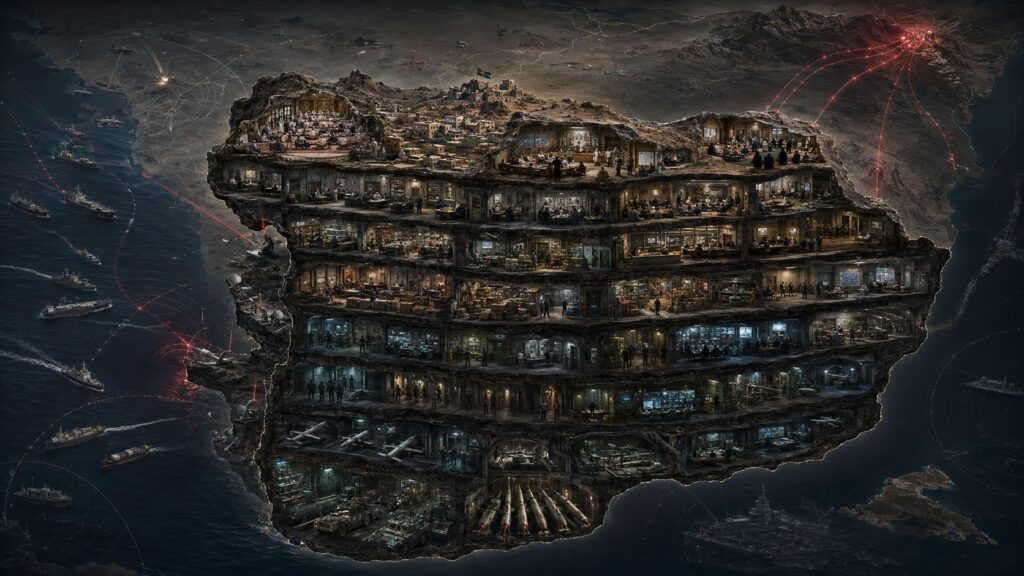
Is this still a militia? Only in part. The Houthis possess a political leadership, ministries and administrative agencies, courts, police and intelligence services, tax and customs structures, religious and media institutions, regular and irregular armed forces, missile and drone capabilities, coastal forces, prisons, and a comprehensive mobilization system. They control Sanaa and large parts of the north and west; by international estimates, roughly two-thirds of Yemen’s population may live in their territory.
That figure, however, describes only the population under their control, not their support base. More accurate than “militia” is therefore: an armed revolutionary movement with a de facto state apparatus – or an authoritarian de facto government with an autonomous military movement. This is what distinguishes the Houthis from a pure guerrilla force: they can administer, collect taxes, and enforce security.
Financing
The notion that Tehran simply wires money to fund the movement falls short. The Houthis control the most populous and economically significant part of Yemen and generate revenue from taxes, customs duties, fuel distribution, telecommunications, fees, the religious obligatory levy zakat, endowment assets, port fees, confiscations, and special levies. The zakat and endowment authorities have become particularly important institutions and are substantially under the control of the innermost leadership apparatus. A study by the Sana’a Center pointed to estimates of roughly $1.8 billion in annual tax revenue for 2022 – to be treated with caution given the absence of transparent budgets.
Beyond that, the U.S. Treasury accuses the movement of substantial revenue from the sale of Iranian oil, from shell companies, and from international procurement networks; more recent American figures place some of these flows in the billions. These are official U.S. government assessments whose evidence is not independently verifiable in every detail. The critical insight: without Iran, the Houthis would likely be militarily weaker – but without their own domestic revenues they could hardly administer millions of people and run a security apparatus.
Control and Autonomy – The Proxy Debate
Are the Houthis an Iranian proxy? In part – but not in the sense of a remote-controlled puppet. Supporting the thesis is Iranian assistance with weapons, technical knowledge, training, financing, and contacts within the “Axis of Resistance”; Lebanon’s Hezbollah also plays an advisory role. Military capabilities – above all long-range missiles and drones – developed faster than local stockpiles alone could explain, and UN investigations repeatedly found connections to Iranian designs in seized systems.

Against the pure proxy thesis stands the fact that the Houthis predated their close cooperation with Iran, possess their own Yemeni history and social base, control their own revenues, and differ religiously from Twelver Shia. Researchers at the Sana’a Center therefore describe them as a movement with interests that align with Iran’s rather than as a mere tool. The comparison with Hezbollah makes the distinction visible: Hezbollah is more tightly integrated into the Iranian system through the ideological principle of the “Supreme Jurisprudent.” The Houthis adopt elements of Iranian revolutionary rhetoric but possess their own religious tradition and a pronounced Yemeni claim to power. The relationship is a strategic partnership with asymmetric dependency.
The Defining Events
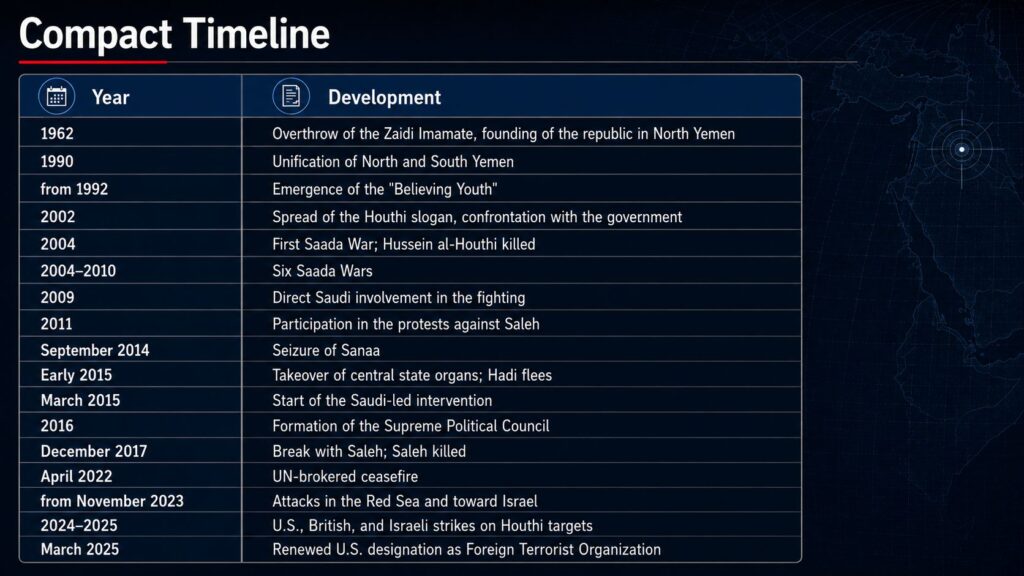
The Houthis’ rise can be traced through a few turning points. Between 2004 and 2010, the government and the movement fought six Saada wars. Hussein al-Houthi was killed on September 10, 2004 – the government expected the movement to disintegrate, but his death made him a martyr and gave the movement a galvanizing symbol; leadership passed to his brother Abdul-Malik. Each round of war made the movement more militarily experienced, while the government lost legitimacy in Saada.
In 2011, the Houthis joined the protests against Saleh. What proved decisive afterward was the paradoxical alliance with the very president against whom they had fought six wars: after his resignation, Saleh still commanded networks within the military and bureaucracy and wanted to weaken his successor; the Houthis needed military expertise and access. Saleh-loyal units enabled the advance on Sanaa, which the Houthis largely seized on September 21, 2014. The rapid success is thus explained not by the strength of a mountain guerrilla force alone – parts of the old state effectively switched sides. The alliance collapsed in December 2017; Saleh was killed by Houthi fighters while attempting to flee, and the movement built a more centralized system of rule.
In March 2015, a Saudi-led coalition intervened. Instead of the expected quick victory, a protracted war developed in which the Houthis held Sanaa, Saada, and large parts of the highlands, while the opposing side fragmented into government troops, separatists, tribal alliances, and militias. The war was waged by virtually all major parties with grave violations of international humanitarian law – coalition airstrikes hit civilian facilities, the Houthis shelled civilian areas, laid mines, and fired missiles at Saudi Arabia. Since the 2022 ceasefire, the conflict has calmed but remains politically unresolved.
The Red Sea Attacks
Since November 2023, the Houthis have attacked numerous merchant and military vessels. They initially claimed to target only ships with connections to Israel but later expanded their target categories. They present the attacks as support for the Palestinians – and Palestine has been a fixed component of their ideology for more than two decades, not something invented in 2023. At the same time, several ships struck had no clearly identifiable connection to Israel; the attacks endangered civilian seafarers, caused deaths, and forced shipping companies to reroute around Africa. The claim of a consistently circumscribed blockade of Israeli shipping is therefore untenable.
The attacks serve multiple functions simultaneously: support for the Palestinian cause, elevation of the Houthis’ standing in Arab public opinion, demonstration of regional reach, domestic legitimation, and pressure on Western states. Whether they constitute “terrorism” depends on the individual act: an attack on a military target is assessed differently from a deliberate strike against civilian vessels and crews to generate political pressure – the latter can be classified as a terrorist act or a grave violation of international law regardless of political sympathy. That, however, does not describe the movement’s entire history and state function.
Human Rights Record
The Houthis have built a pronounced apparatus of repression. Documented or credibly alleged are arbitrary detention, enforced disappearances, torture, special courts targeting political opponents, restrictions on press freedom, pressure on women activists, recruitment of minors, and obstruction of humanitarian aid. The recruitment of children is among the best-documented accusations; in 2022, the authorities in Sanaa signed a UN action plan for its cessation, which acknowledges the problem but does not automatically end it.
Here, too, context applies without serving as an excuse: the Yemen war was waged by nearly all major conflict parties with grave human rights violations – the Saudi-led coalition bombed civilian targets, government-aligned and southern forces operated secret prisons. Objectivity does not mean declaring all sides equally responsible but measuring each side’s accountability against its own actions.
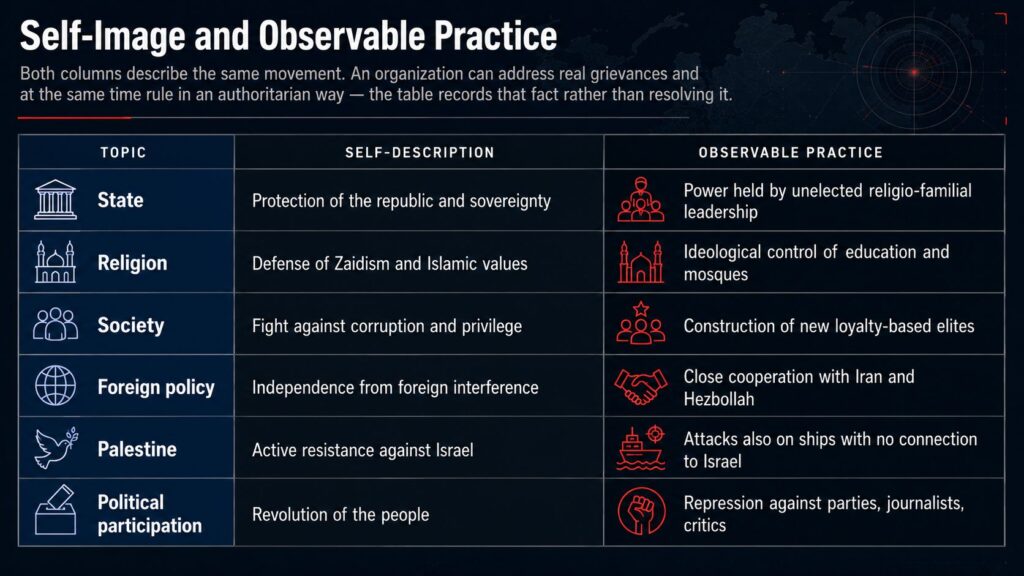
Both columns describe the same movement. An organization can address genuine grievances and rule in an authoritarian manner at the same time – the table records that rather than resolving it.
The Inconsistent Designation
Who lists the Houthis as a terrorist organization is internationally inconsistent. The United States redesignated Ansar Allah as a Foreign Terrorist Organization effective March 5, 2025 – prior to that, there had been several reversals: an initial designation shortly before the end of the first Trump administration in 2021, revocation by the Biden administration out of concern for humanitarian aid, and later a lower sanctions category. Australia designated the Houthis as a terrorist organization in May 2024. The UN Security Council in Resolution 2624 (2022) referred to them as a “terrorist group” and expanded the arms embargo – this applies, however, to the specific Yemen sanctions framework, not to the general UN list for IS and al-Qaeda.
The European Union does not list Ansar Allah on its general terror list but implements UN sanctions against individual leaders. The United Kingdom has not proscribed the movement under the Terrorism Act but participated in strikes on Houthi targets. Germany officially uses the designation “Houthi militia” and implements UN and EU sanctions without an independent terror listing. The designation is thus not a globally uniform fact but a legal decision by individual states – the underlying acts can be examined independently of it.
The Most Common Misconceptions
“Iran founded the Houthis.” False. The movement emerged from Yemeni conflicts; close Iranian support came later and increased sharply during the war from 2015 onward.
“The Houthis are simply Shia like the Iranians.” False. They come from Zaidism, which differs markedly from Iran’s Twelver Shia.
“All Zaidis are Houthis.” False. Many Zaidis reject the Houthis’ rule or support it only tactically.
“The Houthis are just a militia.” Outdated. They operate a comprehensive de facto state apparatus.
“The Houthis represent all of Yemen.” False. They control the largest share of the population, but the country remains deeply divided.
“They are fully controlled by Iran.” Too simplistic. They are closely connected to Iran but possess their own leadership, revenues, and interests.
“The terrorism label is nothing but Western propaganda.” Also too simplistic. Its application is politically selective and inconsistent – but several Houthi actions demonstrably meet criteria that must be examined independently of Western policy.
Overall Assessment
The Houthis are an example of why simple labels do not explain political violence. They are not a group artificially created by Iran – their emergence is explained by Yemen’s history, the decline of Zaidi institutions, regional neglect, state repression, and competition with Saudi-influenced currents. They are equally not a mere resistance movement against external aggression: they have built an authoritarian apparatus of rule, curtailed political competition, persecuted opponents, mobilized minors, and repeatedly endangered civilian shipping.
They possess genuine societal support but govern through coercion, patronage, and ideological control. They are closely allied with Iran but not fully controlled. They take up legitimate grievances but use them to legitimize their own power. And they combine pre-modern religious leadership claims with modern missile warfare, bureaucracy, intelligence control, and a war economy. The label “terrorist organization” names a part of that. It does not explain the whole.
Status: June 29, 2026 The United Nations described the situation in June 2026 as relatively calm but still politically unresolved. At the same time, they stated that 73 UN staff members were being arbitrarily detained by the Houthi de facto authorities; one staff member had died in custody – these detentions significantly impair humanitarian operations. A limited positive signal was an agreement on the release of more than 1,600 prisoners. The intra-Yemeni conflict remains unresolved despite relative calm. Human Rights Watch called for the immediate release of detained UN and civil society staff.
If you regularly read my updates and analyses, I would be grateful for your ongoing support
…or please leave me a small tip to support this work.

About the Author
Michael Hollister is a geopolitical analyst and investigative journalist. He served six years in the German military, including peacekeeping deployments in the Balkans (SFOR, KFOR), followed by 14 years in IT security management. His analysis draws on primary sources to examine European militarization, Western intervention policy, and shifting power dynamics across Asia. A particular focus of his work lies in Southeast Asia, where he investigates strategic dependencies, spheres of influence, and security architectures. Hollister combines operational insider perspective with uncompromising systemic critique-beyond opinion journalism. His work appears on his bilingual website (German/English) www.michael-hollister.com, at Substack and in investigative outlets across the German-speaking world and the Anglosphere.
This analysis appears as part of Hollister’s Geopolitics. New deep-dive analyses weekly-subscribe for free.
Sources
- UN Security Council, Resolution 2624 (2022) – Designation as “terrorist group,” arms embargo: https://press.un.org/en/2022/sc14810.doc.htm
- UN Security Council, Sanctions rationale “The Houthis” (attacks on civilians, sexual violence, child recruitment, mines): https://main.un.org/securitycouncil/en/content/houthis-0
- U.S. State Department, FTO designation of Ansarallah, March 4, 2025: https://www.state.gov/designation-of-ansarallah-as-a-foreign-terrorist-organization/
- Federal Register, FTO designation – effective upon publication March 5, 2025: https://www.federalregister.gov/documents/2025/03/05/2025-03629/foreign-terrorist-organization-designation-of-ansarallah
- Australian Government (National Security), Ansar Allah listed as terrorist organization, effective May 24, 2024: https://www.nationalsecurity.gov.au/what-australia-is-doing/terrorist-organisations/listed-terrorist-organisations/ansar-allah
- Sana’a Center for Strategic Studies – “How Iran’s Islamic Revolution Does, and Does Not, Influence Houthi Rule” (not a puppet, movement with aligned interests; revenue estimate): https://sanaacenter.org/publications/analysis/9050
- UN Special Representative for Children and Armed Conflict, Action plan with the Houthis, April 2022: https://childrenandarmedconflict.un.org/2022/04/new-action-plan-to-strengthen-the-protection-of-children-affected-by-armed-conflict-in-yemen-signed-with-the-houthis/
- U.S. Treasury (OFAC), Sanctions targeting Houthi oil revenue, June 20, 2025 – documented at FDD: https://www.fdd.org/analysis/2025/07/01/treasury-targets-houthi-oil-revenue-building-on-us-sanctions-against-the-group/
- Council on Foreign Relations – “Iran’s Support of the Houthis” (UN investigations into weapons with Iranian design features, “informal partner”): https://www.cfr.org/articles/irans-support-houthis-what-know
- Arab News – UN Secretary-General on 73 detained staff members, one death (June 10, 2026): https://www.arabnews.com/node/2646690/amp
- Security Council Report (73 detained, release of over 1,600 prisoners, “relatively calm, unresolved”): https://www.securitycouncilreport.org/whatsinblue/2026/06/yemen-briefing-and-consultations-45.php
- Human Rights Watch – Yemen: Houthis Should Free UN, Civil Society Staff, June 7, 2026: https://www.hrw.org/news/2026/06/07/yemen-houthis-should-free-un-civil-society-staff
© Michael Hollister – All rights reserved. Redistribution, publication or reuse of this text requires express written permission from the author. For licensing inquiries, please contact the author via www.michael-hollister.com.