Party, Militia, Social State, Resistance Movement, or Iranian Proxy-and Why None of These Labels Alone Suffices.
by Michael Hollister
Exclusive published at Michael Hollister on July 01, 2026
3.211 words * 17 minutes readingtime
This analysis appears as part of Hollister’s Geopolitics. New deep-dive analyses weekly-subscribe for free.

The Label Explains Nothing
In Western capitals, one word suffices to describe Hezbollah: terrorist organization. The word spares the question of where a movement comes from, which population sustains it, which wars produced it, and why half a Lebanese confession remained loyal to it for more than four decades. It is a label, not a finding.
The reverse, however, would be equally useless. Hezbollah is not a pure liberation movement onto which the wrong label has been pinned. It is held responsible for hostage-takings, attacks on embassies and barracks, international operations, and armed pressure on its own state. Both reductions-the demonizing and the romanticizing-miss the same subject. This dossier places both levels side by side and does not resolve the contradiction. An organization can arise from real disadvantage and simultaneously erect an armed parallel power. The one does not disprove the other.
What Hezbollah Is Simultaneously
The most neutral short description reads: Hezbollah is a Shia Islamist movement that emerged during the Lebanese Civil War, was substantially built and permanently supported by Iran. It combines a political party, a social welfare apparatus, an intelligence service, and an independent army. Its societal roots are Lebanese; its religious-strategic orientation is closely linked to the Islamic Republic of Iran.
It is thus not sequentially but at the same time: a Lebanese movement, a parliamentary party, a military apparatus outside full state control, an extensive social, educational, and media network, the representative of large parts of the Shia population, a central pillar of Iran’s regional alliance-and an organization credited with numerous attacks, abductions, and assaults on civilians. This simultaneity is the real key. Whoever strikes out one of these layers is no longer describing Hezbollah but a more convenient invention.
The Name
The Arabic name Hizb Allah means “Party of God.” It is drawn from Quranic language and is meant to express that the movement sees itself not as an ordinary party but as part of a religiously sanctioned struggle. Several transliterations are common-Hizbollah, Hisbollah, Hezbollah, the last being standard in English. It is neither an ethnic group nor a separate confession: the organization recruits its social base primarily from the Lebanese Twelver Shia population.
Where It Comes From
Hezbollah cannot be understood without the structure of Lebanon. The country is not an ordinary centralized state but distributes offices and parliamentary seats by confession: the president is a Maronite Christian, the prime minister a Sunni Muslim, the speaker of parliament a Shia Muslim. This system was designed to prevent the dominance of a single community. In practice, it produced patronage, weak institutions, confessional parties, and competing security apparatuses.
Lebanon’s Shia historically numbered among the country’s most disadvantaged groups. Many lived in the neglected south, in the poor northern Bekaa Valley, or in the growing slums around Beirut, where schools, clinics, roads, and public-sector jobs were absent. The political order long rested on a 1932 census; although the Shia share of the population later grew substantially, political power remained limited. On this soil, the Iranian-born cleric Musa al-Sadr first mobilized a Shia self-organization and the armed Amal Movement-religious, but more Lebanese-national in orientation than the later Hezbollah. His unexplained disappearance in Libya in 1978 made him a symbolic figure.
Two destructive developments were added. From 1975 to 1990, an extraordinarily complex civil war dismantled the Lebanese state; militias controlled neighborhoods, ports, and economic sectors. And from 1970 onward, the PLO, after its expulsion from Jordan, relocated part of its military structures to southern Lebanon, from where it attacked Israel. Israel responded in 1978 with Operation Litani and in 1982 with a large-scale invasion reaching Beirut. For many Shia, the relationship to the PLO was initially ambivalent-some welcomed its expulsion. It was the enduring Israeli occupation with its checkpoints, arrests, destruction, and civilian casualties that became the decisive catalyst for Hezbollah’s emergence.
The organization took shape gradually between 1982 and 1985 from a network of Shia clerics, former Amal members, Islamic student groups, and armed cells. The invasion of 1982 is regarded as the trigger, after which Iranian Revolutionary Guards arrived in the Syrian-controlled Bekaa Valley. The movement published its first public program in February 1985 with the “Open Letter to the Oppressed.” Unlike with the Houthis, Iran’s role here is not supporting but constitutive: Tehran assisted with training, arming, financing, and ideological instruction and brought together various Shia Islamist groups. Syria tolerated this presence because it considered the movement useful against Israel and for exerting influence in Lebanon.
Self-Image and Mission
Hezbollah belongs to the Twelver Shia, the same branch that dominates in Iran-a distinction from the Zaidi Houthis. Its key political doctrine, however, is not Twelver Shiism alone but the concept of Wilayat al-Faqih developed by Ayatollah Khomeini-the guardianship of the supreme Islamic jurist during the absence of the Twelfth Imam. Hezbollah originally recognized Khomeini and later the respective Iranian Supreme Leader as the highest religious-political authority. This is the central difference from an ordinary Lebanese party: its highest ideological authority does not reside exclusively in Lebanon.
The 1985 program was revolutionary, anti-Western, and expressly Islamist-it demanded the expulsion of Israel, American and French influence, and recognized Khomeini as its leadership. It arose, however, in a situation of civil war, occupation, and Western military presence. In the 1990s, a development termed “Lebanonization” followed: the movement accepted elections, fielded candidates, participated in governments, cooperated with Christians, and shelved the immediate demand for an Islamic state. The 2009 manifesto spoke more about national sovereignty, social justice, and reform. This did not mean a complete departure from armed resistance or from the bond with Iran. The apt formula: Hezbollah did not abandon its revolutionary worldview but adapted its practice to a pluralistic, majority non-Islamist Lebanon.
How It Is Organized
At the apex stands the Secretary-General as the public face and most important political authority. The defining officeholders have been Subhi al-Tufaili, Abbas al-Musawi, Hassan Nasrallah, and-since October 2024-Naim Qassem. Nasrallah led the organization from 1992 until his killing in an Israeli airstrike in September 2024. The highest collective body is the Shura Council, with subordinate specialized councils for politics, the military, administration, social affairs, parliament, and religion.
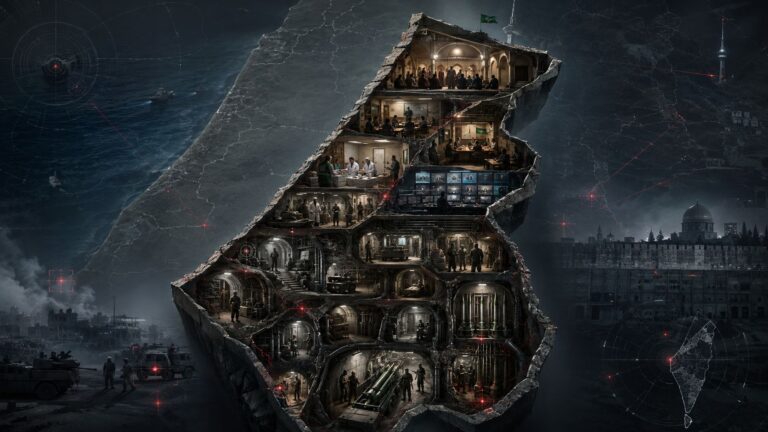
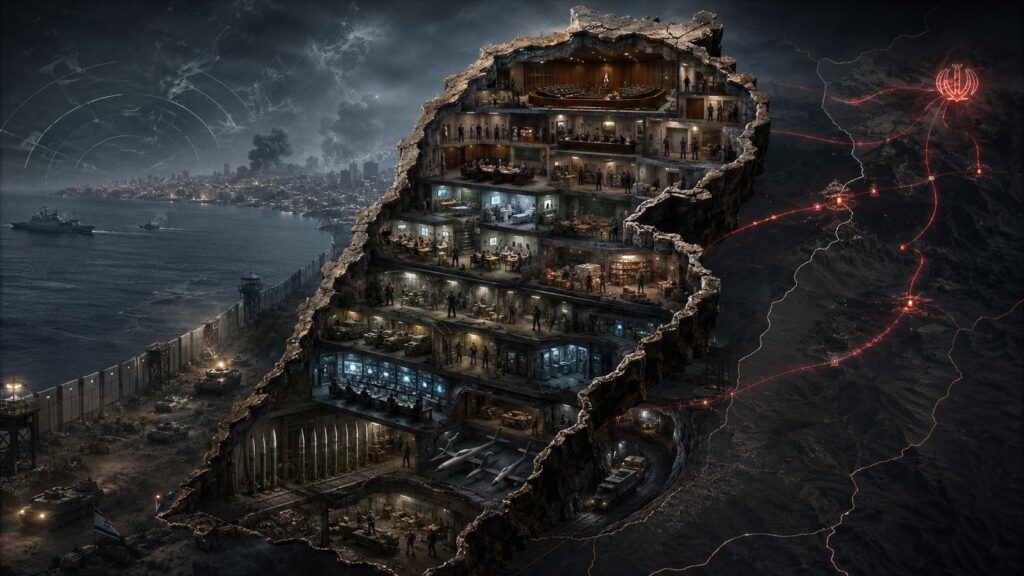
Beneath these lie several apparatuses, organizationally separate, politically one movement: a military wing with infantry, rocket and drone forces, intelligence, special units, and underground facilities, which Hezbollah calls the “Islamic Resistance”; a security and intelligence apparatus for counterintelligence, internal security, and foreign contacts; a political apparatus with a parliamentary caucus and government participation; and a social apparatus consisting of schools, clinics, hospitals, reconstruction organizations, and media outlets. The European Union legally distinguishes between a political and a military wing and has listed only the military part on its terrorism list since 2013. Hezbollah itself rejects this distinction and describes itself as a unified movement with different functional areas. Organizationally, it has a point: a credibly independent political party that happens to coexist alongside a militia of the same name does not exist.
The Social State as a Source of Power
One of the most common errors is to dismiss the social work as mere cover. Hezbollah in fact operates an extensive network of schools, clinics, hospitals, pharmacies, welfare organizations, reconstruction programs, loans, and compensation payments, as well as support for the families of killed fighters. These structures emerged because the Lebanese state was barely present in many regions. For many people, Hezbollah is therefore not first and foremost a foreign policy actor but the organization that pays for a medical treatment, runs a school, repairs a damaged house, or supports a widow.

The services are real-and they are at the same time political bonding, recruitment tool, and source of legitimacy. Those who receive services need not be convinced supporters. But the system creates dependency, loyalty, and social influence. Both levels belong together: genuine assistance and political control are the same instrument here.
Financing
Iran is considered the most important external source of funding, but support comes not only in cash but through weapons, fuel, goods, training, technical assistance, and the circumvention of sanctions. The U.S. Treasury Department stated in 2025 that it had sanctioned financial actors who channeled Iranian funds and revenue from covert oil and commodity sales through exchange houses into Lebanon-official American allegations whose evidence partly rests on non-public intelligence. Beyond this, Hezbollah has its own revenues from donations, religious levies, businesses, real estate, and diaspora networks. Western and Latin American authorities also accuse affiliated networks of money laundering, smuggling, and drug trafficking.
With such allegations, care is required: Was a connection proven in court? Did a member act privately? Did the money flow to the organization-or is the claim based on intelligence? Not every criminal activity by a Shia Lebanese businessman is a Hezbollah operation. At the same time, documented international financial and procurement networks exist. Both are true.
Control and Autonomy – The Proxy Debate
Can Iran give Hezbollah orders? There is no simple answer to this, and that itself is the finding. Substantial Iranian influence is supported by the religious recognition of the Supreme Leader, financial dependence, weapons and technology deliveries, close contacts with the Revolutionary Guards, and the role within the “Axis of Resistance.” Autonomy is supported by the Lebanese social base, independent political interests, independent revenues, independent governing bodies, and decades of institutional development.
What is likely is a graduated decision-making structure. The organization largely decides local political questions on its own; it can make operational decisions independently; strategic questions of a major regional war are closely coordinated with Iran; in existential questions, Tehran holds considerable influence. It would therefore be wrong to portray every rocket launch as a personal order from Tehran-and equally wrong to depict Iran as a mere friendly benefactor without influence. The relationship is closer than that between Iran and the Houthis; a complete separation is scarcely conceivable. But Hezbollah is not a remote-controlled tool. It possesses interests of its own that mostly do not contradict Iran’s regional strategy.
The Defining Events
Four episodes show what Hezbollah is at its core-and the price of its independence.
Israel’s withdrawal from southern Lebanon in May 2000 was its historic victory. It could credibly claim to have forced Israel to withdraw not through negotiations or resolutions but through armed resistance-and thereby gained popularity far beyond its own milieu. That it did not lay down its weapons afterward, it justified with the continued occupation of the Shebaa Farms, Lebanese prisoners, and the weakness of the regular army. The less openly stated reason: the weapons were the most important source of its political supremacy.

The 2006 war began with a Hezbollah attack on an Israeli border patrol and the capture of two soldiers. Israel responded with 34 days of massive airstrikes, blockade, and ground offensive; Hezbollah fired thousands of mostly unguided rockets at Israeli territory. The destruction in Lebanon was enormous. Nasrallah later conceded he might not have ordered the capture had he known the response. The war demonstrated the fundamental conflict: the organization can initiate an independent operation whose consequences the entire country bears.
May 2008 made visible that the weapons are not directed solely against Israel. When the government sought to dismantle Hezbollah’s private telecommunications network, its fighters temporarily seized parts of West Beirut and forced the reversal of the measure. For its supporters, a defense of the resistance; for its opponents, armed proof that it resolves domestic political conflicts militarily if necessary. In effect, it used armed force to compel a political reversal.
The Syria intervention from 2012/2013 onward finally bound it deeply into a regional power struggle. Hezbollah fought for the Assad government-strategically existential because Syria was the land bridge between Iran and Lebanon. It professionalized militarily but suffered heavy losses and lost considerable Arab popularity: the organization admired after 2000 and 2006 now appeared to many Sunnis as a Shia interventionist force.
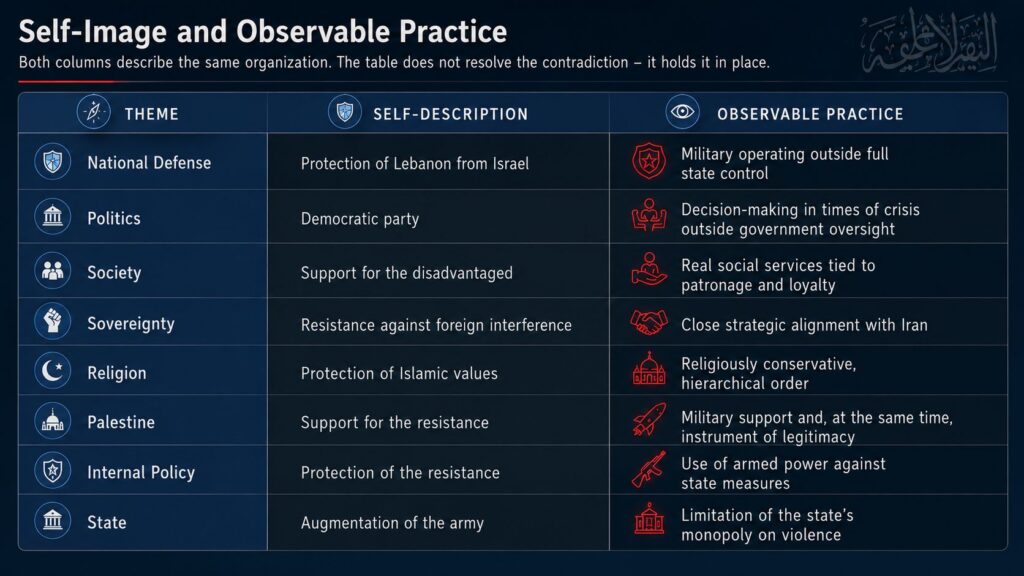
Both columns describe the same organization. The table does not resolve the contradiction-it holds it in place.
The Inconsistent Classification
Who lists Hezbollah as a terrorist organization is not internationally uniform. The United States lists the entire organization as a foreign terrorist organization; the United Kingdom bans it completely; Germany prohibited all activity on its territory in 2020 and treats it as a unitary structure. The European Union, by contrast, lists only the military wing. The United Nations does not place it on the same global list as al-Qaeda and the “Islamic State” but calls for disarmament and a state monopoly on the use of force.
This inconsistency is itself a finding. It does not mean the underlying attacks are fabricated-it shows that states draw different lines between party, resistance movement, and terrorist organization, often out of diplomatic calculation: some governments want to keep channels open to Lebanese politics or avoid blocking humanitarian work. On the merits: several actions attributed to Hezbollah-attacks on civilians, hostage-takings, strikes intended for political intimidation-meet widely accepted definitions of terrorism regardless of Western policy. The word alone, however, does not describe the organization as a whole.
What Would Exist Without It
Two counterfactuals illuminate the actor. Without the Israeli invasion and occupation, the movement would scarcely have developed the same military legitimacy, societal mobilization, and regional significance-armed resistance substantially raised the costs of the occupation and was a major factor in the 2000 withdrawal. But without Iran, an organization with the same ideology, armament, and durability would also probably not have emerged. Neither “the West alone” nor “Iran alone” created Hezbollah; Western and Israeli interventions, together with Lebanese state failure, Shia marginalization, and Iranian revolutionary politics, created the conditions under which it could grow.
And without Hezbollah? Probably less Iranian influence and less danger of unilaterally triggered wars-but also less organized defense against the occupation, less social provision in Shia areas, and weaker political representation for large parts of the Shia population. Whether the state could have assumed these functions is the open question. Historically, it was mostly unable to do so.
The Most Common Misconceptions
“Iran completely invented Hezbollah.” Too simple. Iran was decisive for its construction and ideology; the social foundation arose from Lebanese disadvantage, civil war, and occupation.
“It is nothing but an Iranian puppet.” Too simple. It possesses its own social, political, and military structures-despite an exceptionally close bond with Iran.
“It is only a terrorist organization.” Insufficient. This explains neither its parliamentary nor its social nor its territorial function.
“It is exclusively a liberation movement.” Also insufficient. Its activities extend far beyond resistance against occupation.
“All Shia support it.” Wrong. It enjoys strong backing but not total representation-even in Shia cities there have been protests against it.
“Its social work is mere propaganda.” Wrong. The services are real and simultaneously serve political bonding.
“The political and military wings are completely separate.” Organizationally scarcely tenable. They are functional areas of the same movement.
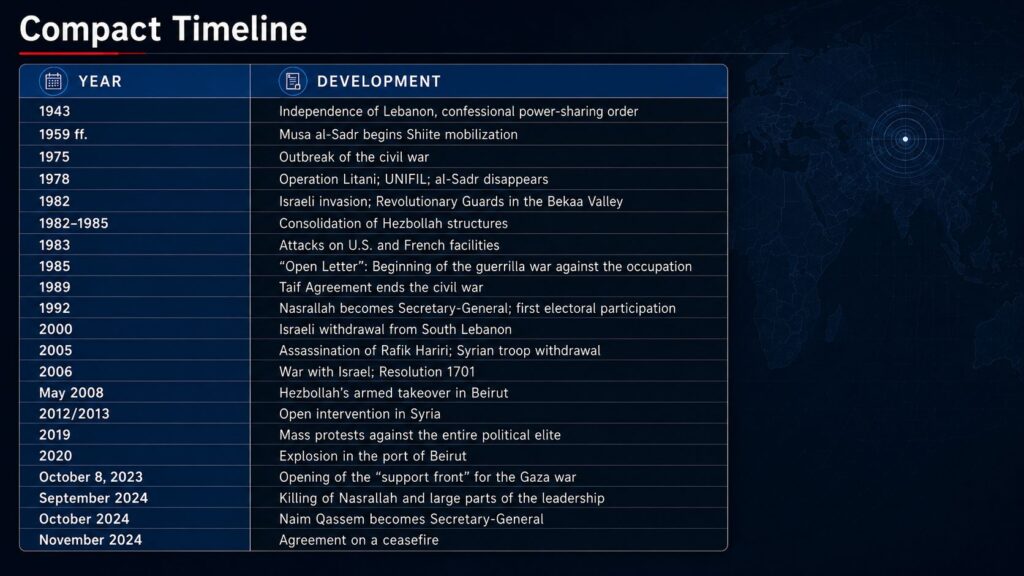
Overall Assessment
Hezbollah did not arise from irrational hatred of the West, nor as a mere foreign terrorist project, but from real disadvantage, a disintegrating state, civil war, Israeli occupation, religious mobilization, and Iranian support. Its early successes against Israel earned it a legitimacy far beyond its own faith community. It offered many people protection, provision, political dignity, and the sense of not being helplessly exposed to an overwhelming occupation.
At the same time, resistance became a permanent power structure. It does not monopolize the state but prevents its full monopoly on the use of force; it participates in elections but possesses an army outside democratic control; it fights foreign interference but is closely bound to Iran; it protects part of the population but exposes the entire country to the consequences of its military decisions; it provides real social services but simultaneously stabilizes a corrupt system; it resisted occupation and later itself intervened in another state.
The most concise defensible assessment therefore reads: Hezbollah is an Islamist resistance and power movement born of Israeli occupation, Shia marginalization, and Lebanese state collapse, with a real societal base, that with Iranian assistance became an autonomous military parallel power-one that towers over democratic institutions, co-wages regional wars, and has employed both guerrilla warfare and terrorist methods. The label “terrorist organization” names a part of this. It does not explain the whole.
As of: 29 June 2026 – Following the heavy losses since 2024-including the killing of Hassan Nasrallah-Hezbollah is weakened but has not disappeared. It continues to be led by Naim Qassem and faces growing pressure to disarm. In June 2026, a new U.S.-brokered Israeli-Lebanese framework was agreed, providing for a phased Israeli withdrawal and the dissolution of Hezbollah’s military structures. Qassem declared this framework null on 27 June, described it as a unilateral capitulation, and insisted on the continuation of armed resistance. The fundamental conflict thus remains unchanged: the state leadership claims sole sovereignty, Israel demands the elimination of the military threat, part of the Shia population fears being left defenseless without the organization-and other Lebanese see its weapons as the primary reason the state cannot act sovereignly.
This analysis appears as part of Hollister’s Geopolitics. For those seeking background beyond the daily headline, new deep-dive analyses appear weekly-subscribe for free at michael-hollister.com.
If you regularly read my updates and analyses, I would be grateful for your ongoing support.
…or please leave me a tip

Michael Hollister is a geopolitical analyst and investigative journalist. He served six years in the German military, including peacekeeping deployments in the Balkans (SFOR, KFOR), followed by 14 years in IT security management. His analysis draws on primary sources to examine European militarization, Western intervention policy, and shifting power dynamics across Asia. A particular focus of his work lies in Southeast Asia, where he investigates strategic dependencies, spheres of influence, and security architectures. Hollister combines operational insider perspective with uncompromising systemic critique-beyond opinion journalism. His work appears on his bilingual website (German/English) www.michael-hollister.com and in investigative outlets across the German-speaking world and the Anglosphere.
Sources
- Hezbollah, “About Hezbollah” (self-description; “Open Letter” 1985 as founding document, Political Document 2009): https://hezbollah.org/about-hezbollah
- Carnegie Middle East Center (Lina Khatib), “Hezbollah’s Ascent and Descent” (Syria intervention as turning point; weapons for intimidation of political opponents): https://carnegieendowment.org/posts/2015/06/hezbollahs-ascent-and-descent
- Washington Institute, “Hezbollah Turns 40” (founding 1982, Wilayat al-Faqih, movement’s concession): https://www.washingtoninstitute.org/policy-analysis/hezbollah-turns-40-implications-groups-internal-regional-and-strategic-shifts
- UN Security Council, Resolution 1701 (2006) – full cessation of hostilities, disarmament south of the Litani: https://press.un.org/en/2006/sc8808.doc.htm
- UN News, Explainer on Resolution 1701 (key elements, Blue Line): https://news.un.org/en/story/2024/10/1155221
- Security Council Report, Consultations on Resolution 1559 (disarmament of militias, Lebanese sovereignty): https://www.securitycouncilreport.org/whatsinblue/2024/10/lebanon-consultations-on-resolution-1559.php
- Security Council Report, Cessation of hostilities Israel-Lebanon, in effect since 27 November 2024 (UN Doc. S/2024/870): https://www.securitycouncilreport.org/whatsinblue/2025/03/lebanon-consultations-on-resolution-1701.php
- Atlantic Council, “History and future of the Hezbollah disarmament question” (Taif exception, armed special status): https://www.atlanticcouncil.org/blogs/menasource/history-and-future-of-hezbollah-disarmament/
- U.S. Treasury Department (OFAC), Sanctions against Hezbollah financial network via exchange houses, 2025: https://home.treasury.gov/news/press-releases/sb0308
- U.S. Treasury Department (OFAC), Hezbollah finance team / evasion network, 28 March 2025: https://home.treasury.gov/news/press-releases/sb0063
- Status box – Reuters (via NBC News), Qassem rejects framework as “surrender,” 27 June 2026: https://www.nbcnews.com/world/lebanon/hezbollah-rejects-us-brokered-israel-lebanon-security-deal-surrender-rcna352040
- Status box – Al Jazeera, Hezbollah rejects Israel-Lebanon framework, 27 June 2026: https://www.aljazeera.com/news/2026/6/27/hezbollah-rejects-israel-lebanon-agreement-as-israeli-attacks-hit-south
© Michael Hollister – All rights reserved. Redistribution, publication or reuse of this text requires express written permission from the author. For licensing inquiries, please contact the author via www.michael-hollister.com.