
UPDATE Report – Updated: June 17, 2026 – Building on my update from June 14, 2026
by Michael Hollister
Exclusive published at Michael Hollister on June 17, 2026
2.617 words * 14 minutes readingtime


TICKER
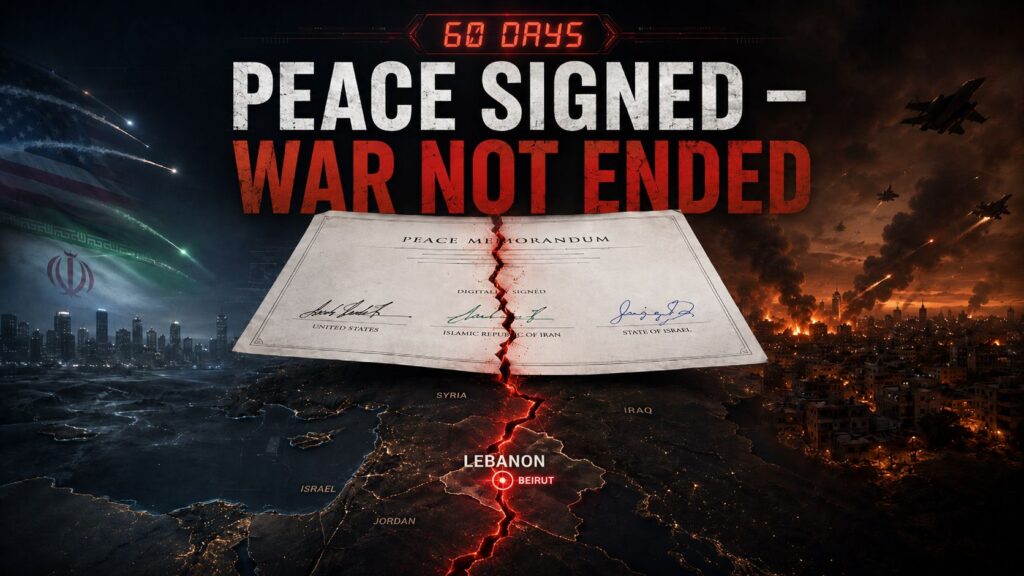
MEMORANDUM SIGNED DIGITALLY – CEREMONY ON JUNE 19 IN SWITZERLAND The end of this war hangs, for now, on a document signed at the press of a key rather than by hand. According to senior U.S. officials, the memorandum was signed digitally on Sunday, June 14, by Donald Trump, Vice President JD Vance, and Iranian Parliament Speaker Mohammad Bagher Ghalibaf; Vance announced the move on June 15. The formal ceremony is set for Friday, June 19, in Switzerland – Geneva is the preferred venue, with Vienna also still named. This is a framework agreement whose text remains secret so far. The evidentiary basis is U.S. official and Iranian state sources, drawing on wire reports.
NO FINAL PEACE – A 60-DAY NEGOTIATING WINDOW The memorandum buys time, not peace. It extends the existing, repeatedly violated ceasefire by another 60 days; within that window, a permanent end to the war, the nuclear question, sanctions, frozen funds, and regional security issues are to be negotiated. Several far-reaching success claims from the White House – among them a lasting end to the war in Lebanon and a permanent dismantling of Iran’s nuclear program – are not borne out by the facts known so far. Only the second, more detailed agreement is meant to settle the actual core. The evidentiary basis is wire and media reports, including an AP analysis.
TRUMP ORDERS HORMUZ OPENING AND END OF BLOCKADE – THE STRAIT STAYS PHYSICALLY CLOSED The order opens the strait on paper; the water does not move with the stroke of a pen. Via Truth Social, Trump ordered the toll-free opening of the Strait of Hormuz and the immediate lifting of the U.S. naval blockade of Iranian ports. In practice, more than 500 ships are waiting to exit the Gulf, clearing potential sea mines will take at least weeks, and a full flow of energy is not to be expected for weeks to months. Shipping companies remain cautious because of mines, insurance risks, and the absence of security guarantees. The evidentiary basis is U.S. presidential via Truth Social, backed by wire and shipping data.
THREE IRANIAN TANKERS PASS THROUGH THE BLOCKADE ZONE The easing has evidently begun even before the ceremony. At least three loaded Iranian tankers have passed through the former U.S. blockade zone – but this does not amount to a restoration of normal shipping traffic. At the start of the week, only a single LNG tanker clearly transited the strait, while numerous ships remained stranded in the Gulf or used alternative routes. Washington is thus opening limited export routes to Tehran even before Friday. The evidentiary basis is wire and ship-tracking reports.
DISPUTE OVER TOLL-FREE PASSAGE VERSUS “SERVICE FEES” The same provision is read in opposite ways by both sides. The U.S. side speaks of passage that is free of charge for at least 60 days. Foreign Minister Abbas Araghchi, by contrast, says Iran levies no toll but rather “service fees” for pilotage and security services; the strait will not return to pre-war operations, and its future administration will be settled later as a regional matter with Oman. As long as the text is missing, the single most expensive variable of the entire agreement remains open. The evidentiary basis is U.S. official statements against the Iranian foreign ministry’s account.
LEBANON REMAINS AN ACTIVE FRONT – FOUR DEAD ON JUNE 16 While diplomats speak of a ceasefire on all fronts, the southern Lebanese front keeps burning. On June 16, Israeli drone strikes in Mayfadoun – a second strike came after people had arrived at the site – and in nearby Shoukin killed at least four people. Beforehand, the Israeli air force said it had intercepted several Hezbollah rockets. Since March 02, the Lebanese Health Ministry has reported more than 3,700 dead in Lebanon. The evidentiary basis is the Lebanese state agency (NNA), backed by wire and media reports.
NETANYAHU: ISRAEL NOT A PARTY TO THE DEAL, NO WITHDRAWAL The agreement’s central provision is rejected by precisely the actor fighting on that front. Prime Minister Netanyahu declared on June 15 that Israel is not a party to a memorandum with Iran, retains its freedom of action against Hezbollah, and will not pull back its troops on the basis of a U.S.-Iranian arrangement. Israeli forces, he said, would remain in security zones in Lebanon, Gaza, and Syria “for as long as necessary.” Vice President Vance had earlier stated that the memorandum also covers Lebanon. The evidentiary basis is Israeli government statements against the U.S. vice-presidential account.
WASHINGTON DIVIDED – VANCE VERSUS HUCKABEE AND RUBIO The contradiction runs not only between Washington and Tehran but straight through the U.S. side itself. While Vance calls Lebanon part of the agreement, U.S. Ambassador Mike Huckabee and Secretary of State Marco Rubio say Hezbollah and Lebanon are not the subject of the deal. Huckabee added that Israel needs no Iranian permission to defend itself. The same administration holds two opposing positions on the decisive front. The evidentiary basis is U.S. official statements, reported via Israeli media.
IRAN MAKES LEBANON A CONDITION AND THREATENS TO RESPOND Tehran explicitly ties the permanent agreement to Lebanon. Araghchi stated that a lasting peace and a final nuclear deal would scarcely be possible without an end to the Israeli presence in Lebanon. Iran treats continued Israeli attacks as a possible breach of the memorandum and threatens a “harsh” response. This places an immediate escalation mechanism inside the agreement itself: an Israeli strike in Lebanon can jeopardize the entire U.S.-Iranian understanding. The evidentiary basis is Iranian state sources.
TRUMP REBUKES NETANYAHU – YET CALLS LEBANON A “MINOR WAR” Trump’s criticism is clear, but without leverage. At the G7 summit in Evian, France, he said he was unhappy with Israel’s conduct in Lebanon and against Hezbollah, and called the bombing of a residential building in Beirut “vicious.” At the same time, he classed the conflict as minor, called Hezbollah a “pin-prick,” and said the deal would survive further Israeli attacks as well. No halt to weapons, sanctions, or other concrete leverage followed the criticism. The evidentiary basis is U.S. presidential statements, reported via wire services and U.S. media.
SENATE FAILS AGAIN ON WAR POWERS – 47 TO 48 Domestic-political control fails again, and again narrowly. On June 16, a motion in the U.S. Senate that would have barred further American acts of war against Iran without express congressional approval failed by a vote of 47 to 48. Four Republicans – Collins, Cassidy, Murkowski, and Paul – voted for it alongside nearly all Democrats; Fetterman was the only Democrat against, and five senators were absent. Trump announced he would submit the treaty text to Congress for review. The evidentiary basis is the parliamentary vote result, backed by media reports.
HARD QUESTIONS DEFERRED – 440 KG OF URANIUM, MISSILES, FUNDS; TRUMP’S “GUARDIAN” OPTION The hardest questions are pushed behind the signature. The whereabouts of roughly 440 kilograms of highly enriched uranium, future enrichment, IAEA inspections, the ballistic missile program, and the tie to Hezbollah all remain unsettled; frozen Iranian funds are stated in contradictory figures and made conditional on Tehran’s compliance. Trump told the New York Times that if no deal is reached in the 60 days, he could resume the strikes – or make the United States the “guardian of the Middle East” in exchange for 20 percent of the region’s oil revenues. The evidentiary basis is media reports, including the New York Times on Trump’s remark.
CHINA WARNS OF A TOUGHER SECOND PHASE The mediators’ most important backer signals that the hard part is yet to come. China’s Foreign Minister Wang Yi told his Pakistani counterpart Ishaq Dar by phone that the second negotiating phase would be “tougher” than the first; the consensus reached so far is far from the goal, more a new starting point. Wang also called for a greater role for the UN Security Council. Beijing and Islamabad intend to stay in close contact and stressed the importance of the Hormuz opening for the world economy. The evidentiary basis is the Chinese foreign ministry’s account, backed by wire reports.
GULF STATES: APPROVAL WITH RESERVATIONS The Gulf welcomes the agreement but ties it to the strait. Qatar called the understanding an important step, highlighted freedom of navigation through the Strait of Hormuz, and explicitly praised Pakistan’s mediation. The United Arab Emirates makes safe, free passage through Hormuz the central condition and demands that Iran fully implement its commitments. For the Gulf’s energy and port economy, the functioning of the strait is the real benchmark of the agreement. The evidentiary basis is Qatari and Emirati government statements, backed by wire and media reports.

ANALYSIS
I. The Shifted Breaking Point: From Washington-Tehran to Beirut
The real finding of this week is a shift. Between Washington and Tehran, calm has held since Sunday – no new major direct wave of attacks, no retaliatory strikes on U.S. targets. The acute danger to the memorandum no longer lies along that axis but in Lebanon. Israel, which explicitly does not see itself as a party, rejects the central provision – a ceasefire on all fronts including Lebanon – and continues its strikes; on June 16 alone, four people died in Mayfadoun and Shoukin. Iran, for its part, makes precisely this front the condition for any lasting treaty. The agreement thus carries its contradiction at its core: it promises an end on all fronts while leaving the decisive front to an actor who is fighting it and considers himself unbound by the arrangement. A ceasefire whose most important front is rejected by the actor doing the fighting is structurally fragile – regardless of what is signed on Friday.
II. An Unread Text, Three Readings – and the Rift on the U.S. Side
There is no signed document in its actual wording – but there are at least three accounts of the same event. Vance says the memorandum also covers Lebanon. Huckabee and Rubio say the opposite. Araghchi speaks of an end on all fronts including Lebanon; Trump calls that same theater a minor conflict that does not endanger the deal. The tension shows most sharply at the Strait of Hormuz, where toll-free opening stands against “service fees,” and pre-war operations against a later regional settlement with Oman. What matters here is not only the disagreement among the signatories but the rift within a single signatory side: the U.S. administration holds two opposing positions on the core front, Lebanon, at the same time. An agreement whose central provision is interpreted in contradictory ways by its signatories – and even within one side – is not yet a binding treaty but a joint declaration of intent with built-in disagreement.
III. Cui bono – Why Signing Is Rational for Both
Behind the question of whether the agreement holds lies the question of who actually wants it. For Washington, the calculus is less clear-cut than the war rhetoric suggests: the conflict carries massive domestic costs – an oil shock, falling approval ratings, a House of Representatives that voted 215 to 208 to demand an end to the war, a crumbling Senate (47 to 48), and a G7 pressing for a binding agreement. A ceasefire that opens Hormuz, dampens energy prices, and defers the hard nuclear questions into a 60-day window stanches the domestic bleeding and keeps every option open. For Tehran, the collapse in exports and the liquidity crunch, the opening of the strait, a possible gradual release of frozen funds, and above all the separation of Washington from Jerusalem all weigh heavily. Following the Voltaire principle, the counterposition must also be named: anyone who sees in the deal only a trap for one side overlooks that a tactical pause serves both sides – even without a military victory. This is a structural reading of the interests at play, not a verdict on intentions.
IV. Hormuz and the Built-In Breaking Points
Three concrete fault lines bear the declaration – and each can topple it. First, Hormuz: ordered open, the strait remains physically closed; toll-free passage stands against “service fees,” the lifting of the blockade against the not-yet-fully-confirmed cessation of all inspection and interception measures, plus mines and more than 500 waiting ships. Second, Lebanon: a ceasefire on all fronts to which Israel, as the central military actor, explicitly does not consider itself bound is not enforceable. Third, the frozen funds: for Tehran they rank among the tangible counter-concessions, yet they are stated in contradictory figures and explicitly tied to compliance with the agreement – leverage that cuts both ways. The architecture of the memorandum thus carries its contradictions within it: it promises an end on all fronts but leaves enforcement to points where the interests of those involved diverge.
STRATEGIC ASSESSMENT
Within a few days, things moved from the digitally signed memorandum to the ceremony scheduled for Friday, June 19, in Switzerland. But signed is not pacified: the full text remains secret, the central front of Lebanon is exempted by a still-fighting party to the conflict, and the U.S. side is not in agreement about precisely that front. What comes together on Friday – if it comes together at all – is likely to be a framework over the U.S.-Iranian axis, while the Israeli-Lebanese strand runs unresolved alongside it. Beneath the diplomatic formulas, the military facts continue: Israeli strikes in Lebanon, a strait in limbo, deferred nuclear questions. The next point of escalation is already built into the agreement.

Michael Hollister
is a geopolitical analyst and investigative journalist. He served six years in the German military, including peacekeeping deployments in the Balkans (SFOR, KFOR), followed by 14 years in IT security management. His analysis draws on primary sources to examine European militarization, Western intervention policy, and shifting power dynamics across Asia. A particular focus of his work lies in Southeast Asia, where he investigates strategic dependencies, spheres of influence, and security architectures. Hollister combines operational insider perspective with uncompromising systemic critique – beyond opinion journalism. His work appears on his bilingual website (German/English) www.michael-hollister.com and in investigative outlets across the German-speaking world and the Anglosphere.
Support my Work – become a Member
Sources
- CNN, June 14, 2026 – US and Iran reach agreement that includes opening Strait of Hormuz: https://www.cnn.com/2026/06/14/world/live-news/iran-war-trump-israel
- NPR, June 15, 2026 – U.S. and Iran announce an initial deal to end the war and reopen the Strait of Hormuz: https://www.npr.org/2026/06/15/nx-s1-5858590/us-iran-deal-updates
- MEMRI, June 16, 2026 – The U.S.-Iran Memorandum Of Understanding, According To Iran: https://www.memri.org/reports/us-iran-memorandum-understanding-according-iran
- Encyclopædia Britannica – 2026 Iran war: https://www.britannica.com/event/2026-Iran-war
- PBS NewsHour / AP, June 15, 2026 – Even with a deal to reopen the Strait of Hormuz, it could take weeks or months for oil to fully flow: https://www.pbs.org/newshour/world/even-with-a-deal-to-reopen-the-strait-of-hormuz-it-could-take-weeks-or-months-for-oil-to-fully-flow
- Al Jazeera, June 17, 2026 – Oil prices continue slide amid hopes for peace, opening of Strait of Hormuz: https://www.aljazeera.com/economy/2026/6/17/oil-prices-continue-slide-amid-hopes-for-peace-opening-of-strait-of-hormuz
- Al Jazeera, June 16, 2026 – Israeli strikes kill four in southern Lebanon amid ceasefire talks: https://www.aljazeera.com/news/2026/6/16/israeli-strikes-kill-four-in-southern-lebanon-amid-ceasefire-talks
- Al Jazeera, June 10, 2026 – Israel kills 16 in Lebanon, UN to probe international law violations: https://www.aljazeera.com/news/2026/6/10/israel-kills-16-in-lebanon-un-to-probe-international-law-violations
- The Times of Israel, June 16, 2026 – Liveblog June 16, 2026: https://www.timesofisrael.com/liveblog-june-16-2026/
- Time, June 16, 2026 – Trump Says Netanyahu Has to Be ‘More Responsible With Respect to Lebanon’: https://time.com/article/2026/06/16/trump-netanyahu-israel-warning-hezbollah-us-iran-peace-deal/
- The Hill, June 16, 2026 – Senate fails to advance Iran war powers resolution: https://thehill.com/homenews/senate/5926564-senate-iran-war-powers/
- The Express Tribune, June 16, 2026 – Beijing sees tougher US-Iran talks ahead: https://tribune.com.pk/story/2613607/beijing-sees-tougher-us-iran-talks-ahead-1
- Al Jazeera, June 14, 2026 – US-Iran ‘peace deal’ announced; Trump says Strait of Hormuz reopening: https://www.aljazeera.com/news/2026/6/14/us-iran-ceasefire-deal-announced-trump-says-strait-of-hormuz-reopening
- Euronews, April 09, 2026 – UAE urges full compliance from Iran following ceasefire announcement: https://www.euronews.com/2026/04/09/uae-urges-full-compliance-from-iran-following-ceasefire-announcement
- The Tech Times, June 13, 2026 – Iran Peace Deal Text Agreed: 440kg Enriched Uranium Stays in Tehran During 60-Day Talks: https://www.techtimes.com/articles/318319/20260613/iran-peace-deal-text-agreed-440kg-enriched-uranium-stays-tehran-during-60-day-talks.htm
© Michael Hollister – All rights reserved. Redistribution, publication or reuse of this text requires express written permission from the author. For licensing inquiries, please contact the author via www.michael-hollister.com.
Newsletter
🇩🇪 Deutsch: Verstehen Sie geopolitische Zusammenhänge durch Primärquellen, historische Parallelen und dokumentierte Machtstrukturen. Monatlich, zweisprachig (DE/EN).
🇬🇧 English: Understand geopolitical contexts through primary sources, historical patterns, and documented power structures. Monthly, bilingual (DE/EN).