
UPDATE Report – Updated: June 14, 2026 – Building on my update from June 10, 2026
by Michael Hollister
Exclusive published at Michael Hollister on June 14, 2026
2.269 words * 12 minutes readingtime


TICKER
Second US strike wave against Iran – strikes along the Hormuz coastline In the night of June 11, the United States carried out a second strike wave against Iranian territory. CENTCOM officially reported further “self-defense strikes” on multiple targets on June 10, citing Iranian surveillance, communications, and air defense systems. Explosions were reported in Tehran, in Bandar Abbas, and along the coastline of the Strait of Hormuz; the Revolutionary Guards named a manufacturing complex among the objects struck. Iranian state media additionally reported detonations on the islands of Qeshm and Kish as well as in Sirik and Kargan, with at least two injured. The damage assessment has not been independently confirmed; the sourcing is US-side and Iranian state media.
Trump threatens to seize oil infrastructure – Kharg Island named explicitly In parallel with the strikes, the US side raised its threat posture toward Iran’s energy infrastructure. Trump announced that Iran would be hit “very hard” that night and declared that in the not-too-distant future the United States would “take” Kharg Island and further nodes of the oil infrastructure, assuming full control over Iran’s oil and gas markets. He drew the comparison explicitly to the approach taken toward Venezuela. This is a stated intention, not an executed operation. The sourcing is presidential via Truth Social and wire agency reports.
Iran declares Hormuz closed – Washington pushes back Following the overnight strikes, Tehran declared the Strait of Hormuz fully closed and warned any vessel attempting to transit. Iranian state media reported that two ships had been fired upon. CENTCOM denied enforcement and stated that commercial traffic was continuing; vessel tracking data showed some tankers reversing course and others continuing to transit. The Iranian closure claim and the US denial stand in irreconcilable opposition; the physical status of the strait remains ambiguous.
Trump calls off major strike – declares the war “over” The threatened large-scale attack did not materialize. On June 11, Trump cancelled the planned strike and declared that the United States had “ended the war with Iran” – a deal was now finalized. Tehran did not initially confirm this. Less than 24 hours passed between the announcement of “very hard” strikes and the declaration of a war ended. The sourcing is presidential, contextualized via CNN and Reuters.
In my own words – The No-Strike List That Failed Four Times
While this update traces the latest escalation, my new dossier exposes a structure running across four decades. Four strikes, four civilian targets: an air raid shelter in Baghdad, the Chinese Embassy in Belgrade, a hospital in Kunduz, and a girls’ school in Minab, Iran. Behind the official explanations of “outdated data,” “wrong maps,” and “human error” lies the same pattern every time: safeguards designed to protect civilian objects from attack fail precisely when they are needed. The No-Strike List thus becomes the symbol of a form of warfare whose technical precision grows while its accountability recedes.
The No-Strike List That Failed Four Times
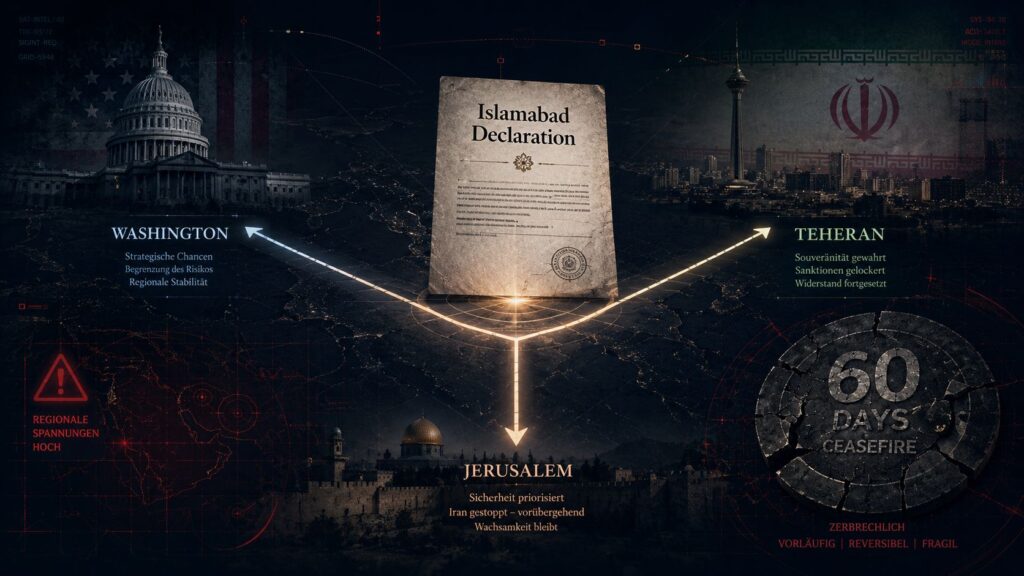
Pakistan and Qatar report “final text” – the Islamabad Declaration The de-escalation is running through a Pakistani-Qatari mediation channel. Pakistan’s Prime Minister Sharif reported a “final, agreed text” on June 12; the draft now bears the name Islamabad Declaration. A Qatari delegation negotiated until late into the night on Wednesday in Tehran. No joint official confirmation from Washington and Tehran has been issued. The sourcing is Pakistani mediator statements, supported by wire agency reports.
Signing postponed – Iran cites delays on US side The ceremony that had been traded for this Sunday in Geneva will not take place. Iran’s foreign ministry spokesman Baghaei stated on June 13 that the memorandum would not be signed on June 14; he pointed to delays on the US side but considered a signature in the coming days possible. On the US side, Vice President Vance is expected to sign; on the Iranian side, parliamentary speaker Ghalibaf. Geneva is listed as the venue, with Vienna named as an alternative. The sourcing is Iranian state.
The contours – 60-day ceasefire, nuclear question deferred, sanctions relief The declaration is a transitional framework, not a final agreement. It extends the ceasefire by 60 days including Lebanon, contains a framework for Iran’s enriched uranium stockpile, and provides for sanctions relief contingent on compliance. The actual nuclear component hinges on a second, more detailed agreement to be negotiated only after signing. Both sides are said to have agreed to the text; final sign-off is pending. The sourcing rests on a diplomat from a mediating state and a US official.
Dispute over Hormuz – “no fees” versus “service charges” At the core of the agreement, the readings diverge. The US side presents Hormuz as immediately and freely reopened. Araghchi, by contrast, states that Iran is not imposing tolls but “service charges”; the strait would not return to pre-war operations, and its future administration would be clarified later as a regional matter with Oman. The same text is thus being read in opposite directions by its prospective signatories. The sourcing is US official statements versus Iranian foreign ministry statements.
Israel distances itself – not a party to the deal, no Lebanon withdrawal Israel is undermining the all-fronts logic of the declaration. The office of Prime Minister Netanyahu stated that Israel is not a party to any memorandum with Iran. Defense Minister Katz said Israel would not withdraw from the occupied areas in Lebanon – while the draft provides for a ceasefire “on all fronts” including Lebanon. Israel is also pressing Washington to block the release of frozen Iranian assets. The sourcing is Israeli government statements, reported via CNN.
Lebanon remains an active front – Israeli strikes despite deal reports While diplomats spoke of an agreement, the southern Lebanese front remained hot. On June 12, Israeli strikes hit the area around Kfar Tebnit near Nabatieh. A return convoy of displaced residents led by Apostolic Nuncio Borgia was held up for over an hour and reached its destination only after twelve hours via an alternate route. Reports from the previous day counted multiple deaths from Israeli strikes in Lebanon. The sourcing is wire agency and media reports, partly based on Lebanese accounts.
Markets exhale – oil falls more than three percent Markets priced in the de-escalation faster than diplomats could sign. Following Trump’s breakthrough announcement, oil fell more than three percent and equity futures recovered. Just days earlier, the European Central Bank had explicitly raised interest rates in response to war-driven inflation. The movement follows the rhythm of shifting deal expectations, not a secured peace. The sourcing is wire agency reports.
In my own words – If the declaration fails: the Kharg scenario
The postponed signing date shows how fragile the situation remains. Should the United States and Iran ultimately fail to agree, one option Trump has already named by name moves back into view: ground troops on Kharg Island. My Iran Insight commentary “Ground Troops and the Double Lock” describes what such an operation would look like militarily – and why the island would be nearly impossible to hold, through to the question of possible mining and the chain of consequences reaching from the strait to Bab al-Mandab and the Suez Canal.
Ground Troops and the Double Lock

ANALYSIS
I. The 48-hour reversal
The defining finding of this week is not a single strike but the speed of the turnaround. On June 11, the threat posture was at its maximum: an announced large-scale attack and the open declaration of intent to “take” Kharg Island and Iran’s oil infrastructure. Kharg handles the bulk of Iran’s crude oil exports; the threat to seize the island was therefore not a strike against radar or air defenses but a reach for the node of Iran’s export economy. A few hours later, the attack was cancelled and the war declared “over.” This reversal is carried by the Pakistani-Qatari channel through which negotiations have been running for weeks, and over which a formula was found in the night of Wednesday that both sides could accept. The maximum threat and the agreement are not two separate events but parts of the same mechanism: the pressure on the oil infrastructure marked the peak at which the lever flipped.
II. One agreement, three readings
There is no signed document – but there are three accounts of the same event. Pakistan reports a “final text” and calls peace closer than ever. Trump promotes the agreement while simultaneously dismissing the Iranian version as “fake” and accusing Tehran of continuing to attack ships. Araghchi urges restraint on speculation while naming contours that contradict the US reading. The postponed signing adds a fourth fact: the specific date has already collapsed. The tension is clearest at the Strait of Hormuz. Where the US side speaks of immediate, fee-free opening, Tehran speaks of “service charges,” of no return to pre-war operations, and of a later regional clarification with Oman. That is not a peripheral detail but the core: an agreement whose central provision is read in opposite directions by its two prospective signatories is not yet an agreement – it is a joint statement of intent with built-in dissent.
III. The built-in fault lines
Three concrete fault lines run through the declaration. First, Hormuz: as long as the fee question and future control remain unresolved and the US counter-blockade of Iranian ports has been running since April 13, the economic core stays open. Second, Lebanon: the draft provides for a ceasefire “on all fronts,” but Israel explicitly does not regard itself as a party and rules out a withdrawal from southern Lebanon. A ceasefire to which one of the central military actors does not consider itself bound is structurally fragile. Third, frozen assets: Israel is pressing Washington to block their release – a relief measure that Tehran counts among the tangible concessions it is receiving. Any one of these three points can sink the agreement, and all three are not side issues but conditions on which one side or the other makes its assent contingent. The architecture of the declaration thus carries its contradictions within itself: it promises an end on all fronts while leaving enforcement to actors whose interests on precisely those fronts are running in opposite directions.
IV. Hormuz between claim and enforcement
The strait this week is less a place than a negotiating object. Iran declares it closed, the United States declares traffic ongoing, and vessel tracking shows both simultaneously: tankers reversing and ships transiting with transponders switched off. Behind this lies a situation established over months – Iran controls passage through coordination and fees, the United States maintains a counter-blockade against vessels calling at Iranian ports. Neither claim is fully enforced: the strait is neither physically sealed, as Tehran asserts, nor freely navigable, as Washington demands. It is precisely this ambivalence that makes Hormuz the actual lever of the agreement. Whoever controls the interpretation of the strait – closed or open, toll or service charge, bilateral or regional with Oman – controls the most expensive variable in the entire deal. The fact that the declaration, according to Tehran, explicitly defers this question to a later regional round is therefore not the postponement of a detail but the displacement of the crux point to after the signature.
STRATEGIC ASSESSMENT
Within 48 hours, the situation moved from an announced seizure of Kharg Island to a declared end of the war. The Islamabad Declaration is closer than any previous negotiating round, but unsigned, its Sunday deadline already gone, and it is being read in three directions in Washington, Tehran, and Jerusalem. Under the diplomatic formulas, the military facts continue to run – US blockade, Israeli strikes in Lebanon, a strait in suspension. A 60-day ceasefire “on all fronts” to which Israel explicitly does not consider itself bound already carries the next escalation point within it.

Michael Hollister
is a geopolitical analyst and investigative journalist. He served six years in the German military, including peacekeeping deployments in the Balkans (SFOR, KFOR), followed by 14 years in IT security management. His analysis draws on primary sources to examine European militarization, Western intervention policy, and shifting power dynamics across Asia. A particular focus of his work lies in Southeast Asia, where he investigates strategic dependencies, spheres of influence, and security architectures. Hollister combines operational insider perspective with uncompromising systemic critique – beyond opinion journalism. His work appears on his bilingual website (German/English) www.michael-hollister.com and in investigative outlets across the German-speaking world and the Anglosphere.
Support my Work – become a Member

Sources
- CNN, June 11, 2026 – Trump cancels planned strikes and touts progress, Iran says no deal finalized: https://www.cnn.com/2026/06/11/world/live-news/iran-war-trump-israel-hnk
- Time, June 12, 2026 – Trump, US, Iran peace deal: details, timeline, conflicting reports: https://time.com/article/2026/06/12/trump-us-iran-peace-deal-details-timeline-conflicting-reports/
- CNN, June 12, 2026 – US and Iran say an agreement is close, but questions remain: https://www.cnn.com/2026/06/12/world/live-news/iran-war-trump-israel
- Axios, June 12, 2026 – What’s in the Iran deal Trump says he’s ready to sign: https://www.axios.com/2026/06/12/iran-deal-mou-strait-open-sanctions-relief
- The Business Standard / Reuters, June 12, 2026 – US-Iran peace memorandum could be signed on Sunday in Geneva: https://www.tbsnews.net/world/us-iran-peace-memorandum-could-be-signed-sunday-geneva-1461326
- Athens Times, June 13, 2026 – Iranian Foreign Ministry: Islamabad memorandum not to be signed tomorrow: https://athens-times.com/iranian-foreign-ministry-spokesperson-us-iran-islamabad-memorandum-not-to-be-signed-tomorrow/
- The Hill, June 12, 2026 – Knives come out for emerging Iran deal: 5 things to know: https://thehill.com/homenews/administration/5921933-us-iran-agreement-details/
- Pakistan Observer, June 12, 2026 – “Islamabad Declaration”: US-Iran deal likely to be signed in Geneva: https://pakobserver.net/islamabad-declaration-us-iran-deal-likely-to-be-signed-in-geneva/
- CBS News, June 12, 2026 – Live updates: US-Iran peace deal, Lebanon strikes, markets: https://www.cbsnews.com/live-updates/iran-war-us-trump-peace-deal-agreement/
- ANI, June 12, 2026 – Iran-US peace deal expected in Geneva to include Hormuz reopening, ceasefire extension: https://aninews.in/news/world/us/iran-us-peace-deal-expected-in-geneva-to-include-hormuz-reopening-ceasefire-extension-reports20260612165533/
© Michael Hollister – All rights reserved. Redistribution, publication or reuse of this text requires express written permission from the author. For licensing inquiries, please contact the author via www.michael-hollister.com.
Newsletter
🇩🇪 Deutsch: Verstehen Sie geopolitische Zusammenhänge durch Primärquellen, historische Parallelen und dokumentierte Machtstrukturen. Monatlich, zweisprachig (DE/EN).
🇬🇧 English: Understand geopolitical contexts through primary sources, historical patterns, and documented power structures. Monthly, bilingual (DE/EN).