
UPDATE Report – Updated: June 10, 2026 – Building on my update from June 07, 2026
by Michael Hollister
Exclusive published at Michael Hollister on June 10, 2026
2.262 words * 12 minutes readingtime

TICKER
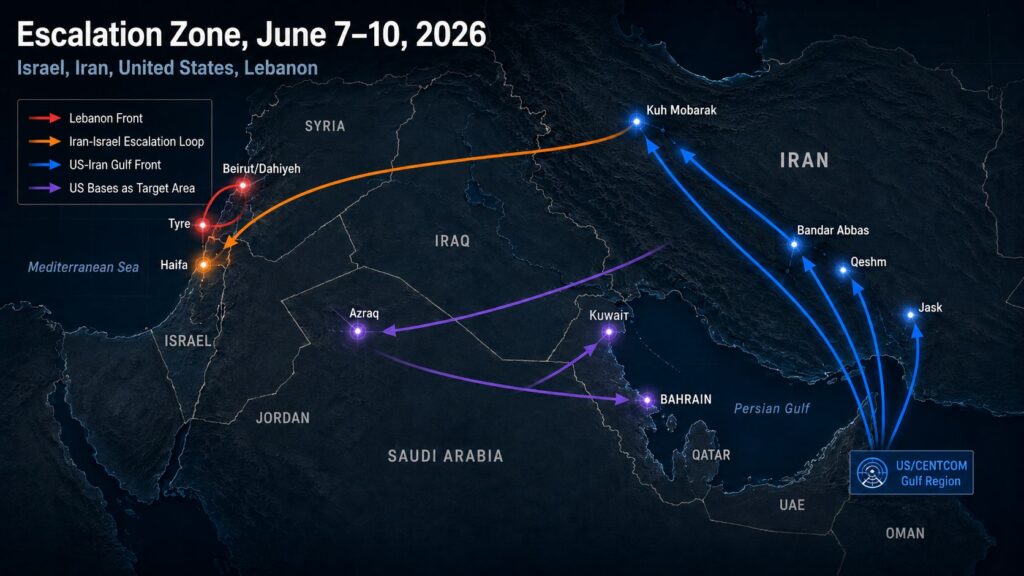
Israel strikes southern Beirut suburb – Hezbollah command center hit in the Dahieh The first Israeli strike on Beirut since the renewal of the US-brokered ceasefire opened the escalation week. On June 07, the Israeli Air Force struck what the Netanyahu office described as a Hezbollah command center in the southern Dahieh; two people were killed. Israel justified the strike as retaliation for a nighttime Hezbollah drone attack on its forces. Lebanon’s National News Agency confirmed the drone attack; the Israeli military confirmed the counterstrike.
Iran responds with the largest missile barrage since the ceasefire It was the first direct Iranian strike on Israeli territory since the April ceasefire – and the largest since the opening weeks of the war. In the night of June 07 to 08, Iran fired more than 20 ballistic missiles in seven salvos targeting northern, central, and southern Israel, according to the Alma Center. The IDF stated that most were intercepted but that the defense was “not hermetic”; a missile fragment landed near Jericho in the West Bank, and a woman was injured on her way to a shelter. The IRGC explicitly described the barrage as retaliation for the Beirut strike.
Trump calls on Netanyahu to hold back – “They’ve shot enough” While the barrage was underway, Washington moved to brake a direct Iran-Israel escalation. Trump declared that Iran had shot enough and should return to the negotiating table; a deal had been only days away. He said he had been “not happy” about Israel’s Beirut strike and announced he would call Netanyahu directly to dissuade him from a counterstrike. The US Embassy in Jerusalem placed its staff on shelter-in-place readiness.
Israel strikes Iran in two waves – defying Trump’s explicit stop appeal Despite Trump’s appeal, Israel struck directly inside Iran on the morning of June 08. The first wave hit air defense systems, missile launchers, and military infrastructure in Isfahan – including a drone factory – as well as in Kermanshah, Karaj, Tabriz, and the Mehrabad area. The second wave struck a Karun petrochemical plant near Mahshahr in Khuzestan province, whose product range includes nitric acid. The aerospace university in Tehran and Basij positions were also targeted.
Israel and Iran signal a conditional ceasefire – each on its own terms After the exchange of strikes, the situation shifted into a fragile pause with contradictory caveats. Netanyahu declared in a video message that the Iran strikes had been halted “for now”; any renewed attack would prompt Israel to hit Tehran and Hezbollah. Israeli and regional officials stated that Israel would suspend its Iran strikes provided Iran halted its missile fire. Iran’s military announced it was suspending its attacks but would resume them if Israel continued its operations in Lebanon.
CENTCOM disables tanker – US Apache crashes off Oman’s coast In parallel with the Iran-Israel line, the maritime front in the Gulf sharpened. CENTCOM reported on June 08 that US forces had disabled the Palau-flagged tanker M/T Marivex in the Gulf of Oman after it attempted to reach an Iranian port in defiance of the blockade. On the same day, a US Army AH-64 Apache attack helicopter crashed near the Omani coast; both crew members were rescued within approximately two hours. CENTCOM initially listed the cause as “under investigation.”

Lebanon tallies the scale of Israel’s campaign The Lebanese government presented the first concrete figures on the toll since the ceasefire took effect. According to the tally, Lebanon recorded nearly 3,500 airstrikes, 407 controlled demolitions, and six large-scale leveling operations between April 17 and June 07. This account is a Lebanese government statement, as reported by Reuters. It outlines the scale of a campaign formally conducted under a ceasefire.
Israel issues first-ever evacuation order for all of Tyre – including the Christian quarter The week’s heaviest single blow fell on the southern Lebanese port city of Tyre. On June 09, the Israeli military ordered the evacuation of the entire city for the first time – including the previously spared Christian old-town quarter near the UNESCO ruins, into which many displaced Shia residents had fled. At least 8 people were killed, with the regional toll later rising to 11 dead and 9 wounded; the previous day, 14 people had died, including 5 near a Red Cross center. Christian clergy, among them Melkite Archbishop George Iskandar, appealed to the international community.
CENTCOM strikes Iran near Hormuz – “self-defense” following the Apache incident The maritime front tipped into a direct US-Iran exchange. In the night of June 10, CENTCOM struck what it described as Iranian air defense systems, ground guidance stations, and surveillance radars near the Strait of Hormuz – at Jask, Qeshm, Bandar Abbas, and Kuh Mobarak – citing “self-defense.” AP reported that the Apache had collided with an Iranian drone near Hormuz, while Trump characterized the incident as a shootdown. The accounts of the precise sequence of events do not align; the sourcing is US-side and wire agency.
Iran strikes US bases in Bahrain, Kuwait, and Jordan Iran answered the US strikes with a coordinated attack on three Gulf states simultaneously. The IRGC declared it had struck the US Fifth Fleet in Bahrain, Al Ali Al Salem Air Base in Kuwait, and a base in Azraq, Jordan; by its own account it hit 21 targets, destroyed 4 of them – including an F-35 hangar in Azraq – and downed an MQ-9 drone over Jam. Jordan reported five intercepted missiles aimed at Azraq, with only fragments and no casualties. Bahrain and Kuwait reported intercepts; sirens and shelter alerts sounded in Manama. The claims of hits are Iranian actor statements.
Iran’s foreign ministry warns Gulf neighbors Tehran addressed the Gulf states directly as co-responsible parties for the first time. Iran’s foreign ministry declared that the neighbors bore a “legal and moral responsibility” to prevent US or Israeli attacks from being launched off their territory. Foreign Minister Araghchi further stated that foreign forces near Iranian territory were in constant danger and announced that no attack would go unanswered. Tehran thereby shifted its threat posture away from Israel and the United States toward the host states of their bases.
Negotiations continue despite escalation – markets nervous Despite the exchange of strikes, neither side officially abandoned the negotiating track. Trump spoke of the final stages of a very good deal; Vice President Vance said a deal could come next week or take months yet. Russia and China called for restraint following the US-Iran escalation. Oil prices rose roughly one percent on June 10 after an intraday drop of five percent the previous day – moving in step with shifting deal expectations.
In my own words – Hollister’s Geopolitics-Compass
While this update reports what has happened, the Geopolitics-Compass turns the perspective 180 degrees:
It asks what the events set in motion.
How does a blocked Strait of Hormuz affect the global economy?
Who bears the consequences when oil flows stall and supply chains break?
The Compass bundles the effects of a full month – the month of May. The forward look at what will matter strategically next is reserved for my supporting readers.
Hollister’s Geopoliticy-Compass May 2026
ANALYSIS
I. Lebanon as the trigger of the Iran-Israel loop
The trigger this week did not sit in the direct Iran-Israel relationship – it sat in Lebanon. Iran did not fire until Israel had struck Beirut’s Dahieh, and it explicitly framed the barrage as retaliation for Lebanon. That is not coincidence but structure: Tehran ties every peace with Washington explicitly to a ceasefire for Lebanon and Gaza. As long as that linkage holds, every Israeli strike in southern Lebanon is simultaneously a strike into Iran’s escalation mechanics – and resets the Iran-Israel loop. The escalation lever therefore lies in a third country whose government cannot deliver at the negotiating table because it does not control the armed reality south of the Litani. Anyone seeking to contain the war between Iran and Israel must first silence the Lebanon front. That is precisely what is not happening: Israel keeps its Lebanon operations open, and the fuse stays live.
II. The rift between Washington and Jerusalem
On June 07, in a broadcast Meet the Press interview, Trump declared he had destroyed Iran’s navy, air force, and air defense over three months; the country had neither radar nor meaningful armed forces. NBC pushed back: roughly half of the IRGC’s unconventional fast-boat fleet remained intact – precisely the forces that contest the Strait of Hormuz. A few hours later, on June 08, Israel struck directly inside Iran – against Trump’s explicit stop appeal, which he had made public the day before. That is the week’s actual finding: not a single strike, but the gap between Washington’s de-escalation signal and Israel’s freedom of action. When the US president says “stand down” and the ally bombs Iran the next morning, the question of the protecting power’s actual leverage demands an answer. The week’s answer is uncomfortable for Washington – and it matters beyond the current date, because it marks the limit of American control over its principal ally.
III. The second escalation engine: Hormuz and the Gulf
Alongside Lebanon, a second escalation line is running that ignites independently: the maritime front in the Gulf. Within a matter of days, CENTCOM disabled a tanker, lost an AH-64 Apache near Oman’s coast, and then struck Iranian radar and air defense installations near Hormuz “in self-defense.” The Apache loss is the finding with explosive force – regardless of whether it was a drone collision or a shootdown: a high-value US asset is destroyed, only days after the president publicly declared Iran had “nothing” left. This is precisely where the circle closes back to NBC’s fact-check: the unconventional fast-boat fleet, half of which remains intact, is the force that disrupts international shipping through the strait and is difficult to counter. The Gulf front therefore does not follow the Iran-Israel rhythm but its own logic of blockade, shipping, and retaliation – and it can continue to escalate even if Iran and Israel pull back in the short term.
IV. The Gulf states as target surface, not actor
With the strikes on Bahrain, Kuwait, and Jordan, the conflict is neither purely Iran-Israel nor purely about the strait: US positions in partner states have become escalation geography. Tehran addressed the neighbors directly on June 10 for the first time – they bore a legal and moral responsibility to prevent attacks from being launched off their territory. That shifts pressure onto states that had wanted to be hosts but not belligerents, forcing them to choose between distancing and deeper entanglement. Trita Parsi of the Quincy Institute for Responsible Statecraft characterized Iran’s rapid response as a new doctrine: proportional, but firm and immediate to every US strike. If that reading holds, the bases in the Gulf monarchies are no longer a deterrent backdrop but calculable targets within a retaliation mechanism – and the Gulf states find themselves in a role they never wished to fill.
STRATEGIC ASSESSMENT
Beirut ignites, and Iran fires on Israel. Israel strikes directly inside Iran the following morning, defying Trump’s explicit word. In parallel, a separate US-Iran exchange escalates over a lost Apache, followed by Iranian strikes on three Gulf states. Negotiations continue, and the strikes continue – both together do not produce a deal, but its postponement at rising stakes.

Michael Hollister
is a geopolitical analyst and investigative journalist. He served six years in the German military, including peacekeeping deployments in the Balkans (SFOR, KFOR), followed by 14 years in IT security management. His analysis draws on primary sources to examine European militarization, Western intervention policy, and shifting power dynamics across Asia. A particular focus of his work lies in Southeast Asia, where he investigates strategic dependencies, spheres of influence, and security architectures. Hollister combines operational insider perspective with uncompromising systemic critique – beyond opinion journalism. His work appears on his bilingual website (German/English) www.michael-hollister.com and in investigative outlets across the German-speaking world and the Anglosphere.
Sources
- NPR, June 07, 2026 – Israeli strike hits southern Beirut in retaliation against Hezbollah: https://www.npr.org/2026/06/07/nx-s1-5849220/israel-lebanon-beirut-airstrike-ceasefire
- NPR / AP, June 07, 2026 – Israel says Iran launched a missile at it, in a first during fragile ceasefire: https://www.npr.org/2026/06/07/g-s1-126816/israel-iran-missile-ceasefire
- The War Zone, June 07, 2026 – Iran Launches Ballistic Missile Attacks On Israel: https://www.twz.com/news-features/iran-launches-ballistic-missile-attacks-on-israel
- Alma Research and Education Center, June 08, 2026 – Daily Report: Israel-Iran Escalation: https://israel-alma.org/daily-report-israel-iran-escalation-june-8-2026-1700/
- The Times of Israel, June 08, 2026 – Liveblog (Tyre evacuation, Netanyahu video, Israeli strikes on Iran): https://www.timesofisrael.com/liveblog-june-8-2026/
- NBC News, June 07, 2026 – Fact-checking Trump’s interview with NBC News’ ‘Meet the Press’: https://www.nbcnews.com/politics/donald-trump/fact-checking-trump-interview-meet-press-june-2026-rcna348518
- Reuters (via The Detroit News), June 09, 2026 – Israel launches deadly strikes on Lebanon’s Tyre after warning: https://www.detroitnews.com/story/news/world/2026/06/09/israel-launches-deadly-strikes-lebanons-tyre-after-warning/90471728007/
- Associated Press, June 09, 2026 – Israel strikes Lebanese city of Tyre hours after latest ceasefire, killing at least 8: https://www.ms.now/news/israel-strikes-tyre-lebanon-ceasefire-iran
- The Times of Israel, June 09, 2026 – Liveblog (Tyre casualties, escalation): https://www.timesofisrael.com/liveblog-june-09-2026/
- Al Jazeera, June 10, 2026 – Iran attacks Bahrain, Kuwait, Jordan in retaliation for US strikes: https://www.aljazeera.com/news/2026/6/10/iran-strikes-bahrain-and-jordan-in-retaliation-for-us-attacks-in-hormuz
- The Manila Times / AFP, June 10, 2026 – Iran attacks US bases in Jordan and Bahrain: https://www.manilatimes.net/2026/06/10/world/iran-attacks-us-bases-in-jordan-and-bahrain/2362412
- CNN, June 10, 2026 – Live updates: Iran launches retaliatory strikes on US bases in Bahrain and Jordan: https://edition.cnn.com/2026/06/09/world/live-news/iran-war-trump-israel
- NBC News, June 10, 2026 – Live blog: US attacks Iran (Apache pilots rescued, status of negotiations): https://www.nbcnews.com/world/iran/live-blog/us-attacks-iran-rcna349305
- The New Arab, June 10, 2026 – After US strikes, Iran hits bases in Jordan, Bahrain, Kuwait: https://www.newarab.com/news/after-us-strikes-iran-hits-bases-jordan-bahrain-kuwait
- The Washington Times, June 09, 2026 – Israel continues assault in Lebanon despite threats of retaliation from Iran: https://www.washingtontimes.com/news/2026/jun/9/israel-continues-assault-lebanon-despite-threats-retaliation/
© Michael Hollister – All rights reserved. Redistribution, publication or reuse of this text requires express written permission from the author. For licensing inquiries, please contact the author via www.michael-hollister.com.
Newsletter
🇩🇪 Deutsch: Verstehen Sie geopolitische Zusammenhänge durch Primärquellen, historische Parallelen und dokumentierte Machtstrukturen. Monatlich, zweisprachig (DE/EN).
🇬🇧 English: Understand geopolitical contexts through primary sources, historical patterns, and documented power structures. Monthly, bilingual (DE/EN).