
As of 29. May 2026
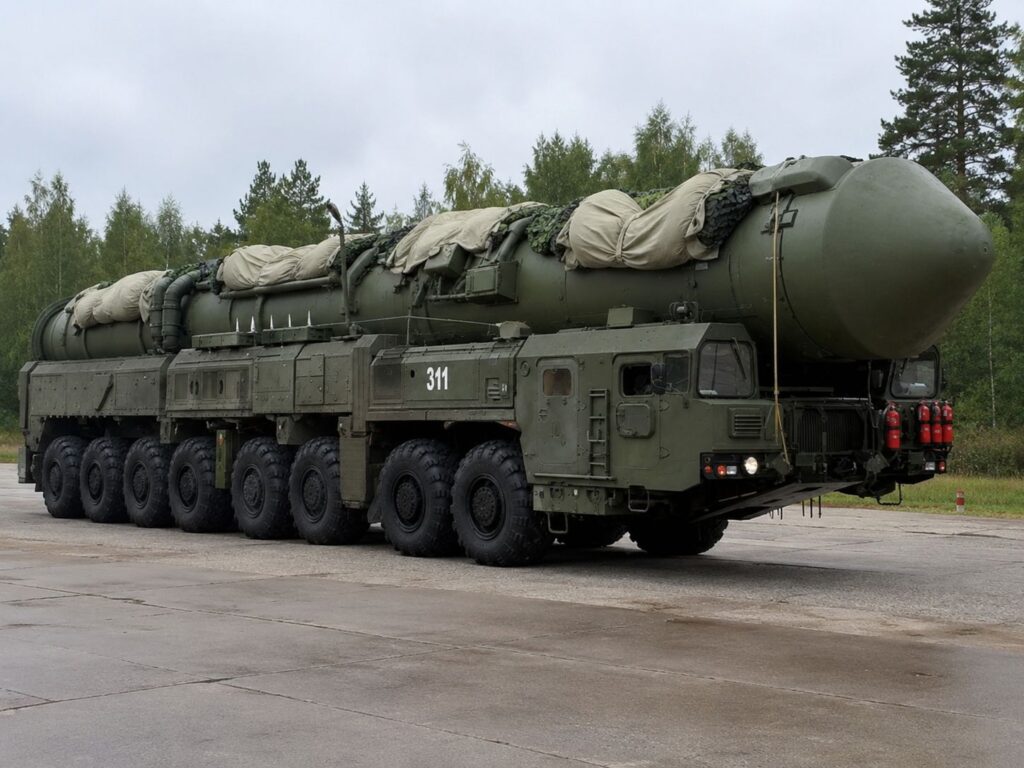
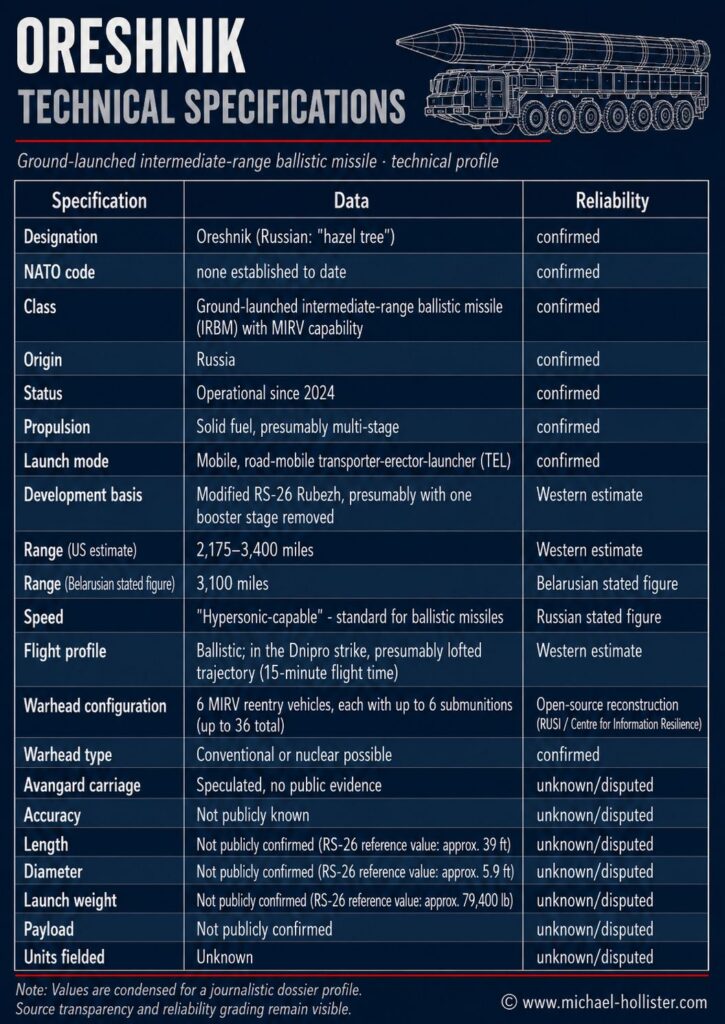
The Oreshnik (Russian for “hazel tree”) is a Russian ground-launched intermediate-range ballistic missile (IRBM) with multiple warhead capability. It was first used in combat on November 21, 2024, and has been considered operational since. Russian officials market it as a “novel” weapon; Western analysts take a more measured view: the Oreshnik is likely a modified variant of the Russian RS-26 Rubezh, a missile originally developed as an intercontinental ballistic missile and discontinued in 2018 in favor of the Avangard hypersonic glide vehicle. Western analysts suspect that one booster stage of the RS-26 was removed, reducing the range to intermediate-range class and reorienting the system toward conventional rather than nuclear warheads.
US range estimates vary between 2,175 and 3,400 miles; the Belarusian Defense Ministry cites 3,100 miles. Even the lower estimates would be sufficient to reach most European capitals from Russian territory. Since December 2025, the Oreshnik has been deployed, according to Russian and Belarusian statements, at the former military airfield Krichev-6 in Belarus, three miles from the Russian-Belarusian border; President Lukashenko speaks of up to ten missiles.

Militarily, the Oreshnik is most significant for its multiple warheads. In the first strike on Dnipro, it released six independently targetable reentry vehicles – likely the first combat use of a MIRV configuration ever recorded. According to open-source estimates by the British Royal United Services Institute (RUSI), each of these warheads can in turn release up to six submunitions; in the strike on the Kyiv area on May 24, 2026, the Centre for Information Resilience documented 36 submunitions from a single warhead based on Reuters footage. The configuration apparently varies by mission. Such warheads are difficult to intercept because they reenter very rapidly and can strike multiple aim points simultaneously or in sequence.
What the Oreshnik is not: based on publicly available evidence, it does not carry a hypersonic glide vehicle such as the Avangard. President Putin describes it as hypersonic-capable – this is, however, not unusual for ballistic missiles and their reentry vehicles; nearly all missiles in this class reach hypersonic velocity. Its conventional effect also appears limited: in the Lviv strike of January 2026, it apparently carried inert warheads according to Ukrainian reports. Unit numbers and unit costs are also likely to argue against mass deployment, though no reliable public figures exist on either point.
Its actual significance therefore lies less in conventional destructive effect than in strategic signaling: Russia is demonstrating that it can reach targets across Europe with nuclear-capable intermediate-range technology – a message that has gained range since the deployment to Belarus.
Operational History and Deployments
November 21, 2024 – First combat use against the city of Dnipro in Ukraine. Launch presumably from the Kapustin Yar test range, flight distance approximately 500 miles. Six reentry vehicles were released – assessed by Western intelligence as likely the first MIRV combat use ever recorded.
December 2025 – Russia deploys Oreshnik missiles to Belarus, presumably at the former military airfield Krichev-6, three miles from the Russian-Belarusian border. President Lukashenko speaks of up to ten missiles to be stationed in Belarus; site conditions on the ground suggest distribution across multiple locations.

January 09, 2026 – Second documented combat use, against an infrastructure target in the Lviv region of western Ukraine. Launch also presumably from Kapustin Yar, flight distance approximately 900 miles. According to Ukrainian reports, the missile carried inert warheads; the impact patterns in concrete and surrounding woodland are nonetheless consistent with the deployment of multiple submunitions. The Russian Defense Ministry justified the strike as a response to an alleged Ukrainian drone attack on a Putin residence on December 29, 2025 – an account disputed by US and EU officials.
May 24, 2026 – Third documented combat use, against Bila Tserkva in the Kyiv area, as part of a combined large-scale strike with Iskander, Kinzhal, and Zircon (according to the Russian Ministry of Defense; not independently verified). Analysis of Reuters footage by the Centre for Information Resilience showed the warhead splitting into 36 submunitions.
Further Reading
Oreshnik – CSIS Missile Threat Primary technical reference: IRBM classification, RS-26 connection, range estimates, MIRV configuration, operational chronology.
Inside Russia’s New Missile, Oreshnik – Reuters Graphics Reuters graphics and analysis with technical visualization and operational chronology.
The Oreshnik Ballistic Missile: From Russia with Love? – RUSI RUSI commentary (December 2024) with open-source assessment of MIRV configuration and strategic significance.
Possible Oreshnik Deployment in Belarus – Arms Control Wonk Jeffrey Lewis (Middlebury Institute) on the Belarus deployment and Krichev-6 site identification.
Pentagon Press Briefing on the First Strike, November 21, 2024 Pentagon assessment of the Oreshnik as an experimental IRBM with RS-26 basis.
© Michael Hollister – All rights reserved. Redistribution, publication or reuse of this text requires express written permission from the author. For licensing inquiries, please contact the author via www.michael-hollister.com.
Newsletter
🇩🇪 Deutsch: Verstehen Sie geopolitische Zusammenhänge durch Primärquellen, historische Parallelen und dokumentierte Machtstrukturen. Monatlich, zweisprachig (DE/EN).
🇬🇧 English: Understand geopolitical contexts through primary sources, historical patterns, and documented power structures. Monthly, bilingual (DE/EN).