
9K720 Iskander – SS-26 “Stone”
As of 29. May 2026
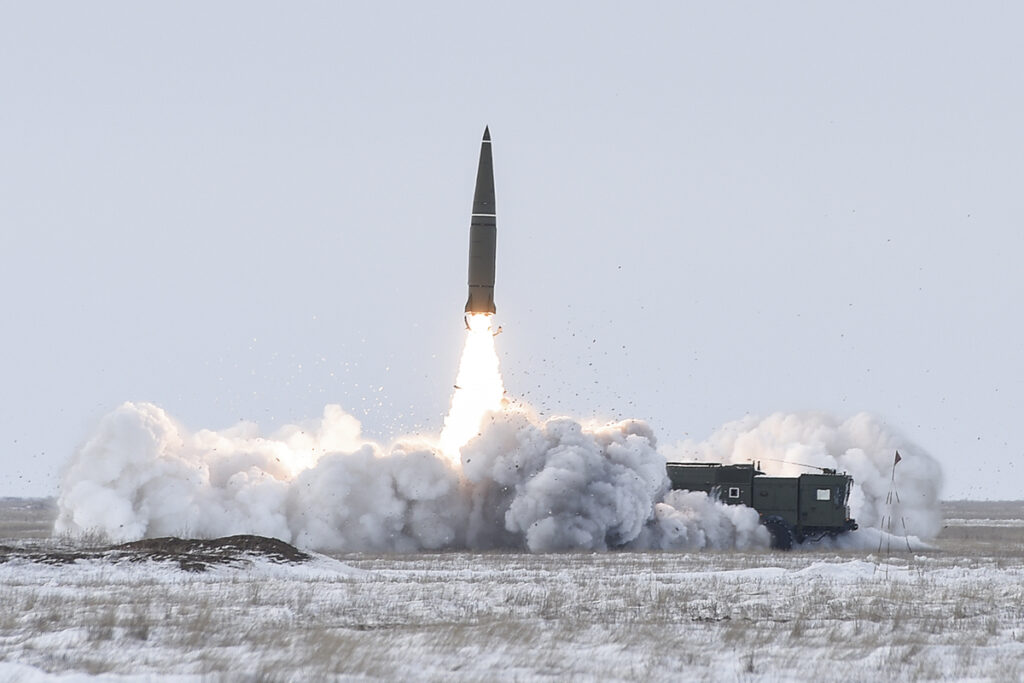
Source: By Mil.ru, CC BY 4.0
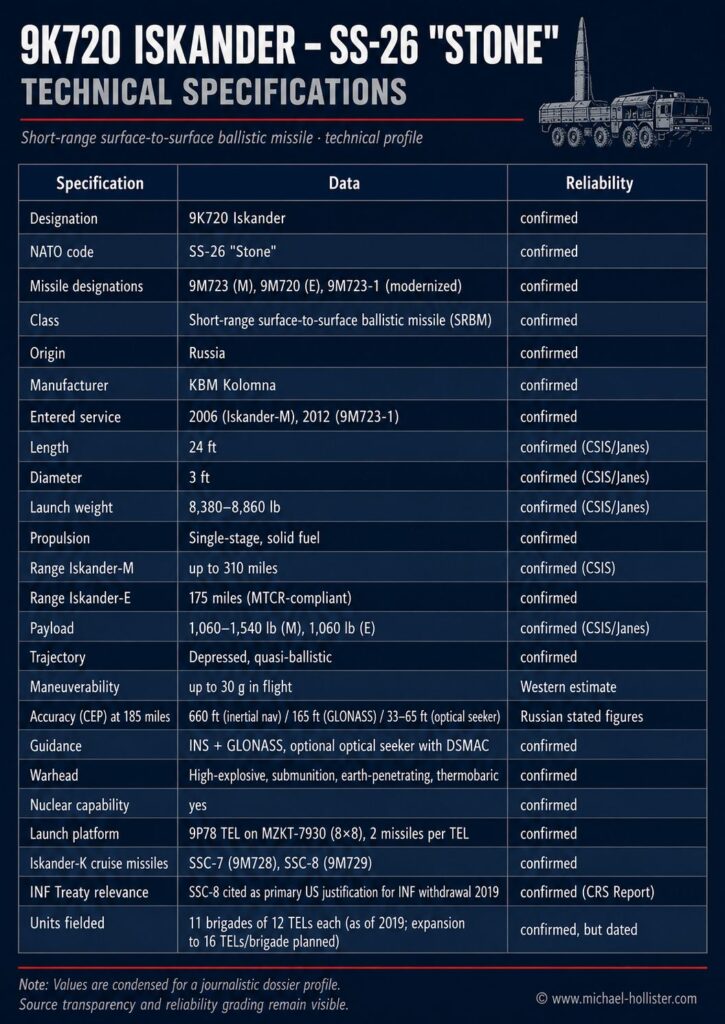
The 9K720 Iskander is a Russian mobile short-range ballistic missile system that has been in active service with the Russian ground forces since 2006. Most people who hear “Iskander” think of a single missile – in reality, it is a complete weapon system: an eight-wheeled transporter-erector-launcher (TEL) on an MZKT-7930 chassis, two ready-to-fire missiles per vehicle, plus reload vehicles, command vehicles, and logistics. The NATO designation is SS-26 “Stone.” The manufacturer is the Mechanical Engineering Design Bureau (KBM) in Kolomna.
Ground-launched, the system comes in three variants: the Iskander-M (9M723) as the primary ballistic version with a range of up to 310 miles, the Iskander-E (9M720) as the export version with a range reduced to 175 miles – precisely below the MTCR export threshold of 185 miles – and the Iskander-K as a cruise missile configuration launched from the same TEL. It is this last variant that has made geopolitical history: the cruise missiles SSC-7 (9M728) and SSC-8 (9M729) employed in the Iskander-K violate the INF Treaty under the US interpretation, because their actual range exceeds the treaty-permitted 310 miles. In 2019, the United States withdrew from the INF Treaty, citing the SSC-8 as the primary justification. Any discussion of the Iskander is therefore unavoidably also a discussion about the end of one of the most important arms control agreements of the Cold War.

Militarily, the Iskander is an operational deep-strike system. Its purpose is to hit high-value targets in the enemy’s rear: ammunition depots, airfields, command centers, air defense positions, chokepoints, and rail junctions. Its effectiveness against modern air defenses rests on three characteristics: a flat, depressed trajectory (as opposed to the high ballistic arc of older systems), in-flight maneuverability of up to 30 g, and very high terminal-phase velocity. Accuracy varies by guidance mode – from 660 feet with a pure inertial navigation system down to 33 to 65 feet with an optional optical seeker head. Warheads can be configured as conventional high-explosive, submunition, earth-penetrating, or thermobaric; nuclear arming is possible.
What the Iskander is not: it is not a strategic intercontinental system, not an “invincible wonder weapon,” and not a substitute for air superiority. Modern air defense systems such as Patriot PAC-3 or THAAD can intercept individual Iskander missiles – provided sensor coverage and ammunition stocks are adequate. Both effects are visible in the Ukraine war: regularly successful Iskander strikes against rear-area targets on the one hand, and documented intercepts by Western systems on the other. The Iskander’s first combat use was not in Ukraine but in the 2008 war in Georgia.
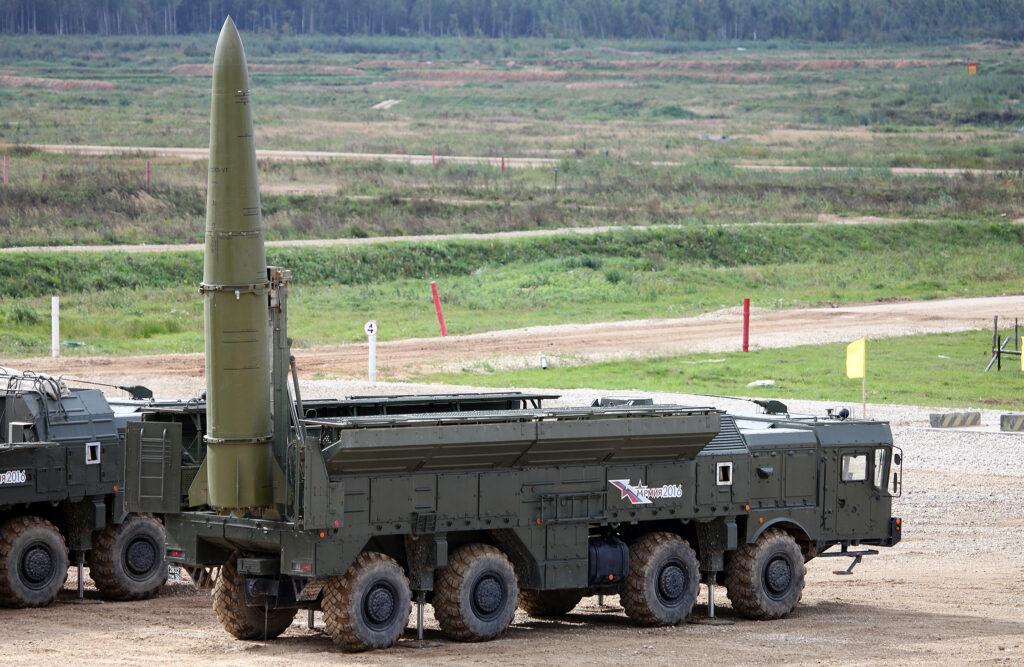
Source: By Vitaly V. Kuzmin – CC BY-SA 4.0
Operational History and Deployments
2008 – First combat use in the war in Georgia. 2016 – Armenia becomes the first export customer for the Iskander-E. 2017 – Algeria purchases four Iskander-E regiments (48 TELs, 120 support vehicles). Since 2018 – Permanent deployment in Kaliningrad, from which targets in Poland, the Baltic states, and Sweden are within range. Since 2022 – Extensive use in the Ukraine war, including the deployment of decoys to confuse enemy air defenses (documented by US intelligence in March 2022). 24. May 2026 – Part of a combined large-scale strike on the Kyiv area together with Oreshnik, Kinzhal, and Zircon (according to the Russian Ministry of Defense; not independently verified).
Further Reading
9K720 Iskander (SS-26) – CSIS Missile Threat Primary technical reference: variants, dimensions, ranges, guidance systems, TEL configuration, INF relevance, operational history.
Iskander-M – Missile Defense Advocacy Alliance Overview with strategic context, Kaliningrad deployment, European threat perception.
Russia, Ukraine and the Tactical Battlefield Missile – IISS IISS paper on ballistic trajectories in the Ukraine war, with specific analysis of the 9M723.

Russian Compliance with the INF Treaty – Congressional Research Service CRS report on the SSC-8 and US withdrawal from the INF Treaty.
Russia Deploys Missile Decoys in Ukraine – CSIS Missile Threat, March 2022 On the use of Iskander decoys in the Ukraine war.
© Michael Hollister – All rights reserved. Redistribution, publication or reuse of this text requires express written permission from the author. For licensing inquiries, please contact the author via www.michael-hollister.com.
Newsletter
🇩🇪 Deutsch: Verstehen Sie geopolitische Zusammenhänge durch Primärquellen, historische Parallelen und dokumentierte Machtstrukturen. Monatlich, zweisprachig (DE/EN).
🇬🇧 English: Understand geopolitical contexts through primary sources, historical patterns, and documented power structures. Monthly, bilingual (DE/EN).