
by Michael Hollister
Exclusive published at Michael Hollister on May 29, 2026
2.624 words * 14 minutes readingtime

Why It Was Barely Reported
While rockets and drones exploded over Kyiv during the night of May 23 to 24, 2026, the tickers of Western news agencies ran hot. Front pages, breaking news alerts, expert commentary. Russia was attacking the Ukrainian capital – unprovoked, brutal, escalatory. The picture was clear.
What almost nobody mentioned: three days earlier, a student dormitory had collapsed in the occupied eastern Ukrainian city of Starobilsk. Teenagers between 14 and 18 years old lay beneath the rubble. Russia had explicitly announced the Kyiv attack as retaliation – and carried it out.
Anyone who wants to understand what really happened this week needs to know both events. This piece documents them – without taking sides, but with one clear finding: one-sided reporting in either direction is not information. It is propaganda.
Starobilsk: What Happened During the Night of May 21 to 22
During the night of May 21 to 22, 2026, Ukrainian drones struck the city of Starobilsk in the Russian-occupied Luhansk Oblast. The target – or at least the object that was hit – was the vocational college of Luhansk Pedagogical University: school buildings and a five-story student dormitory.
The figures reported by Russian authorities in the days that followed rose incrementally: first one dead, then twelve, then eighteen, finally 21 confirmed dead and 42 wounded. According to Russian emergency services, the victims were predominantly young women born between 2003 and 2008 – students. At the time of the strike, Russia’s Investigative Committee stated, 86 teenagers between 14 and 18 years old were in the dormitory.
The attack came in three waves involving a total of 16 drones of the Fire Point FP-1/FP-2 type. Not a malfunction, not a single stray projectile.
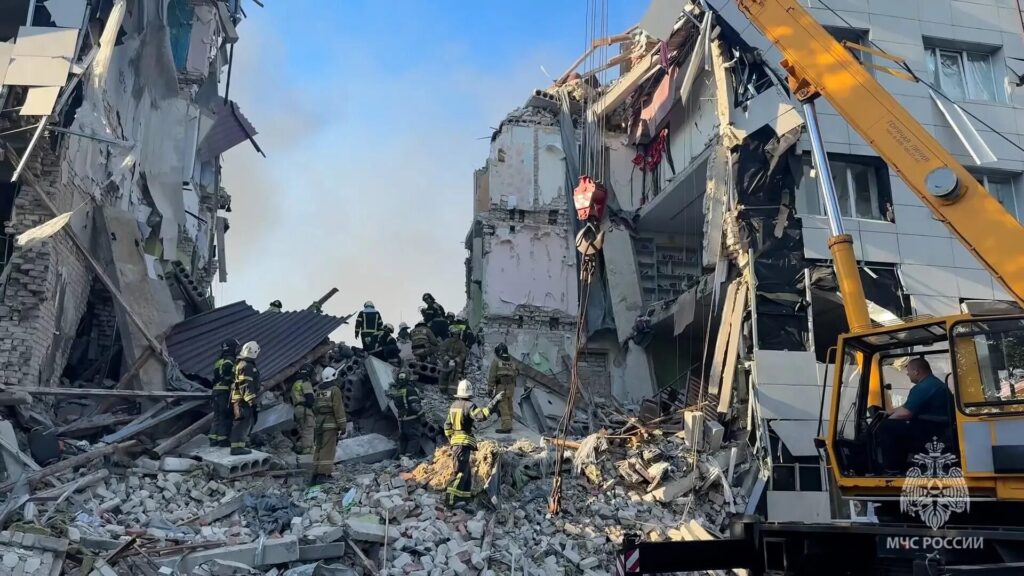
Source Image: Wikipedia

Two Irreconcilable Accounts
Ukraine did not deny the strike but disputed the target designation. The Ukrainian General Staff stated that the target in Starobilsk was a headquarters of the unit “Rubikon” – officially the “Center for Advanced Unmanned Technologies” of the Russian Defense Ministry. Rubikon is not a hypothetical cover designation: the unit is documented through earlier Ukrainian military reports, including a confirmed strike on a Rubikon headquarters in Avdiivka in November 2025. According to Ukrainian sources, the unit coordinates drone strikes on Ukrainian logistics and supply routes. The armed forces had, the General Staff stated, “struck exclusively military infrastructure in accordance with international humanitarian law.”
The decisive question – was Rubikon actually stationed in or directly adjacent to the college? – remains open. Ukraine places the target “within the Starobilsk city area.” The college is located in the city center. Whether the declared military target and the struck civilian building were at the same location, in close proximity, or at a significant distance cannot be verified from the outside.
The Russian side denies any military connection entirely. President Putin stated publicly that there had been no military or security-related facilities near the college. Russia’s human rights commissioner Yana Lantratova visited the site and described the drones as having waited for fleeing students and then struck again in subsequent waves – an account that, if accurate, would constitute a deliberate attack on civilians.
Independent assessment comes from the Conflict Intelligence Team (CIT), an investigative group led by Ruslan Leviev. Leviev analyzed photographs, videos, and obituaries and concluded: the strike hit the pedagogical college. No signs of a military installation at the site were discernible. A foreign journalist brought to the scene by Russian authorities reported the same: students’ belongings in the destroyed dormitory, no visible military presence – though journalists were denied access to adjacent buildings. That restriction matters: without full, independent access, CIT’s finding also remains a partial picture.
The UN Security Council
At Russia’s request, the UN Security Council held an emergency session on May 22. Russia’s UN Ambassador Vassily Nebenzia described the attack as a war crime. Western members expressed doubt and called for independent verification. The UN stated it was alarmed – but was unable to conduct its own assessment due to lack of access to the Russian-occupied territory. Several countries called for an independent investigation. No formal resolution was adopted.
Kyiv: What Happened During the Night of May 23 to 24
Russia had announced its response in advance. Putin publicly stated that the military had been instructed to prepare retaliation. The answer came two days after Starobilsk.
During the night of May 23 to 24, Russia launched – according to Ukrainian sources – 600 attack drones and 90 missiles against Ukraine, with Kyiv and its surrounding region as the primary target. The weapons package included short-range Iskander ballistic missiles, Kinzhal hypersonic missiles, and – for the first time – ground-launched Zircon cruise missiles, according to Ukrainian air defense: a first. And: the Oreshnik.
Oreshnik Strikes Bila Tserkva
The Oreshnik – a Russian medium-range missile with a multiple warhead, nuclear-capable, previously used twice in the Ukraine war – this time struck not Kyiv itself but Bila Tserkva, a city of approximately 200,000 residents roughly 50 miles south of the capital. A military airfield is located there. It was the third Oreshnik deployment in the war.
Russia’s Defense Ministry confirmed the deployment, stating that the Oreshnik had struck “command and control facilities, air force bases, and military-industrial installations.” The missile type carries a MIRV-like multiple warhead: a carrier vehicle delivers several submunition bodies onto the target trajectory, which separate shortly before impact and produce a dispersal pattern. Russian military sources and independent military analysts agree that the Oreshnik is suited to large-area, flat targets such as airfields or industrial installations – not surgical precision strikes in densely built urban environments. The choice of Bila Tserkva rather than central Kyiv follows this logic.

Also deployed for the first time was a ground-launched variant of the Zircon hypersonic missile, previously launched exclusively from warships. Ukrainian air defense chief Ignat confirmed the deployment: the Zircon had been the only genuinely new element of the attack; the rest was familiar and was being “effectively countered.” The strategic significance of the ground-launched variant lies in its geographic flexibility: rather than being fired from a fixed launch area in the Black Sea, it can in future be fired from shifting positions on Russian territory – reducing warning time and complicating defense planning.
Kyiv: Military and Civilian Damage
In Kyiv itself, the strike hit at least 40 targets according to Ukrainian authorities. Russia’s Defense Ministry listed as targets defense enterprises – including facilities producing drones and missiles – as well as air defense installations and command facilities. Ukrainian sources additionally identify damaged civilian objects: the Foreign Ministry building near a point of impact, an opera house, the National Chernobyl Museum, residential buildings, supermarkets. Four people died; more than 80 were wounded.
That is the reality of a strike on a city of millions. Even where the declared targets are military in nature: in a densely built urban environment where infrastructure, residential buildings, and civilian facilities exist in close proximity, there is no clean dividing line. Civilian collateral damage in a strike of this scale on Kyiv is not an unforeseen exception – it is an arithmetical certainty.
The Causality Missing from Western Coverage
What Western reporting on the Kyiv strike structurally omits is the chain of causation. Russia publicly announced its intent to retaliate before the attack – not as a retrospective justification, but as an declared response. Russia’s Defense Ministry confirmed after the strike that the operation had been carried out “in response to Ukrainian strikes on civilian targets on Russian territory.”
One need not fully accept Russia’s account of Starobilsk to acknowledge this connection. The sequence of events is documented: Starobilsk (May 21/22) → Putin’s announcement of retaliation → Kyiv strike (May 23/24). Those who report the third step without mentioning the first two are not describing a conflict – they are constructing a narrative.
This pattern is not new. It runs through Western coverage of the Ukraine war as a whole: Russian actions appear as starting points, Ukrainian actions as reactions – or they do not appear at all. That Ukraine has been striking Russian-occupied cities with drones for years, repeatedly causing civilian casualties, is documented in Western media – but structurally underreported. Starobilsk is not an isolated case. It is a particularly sharp example of a familiar pattern.
The question of proportionality – 21 dead in Starobilsk, 4 dead in Kyiv – does not resolve as simply as it might first appear, for several reasons. First, the death toll in Starobilsk has not been independently verified and is bound up with the context of occupation. Second, Kyiv is one of the best-defended cities in Europe – Ukrainian air defense claims to have intercepted the majority of the drones and missiles. Third, the Kyiv strike is by far the largest of its kind since the war began.
Legal Framework: What Applies, What Remains Unresolved
Both incidents raise questions of international humanitarian law – without any legal judgment being rendered or intended here. For orientation, the relevant framework nonetheless.
International humanitarian law, specifically the Geneva Conventions and their Additional Protocols, distinguishes between combatant and civilian targets. An object loses its protection as a civilian target if it is put to military use – but only for as long as and to the extent that such use continues. The principle of proportionality is decisive: an attack is impermissible if the expected civilian harm is excessive in relation to the anticipated military advantage.
In the case of Starobilsk, the legal assessment turns precisely on the unresolved core question: was Rubikon stationed in or directly adjacent to the college, and if so – does the military target justify an attack with 16 drones on a building in which 86 teenagers are sleeping? This question cannot be answered without an independent investigation. Russia demanded one before the UN Security Council; access remained blocked for lack of agreement.
In the case of Kyiv, Russia struck declared military targets. That civilian infrastructure was damaged and people died is documented. Whether that resulted from insufficient precision, from the sheer scale of the attack, or from target definitions that included civilian facilities cannot be conclusively assessed from the outside.
The Reporting Failure: What Is Documented
The finding is not that Western media failed to report on Starobilsk. BBC, Reuters, AP, CNN – they all covered the incident. The finding is different: Starobilsk appeared as a footnote, Kyiv as the main story. The disproportion in volume, placement, and tone was asymmetric – and asymmetric in both directions.
What is concretely documentable: Russia organized a press visit to Starobilsk on May 24 for 50 accredited foreign correspondents from 19 countries – representatives from the Middle East, Eastern Europe, and the Global South, as well as independent Western journalists. BBC and CNN editorial teams declined to participate. Russian Foreign Ministry spokeswoman Maria Zakharova stated that some Western correspondents had been instructed by their editors not to report. One of the BBC’s Moscow correspondents – Steve Rosenberg – was on X at the time of the press visit commenting on Russian newspaper articles about vegetable gardening.
Zakharova’s statements must be treated with caution – she is not an independent source. What is independently confirmed: the press tour took place, and the major Anglo-American flagship outlets did not participate. Dutch journalist Eric van de Beek wrote on X that there had not been a single standalone report in Western media on the victims of the Ukrainian drone strike on Starobilsk – only mentions in the context of the Russian retaliation.
That is the pattern: not silence, but embedding. Starobilsk is not ignored – it is made a footnote to the Kyiv strike. The causality is inverted: not “Ukraine strikes school, Russia announces retaliation, Kyiv is bombed” – but “Russia bombs Kyiv, citing alleged Ukrainian strike on school.”
On the other side, Russian and pro-Russian media present the mirror image. Starobilsk is an established war crime, Ukraine deliberately targeted children, the Kyiv strike was a precise retaliatory operation against exclusively military targets. The civilian deaths in Kyiv, the damaged opera house, the Chernobyl Museum – in this narrative they do not exist, or exist as a Ukrainian fabrication. Simplicius, one of the most widely read English-language military commentators with a pro-Russian orientation, describes the Kyiv strike as strategically precise and cites the selection of the Bila Tserkva military airfield as evidence of Russian proportionality – while making no mention of civilian damage in Kyiv.
Both accounts are selective. Both are internally consistent in their selection. And both make it impossible for the reader to form a complete picture.
Finding: The Symmetry of Double Standards
Both sides in this war strike civilian objects. Both sides deny it or justify it with military targets nearby. Both sides have media structures that report exactly what fits their narrative.
That is not a new insight – but it warrants clear naming in the specific case of this week.
What happened in Starobilsk is documented in its basic outlines: a vocational college and its dormitory were struck in three drone waves. Teenagers died. Whether the Rubikon headquarters was at the same location, nearby, or whether this constitutes a retrospective justification – that is unresolved and must remain so as long as independent access to the site is impossible.
What happened in Kyiv is also documented: Russia responded with a massive weapons deployment, declared targets were military in nature, actual damage included civilian infrastructure, and four people died.
What is not documented: an unprovoked Russian attack on Kyiv. The provocation is part of the sequence of events – whether one accepts it as justification is a political question. That it occurred is a factual one.
And here lies the actual problem with this week’s coverage: not the lie, but the selection. Those who do not name Starobilsk are not lying about Kyiv. They are only telling half the story. Those who present Kyiv as a purely military precision operation are not lying about Starobilsk. They are only telling the other half. Both halves together produce a picture that neither side finds comfortable – and that is precisely why it comes closest to reality.
Those who show only part of the picture – whether Starobilsk without Kyiv or Kyiv without Starobilsk – are not producing news. They are producing a narrative. The difference between the two is the difference between journalism and propaganda.


Michael Hollister
is a geopolitical analyst and investigative journalist. He served six years in the German military, including peacekeeping deployments in the Balkans (SFOR, KFOR), followed by 14 years in IT security management. His analysis draws on primary sources to examine European militarization, Western intervention policy, and shifting power dynamics across Asia. A particular focus of his work lies in Southeast Asia, where he investigates strategic dependencies, spheres of influence, and security architectures. Hollister combines operational insider perspective with uncompromising systemic critique – beyond opinion journalism. His work appears on his bilingual website (German/English) www.michael-hollister.com, at Substack and in investigative outlets across the German-speaking world and the Anglosphere.
Sources
- Reuters / Al Arabiya English, May 23, 2026 – Toll from Ukrainian strike on college in occupied town rises to 10: https://english.alarabiya.net/amp/News/world/2026/05/23/toll-from-ukrainian-strike-on-college-in-occupied-town-rises-to-10-russiabacked-governor
- Wikipedia – 2026 Starobilsk strike: https://en.wikipedia.org/wiki/2026_Starobilsk_strike
- The Moscow Times, May 25, 2026 – Everything We Know About the Deadly Ukrainian Strike in Occupied Luhansk: https://www.themoscowtimes.com/2026/05/25/everything-we-know-about-the-deadly-ukrainian-strike-in-occupied-luhansk-a92834
- The Defense News – Russia Launches 55 Missiles and 649 Drones Against Ukraine: https://www.thedefensenews.com/Russia-Launches-55-Missiles-and-649-Drones-Against-Ukraine-in-Overnight-Attack-Targeting-Kyiv/
- Novaya Gazeta Europe, May 25, 2026 – Russia carries out massive attack on Kyiv region: https://novayagazeta.eu/amp/articles/2026/05/25/russia-carries-out-massive-attack-on-kyiv-region-including-oreshnik-missile-strike-on-nearby-city-en
- CNN, May 23, 2026 – Russia fires powerful ballistic missile in mass attack on Kyiv: https://edition.cnn.com/2026/05/23/europe/putin-ukraine-strike-starobilsk-intl
- Washington Times, May 24, 2026 – Mass attack Kyiv – Russia uses hypersonic Oreshnik missile: https://www.washingtontimes.com/news/2026/may/24/mass-attack-kyiv-russia-uses-hypersonic-oreshnik-missile/
- Kyiv Independent – Russian attack May 24, 2026: https://kyivindependent.com/russian-attack-may-24-2026/
- Euromaidanpress, May 22, 2026 – Ukraine strikes Rubikon elite Russian drone unit: https://euromaidanpress.com/2026/05/22/ukraine-strikes-rubicon-elite-russian-drone-unit-in-occupied-luhansk-oblast-while-moscow-accuses-kyiv-of-hitting-civilians/
- NPR, May 24, 2026 – Russia pounds Kyiv in powerful drone and missile attack: https://www.npr.org/2026/05/24/nx-s1-5833050/russia-uses-hypersonic-oreshnik-missile-in-mass-attack-on-kyiv
© Michael Hollister – All rights reserved. Redistribution, publication or reuse of this text requires express written permission from the author. For licensing inquiries, please contact the author via www.michael-hollister.com.
Newsletter
🇩🇪 Deutsch: Verstehen Sie geopolitische Zusammenhänge durch Primärquellen, historische Parallelen und dokumentierte Machtstrukturen. Monatlich, zweisprachig (DE/EN).
🇬🇧 English: Understand geopolitical contexts through primary sources, historical patterns, and documented power structures. Monthly, bilingual (DE/EN).