
UPDATE Report – Updated: May 13, 2026 – Building on my update from May 10, 2026
by Michael Hollister
Exclusive published at Michael Hollister on May 13, 2026
3.726 words * 20 minutes readingtime
TICKER
CEASEFIRE “ON LIFE SUPPORT” – TRUMP CALLS IRAN’S RESPONSE “A PIECE OF GARBAGE” AND SAYS HE DIDN’T FINISH READING IT
On May 10, Trump publicly rejected Iran’s response to the U.S. negotiating proposal. Speaking to reporters on the South Lawn of the White House, he said: “After the piece of garbage they sent us – I didn’t even read it to the end.” He described the ceasefire as “right now the weakest” and “on life support.” The Washington Post additionally quotes him saying: “It is incredibly weak.” Trump had previously claimed Iran had been willing to give the U.S. access to its enriched uranium – and then walked it back. Iran’s Foreign Ministry called the U.S. demands “unreasonable.” The ceasefire formally continues – politically, it is a wreck.
IRAN’S CORE DEMANDS – A COMPREHENSIVE END TO THE WAR, NOT AN NUCLEAR DEAL
Iran responded to the U.S. proposal with a package that structurally goes far beyond nuclear issues. According to Al Jazeera and Reuters, Tehran’s demands include: an end to the war on all fronts including Lebanon, withdrawal of U.S. troops from the region, lifting of both blockades, war reparations, release of frozen assets, sanctions relief, guarantees against further attacks, and recognition of Iranian sovereignty over the Strait of Hormuz. Parliamentary Speaker Ghalibaf declared that Washington has “no alternative” but to accept Iran’s rights under the 14-point plan. Al Jazeera’s correspondent in Tehran reported that Iran is seeking security guarantees because it was attacked twice during ongoing negotiations – and does not intend to fall into that trap again. What Trump called an imposition is, from Iran’s perspective, the standard demands of a sovereign state following a war of aggression.
SAUDI ARABIA STRUCK IRAN COVERTLY – FIRST DIRECT SAUDI MILITARY ACTION ON IRANIAN SOIL
Reuters reported on May 12, citing two Western and two Iranian officials, that Saudi Arabia conducted a series of undisclosed airstrikes on Iranian territory in late March 2026. These are the first known direct Saudi military strikes on Iranian soil. One Western official described them as “tit-for-tat strikes in retaliation for when Saudi Arabia was hit.” According to Reuters, the strikes were followed by a roughly 76 percent drop in Iranian attacks on Saudi Arabia within one week. Riyadh informed Tehran after the strikes; intensive diplomatic contacts followed. The attacks have not been officially confirmed; Reuters could not independently verify specific targets. Separately, the Wall Street Journal reported that the UAE had also covertly struck Iranian targets – including, according to Iran International, a facility on Lavan Island. The finding: the Gulf states are no longer passive U.S. platforms. They are conducting their own undeclared war.
IRAN DECLARES HORMUZ A “VAST OPERATIONAL AREA” – CONTROL ZONE EXPANDS UP TO TENFOLD
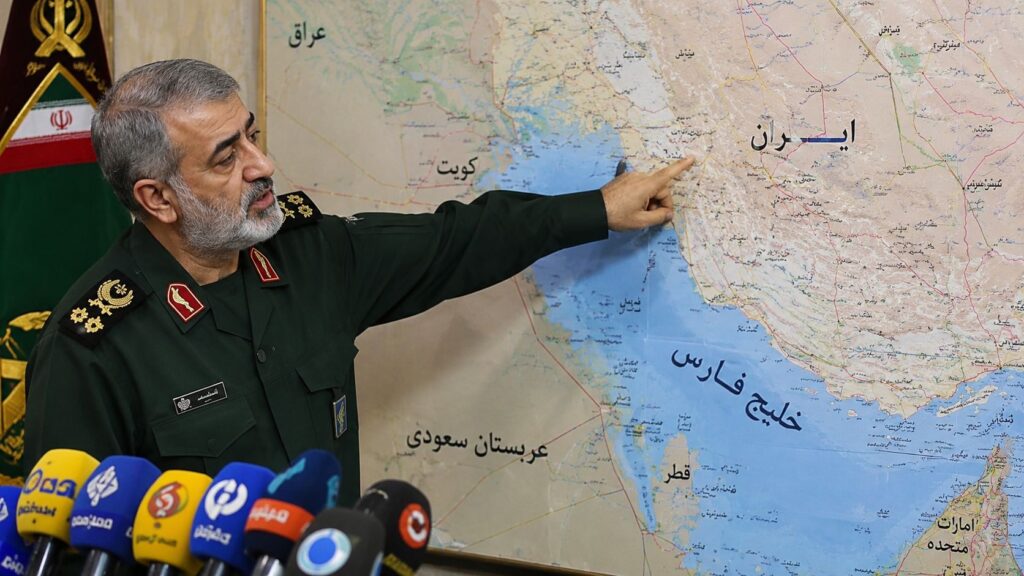
On May 12, Mohammad Akbarzadeh, deputy policy director of the IRGC Navy, declared that the previous definition of the Strait of Hormuz as a “limited area around the islands of Hormuz and Hengam” was outdated. The new control zone extends in a full crescent shape from the coast of Jask in the east to Siri Island in the west – an expansion analysts estimate enlarges the claimed area by up to tenfold. It is the second extension since the war began: on May 4, the IRGC had already published a zone extending along the Omani coast of the Gulf of Oman. The new boundary now also encompasses the UAE’s Fujairah bypass terminal – until now marketed as a safe alternative route to Hormuz. The White House rejected the move. Reuters was unable to obtain immediate comment from Iranian authorities.
IRAN THREATENS 90 PERCENT ENRICHMENT – PARLIAMENTARY SPOKESMAN NAMES WEAPONS-GRADE OPTION PUBLICLY FOR THE FIRST TIME
On May 12, Ebrahim Rezaei, spokesman for the Committee on National Security and Foreign Policy in the Iranian parliament, posted on X: “One of Iran’s options in the event of another attack could be 90 percent enrichment. We will examine this in parliament.” It is the first time an Iranian parliamentary official has named weapons-grade enrichment publicly and explicitly as an option. Iran currently enriches to 60 percent; the jump to 90 percent – considered weapons-grade – is technically achievable in the short term with existing centrifuges.

The IAEA estimated Iran’s stockpile at a minimum of 440 kilograms at the 60 percent level – enough for several bombs if raised to 90 percent. Parliamentary Speaker Ghalibaf simultaneously issued an ultimatum to Washington: either the U.S. accepts Iran’s rights under the 14-point plan “or fails.” Trump had publicly declared preventing Iran’s nuclear weapons program to be his central war objective. Rezaei’s post says: another attack, and Iran moves precisely in that direction.
LEBANON: 380 DEAD SINCE CEASEFIRE – ISRAEL STRIKES COASTAL HIGHWAY NEAR BEIRUT THE DAY BEFORE WASHINGTON TALKS
On May 13, Israel struck three vehicles with drones on the Sidon-Beirut coastal highway in the towns of Barja, Jiyeh, and Saadiyat – roughly 20 kilometers south of the capital. Lebanon’s Health Ministry: 8 dead, including two children. AFP documented the scene; Israel did not initially comment on the coastal highway strikes. The day before, on May 12, Israeli airstrikes in the south killed 13 people, among them a child, a woman, and a Lebanese army soldier. On May 9, an Israeli drone in Nabatiyeh killed a Syrian man and his twelve-year-old daughter: after the first strike, both fled – the drone pursued them, killed the father immediately, and struck the girl a second time as she collapsed 100 meters away. She died in hospital. Lebanon’s Health Minister Nassereddine: since the ceasefire took effect on April 17, 380 people have been killed and 1,122 wounded. A new round of direct talks between Israel and Lebanon was scheduled in Washington on Thursday.
TRUMP: “I DON’T THINK ABOUT AMERICANS’ FINANCIAL SITUATION”
On May 12, before departing for Beijing, a reporter asked Trump on the South Lawn whether the economic burden on the American public was influencing his Iran strategy. Trump: “Not even a little bit. I don’t think about Americans’ financial situation. I don’t think about anybody.” Pentagon war costs were revised upward the same day: Comptroller Jay Hurst put them before Congress at approximately $29 billion – $4 billion more than two weeks prior. According to the Financial Times, U.S. households have paid $35 billion more for gasoline and diesel since the war began, roughly $268 per household. Defense economists and academic researchers estimate total costs at up to $1 trillion when inflation, higher interest rates, and supply chain effects are factored in. Freight rates from Northern Europe to the West Coast have risen 56 percent since February. Food prices are up 30 percent according to the FT; supermarket prices up 13 percent.
TRUMP TRAVELS TO BEIJING – IRAN WAR OVERSHADOWS ECONOMIC SUMMIT WITH XI
Trump arrived in Beijing on May 13 for a visit with President Xi Jinping – his first trip to China since 2017. Before departure, he said he did “not” need China’s help on Iran – but added he wanted to end the war “peacefully or otherwise,” “one way or the other.” Araghchi’s visit to Wang Yi on May 6 had been strategically pre-positioned: China had been pressing Iran toward negotiations and a Hormuz reopening. Wang Yi’s demand for a “prompt resumption of shipping traffic” was absent from the Iranian Foreign Ministry’s readout. Immediately before Trump’s arrival in Beijing, a Chinese oil tanker attempted the Hormuz passage, according to CNN – a signal directed at Washington and Tehran simultaneously. Trump posted on Truth Social during the flight that journalists reporting on Iranian military capabilities were committing “virtual TREASON” – and handed Attorney General Blanche a written note bearing the word “Treason.” According to CNN, he is pursuing subpoenas against war correspondents.

TRUMP ON TRUTH SOCIAL: “BING BING GONE” – WHITE HOUSE REPOSTS AI IMAGES AS WAR COMMUNICATION
On May 12, Trump posted two AI-generated images on Truth Social, which the White House reposted on X. Image one: a U.S. Reaper drone attacking Iranian fast boats engulfed in flames – caption: “BYE BYE, ‘FAST BOATS'”. Image two: a U.S. destroyer firing a laser beam at an Iranian aircraft that explodes – caption: “LASERS: BING, BING, GONE!!!” Both images are visibly digitally generated. It is the first documented instance in this war of the White House officially deploying AI-generated combat imagery as a communication tool. Maersk CEO Vincent Clerc put the additional costs of the Hormuz blockade at $500 million per month. According to U.S. military figures, 1,550 ships carrying approximately 22,500 crew members remain trapped in the Persian Gulf.
TRUMP CALLS THE WAR “IRAN EXCURSION – 6 WEEKS” – WHILE THE CEASEFIRE IS “ON LIFE SUPPORT”
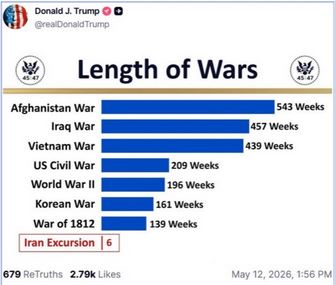
On May 12, Trump posted a graphic on Truth Social titled “Length of Wars”: Afghanistan 543 weeks, Iraq 457 weeks, Vietnam 439 weeks, World War II 196 weeks – and at the very bottom: “Iran Excursion – 6 Weeks.” The graphic appeared the same day he called the ceasefire “on life support” and Iran threatened 90 percent enrichment in response to further U.S. attacks. PBS has documented Trump’s public statements since the war began: on March 1, he said combat operations would last “four to five weeks.” On March 7, he declared Iran had “apologized and capitulated.” On April 11: “We have totally and completely won.” Day 74: the war continues, the ceasefire is paper, Tehran is threatening weapons-grade enrichment – and on Truth Social: Bing Bing Gone.
ISRAEL DELIVERS IRON DOME TO UAE – U.S. AMBASSADOR CONFIRMS PUBLICLY
On May 12, U.S. Ambassador Mike Huckabee confirmed at an event in Tel Aviv that Israel has provided the UAE with an undisclosed number of Iron Dome batteries and operating personnel. “Look at the benefits the UAE has gotten from it,” Huckabee said, referencing the Abraham Accords. The UAE reported dismantling an IRGC-linked cell in April. Bahrain recently arrested 41 people over alleged IRGC ties, after 69 others were stripped of citizenship. The Abraham Accords states are thus being incrementally converted from a political into a military alliance structure – with Israeli air defense as the connective tissue, while Iran threatens and the U.S. negotiates.
HEZBOLLAH DRONE WAR ESCALATES – 230 PROJECTILES AND 100 DRONES SINCE CEASEFIRE OF APRIL 17
The Washington Post reported on May 13 that Hezbollah has deployed approximately 230 projectiles and more than 100 explosive drones against Israeli forces since the April 17 ceasefire. Israel struck more than 1,100 Hezbollah targets in southern Lebanon during the same period. The IDF has identified fiber-optically guided drones as a new tactical threat – nearly impossible to jam, difficult to locate. Hezbollah chief Naim Kassem warned he would make the battlefield “hell” for Israel and called on Lebanon to withdraw from direct talks with Israel – only indirect negotiations, he said, are acceptable. Kassem described Hezbollah’s armament as “an internal Lebanese matter” that cannot be part of any discussions with Israel. Lebanon’s Health Ministry called the ongoing strikes on civilians “continuing serious violations of international humanitarian law.”

ANALYSIS
I. “Piece of Garbage” vs. Sovereign Demands – Why the Positions Are Structurally Irreconcilable
Trump called Iran’s response a “piece of garbage” and said by his own account he did not finish reading it. That is rhetorically understandable – and analytically the problem. A negotiator who does not read the other side’s position is not negotiating. He is waiting for capitulation.
Iran’s list of demands is long. Read soberly, it is also what a state demands after a war of aggression: an end to hostilities on all fronts, withdrawal of foreign troops, compensation for war damage, release of frozen assets, sanctions relief, security guarantees against repetition. Every single one of those points has a counterpart in international post-war negotiations over the past hundred years. The problem is not that the demands are absurd – the problem is that the United States does not want to conduct this kind of negotiation. Washington wants an isolated nuclear deal: Tehran surrenders its nuclear program, the U.S. steps back from active warfare. Iran wants the opposite: first comes a comprehensive settlement of all fronts, then we talk about the nuclear file. These positions are not bridgeable through compromise. They are structurally distinct. One side is negotiating over a weapons system. The other is negotiating over a security architecture. That explains why weeks of talks have produced nothing of substance – and why the next escalatory step was not another negotiating round but the threat of 90 percent enrichment.
II. 90 Percent – What Rezaei’s Post Actually Means
Ebrahim Rezaei is not a fringe figure. He is the spokesman for the Committee on National Security and Foreign Policy in the Iranian parliament – one of the institutionally central positions for nuclear signaling. His decision to name weapons-grade enrichment publicly on X as “one of Iran’s options” and to announce that parliament will “examine” it is not a slip. It is a calculated message.
The technical picture is established: Iran enriches to 60 percent, holds at least 440 kilograms at that level according to IAEA estimates – and the jump to 90 percent is achievable in the short term with existing centrifuges. The strategic logic behind it is equally legible: Iran is watching North Korea. North Korea has nuclear weapons. North Korea is not attacked. The new Supreme Leader Mojtaba Khamenei lost his father, half his family, and the institutional base of the Islamic Republic within weeks. The question of whether a nuclear bomb is the only reliable deterrent presents itself to him with an urgency his predecessor never faced.
Rezaei’s post is a message to several audiences simultaneously: to Washington – another strike triggers a nuclear threshold shift; to Beijing – China should pressure the U.S. before it is too late; to the Iranian public – Tehran is demonstrating agency under extreme pressure. Trump’s stated central war objective was preventing Iran from acquiring nuclear weapons. The direct consequence of his military course is that Iran has for the first time publicly pointed toward weapons-grade enrichment. That is the strategic opposite of what the operation was supposed to achieve.
III. Saudi Arabia Is Running Its Own War – and What That Means for U.S. Gulf Strategy
Reuters’ reporting on Saudi airstrikes on Iranian territory is, if accurate, one of the most significant developments of this conflict – and not because of the strikes themselves, but because of the architecture they reveal.
For decades, Saudi Arabia operated on a clear logic: Iran is the threat, the U.S. is the protection, Riyadh pays and provides bases. That logic has developed two public fractures this week. First: Saudi Arabia struck Iran covertly because the U.S. protective architecture had failed to prevent Iranian strikes on Saudi infrastructure. Second: Saudi Arabia then denied the U.S. military access to Prince Sultan Air Base and airspace when Trump announced Project Freedom without coordinating with Gulf partners. This is no longer a partnership. It is a transactional relationship with its own risk calculus.
Aimen Dean put it precisely: the Gulf states were not afraid of Iran – they were afraid Washington would sacrifice them in an Iran deal while their infrastructure burned. Fujairah had burned. The U.S. response was operationally inadequate. So Riyadh and Abu Dhabi acted on their own. That structurally changes the balance of power in the Gulf: a state that strikes covertly has its own escalation dynamic – independent of Washington. And a state that can withdraw basing rights has leverage over Washington. Both were unthinkable before this war. Both are now documented.
IV. Lebanon: The Ceasefire as Stage Set
380 dead since April 17. That is the balance sheet of a ceasefire that nominally exists and is factually violated every day. A ceasefire under which an average of more than nine people die per day is not a ceasefire. It is an accounting category.
The strikes on the Sidon-Beirut coastal highway on May 13 – eight dead, two children, one day before Washington talks – are not outliers in this context. They are the pattern. In recent days, Israel has struck areas near Beirut where Hezbollah has traditionally had limited presence. It has killed rescue workers, children, a Syrian father and his twelve-year-old daughter – hit twice by the same drone, a hundred meters apart. Lebanon’s Health Ministry called this “a continuing serious violation of international humanitarian law.”
Running in parallel is the agronomy of destruction. 56,264 hectares of agricultural land have been damaged since 2023 by Israeli strikes – through white phosphorus, heavy metals, drone-deployed banned pesticides, destruction of irrigation systems and olive groves. Sixty-five percent of Lebanon’s cultivated land lies in the south and in the Bekaa Valley – precisely where the strikes are concentrated. The World Food Organization already describes Lebanon’s food security situation as precarious; the destruction of farmland deepens dependence on imports in a country that can barely afford them. What has become a strategy in Gaza – destruction of the food base as a tool of war – is playing out in Lebanon through different means but the same logic. A detailed analysis of this method is available here: Israel: Agronomic Warfare
V. The Escalation Protocol – “Bing Bing Gone,” the Treason Note, and the Logic of a Showman in the War Cabinet
Trump is running this war on two levels simultaneously. At the operational level: destroyers through Hormuz, tankers disabled, Iran blockaded, negotiations ongoing. At the communications level: AI images of burning Iranian fast boats, laser weapons against drones, “Bing Bing Gone” as an official White House post.
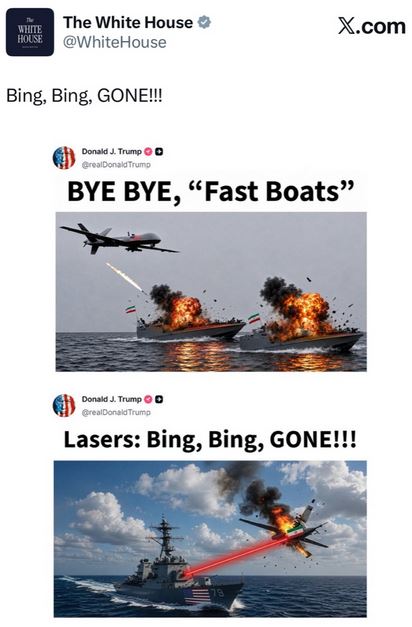
Both are documented and both are real – and the contradiction between the two levels is the actual news event of this week. On the same day Trump called the ceasefire “on life support,” the White House posted AI war graphics on X. On the same day Iran threatened weapons-grade enrichment, he circulated a graphic classifying the ongoing war as a “6-week excursion” – alongside Afghanistan (543 weeks) and Vietnam (439 weeks). On the same day he flew to Beijing to meet Xi Jinping, he handed his Attorney General a handwritten note bearing the word “Treason,” directed at journalists covering Iranian military capabilities.
PBS has documented Trump’s public statements since the war began: March 1 – four to five weeks. March 7 – Iran has capitulated. April 11 – total and complete victory. Day 74: ceasefire on life support, 90 percent threat from Tehran, 380 dead in Lebanon, $29 billion in war costs – and on Truth Social: Bing Bing Gone. This is not a communications failure. This is the communications system. The question that follows is not rhetorical: who in this system actually makes strategic decisions – and on what basis of information?
STRATEGIC ASSESSMENT
Day 74. The ceasefire holds on paper and is violated daily – in Lebanon with 380 dead since April 17, in the Persian Gulf with ongoing tanker operations and drone fire. Iran has for the first time publicly named weapons-grade enrichment as an option. Saudi Arabia has struck Iran covertly and subsequently withdrew U.S. basing rights. The IRGC has expanded its Hormuz control zone by up to tenfold. Trump calls the war a “6-week excursion” and says the financial situation of Americans interests him “not even a little bit.” What this week leaves as a finding: the ceasefire is a fiction, the negotiations are deadlocked, and the only demonstrable movement is toward escalation – on all fronts simultaneously.
Michael Hollister
is a geopolitical analyst and investigative journalist. He served six years in the German military, including peacekeeping deployments in the Balkans (SFOR, KFOR), followed by 14 years in IT security management. His analysis draws on primary sources to examine European militarization, Western intervention policy, and shifting power dynamics across Asia. A particular focus of his work lies in Southeast Asia, where he investigates strategic dependencies, spheres of influence, and security architectures. Hollister combines operational insider perspective with uncompromising systemic critique – beyond opinion journalism. His work appears on his bilingual website (German/English) www.michael-hollister.com, at Substack and in investigative outlets across the German-speaking world and the Anglosphere.
Sources
- NPR, May 10/11, 2026 – Trump says the Iran ceasefire is ‘on life support’: https://www.npr.org/2026/05/10/nx-s1-5817605/trump-rejects-iran-ceasefire-proposal
- Washington Post, May 10, 2026 – Trump says Iran ceasefire is on ‘life support’ (paywalled): https://www.washingtonpost.com/politics/2026/05/10/iran-response-us-proposal-war/
- Al Jazeera, May 11, 2026 – Trump says ceasefire on ‘life support’, slams Iran response: https://www.aljazeera.com/news/2026/5/11/trump-says-ceasefire-on-life-support-slams-iran-response-to-us-proposal
- CBS News, May 11, 2026 – Iran vows to fight on as Trump says ceasefire is “on life support”: https://www.cbsnews.com/live-updates/iran-war-trump-oil-prices-peace-proposal-unacceptable/
- Reuters / Caliber.Az, May 12, 2026 – Saudi Air Force conducted covert “tit-for-tat” strikes on Iran: https://caliber.az/en/post/saudi-air-force-conducted-covert-tit-for-tat-strikes-on-iran-reuters
- Khaama Press, May 12, 2026 – Saudi Arabia carried out covert strikes inside Iran: https://www.khaama.com/saudi-arabia-carried-out-covert-strikes-inside-iran-during-regional-war-reuters-reports/
- The Media Line, May 12, 2026 – Saudi Arabia Secretly Struck Iran After Iranian Attacks: https://themedialine.org/headlines/saudi-arabia-secretly-struck-iran-after-iranian-attacks-reuters-reports/
- The War Zone, May 12, 2026 – IRGC Navy Claims Vast Expansion In Its Definition Of Strait Of Hormuz: https://www.twz.com/news-features/irgc-navy-claims-vast-expansion-in-its-definition-of-strait-of-hormuz
- Reuters / US News, May 12, 2026 – Iran Now Defines Strait of Hormuz as Far Larger Zone: https://www.usnews.com/news/world/articles/2026-05-12/iran-now-defines-strait-of-hormuz-as-far-larger-zone-irgc-officer-says
- Argus Media, May 12, 2026 – IRGC widens Hormuz into ‘vast operational area’: https://www.argusmedia.com/en/news-and-insights/latest-market-news/2825873-irgc-widens-hormuz-into-vast-operational-area
- Euronews, May 12, 2026 – Iran threatens 90% uranium enrichment as peace talks falter: https://www.euronews.com/2026/05/12/iran-threatens-weapons-grade-uranium-enrichment-as-peace-talks-falter
- Times of Israel, May 12, 2026 – Iran official warns country could start enriching uranium to 90%: https://www.timesofisrael.com/liveblog_entry/iran-official-warns-country-could-start-enriching-uranium-to-90-if-attacked-again/
- Al Bawaba, May 12, 2026 – Iran warns it may move to weapons-grade uranium enrichment: https://www.albawaba.com/news/iran-warns-it-may-move-weapons-grade-1627458
- Arab News / AFP, May 13, 2026 – Israeli strike targets car on highway south of Beirut: https://www.arabnews.com/node/2643390/middle-east
- Haaretz, May 13, 2026 – At Least Eight Reportedly Killed in Israeli Strikes Near Beirut: https://www.haaretz.com/israel-news/israel-security/2026-05-13/ty-article-live/hezbollah-fires-explosive-drones-at-israel-after-two-lebanon-medics-said-killed/0000019e-1f4e-d618-adde-1f7e32400005
- PBS / AP, May 9, 2026 – Israeli drone strikes kill 4 near Beirut as southern airstrikes kill at least 13: https://www.pbs.org/newshour/world/israeli-drone-strikes-kill-4-near-beirut-as-southern-airstrikes-kill-at-least-13
- Euronews, May 10, 2026 – At least 39 killed in fresh Israeli strikes on Lebanon: https://www.euronews.com/2026/05/10/at-least-39-killed-in-fresh-israeli-strikes-on-lebanon
- Time, May 13, 2026 – ‘Not Even A Little Bit’: Trump Shrugs Off Americans’ Economic Concerns: https://time.com/article/2026/05/13/trump-economy-financial-concerns-us-pentagon-iran-war-cost/
- Al Jazeera Live, May 13, 2026 – Trump travels to China as conflict with Tehran looms large: https://www.aljazeera.com/news/liveblog/2026/5/13/iran-war-live-trump-travels-to-china-as-conflict-with-tehran-looms-large
- CNN, May 12, 2026 – Day 74: Trump says ‘I don’t think about Americans’ financial situation’: https://www.cnn.com/2026/05/12/world/live-news/trump-iran-war-news
- PBS, May 12, 2026 – A timeline of Trump’s shifting statements about how long the Iran war will last: https://www.pbs.org/newshour/politics/a-timeline-of-trumps-shifting-statements-about-how-long-the-iran-war-will-last
- Republic World, May 12, 2026 – “Bing, Bing, Gone”: Trump Uses AI-Rendered Attacks to Project U.S. Dominance: https://www.republicworld.com/world-news/bing-bing-gone-trump-uses-ai-rendered-attacks-to-project-us-dominance-2026-05-12-123946
- The War Zone / Axios, May 12, 2026 – Israel sent Iron Dome to UAE, Huckabee confirms: https://www.twz.com/news-features/irgc-navy-claims-vast-expansion-in-its-definition-of-strait-of-hormuz
- Daily News Egypt, May 12, 2026 – Iran signals possible 90% uranium enrichment, expands Hormuz posture: https://www.dailynewsegypt.com/2026/05/12/iran-signals-possible-90-uranium-enrichment-expands-hormuz-posture-as-tensions-rise/
- Michael Hollister, April 19, 2026 – Israel: Agronomic Warfare: https://www.michael-hollister.com/de/2026/04/19/israel-agronomische-kriegsfuehrung/?utm_source=substack&utm_medium=Update&utm_campaign=1305
- Michael Hollister, May 10, 2026 – Insider Trading Before Caracas: https://www.michael-hollister.com/de/2026/05/10/insiderhandel-vor-caracas/?utm_source=substack&utm_medium=Update&utm_campaign=1005
© Michael Hollister – All rights reserved. Redistribution, publication or reuse of this text requires express written permission from the author. For licensing inquiries, please contact the author via www.michael-hollister.com.
Newsletter
🇩🇪 Deutsch: Verstehen Sie geopolitische Zusammenhänge durch Primärquellen, historische Parallelen und dokumentierte Machtstrukturen. Monatlich, zweisprachig (DE/EN).
🇬🇧 English: Understand geopolitical contexts through primary sources, historical patterns, and documented power structures. Monthly, bilingual (DE/EN).