
by Michael Hollister
Published at tkp.at on April 06, 2026
3.167 words * 17 minutes readingtime
Part 1 read here:
Follow the Oil: How Washington Is Dismantling China’s Energy Supply
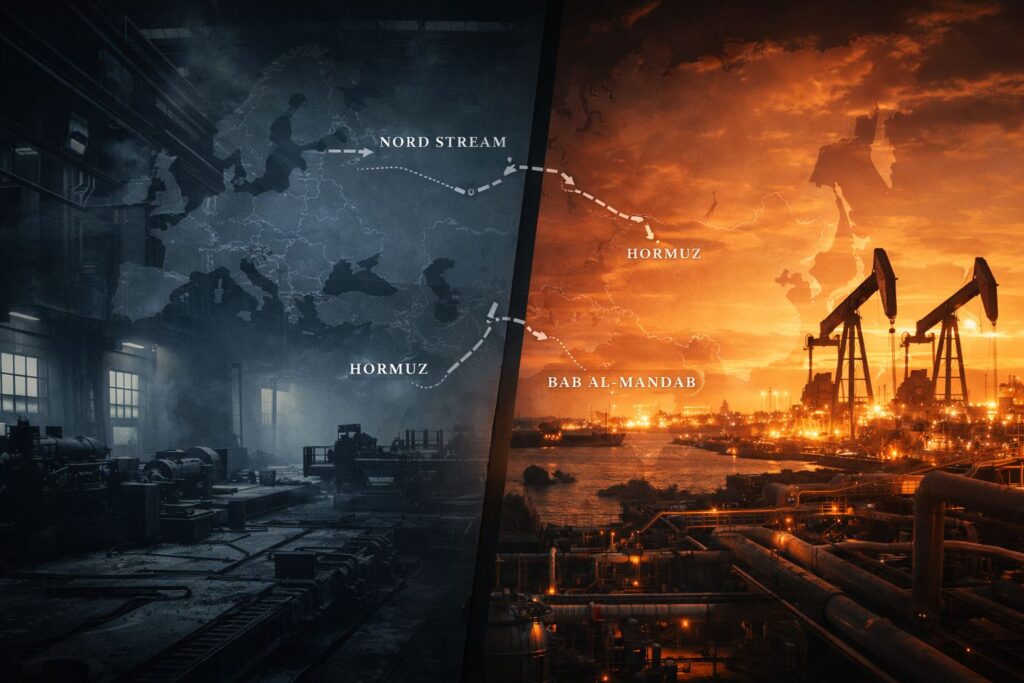

How the West Took Itself Out of the Game – and Who Profits
On April 1, 2026, Donald Trump posted on Truth Social: “All of those countries that can’t get fuel because of the Strait of Hormuz – I have a suggestion for you: Number one, buy from the US. We have plenty. And number two, build up some delayed courage, go to the Strait, and just TAKE IT.”
He added: “The United States won’t be there to help you anymore.”
That sentence is not an affront. It is not a provocation. It is a description of reality – and Trump knows it precisely. Europe cannot. Neither buy what it genuinely needs, nor go and take what it requires. Part 1 of this series showed how US strategy is containing China through energy deprivation – Venezuela, Iran, Panama as sequential steps in a coherent logic. This second part shows what has happened to the other end of that strategy: Europe.
The outcome is clear. Whether it was design or opportunism – that is for the reader to judge. The facts speak for themselves.
1. The First Cut: Nord Stream and the End of the Russian Energy Bridge
Europe relied on Russian natural gas as the backbone of its energy supply for decades. Not out of naivety, but out of economic logic: Russian gas was cheap, reliable, and deliverable via short pipeline routes. The Nord Stream pipelines – Nord Stream 1 operational since 2011, Nord Stream 2 completed but never commercially activated – were the physical embodiment of that dependency. 55 billion cubic meters of annual capacity. For Germany alone.
In September 2022, both pipelines were blown up. Three of four lines destroyed, one damaged. It was the largest attack on critical energy infrastructure in European peacetime history.
Who did it has not been conclusively established in legal terms. What is clear, however, is the outcome. Europe receives no more Russian gas via this route. And Russia, hit with more than 20 EU sanctions packages, has systematically redirected its energy exports toward Asia – to China, India, and the Global South. The path back is politically blocked for the foreseeable future.
The consequences for Europe are measurable. Energy prices exploded in 2022–2023 to three to four times pre-war levels. Industry – above all German industry, which had been built on cheap energy as a competitive advantage – began a systematic exodus. BASF, the world’s largest chemical company headquartered in Ludwigshafen, has massively expanded production in China. What remains in Germany is increasingly administrative overhead. Volkswagen is closing plants. The chemical sector as a whole – natural gas accounts for 45 percent of German industrial energy consumption – faces a location question that no political speech can answer.
Energy supply route East: severed.
2. The Second Cut: Hormuz, the Houthis, and the Double Lock
The first route was Russia. The second was the Gulf region.
Since February 28, 2026 – the start of Operation Epic Fury – the Strait of Hormuz has been effectively closed. Approximately 20 percent of global oil trade and 20 percent of global LNG trade pass through this 20-mile-wide chokepoint off Iran’s southern coast. Before the war: more than 110 ships daily. Today: fewer than 10 – and those pay the Iranian IRGC up to $2 million per transit, in Chinese yuan.
The second chokepoint is Bab al-Mandab, the “Gate of Tears” between Yemen and the Horn of Africa – the entrance to the Red Sea and access to the Suez Canal. Approximately 12 percent of global maritime trade passes through here. Since March 28, 2026, the Houthis have entered the war directly and have struck Israel twice. The threat to close Bab al-Mandab as well is no longer theoretical – it is an activated mechanism.
Hormuz and Bab al-Mandab are not adjacent chokepoints. They are sequential bottlenecks on the same energy artery – the route that carries Gulf oil to Europe. If Hormuz is blocked, oil does not leave the Persian Gulf. If Bab al-Mandab is blocked, it does not reach the Mediterranean. Both simultaneously: the route collapses end to end.
For analysis of the military dimension of this double lock and its implications for possible US ground operations: Iran Insight: Ground Troops and the Double Lock.
For the nuclear risks at the region’s third chokepoint: Iran Insight: What Happens If Bushehr Burns.
Saudi Arabia’s East-West Pipeline – 7 million barrels per day capacity, bypassing Hormuz entirely – has been running at full capacity since February 28. That is not coincidence. It is crisis preparedness Riyadh has been building for years. For Saudi Arabia, there is a way out. For oil tankers from Kuwait, the UAE, or Qatar, there is not.
Energy supply route South: severed.
3. Spain – The Only European Country That Understood
While Germany, France, and the United Kingdom were losing themselves in diplomatic formulations, Spain made a simple decision: no US or Israeli military operations from Spanish soil.
Airports were closed to those operations. The announcement was clear and public.
The result: Iran granted Spain free Hormuz transit. While the rest of Europe complains about rising energy prices, Spain is buying Gulf oil.
That is not coincidence. It is Iran’s implementation of a straightforward principle: those who do not fight are not punished. It is simultaneously the practical refutation of the thesis that Europe cannot adopt a neutral position. Spain did. It works.
What that says about the others – the reader may judge.
4. Europe’s Military Incapacity – Numbers Instead of Rhetoric
Trump says: “Go get your own oil.” What sounds like a challenge is in reality an impossibility – and Trump knows it.
According to the findings of its own analyses (Combat-Ready on Paper, Victory-Ready in Planning), the Bundeswehr holds munitions for two to three days of intense combat. Not weeks. Not months. Days. The air force can conduct approximately four days of air war with its available missiles, after which stocks are exhausted. The navy? According to the defense committee: approximately five days of naval engagement, then air defense missiles run dry – and there is no resupply, because rearming abroad is impossible under hazardous materials regulations. The frigate returns to Germany, rearms, sails back down. That takes weeks.
The logistics: a brigade requires 33,000 gallons of fuel per day. Nine NATO-capable brigades require approximately 810 tanker vehicles. Available: between 100 and 120. Eighty-seven percent are missing.
The artillery: requirement through 2031 for 155mm rounds: 230,000. Current stock: approximately 20,000. Shortfall: 91 percent. In the Ukraine war, Russia fires 10,000 to 20,000 artillery rounds per day. Germany’s entire stockpile would last a single day. (IISS Military Balance 2024, Bundeswehr readiness, https://www.iiss.org)
Combat experience: of 93,000 Afghanistan veterans, at most 1,300 to 1,900 soldiers had actual combat experience – still active and deployable today. That is one to two percent of the Bundeswehr.
And this is after the Zeitenwende, after a €100 billion special defense fund, after “Germany is back.” Five Patriot systems were handed to Ukraine. Self-propelled howitzers, Leopard tanks, munitions – donated, without replacement. The 10th Panzer Division was declared “combat-ready” in 2025 by cannibalizing every other unit. Outside that single division, readiness stands at approximately 50 percent. (Augen geradeaus!, Bundeswehr munitions stockpiles, https://augengeradeaus.net/2024/01/munition-fuer-die-bundeswehr-wie-viel-fehlt-und-was-kostet-das/)
The United Kingdom and France are better positioned – but not well enough that forcing open the Strait of Hormuz against the will of Iran, the IRGC Navy, and its fast boats, drones, and anti-ship missiles would be a realistic option. Twenty-two countries have joined the US coalition framework for Hormuz – including the UAE, Bahrain, Canada, Australia, and several European states. But even that coalition has not opened the strait.
Europe cannot go and get its oil. Not militarily. Not logistically. Not politically.
5. The Economic Attrition – Three Decades in One Sentence
The energy crisis is not the beginning of Europe’s economic weakening. It is the provisional conclusion of a long process.
Germany was for decades the backbone of European industry – built on three pillars: cheap energy from Russia, free access to world markets via open trade routes, and technological export strength in automotive, mechanical engineering, and chemicals. All three pillars are under pressure.
Energy prices have been structurally higher than in the United States, China, or the Middle East since 2022. The result: production relocation. BASF Ludwigshafen is increasingly becoming an administrative hub as production expands in China. Volkswagen is closing plants. The steel sector is fighting for survival. Thyssenkrupp, BASF, Bayer – all under massive cost pressure.
Support for Ukraine has imposed additional burdens on Europe. Not only through direct military aid, but through sanctions that have hit Europe as hard as Russia – if not harder. Russia’s GDP contracted by approximately 2 percent in 2022. European industry absorbed energy price explosions, supply chain disruptions, and demand collapses simultaneously.
And now the Gulf shock is layered on top: oil above $100 per barrel since February 28, fuel prices in Germany temporarily at all-time highs, EU energy ministers in emergency session.
Those who have energy can produce. Those who do not, buy – or shrink.
6. The US Side of the Equation – Oil as State Doctrine
While Europe has systematically lost its energy supply, the United States under Trump has systematically built its own.
“Drill, baby, drill” is not a slogan. It is state doctrine. The United States has been the world’s largest oil producer for years – more than 13 million barrels per day. Venezuela, once a bastion of state oil nationalism, is after the US operation in early 2026 effectively under US energy control – roughly 2,500 miles from US ports, significantly closer than the Persian Gulf. Supply routes short, transportation costs low, dependence on the Middle East eliminated.
Trump said it openly on April 1: “Iran has been essentially decimated. The hard part is done. Go get your own oil.” And: “Buy from the US. We have plenty.” (Al Jazeera, “Trump tells allies ‘get your own oil,'” April 1, 2026, https://www.aljazeera.com/news/2026/4/1/trump-tells-allies-get-your-own-oil-says-iran-war-could-end-in-2-3-weeks)
That is not cynicism. It is supply and demand. Europe needs oil. The United States has oil. Europe cannot get it elsewhere – not without risk, not without cost, not without dependency.
In a free market, US industry could never have competed with European production sites. Cheap European energy, highly developed infrastructure, skilled labor – that was a competitive advantage not easily overcome. But when energy costs in Europe rise to three to four times the level while the United States has the cheapest domestic energy available, the balance shifts fundamentally. US industry gets a chance it would never have had in fair competition.
Whether that was calculated or whether it emerged from a sequence of independent decisions – the reader draws their own conclusions. The outcome is identical.

7. The Strategic Framework – What Brzezinski, Mackinder, and Ismay Knew
These developments cannot be understood without historical context.
Zbigniew Brzezinski described explicitly in The Grand Chessboard (1997) that a rapprochement between Germany and Russia – a German-Russian axis – would represent the greatest threat to American hegemony in Eurasia. Russia alone is manageable. Germany alone is manageable. Both together, with Russian raw materials and German technology and industrial capacity, would constitute a power capable of redefining the geopolitical framework of the 21st century.
Halford Mackinder formulated in his Heartland Theory (1904): whoever controls Eastern Europe commands the Heartland. Whoever commands the Heartland commands the World-Island. Whoever commands the World-Island commands the world. Ukraine, when viewed on that map, is not a coincidental flashpoint. It is geographically a wedge – the most direct land corridor between the German economic space and the Russian resource space. A physical wedge in the most literal sense.
A third element of this framework is Syria – less visible, but strategically no less significant. China’s Belt and Road Initiative envisions a land corridor from Central Asia through Iran and Syria to the Mediterranean – an alternative to the sea-based energy routes connecting Iran and China. After Assad’s fall in December 2024, Hayat Tahrir al-Sham under Ahmed al-Sharaa took control of Syria. Al-Sharaa was on the US terrorism list until 2023, with a $10 million bounty on his head. Today he is Syria’s de facto president. Whether that is coincidence or result – the land corridor that China and Iran were jointly developing is, for now, interrupted. The Belt and Road Initiative loses its western terminus. That too is an outcome that fits a coherent logic.
Lord Hastings Ismay, NATO’s first Secretary General, reduced the purpose of the alliance to three formulas: “Keep the Americans in, the Russians out, the Germans down.”
And then, on April 1, 2026, Trump goes one step further. In an interview with The Telegraph, he describes a US withdrawal from NATO as “beyond reconsideration” – already settled in his mind. Asked directly whether he was considering pulling the United States out of the alliance: “Oh, absolutely, without question. Wouldn’t you do that if you were me?” NATO, he says, is a “paper tiger.” “I was never swayed by NATO. I always knew they were a paper tiger, and Putin knows that too, by the way.”
The backdrop: Europe refused to allow US military aircraft passage for operations against Iran. Spain, but also other countries, denied the use of their bases. Trump responds with the maximum threat – the end of the Article 5 guarantee that Europe has taken for granted since 1949.
Ismay would have known: “Keep the Americans in” was always the first condition. When the first condition falls away, the architecture of the Western security system is open.
All three objectives are met in 2026. The United States is present in Europe as it has not been for decades. Russia is isolated, sanctioned, and tied down in a war of attrition. And Germany? Germany is debating the draft, cannot procure artillery rounds, is losing its industrial base – and declared at the FAZ conference: “This is not our war.”
Whether Brzezinski and Mackinder served as a blueprint or whether history simply moves according to its own laws – the outcome matches the theory.
8. Merz, Ramstein, and the Question of Honesty
Chancellor Friedrich Merz has taken a position in this war that warrants closer scrutiny.
On the one hand, he declares: “This is not our war.” Germany is not part of the conflict and does not wish to become so. That is a legitimate position – with one catch. Because simultaneously, US Reaper drones are operating from German soil. Ramstein Air Base, one of the most important US logistics hubs worldwide, is in Germany. AFRICOM is in Stuttgart. The United States maintains more than 40 military installations on German territory.
“This is not our war” and “launched from our soil” are logically incompatible.
At the FAZ conference, Merz said what Trump is doing in Iran is “a massive escalation with an open outcome” – correct. He questioned whether regime change can be the objective – analytically sound. He simultaneously suggested the Bundeswehr could assist with mine clearance in Hormuz after the war – thereby implicitly accepting a German role in the aftermath of the war he calls “not our war.” (Tagesspiegel, “Merz accuses Trump of ‘massive escalation’ in Iran war,” March 28, 2026, https://www.tagesspiegel.de/internationales/liveblog/verhaltnis-wird-konfrontativer-merz-wirft-trump-massive-eskalation-im-iran-krieg-vor-10586281.html)
This is not political criticism. These are contradictions the reader may weigh.
9. The Full Picture – Europe’s Exit from the Geopolitical Stage
Where does Europe stand on April 1, 2026?
Energy supply East: gone. Energy supply South: gone. Military capacity: minimal. Industrial competitiveness: under massive pressure. Political cohesion: Spain is doing its own thing, the others are arguing over joint statements.
The only remaining energy option is imports from the United States. That is more expensive than Russian gas and more expensive than Gulf oil. It means structural dependence on a partner who just publicly declared: “The USA won’t be there to help you anymore.”
Europe did not end up on the siding by accident. It was led there – through a sequence of decisions whose outcome is now visible: the Nord Stream demolition, Russia sanctions, military aid to Ukraine to the point of self-depletion, Hormuz closure through the Iran war. Whether that sequence was coordinated or whether each link arose independently – the result is a European economy without cheap energy, a European military without combat capability, and a European politics without a strategic compass.
Who profits? The United States has oil to sell, markets to open, and an industry that has suddenly become competitive. China is buying Iranian and Russian oil at discount prices – shielded from the dollar system, settled in yuan. Russia has redirected its energy exports to Asia and is fighting in Ukraine with European money and American munitions – but without European troops in opposition.
Europe is paying the bill. And buying American oil.
Outlook: Part 3 – The Gulf States Between the Fronts
What has happened to Europe is happening to the Gulf states in a different register. They are not on the siding – they are the battleground. Bahrain, Qatar, Kuwait, the UAE: under fire, under pressure, caught between US security guarantees and Iranian threats. And internally divided: Saudi Arabia and the UAE want to see the war ended – but Iran weakened. Qatar and Oman want diplomacy, as fast as possible.
Through this war, Trump has driven a wedge into the Gulf region that threatens OPEC cohesion and is fundamentally rewriting the regional security architecture.
That is the material for Part 3.
Michael Hollister
is a geopolitical analyst and investigative journalist. He served six years in the German military, including peacekeeping deployments in the Balkans (SFOR, KFOR), followed by 14 years in IT security management. His analysis draws on primary sources to examine European militarization, Western intervention policy, and shifting power dynamics across Asia. A particular focus of his work lies in Southeast Asia, where he investigates strategic dependencies, spheres of influence, and security architectures. Hollister combines operational insider perspective with uncompromising systemic critique—beyond opinion journalism. His work appears on his bilingual website (German/English) www.michael-hollister.com, at Substack and in investigative outlets across the German-speaking world and the Anglosphere.
Sources
- Zbigniew Brzezinski – The Grand Chessboard (1997), Basic Books
- Halford Mackinder – “The Geographical Pivot of History” (1904), The Geographical Journal
- Lord Hastings Ismay – NATO founding doctrines, cited in: Timothy Garton Ash, Free World (2004)
- Michael Hollister – “Siegfähig”: Eine Realsatire in 7 Akten (2025): https://www.michael-hollister.com/de/2025/12/28/siegfaehig/
- Michael Hollister – Kriegstüchtig auf dem Papier, Siegfähig in der Planung (2026): https://www.michael-hollister.com/de/2026/01/04/kriegstuechtig-auf-dem-papier-siegfaehig-in-der-planung/
- Michael Hollister – Iran Insight: Ground Troops and the Double Lock (2026): https://www.michael-hollister.com/de/2026/03/29/iran-insight-bodentruppen-und-das-doppelschloss/
- Michael Hollister – Iran Insight: What Happens If Bushehr Burns (2026): https://www.michael-hollister.com/de/2026/03/29/iran-insight-kommentar-was-passiert-wenn-bushehr-brennt/
- Al Jazeera – “Trump tells allies ‘get your own oil'” (April 1, 2026): https://www.aljazeera.com/news/2026/4/1/trump-tells-allies-get-your-own-oil-says-iran-war-could-end-in-2-3-weeks
- NBC News – Iran’s Hormuz toll system (March 29, 2026): https://www.nbcnews.com/world/iran/irans-tehran-toll-booth-forces-tankers-pay-millions-leave-strait-hormu-rcna265258
- Bloomberg – Saudi East-West Pipeline at full capacity (March 29, 2026): via ZDF Liveblog
- Tagesspiegel – Merz accuses Trump of “massive escalation” (March 28, 2026): https://www.tagesspiegel.de/internationales/liveblog/verhaltnis-wird-konfrontativer-merz-wirft-trump-massive-eskalation-im-iran-krieg-vor-10586281.html
- IISS Military Balance 2024 – Bundeswehr readiness: https://www.iiss.org
- Augen geradeaus! – Bundeswehr munitions stockpiles: https://augengeradeaus.net/2024/01/munition-fuer-die-bundeswehr-wie-viel-fehlt-und-was-kostet-das/
- Defence Network – Naval munitions supply: https://defence-network.com/unzureichende-munition-nicht-nur-in-der-bundeswehr/
- Michael Hollister – Follow the Oil, Part 1 (March 24, 2026): https://www.michael-hollister.com (published at TKP.at)
© Michael Hollister – All rights reserved. Redistribution, publication or reuse of this text requires express written permission from the author. For licensing inquiries, please contact the author via www.michael-hollister.com.
Newsletter
🇩🇪 Deutsch: Verstehen Sie geopolitische Zusammenhänge durch Primärquellen, historische Parallelen und dokumentierte Machtstrukturen. Monatlich, zweisprachig (DE/EN).
🇬🇧 English: Understand geopolitical contexts through primary sources, historical patterns, and documented power structures. Monthly, bilingual (DE/EN).