
by Michael Hollister
Exclusive published at Michael Hollister on April 05, 2026
3.515 words * 19 minutes readingtime
This analysis is made available for free – but high-quality research takes time, money, energy, and focus. If you’d like to support this work, you can do so here:

Alternatively, support my work with a Substack subscription – from as little as 5 USD/month or 40 USD/year!
Let’s build a counter-public together.

How American Bombs Are Destroying Gaza
On the night of January 7, 2026, three bombs struck a residential building in the Al-Tuffah neighborhood in northern Gaza. What cameras captured afterward was the familiar image: collapsed walls, rubble, charred household appliances. Two people were killed. The Israel Defense Forces stated they had targeted a senior Hamas operative who had violated the ceasefire in effect since October.
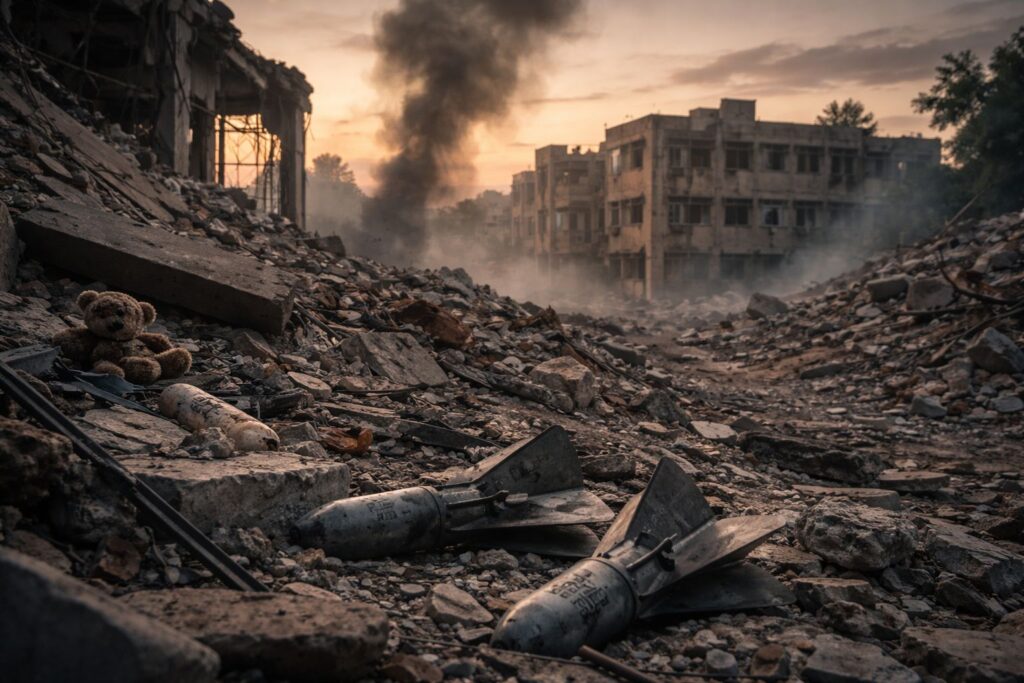
Among the debris lay munitions remnants. Three pieces. Precisely identifiable: the tail actuators of GBU-39 Small Diameter Bombs – 250-pound precision munitions designed for surgical strikes, manufactured by Boeing, produced exclusively in the United States of America.
This strike is not an isolated incident. It is one of at least 79.
What the open-source investigative network Bellingcat documented over more than two years of systematic analysis is the forensic evidentiary chain that had previously been missing. Not the claim that US-manufactured weapons are being used in Gaza – that was known, politically debated, documented by human rights organizations for months. But the specific proof: strike by strike, coordinate by coordinate, weapons system by weapons system. Which American-made systems Israeli forces used to hit civilian infrastructure. What damage resulted. How many people died. Who supplied the weapons. And who was asked – and said nothing. (Bellingcat, “Made in the USA: How American-Built Weapons Have Wrought Destruction in Gaza,” February 4, 2026, https://www.bellingcat.com/news/2026/02/04/made-in-the-usa-how-american-built-weapons-have-wrought-destruction-in-gaza/)
The Method: Why These 79 Cases Are Especially Robust
In conducting this investigation, Bellingcat imposed a methodological constraint on itself that initially looks like a weakness but is in fact the source of the analysis’s strength.
Israel manufactures its own bombs in the MK-80 series, which are structurally identical to US products. Even a recovered fragment cannot definitively prove US origin without a serial number or lot number trace. The MK-84 – the heaviest model in that series, weighing 2,000 pounds – is produced both in the United States and in Israel. A dispute over origin would have been possible, and that is precisely what would have made the entire analysis vulnerable.
Bellingcat therefore restricted its dataset from the outset to three weapons systems that Israel demonstrably does not manufacture itself and sources exclusively from the United States.
The AGM-114 Hellfire missile – for decades the standard precision munition of American attack helicopters and armed drones, manufactured by Lockheed Martin. Designed for pinpoint effect against armored vehicles and individual targets, with a warhead accurate to within a few meters.
The GBU-39 Small Diameter Bomb, also by Boeing – a 250-pound precision munition with a glide profile enabling strikes from long standoff distances. Israel has deployed it in enormous quantities: GBU-39 remnants were found at 20 of the 28 documented school strikes.
The JDAM guidance kit (Joint Direct Attack Munition) by Boeing – not a standalone weapons system but a navigation package that converts conventional unguided bombs into GPS-guided precision munitions via bolt-on tail assembly. The JDAM guidance kit is manufactured exclusively in the United States. Identifying it constitutes proof of American origin – regardless of which bomb body it is attached to. (Defense Security Cooperation Agency, Israel – Munitions Guidance Kits and Munitions Support, June 30, 2025, https://www.dsca.mil/Press-Media/Major-Arms-Sales/ArticleDisplay/Article/4230375/israel-munitions-guidance-kits-and-munitions-support)
No dispute over origin is possible. No gray zone. No grounds to challenge the identification.
Munitions remnants were identified using publicly available photo and video material – footage from local journalists, social media posts, and wire agency coverage. Incidents were geolocated initially by volunteer analysts from the GeoConfirmed community, including several named OSINT specialists. All geolocations were independently verified by Bellingcat. Weapons identification was cross-checked by external explosives residue expert Frederic Gras. The complete dataset is publicly accessible and reproducible.
The result: 79 geolocated incidents with conclusively verified US-manufactured weapons. An additional 26 cases were identified in which the munition was identified but geolocation could not be completed before publication.
Anyone reading this dataset needs to understand two structural limitations. First, international media have had no access to Gaza since the start of the conflict. The entire documentation rests on local journalists – many working at risk to their lives, dozens killed over the course of the conflict – as well as social media material and wire agency footage. The Committee to Protect Journalists has documented that at least 165 Palestinian journalists have been killed since October 2023. The actual number of incidents involving US munitions is in all likelihood substantially higher than the 79 verified cases. (Committee to Protect Journalists, Killed journalists database, https://cpj.org/data/killed/)
Second, Bellingcat deliberately excluded the numerically far larger category of MK-80 bombs for which no lot number verification was available – including the MK-84, more than 14,000 of which are reported to have been delivered to Israel since October 2023. That dimension is entirely absent from the 79 cases. (Reuters, “U.S. has sent Israel thousands of 2,000-pound bombs since Oct. 7,” June 28, 2024, https://www.reuters.com/world/us-has-sent-israel-thousands-2000-pound-bombs-since-oct-7-2024-06-28/)
What the dataset contains is not the complete picture. It is the forensically verifiable floor.
What the 79 Cases Show
Schools: 28 Documented Strikes
No category in the dataset is as numerically unambiguous as schools. Bellingcat documented 28 strikes on school buildings with verified US munitions. In 20 of those cases, GBU-39 remnants were recovered. Most of these strikes occurred before the January 2025 ceasefire – but not all.
The case that most clearly illustrates the methodology is the Khadija School Complex in Deir Al-Balah, struck on July 27, 2024. What happened there can be fully reconstructed through multiple independent sources.
Satellite imagery from Planet Labs shows the school complex in before-and-after comparison: several buildings are completely destroyed following the strikes, the site no longer recognizable. Ground-level video material, published by local journalists and on social media, documents the events across three temporally distinct waves of attack.
In the first wave, five separate areas of the school complex were struck simultaneously. Inside the building, an unexploded GBU-39 bomb body was found – the piece that enabled weapons identification. At the destroyed entrance gate, the fuze housing of an already-detonated GBU-39 was photographed and matched against reference images. Both recovered items show the distinctive characteristics of the GBU-39 clearly.
Following this first wave, evacuation orders were issued. The IDF then demolished two buildings on the eastern side of the complex using heavier munitions. After a second evacuation order, a third strike followed – this time with an MK-80 bomb fitted with a US JDAM guidance kit, visible in free fall on video footage. In the same footage, at least six people are identifiable, including a child, approximately 55 meters from the subsequent point of impact – at the moment of detonation on already-collapsed building sections. (Airwars, Civilian Casualty Report – Khadija School Complex, July 27, 2024, https://airwars.org/civilian-casualties/ispt270724n-july-27-2024/)
The documented casualty toll from this single strike: at least 30 killed, including 15 children and 8 women. At least 100 wounded. These figures come from documentation by the monitoring network Airwars and the report of the UN Office of the High Commissioner for Human Rights, which addresses this strike explicitly. (UN Office of the High Commissioner for Human Rights, Report A/HRC/59/26 – Gaza school buildings, February 2025, https://docs.un.org/en/A/HRC/59/26)
The Khadija school does not stand alone. In May 2025 – following the collapse of the ceasefire and the resumption of hostilities – at least three GBU-39 bombs were dropped on the Fahmy Al-Jarjawi school. According to hospitals in Gaza, 36 people were killed. In July 2025, Hellfire missile fragments were found in the vicinity of the Cairo Elementary School; five people were killed.
By late February 2025, the UN High Commissioner for Human Rights had reported that 403 of the 564 school buildings in Gaza had been directly struck in some form – by airstrikes or other munitions. Schools in Gaza are routinely used as shelters for displaced civilians. The IDF stated in several cases that the affected buildings had housed Hamas infrastructure or command facilities. Independent verification of these claims is not possible due to the absence of media access to Gaza.
Medical Facilities: Direct Strikes and Near-Miss Impacts
Bellingcat’s analysis documented two direct strikes on medical facilities using verified US munitions. Both are individually describable because both combine weapons identification with casualty documentation.
In June 2024, a health clinic in Gaza City was struck with a Hellfire missile. The recovered item – components of the characteristic rocket motor and guidance section of an AGM-114 – was photographed and identified. Killed in the strike was Hani al-Jafarawi, director of Gaza’s rescue and emergency services. The IDF stated the strike targeted a Hamas official responsible for weapons development.
In September 2024, the headquarters of the Gaza Civil Defence in Al-Daraj, Gaza City, was struck with a GBU-39. The bomb penetrated several floors of the building but did not detonate. There were wounded but no fatalities. The intact bomb body in the building enabled an unambiguous identification.
Five additional documented strikes hit locations immediately adjacent to medical facilities. Four struck tents within approximately 150 meters of the main compound of Al-Aqsa Martyrs Hospital in Deir Al-Balah – all four using Hellfire missiles. Bellingcat documented three deaths and 26 wounded in one of these strikes from November 2025.
A further strike hit the Al-Aqsa Mosque directly across from the same hospital, at approximately 50 meters from the main clinic building. The munition used was an MK-82 500-pound bomb fitted with a US JDAM guidance kit. The US Marine Corps Close Air Support manual defines an MK-82 as “Danger Close” – within dangerous proximity to friendly forces – when employed within 425 meters. At distances below 250 meters, the manual states that risk increases a hundredfold relative to the minimum threshold. The hospital is 50 meters away. According to Gaza health authorities, 26 people were killed in this strike. (US Marine Corps, MCWP 3-23.1 Close Air Support – Danger Close Standards, https://www.trngcmd.marines.mil/Portals/207/Docs/TBS/MCWP%203-23.1%20Close%20Air%20Support.pdf)
Residential Areas, High-Rises, Mosques
In September 2025, Israel announced the demolition of 25 high-rise buildings in Gaza City. For at least seven of those structures, Bellingcat was able to document both the evacuation orders and the subsequent demolition using MK-80 bombs with JDAM guidance kits – among them the Al-Soussi Tower, the Al-Roya Tower, and the Al-Roya 2 Tower, all three captured in standalone video footage of the strike showing the JDAM-equipped bombs in free fall.
In one of these cases, a four-year-old girl – Razan Hamdiye – was killed despite an evacuation order having been issued. During the demolition of the Harmony Tower, the Anadolu news agency filmed a group of people approximately 120 meters away who were killed or wounded by the impact – again, despite a prior warning having been issued.
The IDF stated that evacuation notices had been published through multiple channels and that the population had been given sufficient time to clear the area. Bellingcat reviewed the publicly available IDF evacuation notices for Gaza City from September 2025 and found: unlike comparable warnings for Lebanon strikes, which specified a recommended minimum evacuation distance of 500 meters, that figure is entirely absent from the Gaza notices. Munition fragments and debris can kill or injure people within a radius of several hundred meters.
In August 2025, the Aybaki Mosque in Khan Younis – a house of worship built in the 13th century – was struck with MK-80 bombs with JDAM guidance kits. The IDF stated the strike targeted the deputy commander of a Hamas unit.

The Overall Toll: What the Numbers Say – and What They Don’t
For the 79 geolocated incidents, Bellingcat systematically compiled reported casualty figures. The methodology applied throughout was to use the lowest value from available source ranges – if a source reported “between 30 and 40 killed,” the number entered into the dataset was 30.
The result: at least 744 people were killed in these 79 strikes, according to the underlying reports. Among them, at least 175 children. At least 78 women. The figures derive primarily from reports of the Gaza Health Authority, supplemented by Airwars documentation and UN reports. The IDF did not provide a total figure for those killed in these 79 strikes when Bellingcat requested one. The IDF did provide statements for eight strikes in the dataset, naming a military target in each case.
Not included in the figure of 744: the at least 274 fatalities from the IDF hostage rescue operation in Nuseirat in June 2024, during which US munitions were also employed. These casualties were excluded because at least 13 individual strikes during the operation involved different weapons types, making an unambiguous attribution to the identified US systems impossible.
Not included: all strikes involving MK-80 bombs without lot number verification.
Not included: all 26 cases that could not be geolocated before publication.
Not included: all incidents that were simply never photographed, filmed, or reported – in a territory to which international media have had no access since the start of the conflict, and in which dozens of local journalists have been killed in the course of their work.
744 is the forensically verifiable floor. How far the actual figure exceeds it cannot be determined.
The Supply Chain: Who Approved These Weapons – and When
The three documented weapons systems are not traded on the open market. They are not export goods that a company can sell at its discretion to any buyer. They are delivered exclusively through the Foreign Military Sales program – a government-administered export mechanism run by the US Department of Defense, in which the American government acts as intermediary between defense contractors and foreign governments.
This means: every delivery of Hellfire missiles, GBU-39 bombs, or JDAM guidance kits to Israel requires an explicit authorization from the US State Department. Sales above certain thresholds must be notified to Congress, which has a fixed window to raise objections. The supply chain is, on paper, politically fully transparent and controlled.
The figures from this program for Israel since October 7, 2023, are extraordinary. According to the Quincy Institute for Responsible Statecraft, Washington has provided Israel with military assistance totaling at least $21.7 billion during this period – in weapons, equipment, munitions, and services. As of April 2025, there were 751 active FMS cases with Israel, with a combined value of $39.2 billion, including deliveries still pending. (Quincy Institute for Responsible Statecraft, “U.S. Military Aid and Arms Transfers to Israel, October 2023 – September 2025,” William D. Hartung, October 2025, https://quincyinst.org/research/u-s-military-aid-and-arms-transfers-to-israel-october-2023-september-2025/)
What these abstract figures mean concretely can be read from individual approvals – and their timing.
On June 30, 2025, the State Department approved the sale of JDAM guidance kits to Israel valued at $510 million. Specifically: 3,845 KMU-558B/B JDAM kits for the BLU-109 bomb body and 3,280 KMU-572F/B JDAM kits for the MK-82 bomb. Prime contractor: The Boeing Company, St. Charles, Missouri. The Defense Security Cooperation Agency stated that the sale would “improve Israel’s ability to meet current and future threats.”
JDAM guidance kits. Precisely the components Bellingcat had identified in the rubble of the Khadija School Complex. In the rubble of the Al-Roya Tower. At the destroyed Al-Aqsa Mosque. Approved in June 2025, while the dataset already encompassed dozens of documented strikes on schools, hospitals, and residential buildings.
On February 28, 2025, the Trump administration invoked the emergency provision of the Arms Export Control Act to push $4 billion in weapons deliveries to Israel past the standard Congressional review process. Justification: national security. Emergency activations of this kind are rare and must be ordered by the president personally.
On January 30, 2026 – 23 days after the strike on the residential building in Al-Tuffah, four days before the Bellingcat article appeared – the Trump administration approved new weapons sales to Israel valued at $6.67 billion. Among them: 30 Apache attack helicopters from Boeing worth $3.8 billion and infantry fighting vehicles. Prime contractors: Boeing and Lockheed Martin – the same companies whose products Bellingcat had identified in the rubble of Gaza. (The Washington Post, “U.S. approves almost $16 billion in arms sales to Israel, Saudi Arabia,” January 30, 2026, https://www.washingtonpost.com/world/2026/01/30/us-israel-arms-sales-saudi-arabia/)
The State Department’s response, in several identically worded press releases: the sales would “improve Israel’s ability to meet current and future threats.” And: “The proposed sales will not alter the basic military balance in the region.”
The Silence as Finding
Before publication, Bellingcat contacted all relevant institutions and companies for comment. The responses are on record and documented in the article.
The Israel Defense Forces stated that Israel strikes military targets in accordance with international law and takes all possible measures to protect civilians. Hamas, they stated, systematically uses civilian infrastructure for military purposes. The IDF provided no figure for the total number of people killed in the 79 strikes.
The Pentagon declined all comment.
The State Department stated that the US government was “not in a position to make such determinations” – in response to the specific question of how many civilians had been killed by US weapons in Gaza. When asked whether the Department held a different assessment than its own NSM-20 report – the presidential memorandum from the Biden administration that had concluded in 2024 that it was “reasonable to assess” that US weapons had been used in instances inconsistent with international humanitarian law – a spokesperson replied with a single sentence: “NSM-20 is no longer US policy.”
That sentence points to a development that carries more weight than any individual delivery decision. What NSM-20 was, what its elimination means, and which oversight mechanisms were dismantled with it is the subject of Part 2.
Boeing did not respond to Bellingcat’s inquiry. Lockheed Martin did not respond.
Both companies were explicitly asked whether they track how their products are being used in Gaza. No response is also a response. A company that is confident its products are being used lawfully and as intended answers that question. The decision to offer no statement in the face of a specific, named, photographically documented dataset is itself a finding – about the posture of these companies toward their own responsibility.
What This Dataset Means – and What It Does Not
Bellingcat made no moral judgment. Named no guilty parties. Made no demands. What the network accomplished is the conversion of general knowledge into specific, verifiable proof.
General knowledge: that US weapons are being used in Gaza was known from the start of the conflict. That civilians were dying was known. That schools, hospitals, and residential buildings were being struck was known. Human rights organizations including Amnesty International and Human Rights Watch have documented this since 2023. The Biden administration itself had recorded in its NSM-20 report that a violation of international humanitarian law was “reasonable to assess.”
General knowledge generates political pressure. It triggers debate. But it does not open courtrooms. It gives lawyers no foundation to stand on. It gives legislators no lever for concrete action.
Specific proof does. This specific bomb – GBU-39, Boeing, lot class identifiable – used at this location, at this time, demonstrably struck this school, killing these people. This specific guidance kit – JDAM, Boeing, approved through this FMS transaction – was delivered in this sale before it came to rest in this building.
The difference between general knowledge and specific proof is not moral in nature. It is institutional and legal. It determines whether a question can be asked or whether it remains in the realm of approximation. The question that follows inescapably from the Bellingcat dataset is this: who approved these deliveries – with knowledge of what information, under what legal obligations, and with what consequence when those obligations were violated?
That question leads directly into the architecture of American arms export law, into the history of NSM-20, into its elimination by the Trump administration – and into the question of what remains when the last formal oversight mechanism is dismantled.
That is the subject of Part 2.
Diese Analyse ist frei zugänglich – aber gute Recherchen kosten Zeit, Geld, Energie und Nerven. Unterstützen Sie mich, damit diese Arbeit weitergehen kann.

Oder unterstützen Sie mich auf Substack – schon ab 5 USD pro Monat.
Gemeinsam bauen wir eine Gegenöffentlichkeit auf.
Michael Hollister
is a geopolitical analyst and investigative journalist. He served six years in the German military, including peacekeeping deployments in the Balkans (SFOR, KFOR), followed by 14 years in IT security management. His analysis draws on primary sources to examine European militarization, Western intervention policy, and shifting power dynamics across Asia. A particular focus of his work lies in Southeast Asia, where he investigates strategic dependencies, spheres of influence, and security architectures. Hollister combines operational insider perspective with uncompromising systemic critique—beyond opinion journalism. His work appears on his bilingual website (German/English) www.michael-hollister.com, at Substack at https://michaelhollister.substack.com and in investigative outlets across the German-speaking world and the Anglosphere.
Sources
- Bellingcat: “Made in the USA: How American-Built Weapons Have Wrought Destruction in Gaza” (February 4, 2026) https://www.bellingcat.com/news/2026/02/04/made-in-the-usa-how-american-built-weapons-have-wrought-destruction-in-gaza/
- Defense Security Cooperation Agency: Israel – Munitions Guidance Kits and Munitions Support (June 30, 2025) https://www.dsca.mil/Press-Media/Major-Arms-Sales/ArticleDisplay/Article/4230375/israel-munitions-guidance-kits-and-munitions-support
- Quincy Institute for Responsible Statecraft: “U.S. Military Aid and Arms Transfers to Israel, October 2023 – September 2025” (William D. Hartung, October 2025) https://quincyinst.org/research/u-s-military-aid-and-arms-transfers-to-israel-october-2023-september-2025/
- The Washington Post: “U.S. approves almost $16 billion in arms sales to Israel, Saudi Arabia” (January 30, 2026) https://www.washingtonpost.com/world/2026/01/30/us-israel-arms-sales-saudi-arabia/
- Airwars: Civilian Casualty Report – Khadija School Complex, July 27, 2024 https://airwars.org/civilian-casualties/ispt270724n-july-27-2024/
- UN Office of the High Commissioner for Human Rights: Report A/HRC/59/26 – Gaza school buildings (February 2025) https://docs.un.org/en/A/HRC/59/26
- US Marine Corps: MCWP 3-23.1 Close Air Support – Danger Close Standards https://www.trngcmd.marines.mil/Portals/207/Docs/TBS/MCWP%203-23.1%20Close%20Air%20Support.pdf
- Reuters: “U.S. has sent Israel thousands of 2,000-pound bombs since Oct. 7” (June 28, 2024) https://www.reuters.com/world/us-has-sent-israel-thousands-2000-pound-bombs-since-oct-7-2024-06-28/
- Committee to Protect Journalists: Killed journalists database https://cpj.org/data/killed/
© Michael Hollister – All rights reserved. Redistribution, publication or reuse of this text requires express written permission from the author. For licensing inquiries, please contact the author via www.michael-hollister.com.
Newsletter
🇩🇪 Deutsch: Verstehen Sie geopolitische Zusammenhänge durch Primärquellen, historische Parallelen und dokumentierte Machtstrukturen. Monatlich, zweisprachig (DE/EN).
🇬🇧 English: Understand geopolitical contexts through primary sources, historical patterns, and documented power structures. Monthly, bilingual (DE/EN).