
by Michael Hollister
Exclusive published at Michael Hollister on March 15, 2026
3.200 words * 17 minutes readingtime
This analysis is made available for free – but high-quality research takes time, money, energy, and focus. If you’d like to support this work, you can do so here:

Alternatively, support my work with a Substack subscription – from as little as 5 USD/month or 40 USD/year!
Let’s build a counter-public together.
Chokepoint, Cui Bono, and the Question Nobody Is Asking
This is Part 2 of a two-part analysis. Part 1 covered the Davos framework, the negotiating method, Greenland’s resources, and the Golden Dome rhetoric. Part 2 analyzes the Arctic’s geopolitical pivotal position, the full balance of interests, Greenland’s own perspective, and the open questions that follow from this deal.
There is a term in geopolitics that is almost entirely absent from the public debate about Greenland: chokepoint. A maritime chokepoint – a geographic point through which trade and military routes must pass, and which can be controlled, blocked, or monitored. The Strait of Malacca between Malaysia and Indonesia is a chokepoint. The Strait of Hormuz between Iran and the Arabian Peninsula is a chokepoint. The Suez Canal is a chokepoint.
Greenland is part of the most significant chokepoint in the Northern Hemisphere – and almost nobody is talking about it.
VI. The GIUK Gap: When Geography Makes History
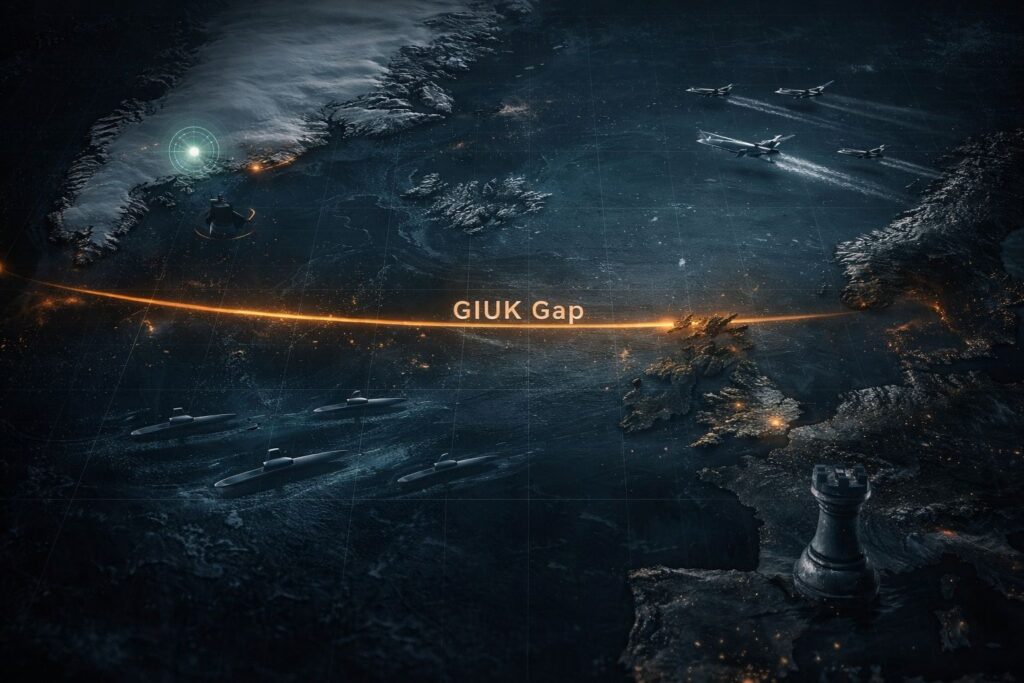
Between Greenland, Iceland, and the United Kingdom lies a maritime passage that has been at the center of every serious NATO military planning exercise since World War II: the GIUK Gap. Greenland-Iceland-United Kingdom. The name describes the geographic line it forms – a natural barrier between the North Atlantic and the Arctic Ocean, through which every Russian or Chinese vessel must pass that wants to move from the northern polar sea into the open Atlantic.
During the Cold War, the GIUK Gap was the cornerstone of NATO’s naval strategy. The Soviet Northern Fleet, based on the Kola Peninsula near Murmansk, was the largest surface fleet in the world. To threaten U.S. Atlantic supply routes, European resupply shipping, and transatlantic communications, it had to pass through this bottleneck. Pituffik Space Base – then Thule Air Base – was NATO’s northernmost strategic installation and monitored precisely this passage.
With the end of the Cold War, the Gap seemed less relevant. The Soviet Union was dissolved, Russia’s navy was decaying, and the Arctic was treated as a strategic backwater. The United States reduced its presence at Pituffik from roughly 10,000 to approximately 150 personnel today.
Then the picture shifted again – and this time faster.
Russia has massively modernized its Northern Fleet over the past decade. The Borei-class submarines – nuclear-powered, equipped with Bulava intercontinental ballistic missiles, capable of carrying 16 warheads with a range of more than 5,000 miles – now patrol systematically beneath the Arctic ice. Russia currently operates seven of these submarines, with more under construction, with the goal of replacing the entire Soviet Northern Fleet capacity by 2030. They are nearly inaudible. And they must, to reach their North Atlantic launch corridors, transit the GIUK Gap.
At the same time, Russia plans to route approximately 30 percent of its total trade volume through the Northern Sea Route by 2030 – the Arctic shipping lane along Russia’s northern coast that connects Asia and Europe without using the Suez Canal. In the summer of 2025, significantly more commercial vessels were already using this route than at any previous point in the history of Arctic shipping. The melting of polar ice is making this route increasingly economically attractive.
China formally introduced the concept of the “Polar Silk Road” in 2018. The People’s Republic – which describes itself as a “Near-Arctic State,” despite having no Arctic coastline – has concrete interests: shorter trade routes to Europe, access to Arctic resources, and, strategically, an alternative route that cannot be blocked at the GIUK Gap. Chinese icebreakers are active in the Arctic. Chinese research stations exist on Svalbard. And the PLA Navy’s shipbuilding program has produced more new warships in the past decade than any other nation on earth.
For NATO, the implication is clear: the GIUK Gap is once again a first-tier strategic priority. And that means Greenland is once again a first-tier strategic priority.
Pituffik today monitors Russian Borei-class SSBNs – nuclear submarines carrying ballistic missiles – and is beginning to integrate Chinese Type-096 submarines into its surveillance picture as well. The 1951 agreement, which permits the United States to build and operate military facilities without separate authorization as long as Denmark is informed, is the legal foundation. The strategic logic: whoever monitors the GIUK Gap controls the passage between the Arctic and the Atlantic. Whoever controls Pituffik monitors the GIUK Gap.
This is the real rationale behind Trump’s Greenland obsession – beyond all the mineral rights rhetoric. It is not about extracting raw materials. It is about permanently, unambiguously, and without Danish veto power controlling the most important maritime surveillance position in the Northern Hemisphere.
The Malacca reversal principle: China has for decades been strategically vulnerable through the Strait of Malacca – the bottleneck through which 80 percent of its oil imports flow, and which the U.S. Navy could close in a crisis scenario. The Chinese call this the “Malacca Dilemma.” The GIUK Gap is for China and Russia the northern equivalent of that dilemma: a geographic chokepoint they do not control, but their adversaries do. Whoever holds Greenland holds the bolt.
VII. Cui Bono – Who Really Wins?
The Latin question “Cui bono?” – who benefits? – is the oldest tool of analysis. Applied consistently, it cuts through layers of rhetoric to the structural core of any deal.
In the case of the Greenland framework from Davos, the answer leads to a remarkably clear balance of interests.
What is established:
The United States gains strategic control over Greenland – without formal ownership, without the political cost of annexation, and without bearing a single dollar of infrastructure costs. The U.S. veto over investments in Greenland, anchored in the framework, secures long-term resource access. The Export-Import Bank loan for Tanbreez – $120 million for a U.S. mining company – secures the first production rights holder. The updated 1951 agreement secures military access.
The U.S. defense industry gains contracts estimated at between $10 and $20 billion for system delivery alone. Raytheon, Lockheed Martin, Rafael (through its joint venture with Raytheon), SpaceX, and Palantir are positioned at the front of the line. Ongoing operating costs: $2 to $3 billion annually – financed by NATO members, not the United States.
White House spokeswoman Anna Kelly captured the calculation with unintended precision: “If this deal goes through, the United States will be achieving all of its strategic goals with respect to Greenland, at very little cost, forever.” Rarely does an administration articulate its own calculus this openly – and rarely has it gone so unremarked. (CNBC, January 23, 2026, https://www.cnbc.com/2026/01/23/trump-greenland-china-rare-earth-mineral.html)
What is strongly indicated:
Europe is effectively absorbing the bulk of the infrastructure costs for Arctic militarization. The Atlantic Council has documented that the framework discussions include a division of labor: the United States assumes responsibility for Greenland’s defense, Europe handles air and maritime surveillance of the Arctic flanks – and foots the bill for operations, munitions, and infrastructure. Trump’s 5-percent-of-GDP NATO defense spending target is not incidental to this: Arctic infrastructure is intended to be co-financed from that pool.
The pattern is identical to the Ukraine deal: Kyiv contributes 50 percent of resource revenues into a joint U.S.-Ukrainian fund, U.S. firms receive preferential treatment for investments, and security guarantees are the consideration. In Greenland: resources under U.S. control, NATO infrastructure financed by Europe, the affected party not at the table. Those who pay do not decide. Those who do not pay do.
What can be stated as a well-founded hypothesis:
With Greenland, Trump has concluded the most complete geopolitical transaction of his second term. Complete in the sense that all strategic objectives are achieved simultaneously: resources secured, military position expanded, China pushed out, costs externalized – and all of it without war, without purchase, without a treaty. The beneficiaries of this deal – U.S. strategists, U.S. defense contractors, U.S. mining companies – have collectively achieved the outcome the United States has been working toward since its first failed purchase attempt in 1946.
The difference: this time it costs the United States almost nothing. And this time it worked.
Who loses:
Denmark loses, in practical terms, decision-making authority over its own territory – not formally, but structurally. The framework was negotiated without Danish participation. The update to the 1951 agreement will proceed without Denmark holding an equal negotiating position. What remains is Danish sovereignty on paper and American control in practice.
Europe loses strategic options. The continent could have developed independent mining projects in Greenland – rare earths for European defense industries, for the renewable energy transition, for high-tech manufacturing. That window is closing. The U.S. veto ensures that European companies may invest – but only under American terms, within an infrastructure whose strategic use Washington controls.
China loses its last point of leverage in Greenland. Shenghe Resources, the state-linked company, loses with the Kvanefjeld framework any realistic chance of returning to that project, even if Greenland’s uranium mining ban were ever politically reversed. The Polar Silk Road remains a doctrine, not a network.
VIII. Greenland Itself: The Object That Wants to Be a Subject
There is an irony in the history of Greenland and its resources that geopolitical analysis almost always overlooks.
Greenland has for years actively sought Western investment in its mining sector. The island needs economic self-sufficiency to one day make its independence from Denmark a reality – and to replace the $600 million annual Danish subsidy with its own revenues. Mining is the only realistic path to that goal. Greenland’s Prime Minister Múte Egede Nielsen has stated repeatedly that Western investors are welcome. The island wanted capital, technology, and partnerships.
What it received is something else: strategic absorption without a question asked, without an invitation extended, and without a say in the outcome.
Greenland’s population – 56,000 people whose land has for centuries been squeezed between Danish administration, American military interests, and now Chinese-American resource rivalry – has expressed itself consistently in polls: 85 percent oppose joining the United States. Aaja Chemnitz Larsen’s phrase – “Nothing about us without us” – is not merely a political slogan. It is the precise description of a structural impossibility: Greenland cannot be the subject of a negotiation at which it is not seated.
Prime Minister Nielsen made clear after Davos: he did not know what was in the framework. He learned of it from the media. His conditions – sovereignty and territorial integrity as red lines – he had conveyed to Rutte, and Rutte had relayed them to Trump. Whether and how those lines are embedded in the framework is unknown.
Greenland had itself proposed an investment screening law in October 2025 – a mechanism that would review and potentially block foreign investments in eight critical sectors, including the extractive industries. And which, as the German Marshall Fund correctly notes, would affect not only Chinese but also American investors. That law is not yet in force. Whether it ever comes into force now depends in part on how much negotiating leverage Greenland retains vis-à-vis Washington.
The environmental movement in Greenland is a political force that outside observers systematically underestimate. The 2021 uranium mining ban was the result of an election in which the issue cut across party lines. Kvanefjeld – the third-largest known rare earth deposit in the world – sits idle not because Washington blocked it, but because Greenlanders chose that outcome. The fact that the arbitration case in which Energy Transition Minerals is seeking $11.5 billion from Greenland – nearly ten times the island’s annual government budget – is running concurrently with the framework negotiations is a detail that underscores the structural asymmetry of this situation.
Greenland wanted economic sovereignty. What it is getting is economic integration on someone else’s terms. Those are not the same thing.
IX. What Remains Open
A framework without a written document is a promise – and promises have expiration dates.
Two questions remain structurally unresolved and will define the years ahead.
The first: What happens to Greenland’s investment screening law? The proposed mechanism would review and block foreign investments in critical sectors – and it would affect American as well as Chinese investors. If Nuuk pushes the law through, it is a direct confrontation with the framework’s logic. If Greenland withdraws it, the island loses its last structural lever against Washington. The law is the most precise measure of Greenland’s actual room to maneuver after Davos.
The second: How does China respond over the medium and long term? The People’s Republic has not abandoned the Polar Silk Road. Its options in Greenland have been severely constrained – but not closed. More likely than a direct response is a gradual expansion onto other Arctic stages: Svalbard, the Northern Sea Route in cooperation with Russia, investments in Iceland. The competition for the Arctic is shifting. It is not ending.
Beyond these, three further questions remain open, whose answers depend on political constellations that are not predictable today: when direct negotiations between the United States, Denmark, and Greenland will begin; whether the uranium mining ban will be politically revived to open Kvanefjeld; and whether Europe will develop an independent Arctic strategy that goes beyond financing NATO infrastructure. All three questions are real. None has an answer today.
X. Conclusion: The Complete Transaction
Davos, January 21, 2026. Twenty minutes. No document. No treaty. No signature.
And yet: a geopolitical reality changed.
What Donald Trump achieved in that conference room in the Swiss Alps is structurally identical to what he has pursued in Gaza, Venezuela, and Iran – with the difference that Greenland is geopolitically more significant than all three combined. It is the attempt to acquire power through positioning, not through ownership. Control through veto rights, not through flags. Cost avoidance through externalization, not through restraint.
The result:
The United States effectively controls access to Greenland’s resources – through the investment veto and the Tanbreez loan. It secures its key military position in the GIUK Gap – through the updated 1951 agreement and the planned expansion of military presence. It pushes China out of its last Arctic foothold – through the explicit exclusion of non-NATO investors. And it offloads the infrastructure costs onto Europe – through the NATO framework, through Rutte’s endorsement, and through Trump’s 5-percent target.
Who pays? Europe. Who decides? Washington. Who was not asked? Greenland.
This is not a deal in the classical sense. It is a restructuring of power relations – fast, without ceremony, without consideration for those affected, and wrapped in rhetoric that makes any objection appear as a threat to Western security.
The real question that emerges from this framework is not about Greenland. It is about the foundation of the transatlantic alliance. When a U.S. president negotiates with the Secretary General of NATO over the territory of a founding member, threatens that member with trade sanctions for defending its land, and then sells the result as a historic breakthrough – what is the value of the alliance to the member that was just bypassed?
That is not a rhetorical question. It is the question that Denmark, Greenland, and – whether they are willing to admit it or not – every other European NATO member will have to answer over the next decade.
The Cold War had clear front lines. The New Arctic has none – at least none drawn on a map. But it has chokepoints. And chokepoints are controlled by whoever holds them – not by whoever owns them. In Davos, on a Wednesday morning in January 2026, Donald Trump pulled that bolt. Without a treaty. Without a flag. Without bearing a single dollar of infrastructure costs.
This analysis is made available for free – but high-quality research takes time, money, energy, and focus. If you’d like to support this work, you can do so here:
Alternatively, support my work with a Substack subscription – from as little as 5 USD/month or 40 USD/year!
Let’s build a counter-public together.
Michael Hollister is a geopolitical analyst and investigative journalist. He served six years in the German military, including peacekeeping deployments in the Balkans (SFOR, KFOR), followed by 14 years in IT security management. His analysis draws on primary sources to examine European militarization, Western intervention policy, and shifting power dynamics across Asia. A particular focus of his work lies in Southeast Asia, where he investigates strategic dependencies, spheres of influence, and security architectures. Hollister combines operational insider perspective with uncompromising systemic critique—beyond opinion journalism. His work appears on his bilingual website (German/English) www.michael-hollister.com, at Substack at https://michaelhollister.substack.com and in investigative outlets across the German-speaking world and the Anglosphere.
Sources
GIUK Gap: Strategy and History
GIUK Gap – Strategic significance, history, NATO surveillance https://en.wikipedia.org/wiki/GIUK_gap
Geopolitics of the GIUK Gap: Past, Present and Future (Geopolitical Monitor) https://www.geopoliticalmonitor.com/geopolitics-of-the-giuk-gap-past-present-and-future/
The GIUK Gap: A New Age of A2/AD in Contested Strategic Maritime Spaces (CSIS Nuclear Network) https://nuclearnetwork.csis.org/the-giuk-gap-a-new-age-of-a2-ad-in-contested-strategic-maritime-spaces/
Atlantic Chokepoint, Cognitive Front: Russian Influence Operations and the GIUK Gap (Arctic Institute) https://www.thearcticinstitute.org/atlantic-chokepoint-cognitive-front-russian-influence-operations-giuk-gap/
Greenland in the Crosshairs: Arctic Power Plays and Polar Politics (Soufan Center) https://thesoufancenter.org/intelbrief-2025-april-4/
Why NATO Needs to Re-Focus on the North Atlantic (National Interest) https://nationalinterest.org/feature/why-nato-needs-to-re-focus-on-the-north-atlantic
War in the Arctic? – U.S. Naval Institute Proceedings, January 2026 https://www.usni.org/magazines/proceedings/2026/january/war-arctic
Russia’s Northern Fleet and Borei-Class Submarines
Atlantic Bastion: The Future of Anti-Submarine Warfare – Borei class, Northern Fleet 2025 (FPRI) https://www.fpri.org/article/2025/08/atlantic-bastion-the-future-of-anti-submarine-warfare/
Russia’s Arctic Military Posture in the Context of the War Against Ukraine (Arctic Institute) https://www.thearcticinstitute.org/russias-arctic-military-posture-context-war-against-ukraine/
New nuclear submarine Knyaz Pozharsky strengthens Russia’s Arctic deterrence (Army Recognition) https://www.armyrecognition.com/news/navy-news/2025/new-nuclear-submarine-knyaz-pozharsky-projects-russian-nuclear-power-into-arctic
Russia expands nuclear submarine fleet (Barents Observer) https://www.thebarentsobserver.com/security/upgraded-nuclear-missile-sub-conducts-tests-in-icy-waters/422800
Northern Sea Route and Arctic Shipping Lanes
Russia’s Northern Sea Route: 193 million tons by 2030 – Rosatom plans (High North News) https://www.highnorthnews.com/en/russia-says-northern-sea-route-transport-270m-tons-2035
Russia raises Arctic route ambitions (Moscow Times) https://www.themoscowtimes.com/2023/12/05/russia-ramps-up-arctic-route-ambitions-a83325
The Northern Sea Route: Russia’s strategic bet on Arctic shipping (Geopolitical Monitor) https://www.geopoliticalmonitor.com/the-northern-sea-route-russias-bet-on-arctic-shipping/
China’s Polar Silk Road and Arctic Strategy
China: Arctic policy, “Near-Arctic State,” Polar Silk Road – overview https://en.wikipedia.org/wiki/Arctic_policy_of_China
Polar Silk Road – China Media Project (origins, significance, current statements) https://chinamediaproject.org/the_ccp_dictionary/polar-silk-road/
Is the Polar Silk Road a Highway or Is It at an Impasse? – RAND Corporation, 2025 https://www.rand.org/pubs/commentary/2025/02/is-the-polar-silk-road-a-highway-or-is-it-at-an-impasse.html
The Polar Silk Road: China’s Strategic Arctic Ambitions (Eurasia Review) https://www.eurasiareview.com/26012026-the-polar-silk-road-chinas-strategic-arctic-ambitions-analysis/
NATO Arctic Sentry and European Arctic Strategy
NATO Arctic Sentry – Official (nato.int) https://www.nato.int/en/what-we-do/deterrence-and-defence/arctic-security
NATO Arctic Sentry – Wikipedia (origins, mandate, Swedish Gripen participation) https://en.wikipedia.org/wiki/NATO_Arctic_Sentry
Atlantic Council: U.S.-Europe Division of Labor
Resolving the Greenland Challenge through Shared Responsibility – U.S. defends Greenland, Europe handles GIUK Gap air/sea surveillance https://www.atlanticcouncil.org/dispatches/resolving-the-greenland-challenge-through-shared-responsibility/
Greenland Is Europe’s Strategic Blind Spot – and Its Responsibility https://www.atlanticcouncil.org/dispatches/greenland-is-europes-strategic-blind-spot-and-its-responsibility/
Framework Content: White House Statement, Greenland PM Nielsen
White House spokeswoman Anna Kelly: “At very little cost, forever” https://www.cnbc.com/2026/01/23/trump-greenland-china-rare-earth-mineral.html
Greenland’s PM Nielsen: Framework terms unclear, sovereignty a red line https://www.cnbc.com/2026/01/22/greenland-trump-nato-deal-nielsen.html
Greenland’s Perspective: Population, Environment, Investment Screening
Greenland’s investment screening law (October 2025) – German Marshall Fund https://www.gmfus.org/news/sovereignty-not-sale
85% of Greenlanders oppose U.S. accession (Defense One) https://www.defenseone.com/threats/2026/01/trumps-golden-dome-excuse-greenland-grab-detached-reality-experts-say/410693/
U.S. lobbied Greenland’s Tanbreez developer not to sell to China (Reuters, syndicated) https://www.miningweekly.com/article/us-lobbied-greenland-rare-earths-developer-tanbreez-not-to-sell-to-china-2025-01-10
Kvanefjeld arbitration: $11.5 billion claim against Greenland (Lawyer Monthly) https://www.lawyer-monthly.com/2026/01/greenland-2026-nato-treaty-crisis-us-power-trial/
European Council: Emergency Session January 2026
EU Emergency European Council on the Arctic Crisis / Costa statement (UK Parliament Library) https://commonslibrary.parliament.uk/research-briefings/cbp-10472/
Carnegie Endowment: China and Greenland
Is the Chinese-Russian threat in Greenland real? – No Chinese mining project ever realized https://uq14r.carnegieendowment.org/russia-eurasia/politika/2026/01/greenland-russia-china-threat
© Michael Hollister — All rights reserved. Redistribution, publication or reuse of this text requires express written permission from the author. For licensing inquiries, please contact the author via www.michael-hollister.com.
Newsletter
🇩🇪 Deutsch: Verstehen Sie geopolitische Zusammenhänge durch Primärquellen, historische Parallelen und dokumentierte Machtstrukturen. Monatlich, zweisprachig (DE/EN).
🇬🇧 English: Understand geopolitical contexts through primary sources, historical patterns, and documented power structures. Monthly, bilingual (DE/EN).