
by Michael Hollister
Exclusive published at Michael Hollister on March 15, 2026
2.320 words * 12 minutes readingtime
This analysis is made available for free – but high-quality research takes time, money, energy, and focus. If you’d like to support this work, you can do so here:

Alternatively, support my work with a Substack subscription – from as little as 5 USD/month or 40 USD/year!
Let’s build a counter-public together.
Europe’s Calculated Sanctions Leak
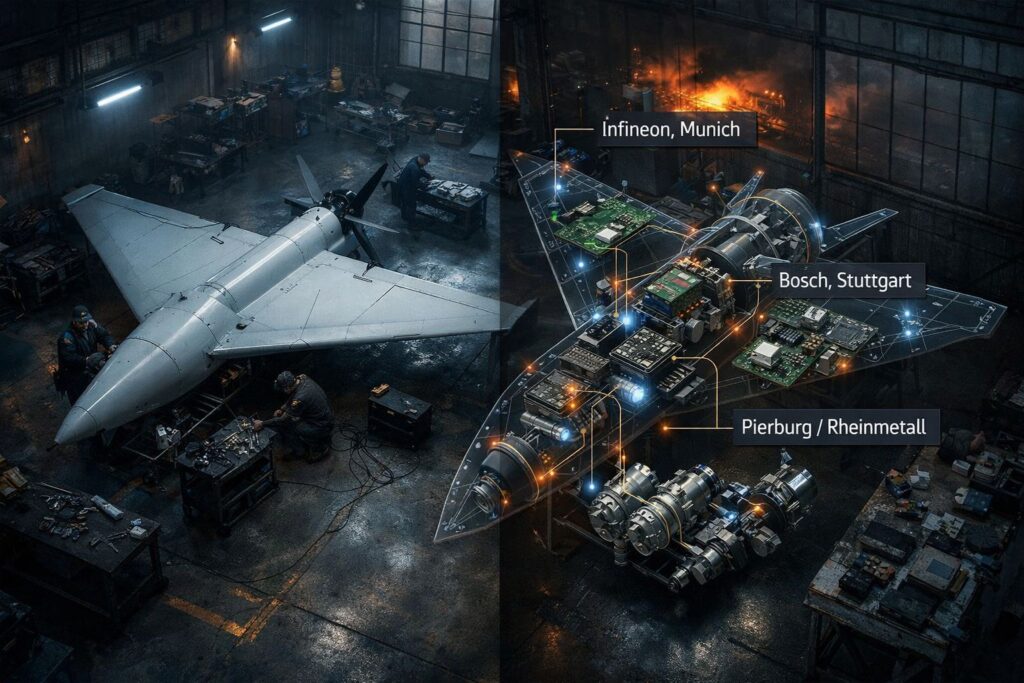
Brussels wires billions to rebuild Ukrainian power plants. Infineon, Bosch, and Rheinmetall supply – through intermediaries – the technology that destroys them. Both at the same time. Both known. Both legal. This is not a system failure. This is policy.
On February 18, 2026, the Organized Crime and Corruption Reporting Project, together with seven partner outlets – including the Kyiv Independent, Belgium’s De Tijd, Vienna’s Der Standard, The Times, and the Irish Times – published a coordinated investigative report. Title: “Made in the EU, Dropped on Kyiv.” What they documented is precise, sourced, and for anyone who wanted to know, has been visible for years.
The question is not whether European components are ending up in Russian drones. The question is why – and why it stays that way.
The Findings: What the Investigation Documents
The Geran-2 is Russia’s primary mass-destruction instrument against Ukrainian energy infrastructure. A kamikaze drone derived from the Iranian Shahed-136, with a range of up to 1,200 miles, a warhead between 110 and 200 pounds, and a unit cost between $20,000 and $50,000. Cheap enough for mass production. Precise enough for power plants.
OCCRP and its partners systematically disassembled and catalogued recovered Geran-2 drones. The result: 687 components analyzed per drone. Only a handful are Russian in origin. 112 components come from EU manufacturers – from 19 companies across 8 countries.
Germany leads this list by a wide margin: 82 documented components. Infineon Technologies of Munich alone accounts for 58 of them – primarily transistors for flight control electronics. Add to that Bosch components, including spark plugs and fuel pumps, plus parts from Pierburg, a subsidiary of Rheinmetall. Other EU suppliers include Austria’s ams-OSRAM, Ireland’s Taoglas and TE Connectivity, Switzerland’s STMicroelectronics and u-blox for GPS navigation, the Netherlands’ NXP Semiconductors, and Polish fuel pump specialists.
Between January 2024 and March 2025, investigators recorded 672 documented shipments of sanctioned EU components to Russia, processed through 178 companies – the majority registered in China and Hong Kong. The output of this supply chain: over 32,000 Geran-2 drones in 2025 alone. In the first six weeks of 2026, another 4,600 followed.
One million Ukrainians spent weeks this winter without electricity, water, or heat. Temperatures dropped to minus four degrees Fahrenheit.
The Supply Chain: Legal to China, Arrived in Russia
Not a single European company shipped directly to Russia. That matters to say, because it’s true – and because it’s precisely what makes the point.
The mechanism works like this: An EU company sells components to a distributor in China or Hong Kong. That distributor sells to a middleman in Turkey, the United Arab Emirates, Serbia, or Kazakhstan. The middleman delivers to a Russian procurement company – often already under sanctions, but that tends to surface later, if at all. The component ends up at the Alabuga facility in the Republic of Tatarstan, where Russia produces its Geran drones under license.
The camouflage works because it exploits a real property of the products themselves: the same chips used in Geran-2 flight control systems are also found in washing machines. The same GPS modules navigating Russian drones are embedded in automotive navigation systems. These so-called dual-use goods are declared in export documents as “spare parts for agricultural machinery” or “components for consumer electronics.” That’s not always a lie. It’s never the whole truth.
Ukraine’s sanctions enforcement chief Vladyslav Vlasiuk put it plainly: “Without Western technologies, Russia would not be able to produce the Geran-2.” (OCCRP, “Made in the EU, Dropped on Kyiv,” February 18, 2026, https://www.occrp.org/en/investigation/made-in-the-eu-dropped-on-kyiv-how-european-parts-are-enabling-russias-winter-drone-war)
The Historical Irony: Whose Drone Is This, Really?
Since the start of Russia’s full-scale invasion, Western audiences have heard about “Iranian Shahed drones” and “Russian Geran-2 copies.” The framing implies: foreign technology, foreign responsibility.
That’s not the full story.
The drone’s basic architecture – the distinctive delta-wing design with a rear-mounted pusher propeller – traces back to a West German development project from the 1980s: an anti-radar drone developed with U.S. involvement as a standoff weapon for suppressing enemy air defenses. Germany never fielded it. The Soviet Union collapsed before the project reached completion. The design disappeared into the archives.
Decades later, the same structural logic resurfaced in the Iranian Shahed – how exactly remains incompletely reconstructed to this day. And now, in 2026, it flies as a Russian mass weapon over Ukrainian power plants: built on the same foundational concept conceived in West Germany, equipped with electronics from German manufacturers.
Weapons analyst Ivan Kirichevsky of the Ukrainian military think tank Defense Express frames it directly: “The triangular kamikaze drone with wingtips and a pusher propeller is a German design, not an Iranian one. It turned out that even the electronics package is the same.” (Kyiv Independent, “How Russian Drones Exploit European Technologies to Strike Ukraine, and Beyond,” February 18, 2026, https://kyivindependent.com/investigation-how-russian-drones-exploit-european-technologies-to-strike-ukraine-and-beyond/)
Germany knows this. It goes unsaid.
The Double Standard: Statement vs. Reality
The companies involved have responded – with the standard toolkit.
Bosch stated that upon learning of the findings, it had “immediately launched investigations and taken appropriate measures.” Infineon pointed out that it had “no control over the conduct of distributors in third countries.” Rheinmetall ships armored infantry vehicles to Kyiv and says nothing about its Pierburg subsidiary, whose fuel pumps Russian engineers prize highly enough to design drone propulsion systems explicitly around that model.
| Company | Public Statement | Documented Finding |
|---|---|---|
| Bosch | “Immediate measures taken” | Components found in drones from 2024 and 2025 |
| Infineon | “No control over distributors” | 58 identified components per drone |
| Rheinmetall/Pierburg | Silence | Fuel pumps in Geran-2 propulsion systems |
| European Commission | “Sanctions circumvention is a core priority” | No tightened regulations since 2024 |
This gap between statement and reality is not unique to the Ukraine arms supply chain. The pattern runs through European security policy at large.
In January 2026, the EU imported significantly more Russian liquefied natural gas than in the same month the previous year – despite the officially agreed phase-out of Russian gas imports scheduled for 2027. France continues to source uranium from Rosatom for its nuclear power plants. EU member states import Russian aluminum, fertilizers, and wheat in substantial quantities. The United States purchases Russian uranium because no adequate alternative exists.
And in a different but structurally identical context: Through its Horizon Europe research program, the EU has channeled billions into Israeli technology companies – with an explicit mandate to fund civilian research only. The CEO of Sightec, a company that received nearly €2.5 million in Horizon funding, publicly stated on LinkedIn in August 2025 that his drone navigation technology was “combat-proven and deployed on over 3,000 drones in critical missions.” The European Commission has not responded. The funding continues. (A full analysis of the Horizon Europe entanglements is available at www.michael-hollister.com)
This is not coincidence. This is method.
The Excuses – and Why They Don’t Hold
Three explanations are systematically offered. All three collapse under scrutiny.
“We don’t know the end user.”
This is the weakest excuse, because it’s the most easily refuted. End-user certificates – documents in which the buyer formally commits to where and for what purpose a product will be used – have been standard practice in international arms exports for decades. Rheinmetall requires them for infantry fighting vehicles. No one would dream of shipping a Leopard 2 to Kazakhstan and saying: “We don’t know who ends up operating it.” Why should the standard be different for semiconductors?
Because it is politically inconvenient – not because it is technically impossible.
“We cannot control our distributors.”
This is simply false for anyone familiar with distribution agreements. Bosch contractually dictates to its trading partners which products must be placed where on store shelves, which competitors may be positioned within what distance, what margins apply, and which customers may be served. A company that controls shelf placement in Hong Kong electronics stores through contract clauses can also enforce end-use obligations. The decision not to do so is a decision.
“Dual-use goods are uncontrollable.”
Half true. A single transistor might end up in a washing machine or in a drone – distinguishing between the two in any given case is genuinely difficult. But 58 Infineon transistors plus a u-blox GPS navigation module plus three Pierburg fuel pumps in a single order routed through Hong Kong to Kazakhstan – that’s not a washing machine. Pattern recognition in export data is technically trivial. The United States applies it: entities on the American Entity List do not receive U.S. chips. Full stop. The EU has chosen otherwise.
The economic calculus behind this choice is transparent. Roughly 32,000 drones, with estimated European electronics content per unit running into the thousands of euros – that puts revenues flowing through these supply chains in the hundreds of millions. The maximum penalty for a proven sanctions violation stands at ten percent of the relevant turnover. The risk is factored in.
Why the Sieve Stays in Place
What is happening here is not a system failure. It is economic logic, applied consistently.
Three structural ratios determine the outcome: Export surplus outweighs sanctions impact. Corporate revenue exceeds Ukraine aid packages. Systemic relevance overrides moral obligation.
No conspiracy is required. No secret agreements, no corrupted officials, no deliberate sabotage. It is enough that the interests are clear. The companies with the most to lose from genuine export controls are the same companies most heavily represented in the corridors of Brussels. The politicians who would need to legislate real enforcement are watching export statistics, tax revenues, and labor market data.
That a different approach works has been proven. The U.S. Export Administration Regulations and the Entity List demonstrate: when Washington decides that a specific Chinese company will no longer receive American semiconductors, it doesn’t receive them. The system functions – when the political will is there.
In Europe, that will is absent. The sanctions architecture is designed to provide moral cover – “we sanctioned Russia” – without compelling economic consequences. The dual-use regime, the absence of distributor liability, the weakness of end-use controls: these are not accidental gaps. They are design features.
Conclusion: The Calculated Sieve
Sanctions are not a wall. They are a sieve. And neither EU policymakers nor European corporations have any substantial interest in plugging the holes.
What is playing out here follows the same logic that governed the Thirty Years’ War, the First World War, and every arms transaction since: wars are markets. Those who supply weapons profit. Those who supply components profit discreetly. Those who do both – aid packages to Kyiv and chips to Hong Kong – profit twice, and risk nothing, because the proof is always one detour further away.
Germany is loudest in condemning the Russian aggressor. Germany pays billions to rebuild Ukrainian power plants. And German chips fly into Ukrainian power plants night after night.
That’s called foreign policy.
This analysis is made available for free – but high-quality research takes time, money, energy, and focus. If you’d like to support this work, you can do so here:
Alternatively, support my work with a Substack subscription – from as little as 5 USD/month or 40 USD/year!
Let’s build a counter-public together.
Michael Hollister is a geopolitical analyst and investigative journalist. He served six years in the German military, including peacekeeping deployments in the Balkans (SFOR, KFOR), followed by 14 years in IT security management. His analysis draws on primary sources to examine European militarization, Western intervention policy, and shifting power dynamics across Asia. A particular focus of his work lies in Southeast Asia, where he investigates strategic dependencies, spheres of influence, and security architectures. Hollister combines operational insider perspective with uncompromising systemic critique—beyond opinion journalism. His work appears on his bilingual website (German/English) www.michael-hollister.com, at Substack at https://michaelhollister.substack.com and in investigative outlets across the German-speaking world and the Anglosphere.
Sources
1. OCCRP Main Investigation (February 18, 2026)
OCCRP: Made in the EU, Dropped on Kyiv – How European Parts Are Enabling Russia’s Winter Drone War https://www.occrp.org/en/investigation/made-in-the-eu-dropped-on-kyiv-how-european-parts-are-enabling-russias-winter-drone-war
Kyiv Independent: How Russian Drones Exploit European Technologies to Strike Ukraine, and Beyond https://kyivindependent.com/investigation-how-russian-drones-exploit-european-technologies-to-strike-ukraine-and-beyond/
Irish Times: How Irish Electronic Components Are Ending Up in Russian Attack Drones Bombarding Ukraine https://www.irishtimes.com/ireland/2026/02/18/how-irish-electronic-components-are-ending-up-in-russian-attack-drones-bombarding-ukraine/
OCCRP: Following Investigation, Ireland Will “Pursue” Issue of Irish Components in Russian Drones https://www.occrp.org/en/news/ireland-pursue-components-in-russian-drones
2. German Components – Infineon, Bosch, Rheinmetall/Pierburg
UNITED24 Media: German-Made Chips Power Russian Shahed Drones, Investigation Finds https://united24media.com/latest-news/german-made-chips-power-russian-shahed-drones-investigation-finds-15911
t-online: Geran-5 – New Russian Combat Drone with German Parts https://www.t-online.de/nachrichten/ukraine/id_101096612/ukraine-krieg-geran-5-neue-russische-kampfdrohne-mit-deutschen-teilen.html
Wirtschaftswoche: Infineon Chips in Russian Drones – The Hong Kong Connection Makes It Possible https://www.wiwo.de/unternehmen/industrie/infineon-chips-in-russischen-drohnen-die-hongkong-connection-machts-moeglich/100198767.html
Kurier: Putin Drones with Western Technology – Report Exposes the System https://www.kurierverlag.de/politik/putin-drohnen-mit-westlicher-technologie-bericht-enthuellt-system-zr-94176348.html
3. Supply Chains and Sanctions Circumvention
Kyiv Post: EU-Made Parts Found in Killer Russian Drones Despite Sanctions https://www.kyivpost.com/post/70387
UNITED24 Media: Russian Geran-2 Drones Are Assembled Almost Entirely from Foreign-Made Parts https://united24media.com/latest-news/russian-geran-2-drones-are-assembled-almost-entirely-from-foreign-made-parts-16069
4. Primary Source: Ukrainian Military Intelligence (HUR)
War & Sanctions Portal – Database of foreign components in Russian weapons (3,000+ components, approximately 400 manufacturers from 32 countries documented) https://warsanctions.gur.gov.ua/en/
5. West German Anti-Radar Drone – Historical Background
Defence Network: Russia Produces Geran-2 Drones at Scale (background analysis including design history and structural origins) https://defence-network.com/russland-produziert-geran-2-drohnen/
6. Horizon Europe – EU Research Funding and Military Technology
Michael Hollister: Horizon Europe – How EU Research Grants Flow into Israeli Military Technology in Violation of the Civilian Mandate, first published at Manova News, October 11, 2025 https://www.michael-hollister.com/de/2025/11/30/horizon-europe/
7. EU Sanctions Policy – Primary Documents
Council of the European Union: Restrictive Measures Against Russia – Overview https://www.consilium.europa.eu/en/policies/sanctions/restrictive-measures-against-russia-over-ukraine/
EUR-Lex: EU Regulation No. 833/2014 – Dual-Use Export Prohibitions, Consolidated Version https://eur-lex.europa.eu/legal-content/EN/TXT/?uri=CELEX%3A02014R0833-20240223
8. Related Articles by the Author
Michael Hollister: Drones Against Hegemony – Iran’s Asymmetric Military Strategy (Part 4) https://www.michael-hollister.com
Michael Hollister: The Axis of Resistance – Iran’s Regional Network (Part 3)
https://www.michael-hollister.com/2026/02/15/the-axis-of-resistance-part-3/
© Michael Hollister – All rights reserved. Redistribution, publication or reuse of this text requires express written permission from the author. For licensing inquiries, please contact the author via www.michael-hollister.com.
Newsletter
🇩🇪 Deutsch: Verstehen Sie geopolitische Zusammenhänge durch Primärquellen, historische Parallelen und dokumentierte Machtstrukturen. Monatlich, zweisprachig (DE/EN).
🇬🇧 English: Understand geopolitical contexts through primary sources, historical patterns, and documented power structures. Monthly, bilingual (DE/EN).