
by Michael Hollister
Exclusive published at Michael Hollister on February 27, 2026
2.985 words * 16 minutes readingtime
This analysis is made available for free – but high-quality research takes time, money, energy, and focus. If you’d like to support this work, you can do so here:

Alternatively, support my work with a Substack subscription – from as little as 5 USD/month or 40 USD/year!
Let’s build a counter-public together.
How Trump Got Greenland Without Spending a Dime
Davos, January 21, 2026. The World Economic Forum – that annual congress of the powerful and their entourages – has seen many memorable moments. This one will go down in history. Not because of a speech, not because of a handshake, not because of a signature. But because of what was quietly decided, without ceremony, after roughly twenty minutes of conversation between two men in a conference room in the Swiss Alps.
Donald Trump, the 47th President of the United States, steps in front of the cameras after his meeting with NATO Secretary General Mark Rutte and announces what he calls a “framework of a future deal” – a framework for a future agreement concerning Greenland and the entire Arctic. Shortly afterward, his statement appears on Truth Social: “This solution, if it is completed, will be a great one for the United States of America and all NATO nations.”
No written document. No signing ceremony. CNN confirms a few hours later: there is no paper that describes, fixes, or gives legal force to this framework.
And yet, something has fundamentally changed in the Arctic since that day.
Danish Prime Minister Mette Frederiksen learns of the deal from the media. She stresses that Rutte assured her sovereignty questions had not been raised. Rutte confirms this to Reuters. Mineral rights, says Rutte, were not discussed. Trump, speaking to CNBC hours after the meeting, says the opposite: that is precisely what it is about – mineral rights and the Golden Dome.
Greenland’s parliamentary representative Aaja Chemnitz Larsen, who learns all of this from the news, sums up the political meaning in three words: “Nothing about us without us.”
Greenland’s Prime Minister Múte Egede Nielsen adds that the terms of the deal are “less defined” than Trump claims. Greenland’s population – 56,000 people whose land has been squeezed between great-power interests for centuries – was not consulted. A January 2026 poll found 85 percent of Greenlanders opposed to joining the United States. For this deal, that was irrelevant.
I. What the Framework Contains – and What It Doesn’t
Precision matters here. What we know for certain is narrower than what is being claimed. What we can reasonably infer is strategically more significant than what has been confirmed. And what is being left unsaid may be the most important part of all.
What is established – from Trump’s own statements, NATO communications, and a briefing given by a European official to Bloomberg:
The framework grants the United States a say and, effectively, veto power over investments in Greenland. Non-NATO states – meaning China and Russia – are to be excluded from mining rights and infrastructure investments. NATO commits to an expanded military presence in the Arctic. The existing 1951 defense agreement between the United States and Denmark – the legal foundation for U.S. military presence on the island – is to be updated. The tariff threat that had been building for weeks against eight European NATO members – 10 percent starting February 1, 25 percent starting in June – is withdrawn.
A note on those tariffs: Trump had threatened these countries with trade sanctions because they had sent troops to Greenland – as a gesture of support for Denmark, in response to Trump’s increasingly aggressive annexation rhetoric. The message was unambiguous: those who stood in the way of his Greenland plans would pay. Those who played along would be rewarded.
What is strongly indicated – from reporting by the New York Times, Bloomberg, and The Hill, drawing on anonymous sources in NATO and government circles:
The framework includes mechanisms that favor U.S. mining companies in new projects in Greenland. A NATO infrastructure fund modeled on the Ukraine minerals deal is under discussion. Europe finances the operation and munitions of the Golden Dome, while U.S. and Israeli companies supply the systems.
What the framework does not contain – though Trump has implied otherwise:
No formal transfer of sovereignty. No purchase. No treaty with Denmark. No treaty with Greenland. Trump was asked directly at CNBC whether the framework fulfilled his central demand – ownership of Greenland. He did not answer. Instead, he called it “infinite” and “forever.”
Republican Senator Mitch McConnell had captured what much of the Washington establishment was thinking weeks earlier: “I have not heard a single thing from this administration that we need from Greenland that this sovereign people is not already willing to give us.” Trump ignored that. He insisted on ownership or nothing. Then he received the framework – and called it a historic victory.
That is the method. And it works.
II. The Method: Negotiating Over the Heads of Those Affected
To understand what actually happened in Davos, you have to step back and look at the full picture.
Donald Trump negotiated with Mark Rutte. Rutte is the NATO Secretary General. He represents the alliance, not its individual members. He has no authority over Danish territory. He has no authority over Greenland’s resources. He is, in Trump’s own logic, essentially a senior employee of an organization whose by far most important member is the United States.
Trump therefore negotiated with his own institutional subordinate over the territory of an ally – and sold the result as a bilateral breakthrough.
We have seen this before. It is the same pattern as the so-called “Board of Peace” for Gaza: Trump designs a plan for a territory – the displacement of 2.2 million Palestinians, the transformation of Gaza into the “Riviera of the Middle East” – and negotiates it with the Israeli government and a handful of Arab heads of state. The population living on that land is not consulted. Their views are treated as irrelevant. The territory is an object, not a subject.
In Greenland, the same logic repeats: the land is not an actor, it is a stage. The population is not a negotiating party, it is a boundary condition. The deal is struck between those who hold power – not between those whose homeland is at stake.
This approach is not new in world history. What is new is that it is being applied this openly against NATO allies. That Trump threatened Denmark – a founding member of the alliance, a reliable partner for seven decades – with trade sanctions for defending its own territory, then negotiated over that territory without Danish participation: that is a precedent. It will not be the last.
The pressure that preceded this deal follows a by now familiar Trumpian script. 2025: demand to purchase Greenland, threats of coercive measures. January 2026: statement that he will get Greenland “the easy way or the hard way.” Appointment of Jeff Landry, Governor of Louisiana, as special envoy for Greenland. Tariffs against eight European NATO members. Military posturing. Then, after the tariff threat: the framework in Davos – and the transformation of the maximum demand into a framework that achieves structurally the same objective without the political cost of formal annexation.
Venezuela, 2025: maximum pressure, Maduro toppled, resource access secured, costs shared with coalition partners. Panama, 2025: canal rhetoric, quiet renegotiation of access rights. Iran, February/March 2026: China’s strategic energy asset destroyed, costs borne through U.S. munitions stockpiles and Israeli involvement. Greenland, January 2026: strategically most important Arctic position secured, resources controlled, China pushed out, bill forwarded to Europe.
The pattern is consistent. And consistent patterns are not coincidences.
III. What Lies Under Greenland’s Ice – and Why It Changes Everything
To understand why Trump has pursued Greenland more tenaciously, more aggressively, and more persistently than almost any other objective of his presidency, you have to understand what lies beneath the ice.
Greenland is, geologically speaking, an anomaly of the most favorable kind. Ancient volcanic activity transformed metamorphic rock in the south into metal ores and sedimentary rock in the north into heavy minerals. The result is one of the most resource-rich landmasses on earth that remains largely untouched.
According to estimates from the U.S. Geological Survey and the Geological Survey of Denmark and Greenland, Greenland holds proven economically recoverable rare earth reserves of 1.5 million metric tons – placing it eighth worldwide. Total estimates for rare earth element oxides range from 36 to 42 million metric tons. If those figures hold, Greenland would be the second-largest rare earth site in the world – after China.
Of the 34 minerals classified as critical raw materials by the European Commission, 25 have been confirmed in Greenland. Among them: graphite, niobium, titanium, copper, gallium, tungsten, zinc, gold, silver, iron, platinum, molybdenum, tantalum, and vanadium. Plus uranium – in quantities that make Greenland one of the largest uranium deposits on earth.
The five minerals that matter most in the context of the U.S. defense industry are the same ones I documented in detail in my analysis “The Materials Paradox: How Critical Raw Material Dependencies Are Undermining U.S. Deterrence in the Indo-Pacific”: neodymium, dysprosium, yttrium, terbium, samarium – all present in Greenland. All essential for high-performance magnets in F-35 engines, Aegis radar systems, precision munitions, lasers, and autonomous drone systems. All currently refined to 85 to 90 percent capacity in China.
Two projects are at the center of this:
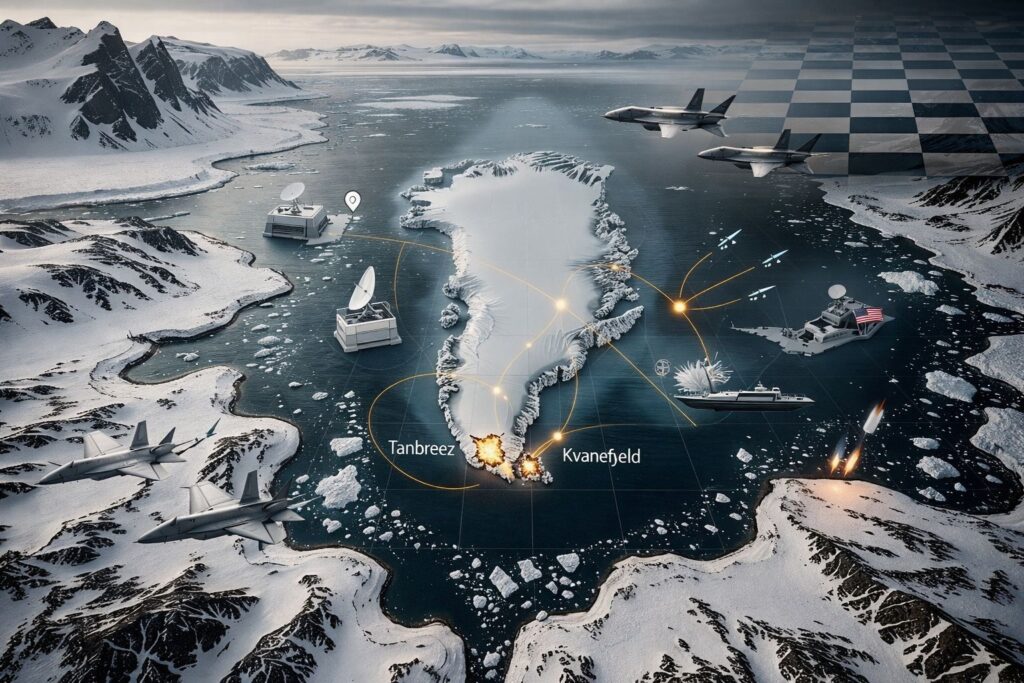
Kvanefjeld, in southern Greenland: the third-largest known rare earth deposit in the world, with more than 11 million metric tons of reserves and resources. High ore grade of 1.43 percent – well above most competing projects globally. The catch: Kvanefjeld also contains uranium. In 2021, Greenland’s newly elected parliament – chosen in an election that largely turned on this issue – banned uranium mining. The project has been frozen since. The Australian operator, Energy Transition Minerals, is pursuing arbitration seeking $11.5 billion in damages – nearly ten times Greenland’s entire annual government budget. Second-largest shareholder: Shenghe Resources, a Chinese state-linked mining company.
Tanbreez, also in southern Greenland: potentially the largest rare earth deposit in the world. Preliminary estimates: 28.2 million metric tons. The pre-feasibility study was completed in 2025. Operator: Critical Metals Corp, New York. The U.S. Export-Import Bank sent the company a Letter of Interest in June 2025 for a $120 million loan – the first U.S. government financing of an overseas mining project in the Trump era. Following briefings by Secretary of State Rubio, Critical Metals shares rose more than 25 percent.
At the same time, the U.S. government – according to the Tanbreez owner himself – has actively warned against selling the deposit to China-linked buyers.
The bottleneck here is not the drilling. The United States and Norway are technologically dominant in Arctic extraction: Schlumberger, Halliburton, Equinor – proven in Alaska, in the Johan Castberg field, in the North Sea. Russia is strong in nuclear-powered drilling platforms, but sanctions block technology exports. China has no relevant Arctic drilling expertise and no permafrost experience.
The bottleneck is refining. China controls 85 to 90 percent of global capacity to process rare earth materials. Not mining – processing. Raw ore from Greenland is worthless if it has to be shipped to China for refining. That is precisely the strategic knot that the U.S. veto over Greenland investments is designed to untie over the medium term: whoever decides who invests in Greenland also decides who builds the refining capacity. And whoever builds that capacity breaks China’s monopoly.
The realistic timeline to first meaningful production runs ten to fifteen years. Which means: the strategic positioning today matters more than the actual extraction tomorrow. Whoever holds veto power over investors controls the deposit – without having moved a single stone. Trump secured that veto in Davos.
IV. Golden Dome: When the Packaging Matters More Than the Contents
“The United States needs Greenland for the purpose of national security. It is vital for the Golden Dome that we are building.” – Donald Trump, Truth Social, January 2026.
That is the official rationale. It is also, as multiple independent military experts documented in the weeks that followed, factually incorrect.
The Golden Dome program – a multilayered missile defense system designed to protect the continental United States against ballistic missiles, hypersonic weapons, and cruise missiles – was initiated by executive order in January 2025. Funding to date: approximately $38 billion ($25 billion through the One Big Beautiful Bill Act of 2025, another $13.4 billion in the FY2026 budget legislation). Total cost estimates: anywhere from $175 billion (White House), $161 to $542 billion (Congressional Budget Office), to $3.6 trillion (American Enterprise Institute). A range that speaks for itself.
What does Golden Dome actually need from Greenland? According to analysis by Defense News and the Bulletin of the Atomic Scientists: little to nothing that the 1951 defense agreement does not already cover. The United States has maintained Pituffik Space Base (formerly Thule Air Base) in northwestern Greenland for more than seven decades. That agreement already permits the U.S. side to construct facilities, station personnel, install and operate systems – without additional authorization. The three Ground-based Midcourse Defense sites (Alaska, California, Fort Drum in New York) cover the relevant intercept corridors for ICBMs from Russia and China. A fourth site in Greenland would, experts say, provide no meaningful strategic improvement. (Defense One, “Experts: Trump’s Golden Dome Excuse for Greenland ‘Detached from Reality,'” January 2026, https://www.defenseone.com/threats/2026/01/trumps-golden-dome-excuse-greenland-grab-detached-reality-experts-say/410693/)
Senator McConnell put it plainly: there is nothing the United States needs from Greenland that Greenland is not already willing to provide.
The obvious follow-up question: why does Europe go along with it anyway? The answer is structural, not emotional. The alternative to the framework – an open investment environment in Greenland where Chinese state companies like Shenghe Resources could operate freely – is, from a European perspective, worse than an expensive U.S.-led framework. Europe pays because it considers the other option more dangerous. That is not consent. It is the absence of a better choice.
So why Golden Dome as the primary argument?
Because it works. “National security” is the trump card that beats every other. In an environment where Russian hypersonic missiles and Chinese missile silos dominate political debate, “we need Greenland for our missile defense system” generates buy-in before anyone examines the details.
The details tell a different story.
Tanbreez, the potentially world’s largest rare earth deposit in southern Greenland, contains – alongside the standard rare earths – zirconium and specific heavy rare earths including samarium and yttrium. These materials are the basis for zirconium diboride heat shields: the technology that makes hypersonic glide vehicles possible in the first place, because they withstand re-entry temperatures of several thousand degrees. In other words: the material that Trump’s “Golden Dome” is supposed to intercept is made from the same deposits as the material used to build the Golden Dome itself.
That is not a coincidence. That is geopolitics at its finest.
And who profits? The Golden Dome supply chain reads like a who’s who of the American and Israeli defense industry.
Raytheon Technologies supplies the SPY-6 radar systems for detecting and tracking incoming threats, plus the SM-6 interceptors for medium-range engagements – unit cost approximately $4 million. Lockheed Martin supplies the PAC-3 MSE interceptors for the short-range layer – unit cost approximately $5 million. Israel’s Rafael, in partnership with Raytheon, supplies the AI-driven fire control system – built on experience with Israel’s Iron Dome, whose Tamir interceptor runs around $50,000 per round.
Operations and munitions: NATO members. Initial estimated contract volumes for system delivery: $10 to $20 billion. Ongoing costs for munitions and operations: $2 to $3 billion annually.
Europe builds the base. Europe pays for the munitions. Europe finances the operations. The U.S. and Israeli defense industries collect the contracts. Greenland becomes the site without having been asked. Rarely has an alliance negotiated its own cost structure this openly – and rarely has the party paying the bills had so little say. The United States gains strategic control over the geopolitically most significant island in the Northern Hemisphere – and bears not a single dollar of system costs.
In this chess move at Davos, Trump achieved more than any of his public threats ever could. He got the outcome he wanted – on a tab paid by others.
V. The Triple Function of the Framework: Resources, Military, China
It would be too simple to describe the Greenland framework as a deal with a single objective. Like all truly clever geopolitical maneuvers, it is a move with multiple simultaneous effects.
First: Resource control without ownership.
The U.S. veto over investments in Greenland is not, legally speaking, a claim of ownership. It is something more effective: a control mechanism that achieves the same result without the political cost of annexation. Whoever decides on investors decides on the development of the deposits. Whoever decides on development decides on supply chains. Whoever decides on supply chains has strategic access to the raw materials – without title, without flag, without deed.
Running in parallel: the Export-Import Bank loan for Tanbreez – $120 million for Critical Metals Corp, making it the first U.S. government-financed mining investment in Greenland. No coincidence that the framework simultaneously locks out non-NATO investors. The American competitor is standing by. The Chinese competitor is barred.
Second: Military positioning for the next decade.
The 1951 agreement is being updated. The full details have not yet been made public. But the direction is clear: more access, more bases, more rotations. From reported indicators: up to 2,000 additional troops, drone hangars, satellite stations, expanded radar infrastructure. From the hypothetical category: the construction of up to four permanent bases (Pituffik, Nuuk, and others) hosting more than 5,000 U.S. personnel – without formally violating Danish sovereignty. Trump’s “Spain airbase logic,” as his own team reportedly calls it internally: you use what you need, whether you own it or not. Spain does not host U.S. bases because of American persuasiveness. It hosts them because the logic of the security architecture makes them inevitable.
Third: Keeping China out of Greenland.
This is the effect that Melissa Sanderson, former U.S. diplomat and board member of the Critical Minerals Institute, identifies as the real objective: “If this were purely a resource strategy, the U.S. would focus on more accessible rare earth deposits – in the United States itself, Canada, Australia, and Brazil. The focus on Greenland is more about China exclusion than resource access.” (CSIS, “Greenland, Rare Earths, and Arctic Security,” https://www.csis.org/analysis/greenland-rare-earths-and-arctic-security)
Shenghe Resources, the Chinese state-linked company holding 12.5 percent of the Kvanefjeld project’s parent company, is the visible expression of that risk. Kvanefjeld has been effectively frozen since 2021 under Greenland’s uranium mining ban. But uranium bans can be reversed by parliamentary vote. With a new framework excluding non-NATO investment, that path is blocked – regardless of what a future Greenlandic parliament might decide.
The Carnegie Endowment for International Peace documented the baseline: not a single Chinese mining project in Greenland has ever been realized. The framework is designed to ensure it stays that way – permanently, structurally, independent of changing governments in Nuuk or Copenhagen.
At the same time, a broader pattern is playing out. Venezuela: Maduro toppled, Venezuelan oil removed from Chinese influence. Panama: canal fees and access rights renegotiated, Chinese involvement in port infrastructure pressured. Iran: China’s most important energy asset in the Middle East – Iran as a cheap oil source and strategic buffer – destabilized by U.S.-Israeli military action. Greenland: rare earths and Arctic position pulled out of China’s reach.
China is losing, step by step, the resource leverage that strengthens its geopolitical negotiating position. Greenland is the most recent – but not the last – move in this chess match.
This is Part 1 of a two-part analysis of the Greenland framework. Part 2 covers the geopolitical significance of the Arctic chokepoint, the perspective of Greenland and Denmark, a complete cui bono analysis, and the strategic outlook.
This analysis is made available for free – but high-quality research takes time, money, energy, and focus. If you’d like to support this work, you can do so here:
Alternatively, support my work with a Substack subscription – from as little as 5 USD/month or 40 USD/year!
Let’s build a counter-public together.
Michael Hollister
is a geopolitical analyst and investigative journalist. He served six years in the German military, including peacekeeping deployments in the Balkans (SFOR, KFOR), followed by 14 years in IT security management. His analysis draws on primary sources to examine European militarization, Western intervention policy, and shifting power dynamics across Asia. A particular focus of his work lies in Southeast Asia, where he investigates strategic dependencies, spheres of influence, and security architectures. Hollister combines operational insider perspective with uncompromising systemic critique—beyond opinion journalism. His work appears on his bilingual website (German/English) www.michael-hollister.com, at Substack at https://michaelhollister.substack.com and in investigative outlets across the German-speaking world and the Anglosphere.
Sources
Primary Sources / Official Statements
Trump on Truth Social: “framework of a future deal” (January 21, 2026) https://truthsocial.com/@realDonaldTrump
CNBC
Trump: Framework covers mineral rights and Golden Dome https://www.cnbc.com/2026/01/21/trump-says-greenland-framework-with-nato-involves-mineral-rights-for-us.html
Trump: “Concept of a deal” – Davos interview with Joe Kernen https://www.cnbc.com/2026/01/21/trump-tariffs-nato-greenland-davos.html
Greenland’s Prime Minister Nielsen: Framework terms unclear, sovereignty is a “red line” https://www.cnbc.com/2026/01/22/greenland-trump-nato-deal-nielsen.html
Trump’s Greenland framework could exclude China from rare earths https://www.cnbc.com/2026/01/23/trump-greenland-china-rare-earth-mineral.html
Denmark open to Golden Dome talks following framework announcement https://www.cnbc.com/2026/01/22/trump-greenland-deal-nato-denmark-golden-dome.html
Why Trump wants Greenland – national security and resources https://www.cnbc.com/2026/01/07/why-trump-wants-greenland-and-what-makes-it-so-important-for-security.html
Reuters
Rutte: Framework commits NATO allies to greater Arctic security (Reuters exclusive, syndicated) https://ca.news.yahoo.com/exclusive-rutte-says-greenland-framework-100945987.html
U.S. lobbied Greenland’s Tanbreez developer not to sell to China https://www.miningweekly.com/article/us-lobbied-greenland-rare-earths-developer-tanbreez-not-to-sell-to-china-2025-01-10
CNN
Trump’s framework sounds like the existing 1951 agreement https://edition.cnn.com/2026/01/22/politics/us-greenland-framework-1951-deal
Rare earths in Greenland – mineral rights and reality https://edition.cnn.com/2026/01/22/business/greenland-rare-earth-minerals-trump
The Hill
Framework details: U.S. access to minerals, non-NATO countries excluded https://thehill.com/homenews/administration/5701884-trump-greenland-deal-framework-details/
Trump: Mineral rights will be part of the Greenland deal https://thehill.com/policy/energy-environment/5701830-trump-greenland-deal-nato-mineral-rights/
Why Greenland’s minerals don’t automatically mean U.S. access https://thehill.com/policy/energy-environment/5697708-greenland-trump-minerals-rare-earths-denmark-nato/
Defense One
Experts: Trump’s Golden Dome justification for Greenland “detached from reality” https://www.defenseone.com/threats/2026/01/trumps-golden-dome-excuse-greenland-grab-detached-reality-experts-say/410693/
Defense News
Why a U.S. takeover of Greenland is not necessary for Golden Dome https://www.defensenews.com/opinion/2026/02/10/why-greenlands-takeover-by-the-us-is-not-needed-for-golden-dome/
Bulletin of the Atomic Scientists
Trump doesn’t need the Golden Dome in Greenland – he needs a stronger NATO https://thebulletin.org/2026/02/trump-doesnt-need-the-golden-dome-in-greenland-he-needs-a-stronger-nato/
National Interest
Why the Golden Dome doesn’t need Greenland https://nationalinterest.org/feature/why-the-golden-dome-doesnt-need-greenland
Carnegie Endowment for International Peace
Is the Chinese-Russian threat in Greenland real? – Not a single Chinese mining project realized https://uq14r.carnegieendowment.org/russia-eurasia/politika/2026/01/greenland-russia-china-threat
Center for Strategic and International Studies (CSIS)
Greenland, rare earths, and Arctic security – Kvanefjeld, Tanbreez, REE reserves https://www.csis.org/analysis/greenland-rare-earths-and-arctic-security
Yale Environment 360
Greenland’s minerals: Between resource control and Arctic reality https://e360.yale.edu/features/greenland-critical-minerals
Atlantic Council
Greenland’s critical minerals require patient statecraft https://www.atlanticcouncil.org/dispatches/greenlands-critical-minerals-require-patient-statecraft/
German Marshall Fund
Sovereignty is not for sale – Denmark and Greenland hold firm https://www.gmfus.org/news/sovereignty-not-sale
Fortune
Trump’s Greenland mining plan would cost “billions over decades” https://fortune.com/2026/01/07/trump-greenland-billions-decades-mineral-experts/
Author’s Background Analysis
Michael Hollister: “The Materials Paradox: How Critical Raw Material Dependencies Are Undermining U.S. Deterrence in the Indo-Pacific” (February 1, 2026) https://www.michael-hollister.com/de/2026/02/01/das-us-materialien-paradoxon/
© Michael Hollister – All rights reserved. Redistribution, publication or reuse of this text requires express written permission from the author. For licensing inquiries, please contact the author via www.michael-hollister.com.
Newsletter
🇩🇪 Deutsch: Verstehen Sie geopolitische Zusammenhänge durch Primärquellen, historische Parallelen und dokumentierte Machtstrukturen. Monatlich, zweisprachig (DE/EN).
🇬🇧 English: Understand geopolitical contexts through primary sources, historical patterns, and documented power structures. Monthly, bilingual (DE/EN).