
by Michael Hollister
Exclusive published at Michael Hollister on February 27, 2026
2.985 words * 16 minutes readingtime
This analysis is made available for free – but high-quality research takes time, money, energy, and focus. If you’d like to support this work, you can do so here:

Alternatively, support my work with a Substack subscription – from as little as 5 USD/month or 40 USD/year!
Let’s build a counter-public together.
Ukraine Negotiations Are Underway — and Europe Is Sitting in the Stands
Two Sentences That Say Everything
December 2025, the White House: Donald Trump declares the Ukraine peace process “95 percent done.” Geneva, February 18, 2026: The third round of trilateral negotiations between the United States, Ukraine, and Russia breaks off after two hours. A source close to the Ukrainian government, speaking anonymously to ABC News, describes the situation bluntly: “The last 5 percent is the entire substance. None of it is agreed.” And then, more sharply still: “Forget the 5 percent—Russia doesn’t even agree to the 95 percent.” (ABC News, “4 years into Russian invasion, fundamental sticking points on Ukraine peace deal remain,” February 24, 2026, https://abcnews.com/International/4-years-russian-invasion-fundamental-sticking-points-ukraine/story?id=130401757)
Meanwhile, today, February 26, 2026: Steve Witkoff, Trump’s special envoy, and Jared Kushner are sitting in Geneva with Ukraine’s chief negotiator Rustem Umerov. It is a bilateral meeting—preparation for the next trilateral round in early March. Kirill Dmitriev, Putin’s economic envoy, has also flown into Geneva. Next door, in the same conference building, Witkoff is simultaneously conducting talks with an Iranian delegation on the Islamic Republic’s nuclear program. (Al Jazeera, “US, Ukraine to meet in Geneva as Russia hits cities with missiles, drones,” February 26, 2026, https://www.aljazeera.com/news/2026/2/26/us-ukraine-to-meet-in-geneva-as-russia-attacks-kyiv-with-missiles-drones; CNN Live Updates, “US and Iran In Talks in Geneva—Ukraine talks parallel,” February 26, 2026, https://www.cnn.com/us/live-news/trump-administration-us-iran-talks-02-26-26)
One man, two wars, one day. That is the compression of the current moment.
The negotiating chronology of recent weeks: Davos (January 2026)—initial exploratory contacts. Abu Dhabi (February 4–5)—first official trilateral round. Abu Dhabi II (early February)—second round, no breakthrough, but the U.S. and Russia agree for the first time since 2021 to restore military communication channels. Geneva (February 17–18)—third round, premature collapse. Geneva bilateral (February 26)—preparation for the fourth round. Trilateral early March—scheduled, date open. (Euronews, “US and Russia agree to re-establish military dialogue after Ukraine peace talks in Abu Dhabi,” February 6, 2026, https://www.euronews.com/2026/02/06/us-and-russia-agree-to-re-establish-military-dialogue-after-ukraine-peace-talks-in-abu-dha; Foreign Policy, “Russia-Ukraine Peace Talks Cut Short in Geneva,” February 18, 2026, https://foreignpolicy.com/2026/02/18/russia-ukraine-peace-talks-geneva-zelensky-putin-stalled-negotiations/)
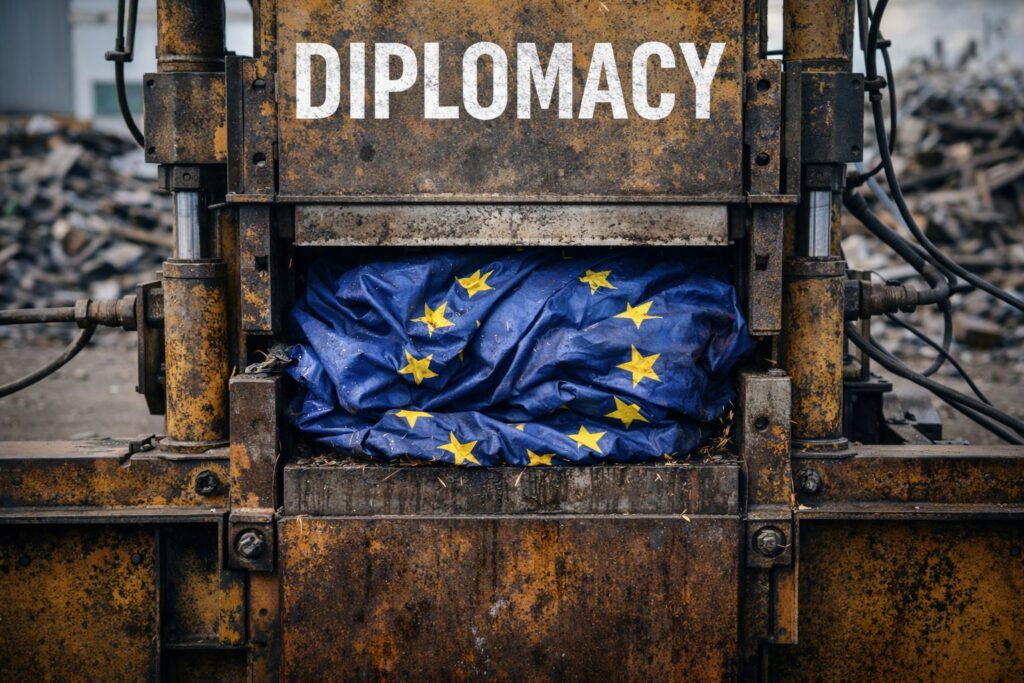
At none of these tables sat an EU representative. At none of the planned tables will one sit.
What this article documents has barely registered in European newsrooms: Russia has conceded more in these negotiations than at any point since the war began—and Europe is not finding out, because it is not at the table.
What Is Actually on the Table
The Quincy Institute for Responsible Statecraft in Washington published a document on January 29, 2026 that received almost no coverage in European mainstream media. Authors Anatol Lieven, director of the Eurasia Program, and Mark Episkopos, research fellow, have systematically documented the state of negotiations—not as opinion, but as an inventory of documented positions from both sides. What it contains is remarkable. (Quincy Institute for Responsible Statecraft, Anatol Lieven and Mark Episkopos, “Frequently Asked Questions About the Russia-Ukraine Negotiations,” January 29, 2026, https://quincyinst.org/research/frequently-asked-questions-about-the-russia-ukraine-negotiations/)
Russia has made substantial concessions. The original Russian demand from the Istanbul talks of 2022 was to cap the Ukrainian army at a maximum of 85,000 troops. The current state of negotiations envisages a Ukrainian peacetime army of at least 600,000—in some drafts up to 800,000 troops. That would be by far the largest army in Europe—larger than the Bundeswehr at full strength, larger than the French armed forces. This shift by a factor of ten is not a marginal adjustment; it is a strategic reversal. (Axios, “Trump Ukraine peace plan 28 points,” November 20, 2025, https://www.axios.com/2025/11/20/trump-ukraine-peace-plan-28-points-russia)
Why Moscow has moved this far remains an open question. Exhaustion, strategic calculation with regard to Washington’s Indo-Pacific pivot, or Chinese pressure toward de-escalation—all three factors play a role; none is conclusively documented. What is documented: the movement is happening.
Beyond this, Moscow has accepted Ukraine’s accession to the EU. This is a position Putin had explicitly rejected both before and after the Euromaidan of 2014. At the Alaska Summit in August 2025—the first direct meeting between Trump and Putin since the war began, documented at Joint Base Elmendorf-Richardson in Anchorage—Putin agreed in principle to substantial, binding Western security guarantees for Ukraine, as the Quincy Institute establishes on the basis of summit documents. At the same time, Moscow continued to categorically reject any Western troop presence on Ukrainian soil. Principle yes, implementation no—this contradiction remains unresolved and constitutes one of the central sticking points in the ongoing negotiations. And in the Donbas, Moscow has abandoned its original maximalist position: Russia is prepared to freeze the front line in the Zaporizhzhia and Kherson regions—thereby foregoing the complete annexation of these territories it formally claims.
The Ukrainian side has also made concessions. President Zelensky has publicly and repeatedly acknowledged that the eastern and southeastern territories cannot be recovered through negotiations. Ukraine has agreed to the White House proposal to demilitarize parts of eastern Donetsk—including those parts still under Kyiv’s control. NATO membership is de facto off the table; what is being negotiated instead are alternative security guarantees. A nationwide referendum on territorial concessions that could be submitted to the Rada for ratification is no longer being ruled out by Kyiv.
There is also a frequently overlooked element: the so-called Prosperity Package. Washington has signaled an international reconstruction and development program for the post-war Ukraine. It is the economic lever of the deal—the message being: those who make concessions get reconstruction. Classic transactional dealmaking, as Trump has practiced it throughout his real-estate career. (Kyiv Post, “Zelensky Announces Ukraine-US Talks Set for Thursday in Geneva,” February 25, 2026, https://www.kyivpost.com/post/70758; Mezha.net, “US Envoy Details Progress in Ukraine-Russia-US Geneva Peace Talks,” February 26, 2026, https://mezha.net/eng/bukvy/us-envoy-details-progress-in-ukraine-russia-us-geneva-peace-talks/)
All of this is documented, substantiated, reconstructable from government communications and primary sources. It is not rumor. It is the state of negotiations that has barely registered in European newsrooms.
The Real Sticking Points
And yet: the Geneva talks of February 18 collapsed prematurely. Zelensky publicly described the first day as “difficult” and accused Russia of stalling the negotiations. Medinsky, Russia’s chief negotiator, described the round as “difficult but substantive.” The White House spoke of “meaningful progress.” None of the three sides had described the same evening. (TIME, “Ukraine-Russia Peace Talks End Abruptly,” February 18, 2026, https://time.com/7379321/ukraine-russia-peace-talks-end-zelensky-trump-clash/)
What is blocking progress can be reduced to three core questions.
The Donbas. The last unresolved territorial problem is eastern Donetsk. Russia demands the complete withdrawal of Ukrainian forces from the entire Donetsk region—that is, not only from the Russian-controlled parts, but also from the 20 percent of the territory still under Ukrainian control. Kyiv wants to freeze the front line where it stands. This is not a minor difference. It is the psychological and military core problem of the conflict—ten years of fighting, countless dead, deeply inscribed identity politics on both sides.
The Zaporizhzhia Nuclear Power Plant. Before the war it supplied roughly a quarter of Ukraine’s electricity. Russian forces hold it under military occupation. Washington has proposed a three-party administrative framework: the United States, Ukraine, and Russia as joint managers. The model is pragmatic—it addresses Ukrainian energy needs, U.S. economic interests, and does not entirely exclude Russia. For Kyiv it nonetheless remains a concession difficult to sell domestically. For Moscow, any arrangement that subjects its military possession to joint Ukrainian and American oversight is negotiating-technically sensitive.
The security guarantees. Zelensky has publicly requested 30 to 50 years of U.S. guarantees for Ukraine. The White House is moving in this direction—but what exactly these guarantees would encompass remains open. The decisive point: the plans discussed by France and Britain to station European troops in Ukraine as “peacekeeping” represent an absolute red line for Moscow. Putin has communicated this explicitly on multiple occasions. If Europe holds to this concept and introduces it into the negotiations, it endangers the entire process.
The GRU Signal
There is one aspect of the negotiating architecture that is almost entirely ignored in Western media—and that perhaps says more about the seriousness of the situation than all official statements combined.
Russia sent General Igor Kostyukov to the talks in Abu Dhabi and Geneva. Kostyukov is the head of the GRU—Russian military intelligence. His Ukrainian counterpart is Kyrylo Budanov, director of the HUR, Ukraine’s military intelligence service.
When intelligence chiefs negotiate directly, it is not a gesture of courtesy. It is a signal of seriousness. The GRU is not a diplomatic agency; it is the operational intelligence of the Russian military apparatus. Budanov is, on the Ukrainian side, the man who knows more about Russian troop deployments and operational plans than any diplomat.
This level of talks is beyond the reach of human rights rhetoric, narrative management, and public performance. What is being discussed here are military realities—troop positions, buffer zone widths, monitoring mechanisms for a potential ceasefire. When Putin sends Kostyukov, he has decided: this is not theater. This is substance.
Trump’s Timeline and the Strategic Framework
To understand why these negotiations are taking place at all, one must understand why Washington is conducting them.
The answer is contained in two documents. The National Security Strategy of November 2025 describes Russia as a “persistent but manageable threat” and simultaneously states that Europe should assume primary responsibility for its own conventional defense. The National Defense Strategy of January 2026 explicitly identifies China as the United States’ actual strategic priority. (White House, National Security Strategy, November 2025, https://www.whitehouse.gov/wp-content/uploads/2025/12/2025-National-Security-Strategy.pdf; U.S. Department of Defense, National Defense Strategy, January 2026, https://www.defense.gov/National-Defense-Strategy/)
The subtext is unambiguous: Washington wants its hands free. A frozen Ukraine conflict is the prerequisite for the full strategic pivot into the Indo-Pacific. Europe is to conventionally deter Russia—that is the new division of labor. America handles China.
Against this backdrop, the Bloomberg report of February 24 must be read: according to NATO circles and European diplomats, the Trump administration is aiming to achieve a peace deal by July 4, 2026. The symbolism is hard to surpass: 250 years of American independence, celebrated with an end to the largest European war since 1945. Trump as peacemaker on the world’s biggest stage—that is the PR frame the White House has in mind. (Bloomberg, “Four Years Into Putin’s War, Ukraine Peace Push Is Stalling,” February 24, 2026, https://www.bloomberg.com/news/articles/2026-02-24/four-years-into-putin-s-war-the-ukraine-peace-push-is-stalling)
Important qualification: Bloomberg is citing allies and diplomatic circles here, not an official Trump statement. The deadline is not a formal ultimatum—it is a pressure instrument, part of the transactional negotiating style Trump has practiced for decades. And it explains the pace: Witkoff in Geneva, Witkoff in Tehran, Kushner in a private jet between capitals. The calendar is running.
Europe Is Absent — The Finding
And now to the actual story.
Four rounds of negotiations. No EU representative at the table. No EU mandate for the talks. No EU position anchored in the draft texts.
Yet Europe has pumped over 120 billion euros into Ukraine since February 2022—in weapons deliveries, budget support, refugee accommodation, humanitarian assistance. European countries have trained Ukrainian soldiers. European defense industries supply ammunition, tanks, artillery. The EU has adopted nineteen sanctions packages against Russia; the twentieth is currently in preparation. European taxpayers bear a substantial share of the costs of this war.
At the negotiating table: nothing.
Europe’s response to this situation was on display in Munich. At the security summit on February 13 and 14, the dissonance was impossible to miss. Macron had been trying for weeks to arrange a phone call with Putin—it never materialized. The Élysée sent Macron’s foreign policy adviser to Moscow instead; the Kremlin responded with public mockery. At the joint press appearance of Macron, Merz, and Starmer in Munich, Macron repeatedly attempted to reach across to Merz—Merz ignored him pointedly. The Berliner Zeitung wrote afterward: the result of Munich was not the transatlantic split, but the intra-European one. (Kyiv Post, “Merz Pours Cold Water on Macron’s Push for Putin Talks,” February 14, 2026, https://www.kyivpost.com/post/70053)
This moment is more than anecdote. It shows that Europe is not entering this negotiating phase as a unified actor—but as a sum of national positions that are blocking one another in Munich. Macron wants a channel to Moscow. Merz wants red lines. Kallas wants norms. None of these approaches is wrong. Together they do not constitute a negotiating position.
Merz formulated his stance sharply: “No dictated peace over the heads of Europe and Ukraine.” Von der Leyen published statements about support “from a position of strength.” Kallas spoke about norms and accountability. Macron said any peace plan could “only be concluded with Europeans at the table.” All of these sentences are entirely correct. And all of these sentences change the negotiating structure in Geneva by precisely zero. (China Daily/AFP, “EU leaders reject peace deal shaped without Ukrainians, Europeans,” December 2025, https://global.chinadaily.com.cn/a/202512/02/WS692e489fa310d6866eb2c711.html)
Zelensky himself clarified this—calmly and without indignation: if Europe opens its own negotiating channel with Russia, Russia will humiliate Europe. This is not a criticism of Europe. It is an assessment of the power situation.
The structural reasons for Europe’s absence are not Washington’s malice. They are negotiating logic. Russia regards the EU and its member states as parties to the conflict—as weapons suppliers, as sanctions imposers, as political backers of Kyiv. Bringing a party to the conflict to the table where peace is being negotiated is diplomatically unusual. Those who co-financed the war do not negotiate as neutrals. This applies to both sides.
Washington, meanwhile, has a clear interest in keeping the negotiations lean. Every additional actor brings additional conditions, additional red lines, additional domestic political considerations. The European troop plans—the concept of a “Coalition of the Willing” led by France and Britain—would trigger an immediate Russian veto if introduced as a negotiating position in Geneva. Trump does not need Europe at the table to make a deal. He needs Europe afterward to pay for it.
Three Scenarios
What comes next? No probabilities—that would be speculation. But three qualitative scenarios can be derived from the state of negotiations.
The first scenario: a deal without Europe. The United States, Russia, and Ukraine agree on an arrangement along the current front line, with modified security guarantees, a three-party management framework for Zaporizhzhia, and a reconstruction fund as the economic framework. Europe is integrated into implementation—as financier, as trainer, possibly as guarantor along the front line. But the architecture of the deal will have been set without European input. This is the most realistic scenario given the current negotiating dynamic.
The second scenario: European troop presence as negotiating currency. If Russia ultimately accepts a European military presence in Ukraine—as part of a comprehensive package, not as a unilateral measure—Europe would retrospectively obtain a security role. This presupposes that Moscow abandons its current categorical resistance. There are currently no signs of this.
The third scenario: failure. The negotiations collapse over the Donbas problem. Russia insists on complete Ukrainian troop withdrawal; Ukraine refuses; the United States loses patience or turns its attention to the Iran dossier. The war continues. Europe continues to arm, without a strategic framework, without a negotiating mandate, without any prospect of conclusion.
The Framework Is Set Before Europe Has Responded
The negotiations in Geneva will reach a result—or they will fail. Both outcomes will happen without a European voice at the table where the terms are being formulated.
If they succeed, the security architecture of Europe for the coming decades will have been set by Washington, Moscow, and Kyiv. The borders, the guarantees, the armament ceilings, the economic integration of Ukraine—all of this will appear in drafts that European capitals have taken note of but did not help write. Then, when the ink is dry, Europe will be asked to pay.
If the negotiations fail, Europe continues to fight alongside—equally without any say over the conditions under which this war is being waged and ended.
This is not catastrophe by malice. It is marginalization through structural irrelevance at the decisive moment. Europe has invested four years of money, weapons, and political capital in this war. It has—for reasons rooted in the negotiating logic of both principal parties—failed to secure a seat at the table.
Reports from Geneva speak of progress. And simultaneously of deadlock. Both are true. What is not true: that Europe is part of the process deciding war and peace on its own continent.
Europe pays. Europe fights alongside. Europe does not negotiate.
This analysis is made available for free – but high-quality research takes time, money, energy, and focus. If you’d like to support this work, you can do so here:
Alternatively, support my work with a Substack subscription – from as little as 5 USD/month or 40 USD/year!
Let’s build a counter-public together.
Michael Hollister
is a geopolitical analyst and investigative journalist. He served six years in the German military, including peacekeeping deployments in the Balkans (SFOR, KFOR), followed by 14 years in IT security management. His analysis draws on primary sources to examine European militarization, Western intervention policy, and shifting power dynamics across Asia. A particular focus of his work lies in Southeast Asia, where he investigates strategic dependencies, spheres of influence, and security architectures. Hollister combines operational insider perspective with uncompromising systemic critique—beyond opinion journalism. His work appears on his bilingual website (German/English) www.michael-hollister.com, at Substack at https://michaelhollister.substack.com and in investigative outlets across the German-speaking world and the Anglosphere.
© Michael Hollister — All rights reserved. Redistribution, publication or reuse of this text requires express written permission from the author. For licensing inquiries, please contact the author via www.michael-hollister.com.
Newsletter
🇩🇪 Deutsch: Verstehen Sie geopolitische Zusammenhänge durch Primärquellen, historische Parallelen und dokumentierte Machtstrukturen. Monatlich, zweisprachig (DE/EN).
🇬🇧 English: Understand geopolitical contexts through primary sources, historical patterns, and documented power structures. Monthly, bilingual (DE/EN).