
by Michael Hollister
Published at apolut media on February 08, 2026
4.202 words * 22 minutes readingtime
Please read Part 1 here:
Iran’s Nuclear Poker – Part 1 – Ambiguity as Strategy
Please read Part 2 here:
Who Really Governs Iran? – Power and Decision in Tehran
Please read Part 3 here:
The Axis of Resistance – Iran’s Regional Network Between Expansion and Erosion
This analysis is made available for free – but high-quality research takes time, money, energy, and focus. If you’d like to support this work, you can do so here:

Alternatively, support my work with a Substack subscription – from as little as 5 USD/month or 40 USD/year!
Let’s build a counter-public together.
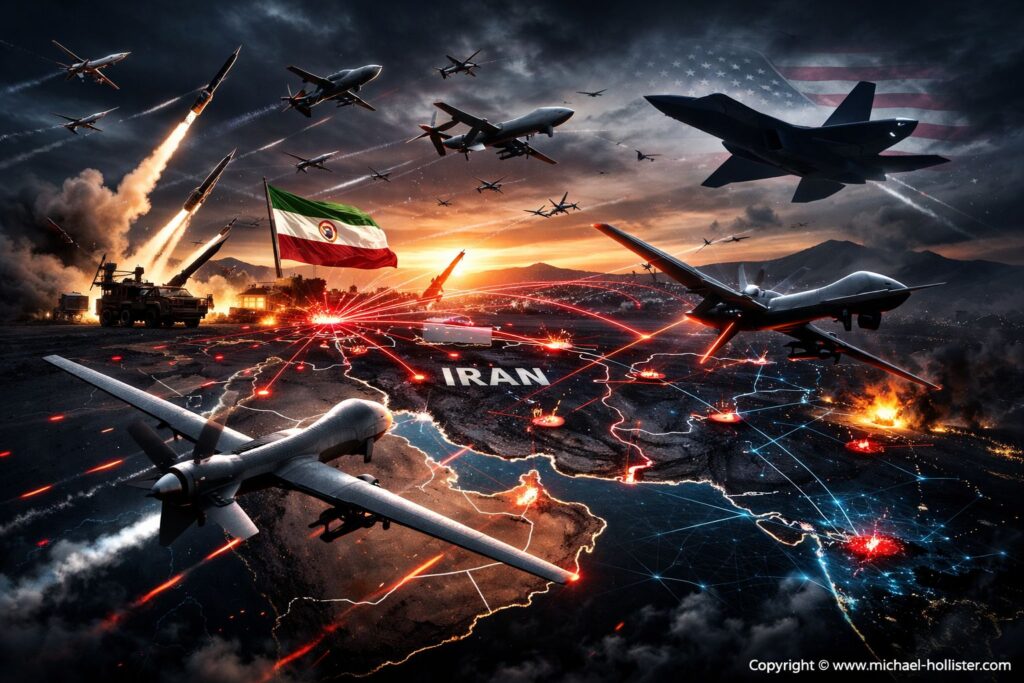
Iran’s Asymmetric Military Strategy
How the Islamic Republic Compensates for Conventional Weakness Through Innovative Technology
When Iranian missiles struck the American Al-Asad Air Base in Iraq at 1:34 AM on January 8, 2020, the US Army experienced something historically unique: For the first time since the Korean War, American ground troops were subjected to bombardment by eleven theater tactical ballistic missiles. Major Alan Johnson, who had taken shelter in a concrete bunker, described the detonation 20 meters from his position as “like a freight train passing by”. The Iranian missiles, each equipped with a warhead of over 450 kilograms, struck bunkers designed for projectiles of maximum 30 kilograms. That nobody was killed was due to timely evacuation based on satellite early warning—otherwise, General Kenneth McKenzie, Commander of US Central Command estimated, 100 to 150 American soldiers would have been killed or wounded and 20 to 30 aircraft destroyed.
The attack on Al-Asad came five days after the American drone strike that killed Qassem Soleimani, commander of the IRGC Quds Force, in Baghdad. Iran responded with a calculated strike that demonstrated military precision but deliberately avoided American casualties through advance warning to the Iraqi government—thereby preventing further escalation. What the attack unequivocally proved, however: Iran possesses missile technology that can threaten American bases throughout the entire region. And this capability is not a military accessory but the centerpiece of a strategic doctrine born from necessity.
The Legacy of Sanctions: Iran’s Conventional Weakness
To understand Iran’s investment in asymmetric weapons technology, one must first grasp the starting position: The Islamic Republic operates with one of the oldest and most obsolete air forces in the region. The Iranian Air Force still flies F-14 Tomcat fighter jets from the 1970s, F-4 Phantom jets from the Vietnam War, and a handful of Russian aircraft for which spare parts and maintenance are chronically scarce. The average age of the Iranian air fleet is over forty years. The tragic death of President Ebrahim Raisi and Foreign Minister Hossein Amir-Abdollahian in a crashed Bell 212 helicopter in May 2024—a model estimated at 40 to 50 years of operational life—was a publicly visible symbol of this structural weakness.
The cause of this erosion is not lack of financial capacity but political isolation. Since the Islamic Revolution in 1979, Iran has been cut off from Western spare parts supplies for its former US equipment. UN sanctions from 2010 and intensified US sanctions after withdrawal from the nuclear agreement in 2018 further complicated acquisition of modern Russian or Chinese fighter aircraft. Even when Russia signaled willingness in 2023 to deliver Su-35 jets, the deal failed due to logistical and financial hurdles. Iran cannot achieve conventional air superiority—not against Israel, not against Saudi Arabia, and certainly not against the USA.
This strategic predicament forces innovation. When conventional armament is blocked, alternative paths must be found. Iran chose a combination of missiles, drones, and an asymmetric warfare doctrine aimed at achieving deterrence not through mass but through precision and cost-effectiveness. The result is a military program increasingly perceived as alarming in Western defense circles—and regarded by Iranian military strategists as proof that technological creativity can compensate for geopolitical weakness.
Drones: From Copies to Strategic Weapons
The spark for Iran’s drone program came from an accident. On December 4, 2011, an RQ-170 Sentinel, a highly advanced American stealth reconnaissance drone, crashed over Iranian territory—or was, as Iran claims, forced to land through electronic warfare. What followed was a textbook example of reverse engineering: Iranian engineers dismantled the drone, studied its avionics, stealth construction, and communication systems. Five years later, in 2016, Iran presented the Shahed Saegheh, a drone with striking similarities to the RQ-170. Whether complete copy or merely inspired indigenous development—the message was unmistakable: Iran could develop its own capabilities from captured technology.
Today Iran possesses one of the most diverse drone fleets in the Middle East. The best-known development is the kamikaze drones of the Shahed family, particularly the Shahed-136 and Shahed-131. These unmanned systems are not classical reconnaissance drones but so-called loitering munitions: They carry a warhead of around 50 kilograms, fly at low speed on programmed routes, and crash into targets upon arrival—hence the term “kamikaze drone.” Their range reaches up to 2,000 kilometers, their production costs estimated at $20,000 per unit. For comparison: An American interceptor missile that could shoot down such a drone costs three million dollars. This asymmetric cost-benefit calculation is the strategic core of Iranian doctrine.
The effectiveness of this technology became obvious in 2022 during the Ukraine war. Russia began using Shahed-136 drones in large quantities from summer 2022 to attack Ukrainian energy infrastructure. Reports indicate Iran delivered “several hundred” drones to Moscow in exchange for 140 million euros in cash plus captured Western weapons. The deal had several strategic dimensions for Iran: It generated urgently needed foreign currency, deepened military cooperation with Russia, and provided Iranian engineers with invaluable feedback from a high-intensity conflict.
Ukraine became the global testing ground for Iranian drone technology. Ukrainian air defense had to learn to combat the low-flying Shahed-136—initially with limited success. The drones flew in waves, often at night, systematically targeting power plants and substations. Their effect lay not in the explosive power of individual impacts but in cumulation: dozens of attacks over weeks and months exhausted Ukrainian defense capacities and forced the country to use expensive air defense missiles against cheap drones. Western military observers spoke of an “asymmetric power relationship” that could not be balanced even through massive weapons deliveries to Ukraine.
For Iran, the Ukraine deployment was confirmation of its own concept: mass beats quality when the mass is cheap enough. Satellite images from late 2023 also showed construction of a factory in Russia’s Tatarstan region licensed to produce Shahed-136 drones—a sign that Moscow not only uses the technology but permanently integrates it. The geopolitical message was unmistakable: Iran is no longer just a regional actor but an arms supplier with global reach.
Besides kamikaze drones, Iran possesses reconnaissance and attack drones like the Mohajer-6, which can be armed with guided missiles, and the Ababil family, variants of which have been transferred to regional allies. The Houthis in Yemen build their own Qasef-1 drones based on Iranian blueprints, structurally similar to Iranian Ababil-II models and featuring identical serial number prefixes. A 2020 report by the British organization Conflict Armament Research documented that the Houthis have now built their own production capacities—an indication that Iran not only exports finished systems but transfers know-how.
Cyber Warfare: The Invisible Weapon
Iran’s asymmetric strategy is not limited to physical weapons. Cyber operations are an integral component of military doctrine—and their development was triggered by a humiliation Iran has never forgotten. In 2010, the Stuxnet computer worm, allegedly developed by the USA and Israel, infected Iranian uranium enrichment facilities in Natanz and destroyed approximately 1,000 centrifuges. The attack was a technological masterpiece and a strategic slap in the face: Iran was vulnerable in an area it had considered secure.
The response followed promptly. Iran built its own cyber units under IRGC leadership, developing both defensive and offensive capabilities. In 2012, American banks became targets of coordinated DDoS attacks that paralyzed websites. In 2012 and 2013, attacks followed on Saudi Aramco, where the malware “Shamoon” erased over 30,000 computers. Western security agencies attributed these operations to Iranian actors. The message was clear: Iran could strike back, even if not at the same technological level as its adversaries.
Today Iranian cyber capabilities are a complementary component of asymmetric strategy. They serve reconnaissance, sabotage, and distraction. When Iran attacked Al-Asad in January 2020, IRGC commander Amir Hajizadeh later claimed Iranian units simultaneously conducted cyber attacks on American communication systems. Whether this is true remains unclear—but the claim itself shows how Iran understands cyber as part of an integrated attack. Drones, missiles, cyber: all tools of the same doctrine.
Missiles: Precision as Deterrence
Parallel to drones, Iran developed an extensive missile program whose roots also lie in a painful experience: the Iran-Iraq War of the 1980s. Iraqi forces used Soviet Scud missiles to bomb Iranian cities—including Tehran, over 480 kilometers from the Iraqi border. The psychological and material impact of these attacks permanently shaped the Islamic Republic’s strategic thinking. Iran began developing its own missiles, initially through imports from China (Silkworm, C-801, C-802 anti-ship missiles and M-7 short-range missiles between 1986 and 1995), later through independent further developments.
Today Iran’s missile arsenal comprises several families with different ranges and deployment profiles. The Sejjil family, whose latest model Sejjil-2 was introduced in 2009, is based on solid-fuel technology, allowing shorter launch preparation times than liquid-fuel missiles. The Sejjil-2 has a range of approximately 2,000 kilometers and an estimated CEP (Circular Error Probable, statistical accuracy) of around 50 meters—capable of reaching Israeli targets. Reports indicate it was used in Iran’s attack on Israel in April 2024, when over 300 projectiles (170 drones, 30 cruise missiles, 120 ballistic missiles) were fired at Israeli territory. Despite a 99 percent interception rate by Israeli and American air defense systems, the attack demonstrated Iran’s ability to fire massed salvos.
The arsenal is supplemented by the Fateh family, precision-guided short-range missiles with a range of approximately 300 kilometers and a CEP under ten meters. These missiles were specifically exported to Iranian proxy groups: Hezbollah in Lebanon possesses, according to estimates, over 150,000 rockets and projectiles, including Iranian Raad, Fajr, and Zilzal types. The Houthis in Yemen deploy modified versions of the Fateh-110 to attack Saudi targets. Iraqi militias connected to Iran have conducted over 151 attacks on US bases in Iraq and Syria since October 2023—many using Iranian or Iranian-inspired technology.
The strategic significance of these precision missiles lies less in their destructive power than in their psychological effect: They make costly infrastructure, military bases, and energy facilities vulnerable without Iran needing air superiority itself. When Iran conducted attacks in January 2024 on alleged Mossad facilities in Erbil (Iraqi Kurdistan) and on bases of the Sunni militia Jaish al-Adl in Pakistan, precision-guided missiles were the weapon of choice. The message was clear: Iran can hit targets beyond its borders without sending aircraft into hostile airspace.
Asymmetric Doctrine: Mosaic Defense and Swarm Tactics
These technological capabilities are embedded in a military doctrine Iran officially calls “Forward Defense” or “Offensive Defense.” First formulated in 2003 and anchored in the Five-Year Plans passed by parliament in 2004 and 2017, this strategy aims to combat threats outside Iranian territory before they reach Iran itself. Concretely this means: Iran relies on a network of regional proxy groups (Hezbollah, Houthis, Iraqi Shiite militias, Hamas, Islamic Jihad) equipped with Iranian technology and capable of conducting coordinated attacks in conflict situations.
This strategy follows the principle of “Mosaic Defense”—a term describing distribution of deterrence capacities across multiple actors instead of concentrating them in a central military apparatus. From Iran’s perspective, this has several advantages: First, it complicates preemptive strikes against Iranian infrastructure because the threat is geographically distributed. Second, it allows Iran to act indirectly and avoid direct confrontations when politically opportune. Third, it creates strategic depth that compensates for Iran’s conventional weakness.
A central element of this doctrine is swarm tactics: coordinated deployment of many low-cost drones and missiles overwhelms even highly modern air defense systems. When drones and cruise missiles struck the Saudi oil facilities of Abqaiq and Khurais on September 14, 2019, 18 impact points were recorded in Abqaiq and four in Khurais. The attacks disabled 5.7 million barrels per day of production capacity—five percent of global oil production. Saudi Patriot missile systems stationed on-site could not repel the attacks. The reason: Patriot systems are optimized for high-flying targets, not for low-flying drones and cruise missiles. Moreover, the sheer number of attackers—25 drones and missiles—was too high to combat effectively.
The Houthis claimed responsibility for the attack, but debris analysis and impact direction (from the northwest) pointed to Iran as origin. A Reuters report from 2019, citing Iranian government sources, claimed the attack was planned at a closed meeting of Iranian military leaders in May 2019—with the aim of punishing the USA for withdrawal from the nuclear agreement without causing mass casualties. Supreme Leader Khamenei allegedly approved the operation under the condition that no civilians or US military personnel be killed. Whether this account is accurate or not—the effect was real: Saudi Arabia and the United Arab Emirates began opening channels to Tehran after 2019 to avoid escalation.
Innovation Under Sanctions: The Limits of Improvisation
Iran’s ability to build a functioning military technology program despite decades of sanctions is remarkable—but it has clear limits. The Iranian military industry is heavily dominated by the Islamic Revolutionary Guards (IRGC). Companies like Iran Aviation Industries Organization and HESA (Iran Aircraft Manufacturing Industrial Company) operate under IRGC supervision and produce drones, missiles, and modified helicopters. The IRGC is simultaneously military organization, economic conglomerate, and political actor—an interconnection that enables innovation but also encourages corruption and inefficiency.
Production is based on a mixture of reverse engineering, smuggling of dual-use components (such as Czech TJ100 turbojets installed in cruise missiles), and independent research. Iran has learned to work with limited resources: Instead of developing highly complex systems, it relies on proven, robust technology that can be mass-produced cost-effectively. This works better for drones and missiles than for fighter jets or modern air defense systems. Iran cannot build F-35s, S-400 systems, or modern frigates. What Iran can do is shift the asymmetry of conflict in its favor: $20,000 drone versus $3 million interceptor missile.
This strategy has its own weaknesses. Iran possesses no air superiority and will not achieve it in the foreseeable future. In case of a comprehensive conflict against a coalition of USA, Israel, and Gulf states, Iran’s conventional military would be decimated within days. Similarly, Iranian naval capabilities are limited—the fleet consists of obsolete frigates, fast boats, and some submarines that would stand no chance against the US Navy or Israeli Navy. Iran’s asymmetric capabilities are primarily defensive and deterrent, not offensive in the sense of a conquest strategy.
Regional Proliferation: Proxy Armament as Power Projection
The transfer of Iranian drone and missile technology to allied groups is not a sideshow but an integral component of Iranian security strategy. Hezbollah in Lebanon is the most prominent example: The organization possesses a missile arsenal larger than that of some European states. Hassan Nasrallah, Hezbollah’s long-time Secretary-General, said openly in 2016: “We are transparent that Hezbollah’s budget, its income, its expenses, everything it eats and drinks, its weapons and missiles, come from the Islamic Republic of Iran.”
What this statement does not reveal is the qualitative transformation Hezbollah’s arsenal has undergone in the last 15 years. In the 1990s and 2000s, Hezbollah possessed primarily inaccurate Katyusha rockets and Fajr systems—weapons that had to be fired in volleys to achieve any hits at all. Since the mid-2010s, however, Iran has delivered precision-guided missiles like the Fateh-110 to Hezbollah or supported the organization in converting existing missiles to precision systems. This transformation is strategically decisive: Precision missiles allow Hezbollah to specifically target military installations, command centers, or critical infrastructure without mass civilian casualties.
Israel has responded to this development with massive airstrikes. In 2018, the Israeli Air Force repeatedly bombed warehouses in Lebanon where Iranian precision upgrade kits were allegedly stored. In September 2024, shortly before the escalation leading to Israeli invasion, Israel specifically destroyed buildings where, according to Israeli claims, precision missiles were hidden. The message was unmistakable: Israel regards Hezbollah’s precision arsenal as an existential threat and is willing to act preemptively. That Hezbollah still continues receiving precision-guided systems shows Iran’s determination to maintain this strategic depth.
The Houthis in Yemen, who have been fighting against a Saudi-led coalition since 2014, have also massively benefited from Iranian support. Their ability to strike targets over 1,000 kilometers away with modified Qasef-1 drones and Fateh-110 variants would be unthinkable without Iranian know-how transfer. In March 2022, Houthis attacked Saudi oil facilities in Jeddah with drones—over 1,000 kilometers from the Yemeni-Saudi border. Since the Gaza war from October 2023, the Houthis have repeatedly attacked ships in the Red Sea, significantly impacting global maritime trade. These attacks serve Iranian interests by tying up US and allied attention while simultaneously pressuring Israel.
In Iraq, numerous Shiite militias operate that nominally answer to the Iraqi government but actually receive Iranian support. These groups have conducted over 151 attacks on US bases in Iraq and Syria since October 2023, mostly with missiles and drones. The attacks are rarely lethal but politically effective: They demonstrate that American presence in Iraq is not unchallenged, and they signal Iranian influence.
Hamas and Islamic Jihad in Gaza have also received Iranian support, although volumes are limited due to Israeli blockade. Reports indicate Iran supplied Hamas with blueprints for missiles like the Fajr-5 and M-302, which Hamas then produced indigenously in Gaza. Iranian officials repeatedly emphasized after October 7, 2023 that the Hamas attacks were independently planned, but the capabilities Hamas demonstrated are hardly conceivable without Iranian groundwork.
Geopolitical Implications: The Erosion of Air Superiority
The strategic effects of Iranian drone and missile programs reach far beyond the Middle East. At a US Congressional hearing in 2021, General Kenneth McKenzie explained that Iran “continues to threaten regional partners and the free flow of commerce through the employment of proxy forces and the proliferation of armed unmanned aerial systems”. Congressman Scott DesJarlais formulated it even more clearly: “As a result of the challenges in detecting and defeating unmanned aerial systems, the United States is operating for the first time since the Korean War without complete air superiority.”
This statement marks a turning point in strategic debate. Since World War II, American military strategy rested on the assumption that the USA could quickly achieve air superiority in conflict and thereby paralyze enemy infrastructure. Drones and precision missiles change this calculation: They are cheap, hard to detect, and can be deployed in masses. Even if 90 percent are intercepted, the remaining ten percent suffice to damage critical infrastructure. Defense costs quickly exceed attack costs.
A historical turning point occurred in April 2024 when Iran fired over 300 projectiles directly at Israel—170 drones, 30 cruise missiles, and 120 ballistic missiles. The immediate military effect was small: a coordinated defense by Israeli, American, Jordanian, and other regional partners intercepted 99 percent of attacks. But strategic significance lay not in damage but in the symbolic threshold that was crossed. Since 1991, when Iraqi Scud missiles fell on Israel, no state had directly attacked Israel with missiles and drones. Iran broke this taboo.
The operation was carefully calibrated: Iran passed advance warnings through diplomatic channels to avoid mass casualties but simultaneously demonstrated capability and will for direct attacks. From Iran’s perspective, this was a success—not because targets were destroyed but because a new red line was established. Israel and the USA had to accept that Iran is prepared to act directly when Tehran sees its interests threatened. Deterrence functioned in both directions: Israel refrained from massive retaliation because larger conflict was not in Tel Aviv’s interest. Iran’s military technology had worked not through destruction but through threat potential.
For regional actors like Israel and Saudi Arabia, this means fundamental realignment of security strategies. Thomas Friedman wrote in the New York Times after the Abqaiq attacks that “every country must now recalculate its security strategy, starting with Israel.” A co-founder of Israel’s Dimona nuclear reactor was quoted saying Israel should possibly close the facility given demonstrated Iranian capabilities. Saudi Arabia, which for decades pursued confrontational policy against Iran, began opening channels after 2019. The UAE followed this example even earlier after tankers were attacked off their coast in 2019.
For Iran itself, these developments are confirmation of its strategic choice. Supreme Leader Ali Khamenei declared in 2022 the world stands “on the threshold of a new international order,” referring to the “axis of resistance” and rising Asian powers as factors accelerating the decline of American hegemony. IRGC Commander Hossein Salami formulated it even more directly in 2023: “Iran has changed the global scene and disrupted the order created by Western powers.”
Outlook: Successes, Limits, and Future Questions
Iran’s asymmetric military strategy is successful within its own frame of reference. The country has built capabilities despite massive sanctions and international isolation that present American and Israeli planners with considerable problems. The cost-benefit calculation—$20,000 drone versus $3 million interceptor missile—is compelling from Iran’s perspective. Proliferation of this technology to proxy groups creates strategic depth Iran could not have achieved without conventional forces. Psychological effect is also considerable: Regional opponents must permanently reckon with attacks, restricting political room for maneuver.
Nevertheless, the limits of this strategy remain obvious. Iran cannot achieve air superiority, permanently control sea routes, or conduct large-scale ground operations. In case of comprehensive war against a coalition of USA, Israel, and Gulf states, Iran’s conventional military would be quickly decimated. Asymmetric capabilities are primarily defensive and deterrent—they can deter opponents from attacks but do not enable military expansion.
Moreover, proliferation of Iranian technology carries risks for Iran itself. Proxy groups pursue their own agendas not always aligned with Iranian interests. Hamas’s decision to attack Israel on October 7, 2023, occurred according to Iranian statements without consulting Tehran—drawing Iran into an escalation spiral it possibly wanted to avoid. Similarly, the Houthis could provoke intervention through attacks on international shipping that would also affect Iran.
The future of Iranian military technology will likely point in two directions: On one hand, Iran will attempt to equip its drones with artificial intelligence to develop autonomously operating swarms. On the other hand, Iran will work on hypersonic missiles that are even harder to intercept due to speed and maneuverability. Both developments would further shift asymmetric dynamics in Iran’s favor—unless simultaneous breakthroughs in air defense technology occur.
What remains is a sober recognition: Iran has made a strategic strength from its conventional weakness. Drones and missiles are no full substitutes for modern air forces, but they are effective means of deterrence and indirect conflict conduct. They change regional power balances and force opponents to rethink their security strategies. Whether this suffices to realize Iran’s vision of a “new world order” is questionable. But it suffices to make Iran a factor nobody in the region can ignore.
Diese Analyse ist frei zugänglich – aber gute Recherchen kosten Zeit, Geld, Energie und Nerven. Unterstützen Sie mich, damit diese Arbeit weitergehen kann.

Oder unterstützen Sie mich auf Substack – schon ab 5 USD pro Monat.
Gemeinsam bauen wir eine Gegenöffentlichkeit auf.
Michael Hollister
is a geopolitical analyst and investigative journalist. He served six years in the German military, including peacekeeping deployments in the Balkans (SFOR, KFOR), followed by 14 years in IT security management. His analysis draws on primary sources to examine European militarization, Western intervention policy, and shifting power dynamics across Asia. A particular focus of his work lies in Southeast Asia, where he investigates strategic dependencies, spheres of influence, and security architectures. Hollister combines operational insider perspective with uncompromising systemic critique—beyond opinion journalism. His work appears on his bilingual website (German/English) www.michael-hollister.com, at Substack at https://michaelhollister.substack.com and in investigative outlets across the German-speaking world and the Anglosphere.
SOURCES
Primary Source:
- Iran’s Missile and Drone Program: Disrupting U.S. Aerial Hegemony, Middle East Council on Global Affairs, July 2024
Technical Documentation:
- Iranian Technology Transfers to Yemen, Conflict Armament Research, 2017
- Evolution of UAVs Employed by Houthi Forces in Yemen, Conflict Armament Research, 2020
- Missiles of Iran, CSIS Missile Defense Project
US Congressional and Military Sources:
- National Security Challenges and U.S. Military Activities in the Greater Middle East and Africa, House Armed Services Committee, April 2021
- “Who would live and who would die: The inside story of the Iranian attack on Al Asad Airbase”, CBS News 60 Minutes, August 2021
- “Army approves 39 Purple Hearts for 2020 Iran missile attack”, Military Times, December 2021
- “Iran’s 2020 attack on US base underscored maximum pressure folly”, Responsible Statecraft, January 2022
- “Everything New We Just Learned About The 2020 Iranian Missile Attack On U.S. Forces In Iraq”, The War Zone, March 2021
Abqaiq Attack Analysis:
- “Iran’s role in Saudi Aramco attacks: Special Report”, Reuters, November 2019
- “What We Know About The Attack On Saudi Oil Facilities”, NPR, September 2019
- “The September 2019 Attacks on Abqaiq and Khurais”, United Against Nuclear Iran, https://www.unitedagainstnucleariran.com/september-2019-attacks-on-abqaiq-and-khurais
- “Drone and missile debris proves Iranian role in Aramco attack, Saudi defense ministry claims”, CNBC, September 2019
Drone Technology:
- “Iran builds attack drone similar to captured US model”, The Guardian, October 2016
© Michael Hollister — All rights reserved. Redistribution, publication or reuse of this text requires express written permission from the author. For licensing inquiries, please contact the author via www.michael-hollister.com.
Newsletter
🇩🇪 Deutsch: Verstehen Sie geopolitische Zusammenhänge durch Primärquellen, historische Parallelen und dokumentierte Machtstrukturen. Monatlich, zweisprachig (DE/EN).
🇬🇧 English: Understand geopolitical contexts through primary sources, historical patterns, and documented power structures. Monthly, bilingual (DE/EN).